Page 99 of 448
2-31
When this light comes on, you can shift to the next
higher gear if weather, road and traffic conditions let
you. For the best fuel economy, accelerate slowly and
shift when the light comes on.
While you accelerate, it is normal for the light to go
on and off if you quickly change the position of the
accelerator. Ignore the SHIFT light when you downshift.
CAUTION:
If you skip a gear when you downshift, you could
lose control of your vehicle. You could injure
yourself or others. Don't shift down more than
one gear at a time when you downshift.
If your vehicle has four-wheel drive and is equipped
with a manual transmission, disregard the SHIFT light
when the transfer case is in 4LO.
Four-Wheel Drive (If Equipped)
If your vehicle has four-wheel drive, you can send
your engine's driving power to all four wheels for extra
traction. To get the most satisfaction out of four
-wheel
drive, you must be familiar with its operation. Read the
part that follows before using four
-wheel drive.
You should use two
-wheel high (2HI) for most
normal driving conditions.
NOTICE:
Driving in the 4HI or 4LO positions for a long
time on dry or wet pavement could shorten the
life of your vehicle's drivetrain.
ProCarManuals.com
Page 102 of 448
2-34
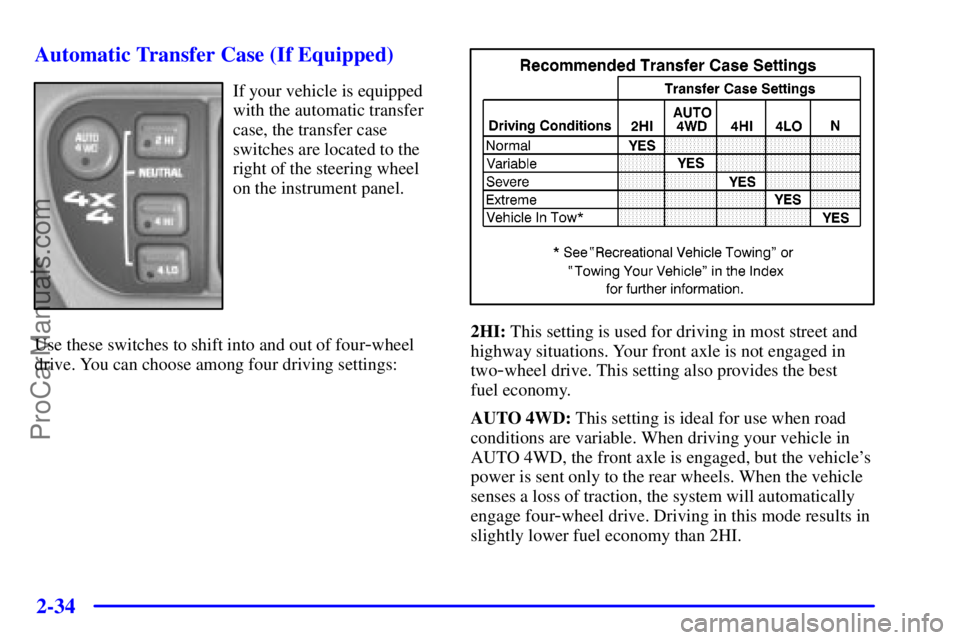
Automatic Transfer Case (If Equipped)
If your vehicle is equipped
with the automatic transfer
case, the transfer case
switches are located to the
right of the steering wheel
on the instrument panel.
Use these switches to shift into and out of four
-wheel
drive. You can choose among four driving settings:2HI: This setting is used for driving in most street and
highway situations. Your front axle is not engaged in
two
-wheel drive. This setting also provides the best
fuel economy.
AUTO 4WD: This setting is ideal for use when road
conditions are variable. When driving your vehicle in
AUTO 4WD, the front axle is engaged, but the vehicle's
power is sent only to the rear wheels. When the vehicle
senses a loss of traction, the system will automatically
engage four
-wheel drive. Driving in this mode results in
slightly lower fuel economy than 2HI.
ProCarManuals.com
Page 135 of 448

2-67
Variance is the difference between magnetic north and
geographic north. In some areas, the difference between
the two can be great enough to cause false compass
readings. If this happens, follow these instructions to
set the variance for your particular location:
1. Find your location on the zone map earlier in this
section. Record your zone number.
2. Press and hold both the MODE and the US/MET
buttons in the COMP/TEMP mode.
3. After five seconds, the compass will acknowledge
the variation mode by displaying the current zone
number. When it does, release both buttons.
4. Press US/MET until your zone number appears
on the display.
5. Press MODE to enter your zone number.
Your variance is now set and the display will
return to the COMP/TEMP mode.TRIP: Once in the TRIP mode, pressing the
MODE button will step you through the following
TRIP functions:
�AVG ECON: The average fuel economy since the
last reset is displayed.
�INST ECON: Instantaneous fuel economy for the
last second of driving is displayed.
�RANGE: The display indicates the estimated
distance that can be travelled with the remaining fuel
in the tank, based on the fuel economy for the last
few hours of driving.
�FUEL USED: The fuel used since the last reset
is displayed.
�AVG SPEED: The average speed since the last
reset is displayed.
To reset the trip computer, press the MODE and
US/MET buttons simultaneously for at least two seconds.
All functions will be displayed for half a second once the
system is reset. Reset can only be performed in the
AVG ECON, FUEL USED and AVG SPEED modes.
All three modes are reset simultaneously.
ProCarManuals.com
Page 154 of 448
2-86
Instrument Panel Cluster
Your instrument panel cluster is designed to let you know at a glance how your vehicle is running. You'll know how fast
you're going, about how much fuel you've used, and many other things you'll need to know to drive safely and economically.
Standard Automatic Transmission Cluster, Canada similar
ProCarManuals.com
Page 160 of 448

2-92
You can only drive for a short time with the reading in
either warning zone. If you must drive, turn off all
unnecessary accessories.
Readings in either warning zone indicate a possible
problem in the electrical system. Have the vehicle
serviced as soon as possible.
Shift Light
You have the shift light
on the instrument panel
cluster if you have a
manual transmission.
Shifting when the indicator light is on will help you get
the best fuel economy. See ªShift Lightº in the Index.
Brake System Warning Light
When the ignition is on, the brake system warning light
will come on when you set your parking brake. The light
will stay on if your parking brake doesn't release fully.
If it stays on after your parking brake is fully released,
it means you have a brake problem.
Your vehicle's hydraulic brake system is divided into
two parts. If one part isn't working, the other part can
still work and stop you. For good braking, though, you
need both parts working well.
If the warning light comes on, there could be a brake
problem. Have your brake system inspected right away.
United States Canada
ProCarManuals.com
Page 162 of 448

2-94
Engine Coolant Temperature Gage
United States Canada
This gage shows the engine coolant temperature.
If the gage pointer moves into the red area, your engine
is too hot!
It means that your engine coolant has overheated.
If you have been operating your vehicle under normal
driving conditions, you should pull off the road, stop
your vehicle and turn off the engine as soon as possible.
See ªEngine Overheatingº in the Index for
more information.
Malfunction Indicator Lamp
(Service Engine Soon Light in the United
States or Check Engine Light in Canada)
United States Canada
Your vehicle is equipped with a computer which
monitors operation of the fuel, ignition and emission
control systems.
This system is called OBD II (On
-Board
Diagnostics
-Second Generation) and is intended to
assure that emissions are at acceptable levels for the life
of the vehicle, helping to produce a cleaner environment.
The SERVICE ENGINE SOON or CHECK ENGINE
light comes on to indicate that there is a problem and
service is required. Malfunctions often will be indicated
by the system before any problem is apparent. This may
prevent more serious damage to your vehicle. This system
is also designed to assist your service technician in correctly
diagnosing any malfunction.
ProCarManuals.com
Page 163 of 448
2-95
NOTICE:
If you keep driving your vehicle with this light
on, after a while, your emission controls may not
work as well, your fuel economy may not be as
good and your engine may not run as smoothly.
This could lead to costly repairs that may not be
covered by your warranty.
NOTICE:
Modifications made to the engine, transmission,
exhaust, intake or fuel system of your vehicle or
the replacement of the original tires with other
than those of the same Tire Performance Criteria
(TPC) can affect your vehicle's emission controls
and may cause the SERVICE ENGINE SOON
OR CHECK ENGINE light to come on.
Modifications to these systems could lead to
costly repairs not covered by your warranty.
This may also result in a failure to pass a
required Emission Inspection/Maintenance test.
This light should come on, as a check to show you it is
working, when the ignition is on and the engine is not
running. If the light doesn't come on, have it repaired.
This light will also come on during a malfunction in one
of two ways:
�Light Flashing
-- A misfire condition has been
detected. A misfire increases vehicle emissions and
may damage the emission control system on your
vehicle. Dealer or qualified service center diagnosis
and service may be required.
�Light On Steady
-- An emission control
system malfunction has been detected on your
vehicle. Dealer or qualified service center diagnosis
and service may be required.
If the Light Is Flashing
The following may prevent more serious damage to
your vehicle:
�Reducing vehicle speed.
�Avoiding hard accelerations.
�Avoiding steep uphill grades.
�If you are towing a trailer, reduce the amount of
cargo being hauled as soon as it is possible.
If the light stops flashing and remains on steady,
see ªIf the Light Is On Steadyº following.
ProCarManuals.com
Page 164 of 448

2-96
If the light continues to flash, when it is safe to do so,
stop the vehicle. Find a safe place to park your vehicle.
Turn the key off, wait at least 10 seconds and restart the
engine. If the light remains on steady, see ªIf the Light
Is On Steadyº following. If the light is still flashing,
follow the previous steps, and drive the vehicle to your
dealer or qualified service center for service.
If the Light Is On Steady
You may be able to correct the emission system
malfunction by considering the following:
Did you recently put fuel into your vehicle?
If so, reinstall the fuel cap, making sure to fully
install the cap. See ªFilling Your Tankº in the Index.
The diagnostic system can determine if the fuel cap
has been left off or improperly installed. A loose or
missing fuel cap will allow fuel to evaporate into the
atmosphere. A few driving trips with the cap properly
installed should turn the light off.Did you just drive through a deep puddle of water?
If so, your electrical system may be wet. The condition
will usually be corrected when the electrical system
dries out. A few driving trips should turn the light off.
Have you recently changed brands of fuel?
If so, be sure to fuel your vehicle with quality fuel.
See ªFuelº in the Index. Poor fuel quality will cause
your engine not to run as efficiently as designed.
You may notice this as stalling after start
-up, stalling
when you put the vehicle into gear, misfiring, hesitation
on acceleration or stumbling on acceleration. (These
conditions may go away once the engine is warmed up.)
This will be detected by the system and cause the light
to turn on.
If you experience one or more of these conditions,
change the fuel brand you use. It will require at least
one full tank of the proper fuel to turn the light off.
If none of the above steps have made the light turn off,
have your dealer or qualified service center check the
vehicle. Your dealer has the proper test equipment and
diagnostic tools to fix any mechanical or electrical
problems that may have developed.
ProCarManuals.com