Page 167 of 448
2-99
Tow/Haul Mode Light (If Equipped)
This light should come on
when the tow/haul mode
has been selected.
For more information, see ªTow/Haul Modeº in
the Index.
Check Gages Light
The CHECK GAGES light
will come on briefly when
you are starting the engine.
If the light comes on and stays on while you are driving,
check your coolant temperature and engine oil pressure
gages to see if they are in the warning zones.
Gate Ajar Light
If this light comes on, your
liftgate or liftglass is ajar.
Try closing the liftgate or
liftglass again. Never drive
with the liftgate or liftglass
even partially open.
Fuel Gage
United States Canada
When the ignition is on, the fuel gage tells you about
how much fuel you have remaining.
ProCarManuals.com
Page 168 of 448
2-100
Here are four things that some owners ask about.
None of these show a problem with your fuel gage:
�At the gas station, the gas pump shuts off before
the gage reads full.
�It takes a little more or less fuel to fill up than the
gage indicated. For example, the gage may have
indicated the tank was half full, but it actually took a
little more or less than half the tank's capacity to fill
the tank.
�The gage moves a little when you turn a corner or
speed up.
�The gage doesn't go back to empty when you turn
off the ignition.Low Fuel Light
The LOW FUEL light will
come on briefly when you
are starting the engine.
This light comes on when the fuel tank is low on fuel.
To turn it off, add fuel to the fuel tank. See ªFuelº in
the Index.
ProCarManuals.com
Page 232 of 448
4-16 Before You Go Off-Roading
There are some things to do before you go out.
For example, be sure to have all necessary maintenance
and service work done. Check to make sure all
underbody shields (if so equipped) are properly
attached. Be sure you read all the information about
your four
-wheel-drive vehicle in this manual. Is there
enough fuel? Is the spare tire fully inflated? Are the
fluid levels up where they should be? What are the local
laws that apply to off
-roading where you'll be driving?
If you don't know, you should check with law
enforcement people in the area. Will you be on
someone's private land? If so, be sure to get the
necessary permission.
Loading Your Vehicle for Off-Road Driving
There are some important things to remember about
how to load your vehicle.
�The heaviest things should be on the load floor and
forward of your rear axle. Put heavier items as far
forward as you can.
�Be sure the load is secured properly, so driving on
the off
-road terrain doesn't toss things around.
CAUTION:
�Cargo on the load floor piled higher than the
seatbacks can be thrown forward during a
sudden stop. You or your passengers could
be injured. Keep cargo below the top of
the seatbacks.
�Unsecured cargo on the load floor can be
tossed about when driving over rough
terrain. You or your passengers can be struck
by flying objects. Secure the cargo properly.
�Heavy loads on the roof raise the vehicle's
center of gravity, making it more likely to roll
over. You can be seriously or fatally injured if
the vehicle rolls over. Put heavy loads inside
the cargo area, not on the roof. Keep cargo
in the cargo area as far forward and low
as possible.
You'll find other important information in this manual.
See ªVehicle Loading,º ªLuggage Carrierº and ªTiresº
in the Index.
ProCarManuals.com
Page 244 of 448

4-28
If the water isn't too deep, then drive through it slowly.
At fast speeds, water splashes on your ignition system
and your vehicle can stall. Stalling can also occur if you
get your tailpipe under water. And, as long as your
tailpipe is under water, you'll never be able to start your
engine. When you go through water, remember that
when your brakes get wet, it may take you longer to stop.
CAUTION:
Driving through rushing water can be dangerous.
Deep water can sweep your vehicle downstream
and you and your passengers could drown.
If it's only shallow water, it can still wash away
the ground from under your tires, and you could
lose traction and roll the vehicle over. Don't drive
through rushing water.
See ªDriving Through Waterº in the Index for more
information on driving through water.
After Off-Road Driving
Remove any brush or debris that has collected on
the underbody, chassis or under the hood.
These accumulations can be a fire hazard.
After operation in mud or sand, have the brake linings
cleaned and checked. These substances can cause
glazing and uneven braking. Check the body structure,
steering, suspension, wheels, tires and exhaust system
for damage. Also, check the fuel lines and cooling
system for any leakage.
Your vehicle will require more frequent service due to
off
-road use. Refer to the Maintenance Schedule for
additional information.
ProCarManuals.com
Page 251 of 448

4-35
The exit ramp can be curved, sometimes quite sharply.
The exit speed is usually posted.
Reduce your speed according to your speedometer, not
to your sense of motion. After driving for any distance
at higher speeds, you may tend to think you are going
slower than you actually are.
Before Leaving on a Long Trip
Make sure you're ready. Try to be well rested. If you
must start when you're not fresh
-- such as after a day's
work
-- don't plan to make too many miles that first part
of the journey. Wear comfortable clothing and shoes you
can easily drive in.
Is your vehicle ready for a long trip? If you keep it
serviced and maintained, it's ready to go. If it needs
service, have it done before starting out. Of course,
you'll find experienced and able service experts in
GM dealerships all across North America. They'll be
ready and willing to help if you need it.Here are some things you can check before a trip:
�Windshield Washer Fluid: Is the reservoir full?
Are all windows clean inside and outside?
�Wiper Blades: Are they in good shape?
�Fuel, Engine Oil, Other Fluids: Have you checked
all levels?
�Lamps: Are they all working? Are the lenses clean?
�Tires: They are vitally important to a safe,
trouble
-free trip. Is the tread good enough for
long
-distance driving? Are the tires all inflated to
the recommended pressure?
�Weather Forecasts: What's the weather outlook
along your route? Should you delay your trip a
short time to avoid a major storm system?
�Maps: Do you have up
-to-date maps?
ProCarManuals.com
Page 257 of 448

4-41
CAUTION:
Snow can trap exhaust gases under your vehicle.
This can cause deadly CO (carbon monoxide) gas
to get inside. CO could overcome you and kill
you. You can't see it or smell it, so you might not
know it is in your vehicle. Clear away snow from
around the base of your vehicle, especially any
that is blocking your exhaust pipe. And check
around again from time to time to be sure snow
doesn't collect there.
Open a window just a little on the side of the
vehicle that's away from the wind. This will
help keep CO out.
Run your engine only as long as you must. This saves
fuel. When you run the engine, make it go a little faster
than just idle. That is, push the accelerator slightly. This
uses less fuel for the heat that you get and it keeps the
battery charged. You will need a well
-charged battery to
restart the vehicle, and possibly for signaling later on
with your headlamps. Let the heater run for a while.Then, shut the engine off and close the window almost
all the way to preserve the heat. Start the engine again
and repeat this only when you feel really uncomfortable
from the cold. But do it as little as possible. Preserve the
fuel as long as you can. To help keep warm, you can get
out of the vehicle and do some fairly vigorous exercises
every half hour or so until help comes.
Recreational Vehicle Towing
There may be times when you want to tow your vehicle
behind another vehicle for use at your destination.
Be sure to use the proper towing equipment designed
for recreational vehicle towing. Follow the instructions
for the towing equipment.
When towing your vehicle, turn the ignition to OFF.
To prevent your battery from draining while towing,
remove the RDO BATT and CLSTR fuses from the
instrument panel fuse block. Be sure to replace the fuses
when you reach your destination. See ªFuses and Circuit
Breakersº in the Index.
ProCarManuals.com
Page 259 of 448
4-43
4. With the engine running, shift the transfer case to
NEUTRAL. See ªFour
-Wheel Driveº in the Index
for the proper procedure to select the NEUTRAL
position for your vehicle.
CAUTION:
Shifting the transfer case into NEUTRAL can
cause your vehicle to roll even if the transmission
is in PARK (P), for an automatic transmission,
or if your vehicle is in gear, for a manual
transmission. You or others could be injured.
Make sure the parking brake is firmly set
before you shift the transfer case into NEUTRAL.
See ªFour
-Wheel Drive (Automatic Transfer Case)º
in the Index.
5. Release the parking brake only after the vehicle
being towed is firmly attached to the towing vehicle.
6. Turn the ignition to OFF. The OFF position unlocks
the steering column and reduces battery drain.
Unlocking the steering column will allow the proper
movement of the front wheels and tires during towing.
Loading Your Vehicle
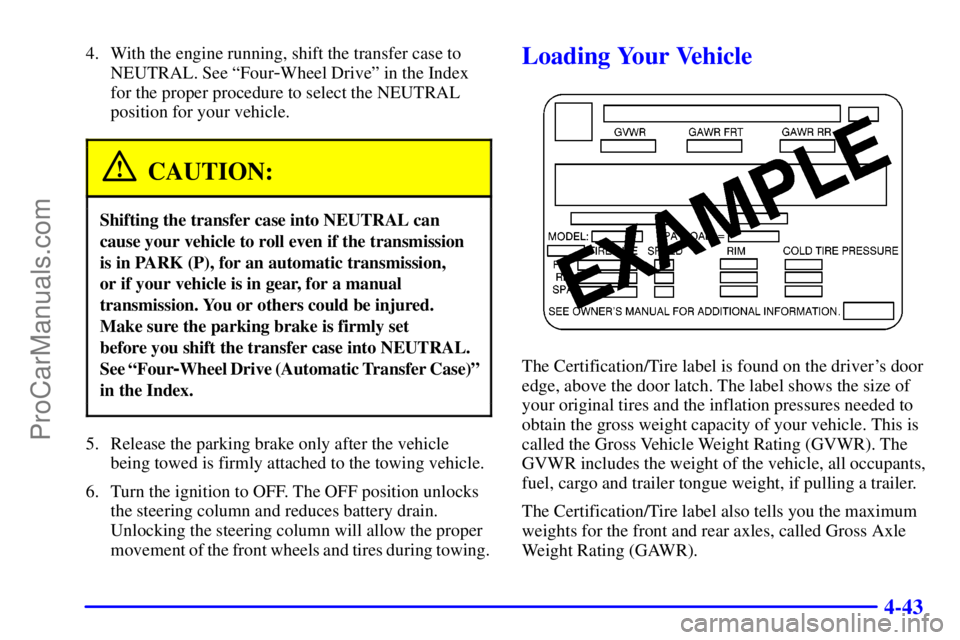
The Certification/Tire label is found on the driver's door
edge, above the door latch. The label shows the size of
your original tires and the inflation pressures needed to
obtain the gross weight capacity of your vehicle. This is
called the Gross Vehicle Weight Rating (GVWR). The
GVWR includes the weight of the vehicle, all occupants,
fuel, cargo and trailer tongue weight, if pulling a trailer.
The Certification/Tire label also tells you the maximum
weights for the front and rear axles, called Gross Axle
Weight Rating (GAWR).
ProCarManuals.com
Page 263 of 448
4-47
NOTICE:
Pulling a trailer improperly can damage your
vehicle and result in costly repairs not covered
by your warranty. To pull a trailer correctly,
follow the advice in this part, and see your
dealer for important information about towing
a trailer with your vehicle. Additional rear axle
maintenance is required for a vehicle used to tow
a trailer. See ªScheduled Maintenance Servicesº
in the Index.
To identify what the vehicle trailering capacity is for
your vehicle, you should read the information in
ªWeight of the Trailerº that appears later in
this section.
If yours was built with trailering options, as many are,
it's ready for heavier trailers. But trailering is different
than just driving your vehicle by itself. Trailering means
changes in handling, durability and fuel economy.
Successful, safe trailering takes correct equipment,
and it has to be used properly.
That's the reason for this part. In it are many
time
-tested, important trailering tips and safety rules.
Many of these are important for your safety and that
of your passengers. So please read this section carefully
before you pull a trailer.
ProCarManuals.com