2001 FORD POSTAL EXPLORER brake light
[x] Cancel search: brake lightPage 32 of 88

Sand
When driving over sand, try to keep all four wheels on the most solid
area of the trail. Do not reduce the tire pressures but shift to a lower
gear and drive steadily through the terrain. Apply the accelerator slowly
and avoid spinning the wheels.
Mud and water
If you must drive through high water, drive slowly. Traction or brake
capability may be limited.
When driving through water, determine the depth; avoid water higher
than the bottom of the hubs (if possible) and proceed slowly. If the
ignition system gets wet, the vehicle may stall.
Once through water, always try the brakes. Wet brakes do not stop the
vehicle as effectively as dry brakes. Drying can be improved by moving
your vehicle slowly while applying light pressure on the brake pedal.
After driving through mud, clean off residue stuck to rotating driveshafts
and tires. Excess mud stuck on tires and rotating driveshafts causes an
imbalance that could damage drive components.
If the transmission, transfer case or front axle are submerged in water,
their fluids should be checked and changed, if necessary.
Water intrusion into the transmission may damage the
transmission.
If the rear axle is submerged in water, the rear axle lubricant should be
checked and changed, if necessary. The rear axle is filled with a
synthetic lubricant and does not normally require a lubricant change for
the life of the vehicle. Rear axle lubricant quantities should not need to
be checked unless a leak is suspected.
Driving on hilly or sloping terrain
When climbing a steep hill, start in a lower gear rather than downshifting
to a lower gear from a higher gear once the ascent has started. This
reduces the strain on the engine.
When descending a steep hill, avoid sudden braking. Shift to a lower gear
when added engine braking is desired.
Automatic transmissions may shift frequently while driving up steep
grades. Eliminate frequent shifting by shifting out of
(Overdrive) into
D (Drive).
Driving
32
Page 37 of 88
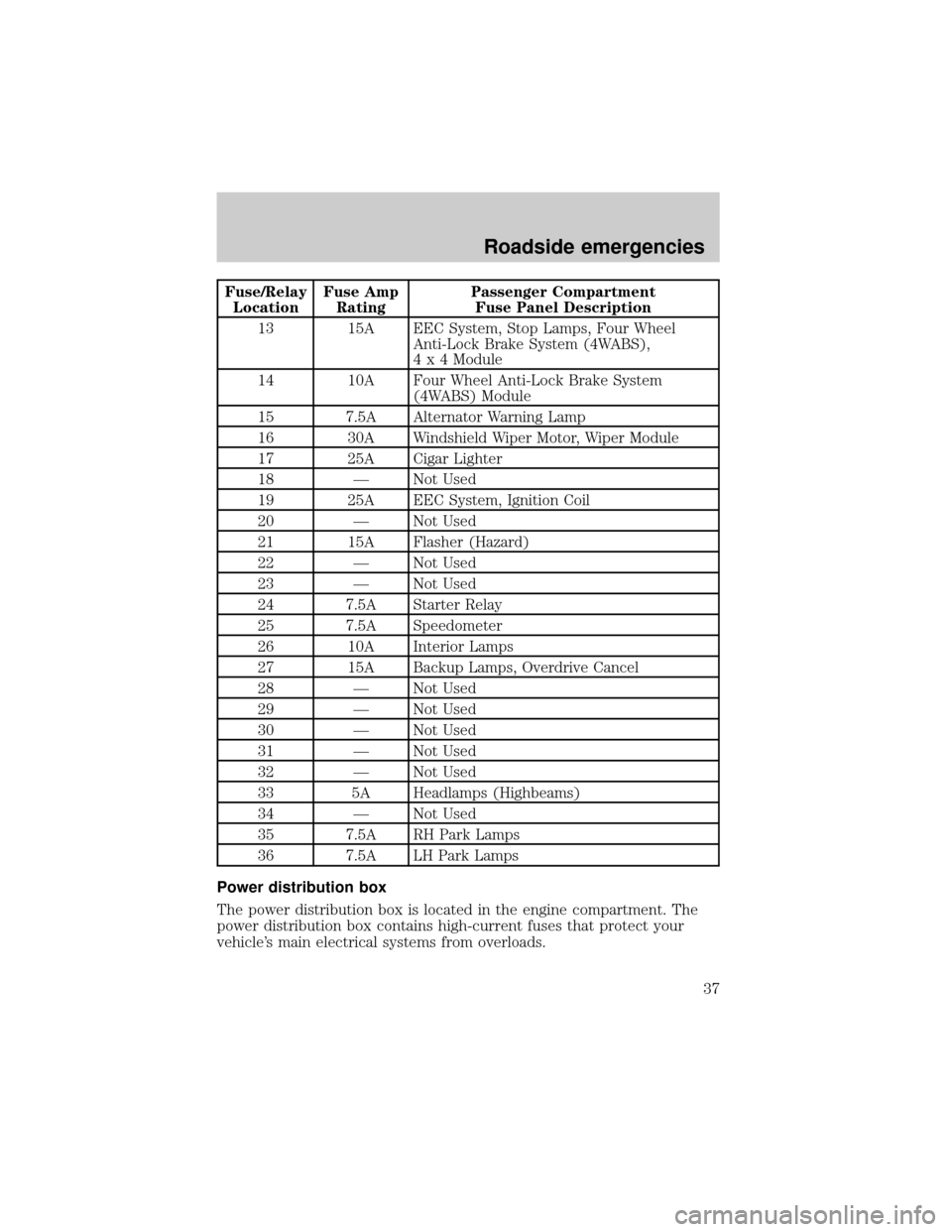
Fuse/Relay
LocationFuse Amp
RatingPassenger Compartment
Fuse Panel Description
13 15A EEC System, Stop Lamps, Four Wheel
Anti-Lock Brake System (4WABS),
4 x 4 Module
14 10A Four Wheel Anti-Lock Brake System
(4WABS) Module
15 7.5A Alternator Warning Lamp
16 30A Windshield Wiper Motor, Wiper Module
17 25A Cigar Lighter
18 Ð Not Used
19 25A EEC System, Ignition Coil
20 Ð Not Used
21 15A Flasher (Hazard)
22 Ð Not Used
23 Ð Not Used
24 7.5A Starter Relay
25 7.5A Speedometer
26 10A Interior Lamps
27 15A Backup Lamps, Overdrive Cancel
28 Ð Not Used
29 Ð Not Used
30 Ð Not Used
31 Ð Not Used
32 Ð Not Used
33 5A Headlamps (Highbeams)
34 Ð Not Used
35 7.5A RH Park Lamps
36 7.5A LH Park Lamps
Power distribution box
The power distribution box is located in the engine compartment. The
power distribution box contains high-current fuses that protect your
vehicle's main electrical systems from overloads.
Roadside emergencies
37
Page 52 of 88

SERVICE RECOMMENDATIONS
To help you service your vehicle:
²We highlight do-it-yourself items in the engine compartment for easy
location.
²We provide a scheduled maintenance guide which makes tracking
routine service easy.
If your vehicle requires professional service, your dealership can provide
the necessary parts and service. Check your ªWarranty Guideº to find out
which parts and services are covered.
Use only recommended fuels, lubricants, fluids and service parts
conforming to specifications. Motorcraft parts are designed and built to
provide the best performance in your vehicle.
PRECAUTIONS WHEN SERVICING YOUR VEHICLE
Be especially careful when inspecting or servicing your vehicle.
²Do not work on a hot engine.
²When the engine is running, make sure that loose clothing, jewelry or
long hair does not get caught up in moving parts.
²Do not work on a vehicle with the engine running in an enclosed
space, unless you are sure you have enough ventilation.
²Keep all lit cigarettes, open flames and other lit material away from
the battery and all fuel related parts.
If you disconnect the battery, the engine must ªrelearnº its idle
conditions before your vehicle will drive properly, as explained inBattery
in this chapter.
Working with the engine off
1. Set the parking brake and ensure the gearshift is securely latched in P
(Park).
2. Turn off the engine and remove the key.
3. Block the wheels to prevent the vehicle from moving unexpectedly.
Working with the engine on
1. Set the parking brake and ensure the gearshift is securely latched in P
(Park).
2. Block the wheels to prevent the vehicle from moving unexpectedly.
Maintenance and care
52
Page 66 of 88
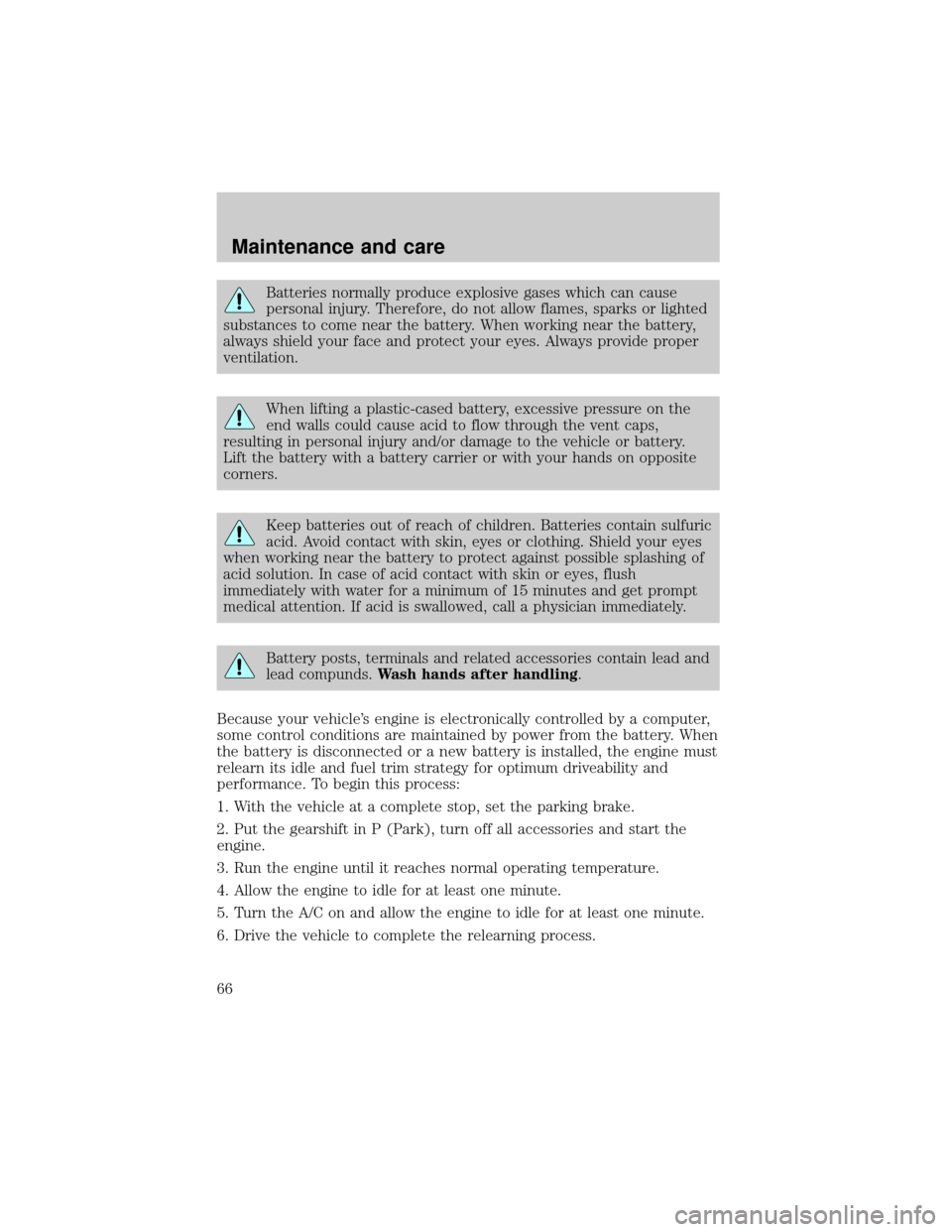
Batteries normally produce explosive gases which can cause
personal injury. Therefore, do not allow flames, sparks or lighted
substances to come near the battery. When working near the battery,
always shield your face and protect your eyes. Always provide proper
ventilation.
When lifting a plastic-cased battery, excessive pressure on the
end walls could cause acid to flow through the vent caps,
resulting in personal injury and/or damage to the vehicle or battery.
Lift the battery with a battery carrier or with your hands on opposite
corners.
Keep batteries out of reach of children. Batteries contain sulfuric
acid. Avoid contact with skin, eyes or clothing. Shield your eyes
when working near the battery to protect against possible splashing of
acid solution. In case of acid contact with skin or eyes, flush
immediately with water for a minimum of 15 minutes and get prompt
medical attention. If acid is swallowed, call a physician immediately.
Battery posts, terminals and related accessories contain lead and
lead compunds.Wash hands after handling.
Because your vehicle's engine is electronically controlled by a computer,
some control conditions are maintained by power from the battery. When
the battery is disconnected or a new battery is installed, the engine must
relearn its idle and fuel trim strategy for optimum driveability and
performance. To begin this process:
1. With the vehicle at a complete stop, set the parking brake.
2. Put the gearshift in P (Park), turn off all accessories and start the
engine.
3. Run the engine until it reaches normal operating temperature.
4. Allow the engine to idle for at least one minute.
5. Turn the A/C on and allow the engine to idle for at least one minute.
6. Drive the vehicle to complete the relearning process.
Maintenance and care
66
Page 84 of 88

A
Air cleaner filter .........................80
Antifreeze
(see Engine coolant) ..................57
Anti-lock brake system
(see Brakes) ..........................23±24
Automatic transmission
driving an automatic
overdrive ...................................27
fluid, adding ..............................62
fluid, checking ..........................62
fluid, refill capacities ................80
fluid, specification ....................82
Axle
lubricant specifications ......81±82
refill capacities ..........................80
B
Battery .........................................65
acid, treating emergencies .......65
charging system warning light ..9
jumping a disabled battery ......43
maintenance-free ......................65
replacement, specifications .....80
servicing ....................................65
voltage gauge ............................11
Brakes ..........................................23
anti-lock ...............................23±24
anti-lock brake system
(ABS) warning light .............8, 24
brake warning light ....................7
fluid, checking and adding ......56
fluid, refill capacities ................80
fluid, specifications .............81±82
lubricant specifications ......81±82
shift interlock ............................26
Break-in period .............................3C
Capacities for refilling fluids ......80
Coolant
checking and adding ................57
refill capacities ....................61, 80
specifications ......................81±82
D
Dipstick
automatic transmission fluid ...62
engine oil ...................................54
Doors
lubricant specifications ............81
Driveline universal
joint and slip yoke ......................64
Driving under special
conditions ....................................32
mud ......................................31±32
sand ...........................................32
snow and ice .......................31, 33
through water ...........................32
E
Emergencies, roadside
jump-starting ............................43
Emission control system ............78
Engine ..........................................82
check engine/
service engine soon light ...........6
coolant .......................................57
idle speed control .....................65
lubrication specifications ...81±82
refill capacities ..........................80
service points ............................53
starting after a collision ...........34
Engine oil ....................................54
Index
84
Page 86 of 88

headlamps, flash to pass ..........14
instrument panel, dimming .....13
Lane change indicator
(see Turn signal) ........................16
Lights, warning and indicator ......6
anti-lock brakes (ABS) ........8, 24
brake ............................................7
charging system ..........................9
high beam ...................................8
overdrive off ................................8
safety belt ...................................7
service engine soon ....................6
turn signal indicator ...................8
Lubricant specifications .......81±82
M
Manual transmission
fluid capacities ..........................80
lubricant specifications ............82
Motorcraft parts ....................78, 80
O
Octane rating ..............................75
Odometer .....................................10
Oil (see Engine oil) ....................54
Overdrive .....................................16
P
Parking brake ..............................24
Parts (see Motorcraft parts) ......80
Power distribution box
(see Fuses) .................................37Power steering ............................25
fluid, checking and adding ......62
fluid, refill capacity ..................80
fluid, specifications .............81±82
R
Relays ....................................34, 39
S
Safety defects, reporting ............83
Safety restraints
warning light and chime ........7, 9
Servicing your vehicle ................52
Spark plugs, specifications ...80, 82
Special notice ................................3
utility-type vehicles ....................3
Specification chart,
lubricants ...............................81±82
Speedometer .................................9
Starting your vehicle ............18±21
jump starting ............................43
Steering wheel
tilting .........................................15
T
Tires .................................40, 67±69
changing ....................................40
checking the pressure ..............69
replacing ....................................70
rotating ......................................69
snow tires and chains ..............71
tire grades .................................68
treadwear ..................................68
Towing .........................................69
wrecker ......................................49
Index
86