2001 FORD POSTAL EXPLORER check transmission fluid
[x] Cancel search: check transmission fluidPage 32 of 88
Sand
When driving over sand, try to keep all four wheels on the most solid
area of the trail. Do not reduce the tire pressures but shift to a lower
gear and drive steadily through the terrain. Apply the accelerator slowly
and avoid spinning the wheels.
Mud and water
If you must drive through high water, drive slowly. Traction or brake
capability may be limited.
When driving through water, determine the depth; avoid water higher
than the bottom of the hubs (if possible) and proceed slowly. If the
ignition system gets wet, the vehicle may stall.
Once through water, always try the brakes. Wet brakes do not stop the
vehicle as effectively as dry brakes. Drying can be improved by moving
your vehicle slowly while applying light pressure on the brake pedal.
After driving through mud, clean off residue stuck to rotating driveshafts
and tires. Excess mud stuck on tires and rotating driveshafts causes an
imbalance that could damage drive components.
If the transmission, transfer case or front axle are submerged in water,
their fluids should be checked and changed, if necessary.
Water intrusion into the transmission may damage the
transmission.
If the rear axle is submerged in water, the rear axle lubricant should be
checked and changed, if necessary. The rear axle is filled with a
synthetic lubricant and does not normally require a lubricant change for
the life of the vehicle. Rear axle lubricant quantities should not need to
be checked unless a leak is suspected.
Driving on hilly or sloping terrain
When climbing a steep hill, start in a lower gear rather than downshifting
to a lower gear from a higher gear once the ascent has started. This
reduces the strain on the engine.
When descending a steep hill, avoid sudden braking. Shift to a lower gear
when added engine braking is desired.
Automatic transmissions may shift frequently while driving up steep
grades. Eliminate frequent shifting by shifting out of
(Overdrive) into
D (Drive).
Driving
32
Page 62 of 88
Vehicles driven year-round in non-extreme climates should use a 50/50
mixture of engine coolant and distilled water for optimum cooling system
and engine protection.
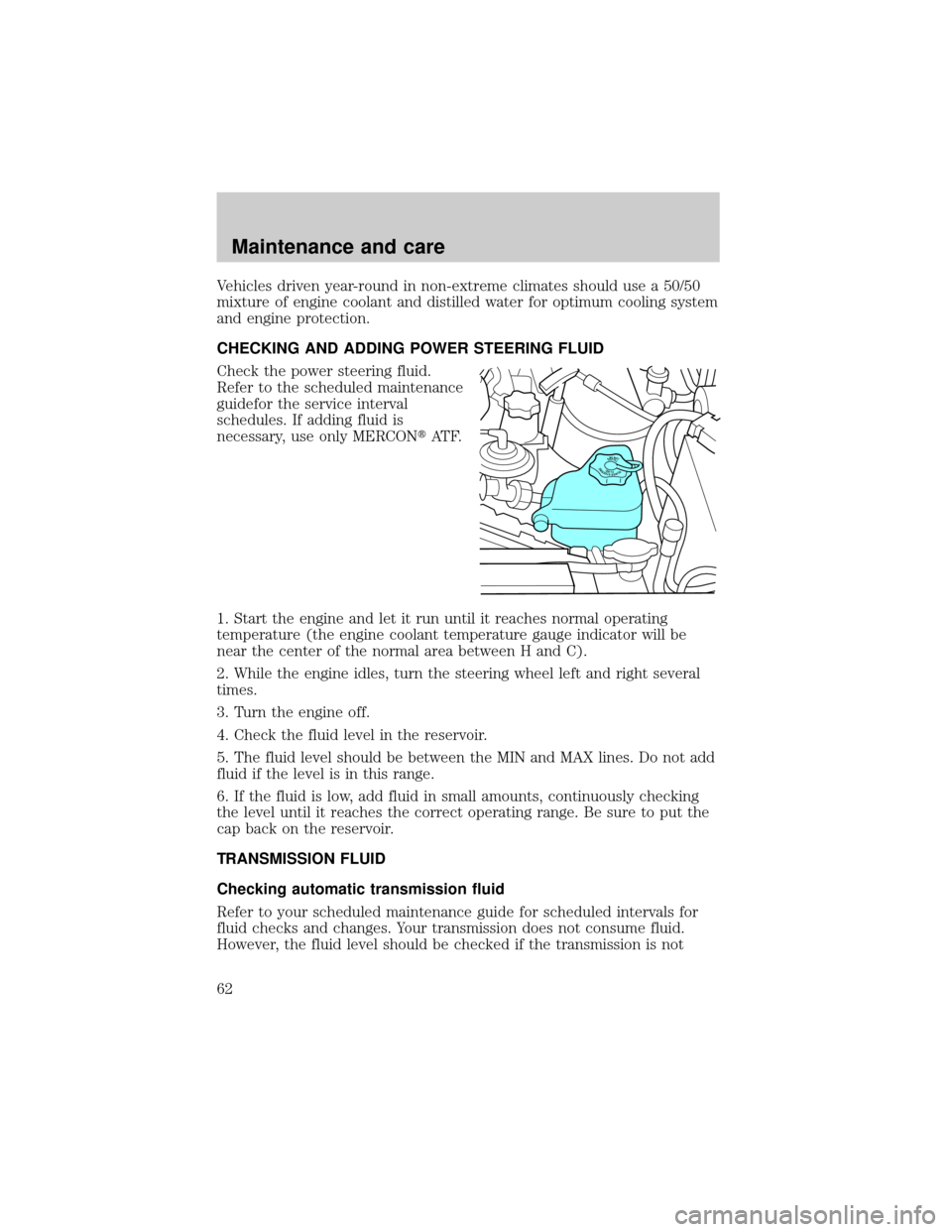
CHECKING AND ADDING POWER STEERING FLUID
Check the power steering fluid.
Refer to the scheduled maintenance
guidefor the service interval
schedules. If adding fluid is
necessary, use only MERCONtAT F.
1. Start the engine and let it run until it reaches normal operating
temperature (the engine coolant temperature gauge indicator will be
near the center of the normal area between H and C).
2. While the engine idles, turn the steering wheel left and right several
times.
3. Turn the engine off.
4. Check the fluid level in the reservoir.
5. The fluid level should be between the MIN and MAX lines. Do not add
fluid if the level is in this range.
6. If the fluid is low, add fluid in small amounts, continuously checking
the level until it reaches the correct operating range. Be sure to put the
cap back on the reservoir.
TRANSMISSION FLUID
Checking automatic transmission fluid
Refer to your scheduled maintenance guide for scheduled intervals for
fluid checks and changes. Your transmission does not consume fluid.
However, the fluid level should be checked if the transmission is not
DONOTOVERFILLPOWERSTEERINGFLUID
Maintenance and care
62
Page 63 of 88
working properly, i.e., if the transmission slips or shifts slowly or if you
notice some sign of fluid leakage.
Automatic transmission fluid expands when warmed. To obtain an
accurate fluid check, drive the vehicle until it is warmed up
(approximately 30 km [20 miles]). If your vehicle has been operated for
an extended period at high speeds, in city traffic during hot weather or
pulling a trailer, the vehicle should be turned off for about 30 minutes to
allow fluid to cool before checking.
1. Drive the vehicle 30 km (20 miles) or until it reaches normal operating
temperature.
2. Park the vehicle on a level surface and engage the parking brake.
3. With the parking brake engaged and your foot on the brake pedal,
start the engine and move the gearshift lever through all of the gear
ranges. Allow sufficient time for each gear to engage.
4. Latch the gearshift lever in P (Park) and leave the engine running.
5. Remove the dipstick, wiping it clean with a clean, dry lint free rag. If
necessary, refer toIdentifying components in the engine compartment
in this chapter for the location of the dipstick.
6. Install the dipstick making sure it is fully seated in the filler tube.
7. Remove the dipstick and inspect the fluid level. The fluid should be in
the designated area for normal operating temperature or ambient
temperature.
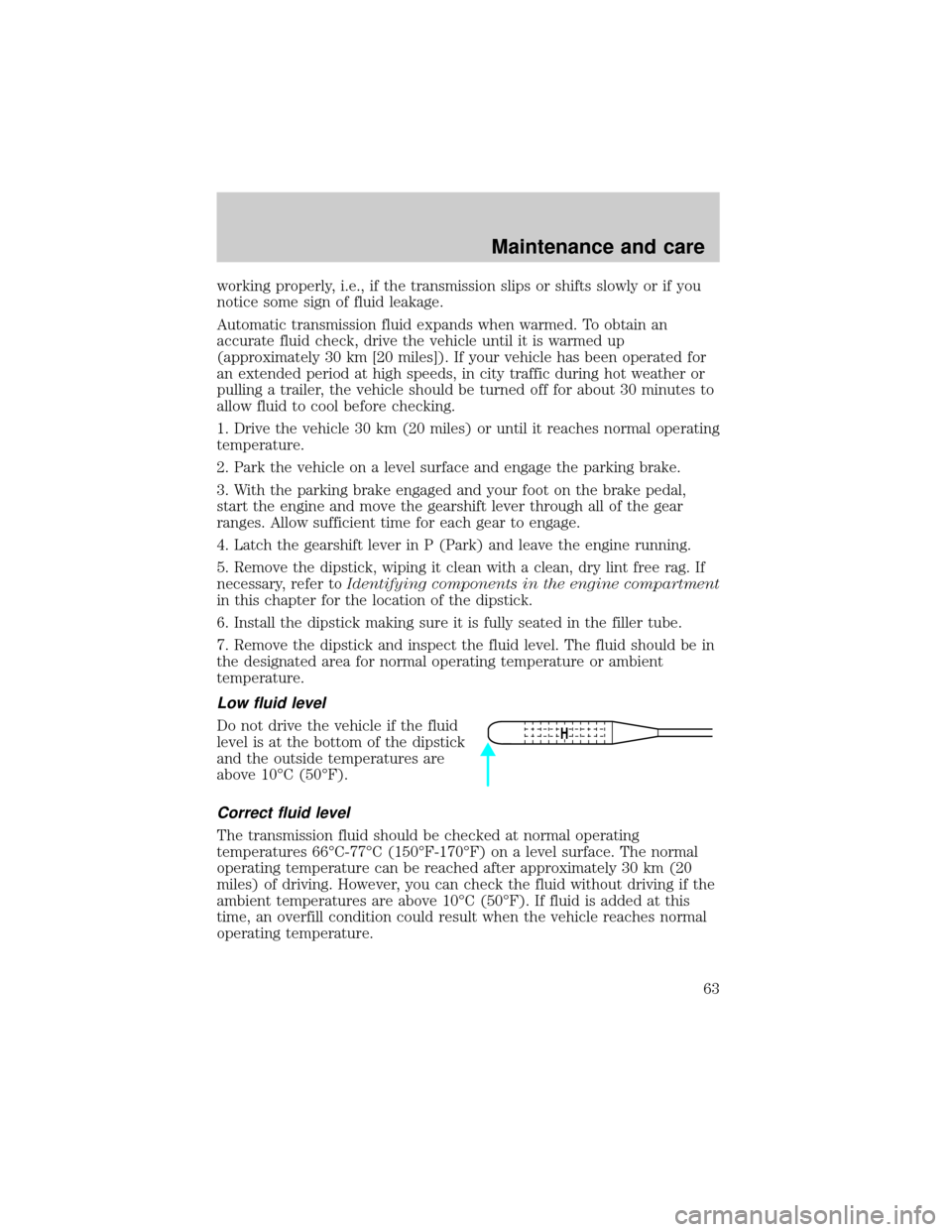
Low fluid level
Do not drive the vehicle if the fluid
level is at the bottom of the dipstick
and the outside temperatures are
above 10ÉC (50ÉF).
Correct fluid level
The transmission fluid should be checked at normal operating
temperatures 66ÉC-77ÉC (150ÉF-170ÉF) on a level surface. The normal
operating temperature can be reached after approximately 30 km (20
miles) of driving. However, you can check the fluid without driving if the
ambient temperatures are above 10ÉC (50ÉF). If fluid is added at this
time, an overfill condition could result when the vehicle reaches normal
operating temperature.
H
Maintenance and care
63
Page 84 of 88

A
Air cleaner filter .........................80
Antifreeze
(see Engine coolant) ..................57
Anti-lock brake system
(see Brakes) ..........................23±24
Automatic transmission
driving an automatic
overdrive ...................................27
fluid, adding ..............................62
fluid, checking ..........................62
fluid, refill capacities ................80
fluid, specification ....................82
Axle
lubricant specifications ......81±82
refill capacities ..........................80
B
Battery .........................................65
acid, treating emergencies .......65
charging system warning light ..9
jumping a disabled battery ......43
maintenance-free ......................65
replacement, specifications .....80
servicing ....................................65
voltage gauge ............................11
Brakes ..........................................23
anti-lock ...............................23±24
anti-lock brake system
(ABS) warning light .............8, 24
brake warning light ....................7
fluid, checking and adding ......56
fluid, refill capacities ................80
fluid, specifications .............81±82
lubricant specifications ......81±82
shift interlock ............................26
Break-in period .............................3C
Capacities for refilling fluids ......80
Coolant
checking and adding ................57
refill capacities ....................61, 80
specifications ......................81±82
D
Dipstick
automatic transmission fluid ...62
engine oil ...................................54
Doors
lubricant specifications ............81
Driveline universal
joint and slip yoke ......................64
Driving under special
conditions ....................................32
mud ......................................31±32
sand ...........................................32
snow and ice .......................31, 33
through water ...........................32
E
Emergencies, roadside
jump-starting ............................43
Emission control system ............78
Engine ..........................................82
check engine/
service engine soon light ...........6
coolant .......................................57
idle speed control .....................65
lubrication specifications ...81±82
refill capacities ..........................80
service points ............................53
starting after a collision ...........34
Engine oil ....................................54
Index
84
Page 86 of 88

headlamps, flash to pass ..........14
instrument panel, dimming .....13
Lane change indicator
(see Turn signal) ........................16
Lights, warning and indicator ......6
anti-lock brakes (ABS) ........8, 24
brake ............................................7
charging system ..........................9
high beam ...................................8
overdrive off ................................8
safety belt ...................................7
service engine soon ....................6
turn signal indicator ...................8
Lubricant specifications .......81±82
M
Manual transmission
fluid capacities ..........................80
lubricant specifications ............82
Motorcraft parts ....................78, 80
O
Octane rating ..............................75
Odometer .....................................10
Oil (see Engine oil) ....................54
Overdrive .....................................16
P
Parking brake ..............................24
Parts (see Motorcraft parts) ......80
Power distribution box
(see Fuses) .................................37Power steering ............................25
fluid, checking and adding ......62
fluid, refill capacity ..................80
fluid, specifications .............81±82
R
Relays ....................................34, 39
S
Safety defects, reporting ............83
Safety restraints
warning light and chime ........7, 9
Servicing your vehicle ................52
Spark plugs, specifications ...80, 82
Special notice ................................3
utility-type vehicles ....................3
Specification chart,
lubricants ...............................81±82
Speedometer .................................9
Starting your vehicle ............18±21
jump starting ............................43
Steering wheel
tilting .........................................15
T
Tires .................................40, 67±69
changing ....................................40
checking the pressure ..............69
replacing ....................................70
rotating ......................................69
snow tires and chains ..............71
tire grades .................................68
treadwear ..................................68
Towing .........................................69
wrecker ......................................49
Index
86
Page 87 of 88

Transmission ...............................26
fluid, checking and adding
(automatic) ...............................62
fluid, refill capacities ................80
lubricant specifications ......81±82
Trip odometer .............................11
Turn signal ..............................8, 16
V
Vehicle Identification
Number (VIN) .............................82Ventilating your vehicle .............22
W
Warning chimes .............................9
Warning lights (see Lights) .........6
Washer fluid ................................57
Windshield washer fluid and
wipers
checking and adding fluid .......57
operation ...................................16
Wrecker towing ...........................49
Index
87
Page 88 of 88
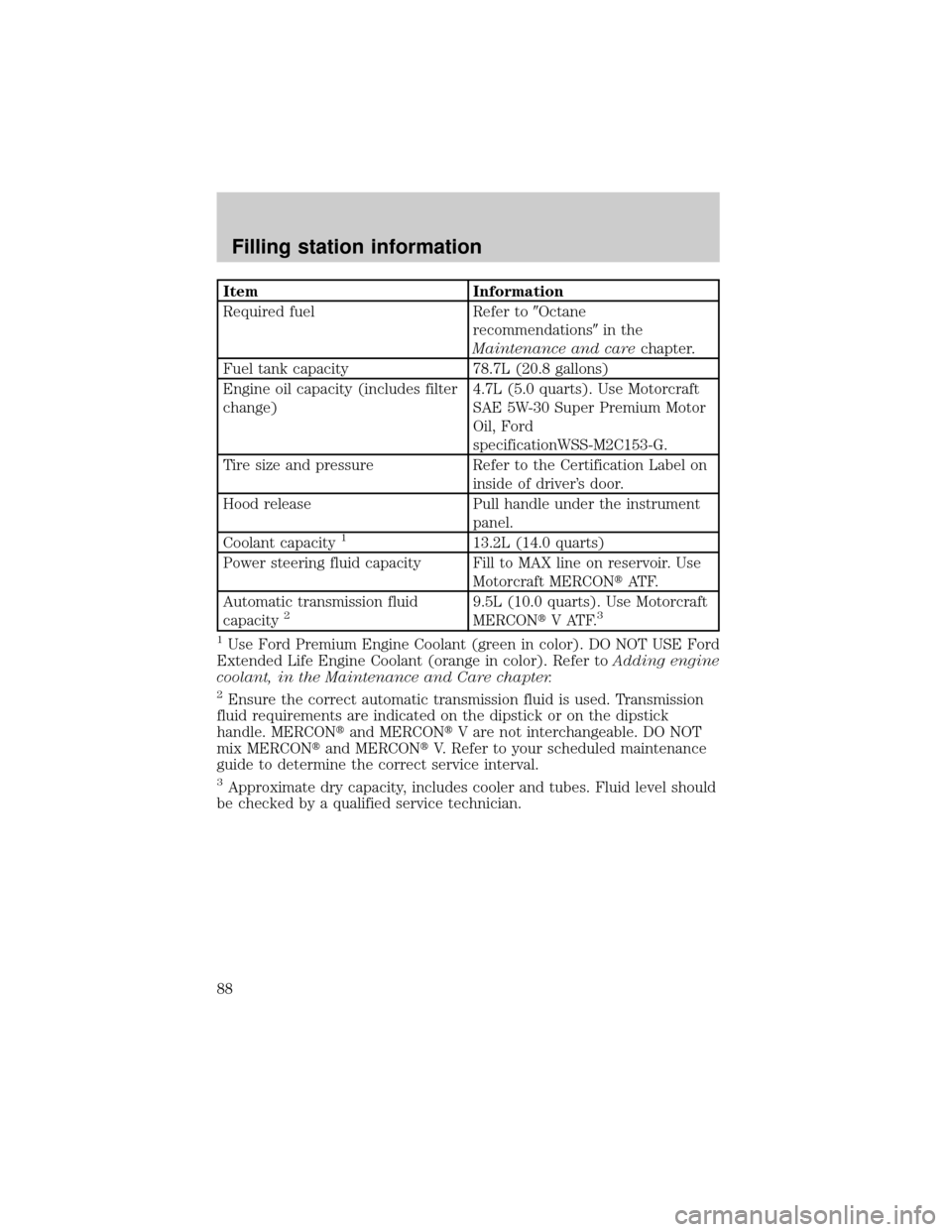
Item Information
Required fuel Refer to9Octane
recommendations9in the
Maintenance and carechapter.
Fuel tank capacity 78.7L (20.8 gallons)
Engine oil capacity (includes filter
change)4.7L (5.0 quarts). Use Motorcraft
SAE 5W-30 Super Premium Motor
Oil, Ford
specificationWSS-M2C153-G.
Tire size and pressure Refer to the Certification Label on
inside of driver's door.
Hood release Pull handle under the instrument
panel.
Coolant capacity
113.2L (14.0 quarts)
Power steering fluid capacity Fill to MAX line on reservoir. Use
Motorcraft MERCONtAT F.
Automatic transmission fluid
capacity
29.5L (10.0 quarts). Use Motorcraft
MERCONtV ATF.3
1
Use Ford Premium Engine Coolant (green in color). DO NOT USE Ford
Extended Life Engine Coolant (orange in color). Refer toAdding engine
coolant, in the Maintenance and Care chapter.
2Ensure the correct automatic transmission fluid is used. Transmission
fluid requirements are indicated on the dipstick or on the dipstick
handle. MERCONtand MERCONtV are not interchangeable. DO NOT
mix MERCONtand MERCONtV. Refer to your scheduled maintenance
guide to determine the correct service interval.
3Approximate dry capacity, includes cooler and tubes. Fluid level should
be checked by a qualified service technician.
Filling station information
88