2001 DODGE RAM ignition
[x] Cancel search: ignitionPage 2793 of 2889
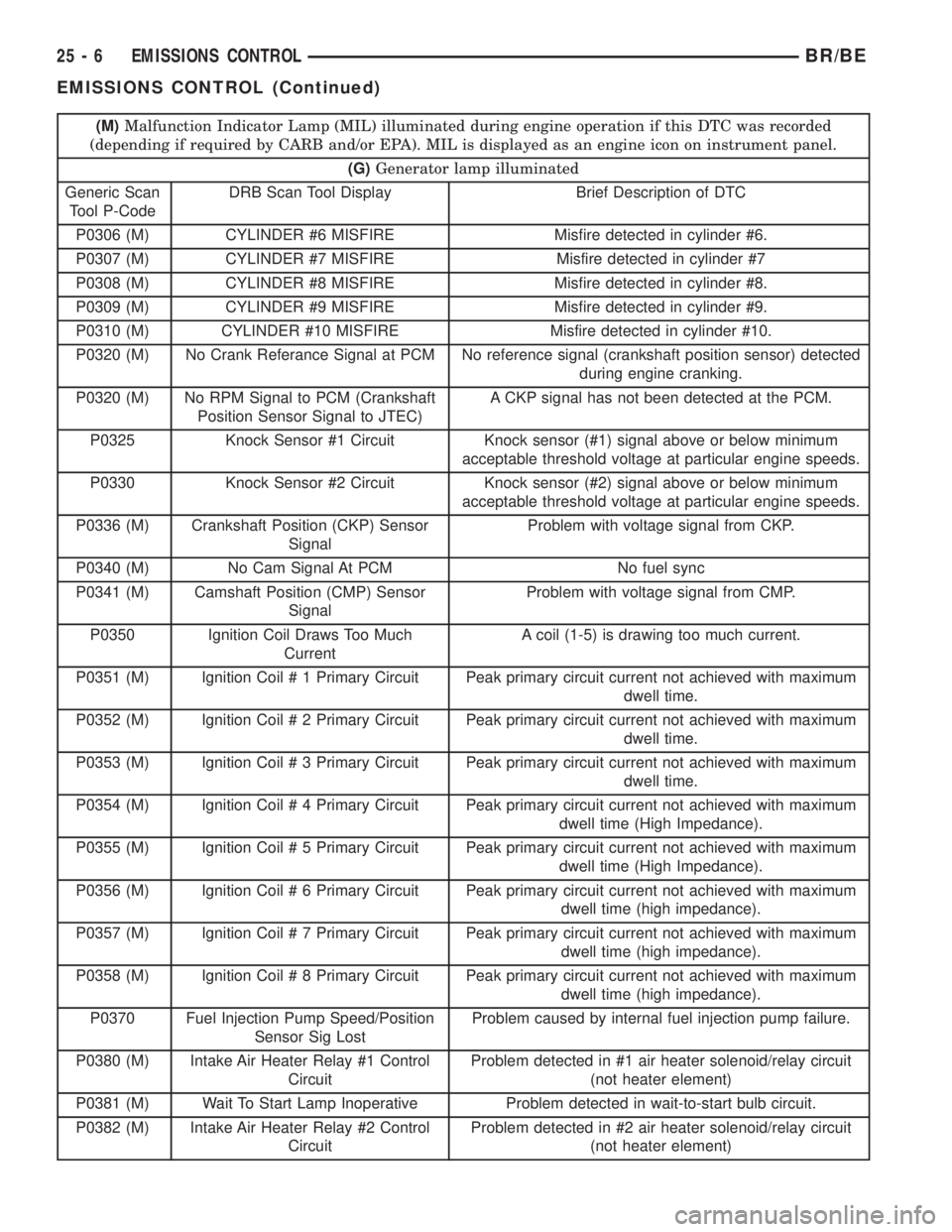
(M)Malfunction Indicator Lamp (MIL) illuminated during engine operation if this DTC was recorded
(depending if required by CARB and/or EPA). MIL is displayed as an engine icon on instrument panel.
(G)Generator lamp illuminated
Generic Scan
Tool P-CodeDRB Scan Tool Display Brief Description of DTC
P0306 (M) CYLINDER #6 MISFIRE Misfire detected in cylinder #6.
P0307 (M) CYLINDER #7 MISFIRE Misfire detected in cylinder #7
P0308 (M) CYLINDER #8 MISFIRE Misfire detected in cylinder #8.
P0309 (M) CYLINDER #9 MISFIRE Misfire detected in cylinder #9.
P0310 (M) CYLINDER #10 MISFIRE Misfire detected in cylinder #10.
P0320 (M) No Crank Referance Signal at PCM No reference signal (crankshaft position sensor) detected
during engine cranking.
P0320 (M) No RPM Signal to PCM (Crankshaft
Position Sensor Signal to JTEC)A CKP signal has not been detected at the PCM.
P0325 Knock Sensor #1 Circuit Knock sensor (#1) signal above or below minimum
acceptable threshold voltage at particular engine speeds.
P0330 Knock Sensor #2 Circuit Knock sensor (#2) signal above or below minimum
acceptable threshold voltage at particular engine speeds.
P0336 (M) Crankshaft Position (CKP) Sensor
SignalProblem with voltage signal from CKP.
P0340 (M) No Cam Signal At PCM No fuel sync
P0341 (M) Camshaft Position (CMP) Sensor
SignalProblem with voltage signal from CMP.
P0350 Ignition Coil Draws Too Much
CurrentA coil (1-5) is drawing too much current.
P0351 (M) Ignition Coil # 1 Primary Circuit Peak primary circuit current not achieved with maximum
dwell time.
P0352 (M) Ignition Coil # 2 Primary Circuit Peak primary circuit current not achieved with maximum
dwell time.
P0353 (M) Ignition Coil # 3 Primary Circuit Peak primary circuit current not achieved with maximum
dwell time.
P0354 (M) Ignition Coil # 4 Primary Circuit Peak primary circuit current not achieved with maximum
dwell time (High Impedance).
P0355 (M) Ignition Coil # 5 Primary Circuit Peak primary circuit current not achieved with maximum
dwell time (High Impedance).
P0356 (M) Ignition Coil # 6 Primary Circuit Peak primary circuit current not achieved with maximum
dwell time (high impedance).
P0357 (M) Ignition Coil # 7 Primary Circuit Peak primary circuit current not achieved with maximum
dwell time (high impedance).
P0358 (M) Ignition Coil # 8 Primary Circuit Peak primary circuit current not achieved with maximum
dwell time (high impedance).
P0370 Fuel Injection Pump Speed/Position
Sensor Sig LostProblem caused by internal fuel injection pump failure.
P0380 (M) Intake Air Heater Relay #1 Control
CircuitProblem detected in #1 air heater solenoid/relay circuit
(not heater element)
P0381 (M) Wait To Start Lamp Inoperative Problem detected in wait-to-start bulb circuit.
P0382 (M) Intake Air Heater Relay #2 Control
CircuitProblem detected in #2 air heater solenoid/relay circuit
(not heater element)
25 - 6 EMISSIONS CONTROLBR/BE
EMISSIONS CONTROL (Continued)
Page 2802 of 2889
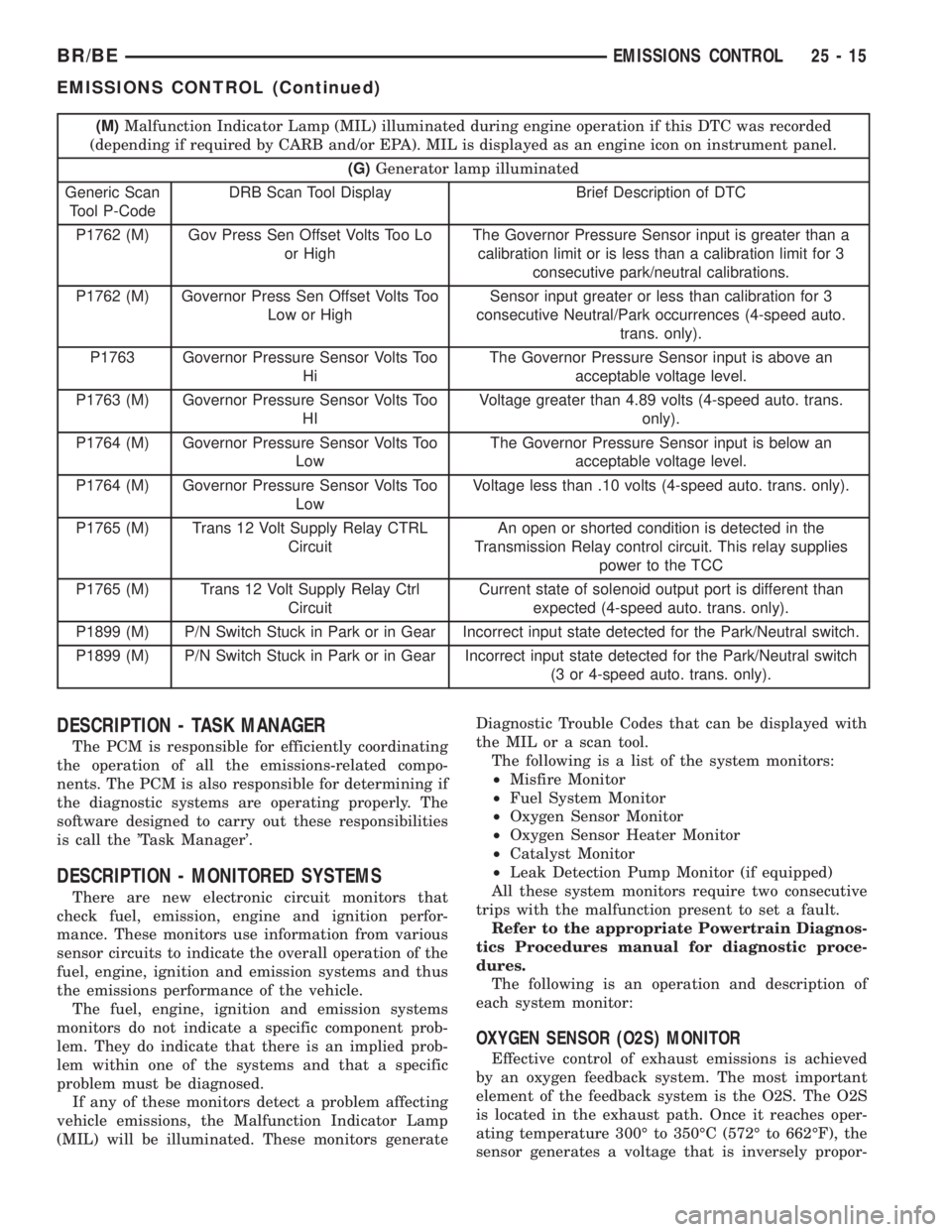
(M)Malfunction Indicator Lamp (MIL) illuminated during engine operation if this DTC was recorded
(depending if required by CARB and/or EPA). MIL is displayed as an engine icon on instrument panel.
(G)Generator lamp illuminated
Generic Scan
Tool P-CodeDRB Scan Tool Display Brief Description of DTC
P1762 (M) Gov Press Sen Offset Volts Too Lo
or HighThe Governor Pressure Sensor input is greater than a
calibration limit or is less than a calibration limit for 3
consecutive park/neutral calibrations.
P1762 (M) Governor Press Sen Offset Volts Too
Low or HighSensor input greater or less than calibration for 3
consecutive Neutral/Park occurrences (4-speed auto.
trans. only).
P1763 Governor Pressure Sensor Volts Too
HiThe Governor Pressure Sensor input is above an
acceptable voltage level.
P1763 (M) Governor Pressure Sensor Volts Too
HIVoltage greater than 4.89 volts (4-speed auto. trans.
only).
P1764 (M) Governor Pressure Sensor Volts Too
LowThe Governor Pressure Sensor input is below an
acceptable voltage level.
P1764 (M) Governor Pressure Sensor Volts Too
LowVoltage less than .10 volts (4-speed auto. trans. only).
P1765 (M) Trans 12 Volt Supply Relay CTRL
CircuitAn open or shorted condition is detected in the
Transmission Relay control circuit. This relay supplies
power to the TCC
P1765 (M) Trans 12 Volt Supply Relay Ctrl
CircuitCurrent state of solenoid output port is different than
expected (4-speed auto. trans. only).
P1899 (M) P/N Switch Stuck in Park or in Gear Incorrect input state detected for the Park/Neutral switch.
P1899 (M) P/N Switch Stuck in Park or in Gear Incorrect input state detected for the Park/Neutral switch
(3 or 4-speed auto. trans. only).
DESCRIPTION - TASK MANAGER
The PCM is responsible for efficiently coordinating
the operation of all the emissions-related compo-
nents. The PCM is also responsible for determining if
the diagnostic systems are operating properly. The
software designed to carry out these responsibilities
is call the 'Task Manager'.
DESCRIPTION - MONITORED SYSTEMS
There are new electronic circuit monitors that
check fuel, emission, engine and ignition perfor-
mance. These monitors use information from various
sensor circuits to indicate the overall operation of the
fuel, engine, ignition and emission systems and thus
the emissions performance of the vehicle.
The fuel, engine, ignition and emission systems
monitors do not indicate a specific component prob-
lem. They do indicate that there is an implied prob-
lem within one of the systems and that a specific
problem must be diagnosed.
If any of these monitors detect a problem affecting
vehicle emissions, the Malfunction Indicator Lamp
(MIL) will be illuminated. These monitors generateDiagnostic Trouble Codes that can be displayed with
the MIL or a scan tool.
The following is a list of the system monitors:
²Misfire Monitor
²Fuel System Monitor
²Oxygen Sensor Monitor
²Oxygen Sensor Heater Monitor
²Catalyst Monitor
²Leak Detection Pump Monitor (if equipped)
All these system monitors require two consecutive
trips with the malfunction present to set a fault.
Refer to the appropriate Powertrain Diagnos-
tics Procedures manual for diagnostic proce-
dures.
The following is an operation and description of
each system monitor:
OXYGEN SENSOR (O2S) MONITOR
Effective control of exhaust emissions is achieved
by an oxygen feedback system. The most important
element of the feedback system is the O2S. The O2S
is located in the exhaust path. Once it reaches oper-
ating temperature 300É to 350ÉC (572É to 662ÉF), the
sensor generates a voltage that is inversely propor-
BR/BEEMISSIONS CONTROL 25 - 15
EMISSIONS CONTROL (Continued)
Page 2805 of 2889
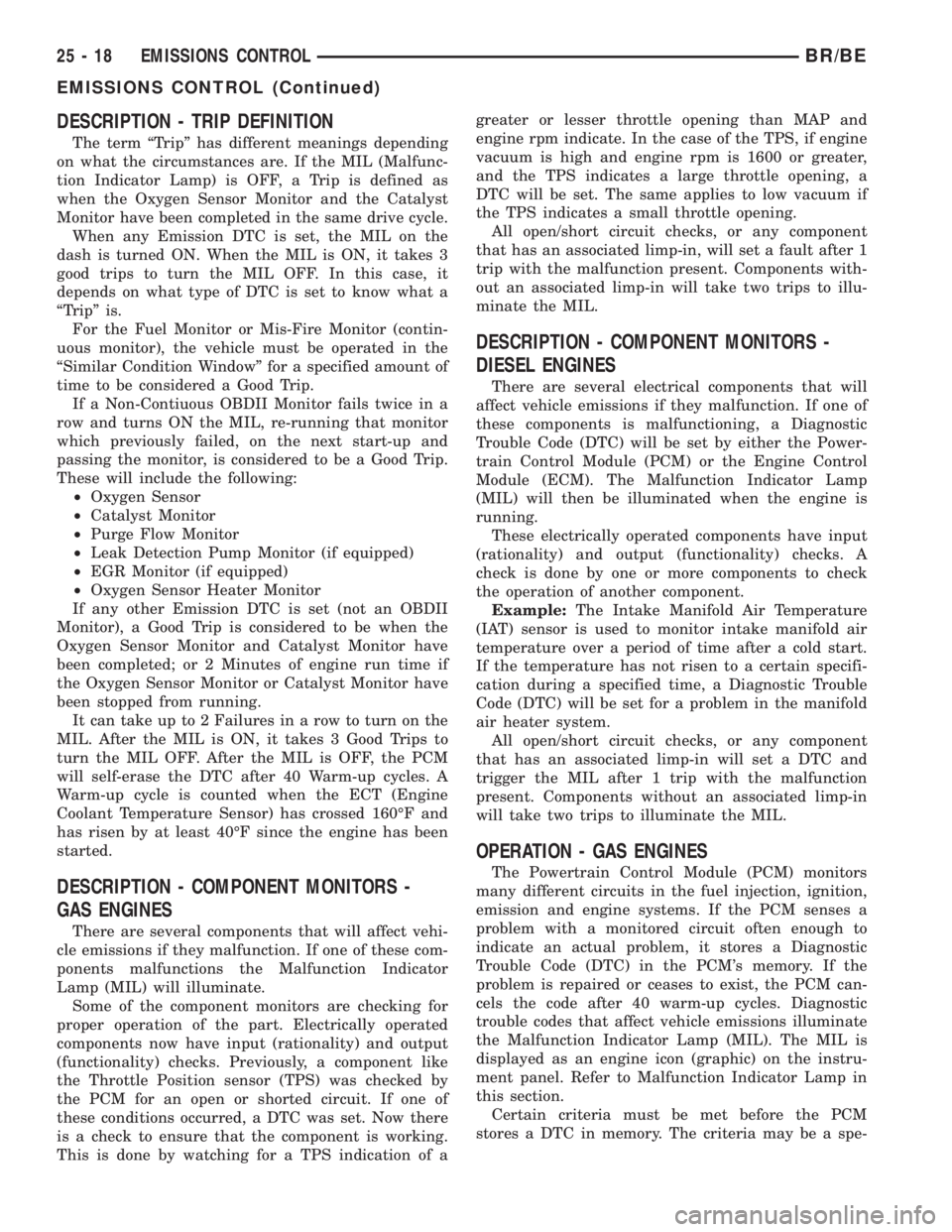
DESCRIPTION - TRIP DEFINITION
The term ªTripº has different meanings depending
on what the circumstances are. If the MIL (Malfunc-
tion Indicator Lamp) is OFF, a Trip is defined as
when the Oxygen Sensor Monitor and the Catalyst
Monitor have been completed in the same drive cycle.
When any Emission DTC is set, the MIL on the
dash is turned ON. When the MIL is ON, it takes 3
good trips to turn the MIL OFF. In this case, it
depends on what type of DTC is set to know what a
ªTripº is.
For the Fuel Monitor or Mis-Fire Monitor (contin-
uous monitor), the vehicle must be operated in the
ªSimilar Condition Windowº for a specified amount of
time to be considered a Good Trip.
If a Non-Contiuous OBDII Monitor fails twice in a
row and turns ON the MIL, re-running that monitor
which previously failed, on the next start-up and
passing the monitor, is considered to be a Good Trip.
These will include the following:
²Oxygen Sensor
²Catalyst Monitor
²Purge Flow Monitor
²Leak Detection Pump Monitor (if equipped)
²EGR Monitor (if equipped)
²Oxygen Sensor Heater Monitor
If any other Emission DTC is set (not an OBDII
Monitor), a Good Trip is considered to be when the
Oxygen Sensor Monitor and Catalyst Monitor have
been completed; or 2 Minutes of engine run time if
the Oxygen Sensor Monitor or Catalyst Monitor have
been stopped from running.
It can take up to 2 Failures in a row to turn on the
MIL. After the MIL is ON, it takes 3 Good Trips to
turn the MIL OFF. After the MIL is OFF, the PCM
will self-erase the DTC after 40 Warm-up cycles. A
Warm-up cycle is counted when the ECT (Engine
Coolant Temperature Sensor) has crossed 160ÉF and
has risen by at least 40ÉF since the engine has been
started.
DESCRIPTION - COMPONENT MONITORS -
GAS ENGINES
There are several components that will affect vehi-
cle emissions if they malfunction. If one of these com-
ponents malfunctions the Malfunction Indicator
Lamp (MIL) will illuminate.
Some of the component monitors are checking for
proper operation of the part. Electrically operated
components now have input (rationality) and output
(functionality) checks. Previously, a component like
the Throttle Position sensor (TPS) was checked by
the PCM for an open or shorted circuit. If one of
these conditions occurred, a DTC was set. Now there
is a check to ensure that the component is working.
This is done by watching for a TPS indication of agreater or lesser throttle opening than MAP and
engine rpm indicate. In the case of the TPS, if engine
vacuum is high and engine rpm is 1600 or greater,
and the TPS indicates a large throttle opening, a
DTC will be set. The same applies to low vacuum if
the TPS indicates a small throttle opening.
All open/short circuit checks, or any component
that has an associated limp-in, will set a fault after 1
trip with the malfunction present. Components with-
out an associated limp-in will take two trips to illu-
minate the MIL.
DESCRIPTION - COMPONENT MONITORS -
DIESEL ENGINES
There are several electrical components that will
affect vehicle emissions if they malfunction. If one of
these components is malfunctioning, a Diagnostic
Trouble Code (DTC) will be set by either the Power-
train Control Module (PCM) or the Engine Control
Module (ECM). The Malfunction Indicator Lamp
(MIL) will then be illuminated when the engine is
running.
These electrically operated components have input
(rationality) and output (functionality) checks. A
check is done by one or more components to check
the operation of another component.
Example:The Intake Manifold Air Temperature
(IAT) sensor is used to monitor intake manifold air
temperature over a period of time after a cold start.
If the temperature has not risen to a certain specifi-
cation during a specified time, a Diagnostic Trouble
Code (DTC) will be set for a problem in the manifold
air heater system.
All open/short circuit checks, or any component
that has an associated limp-in will set a DTC and
trigger the MIL after 1 trip with the malfunction
present. Components without an associated limp-in
will take two trips to illuminate the MIL.
OPERATION - GAS ENGINES
The Powertrain Control Module (PCM) monitors
many different circuits in the fuel injection, ignition,
emission and engine systems. If the PCM senses a
problem with a monitored circuit often enough to
indicate an actual problem, it stores a Diagnostic
Trouble Code (DTC) in the PCM's memory. If the
problem is repaired or ceases to exist, the PCM can-
cels the code after 40 warm-up cycles. Diagnostic
trouble codes that affect vehicle emissions illuminate
the Malfunction Indicator Lamp (MIL). The MIL is
displayed as an engine icon (graphic) on the instru-
ment panel. Refer to Malfunction Indicator Lamp in
this section.
Certain criteria must be met before the PCM
stores a DTC in memory. The criteria may be a spe-
25 - 18 EMISSIONS CONTROLBR/BE
EMISSIONS CONTROL (Continued)
Page 2810 of 2889
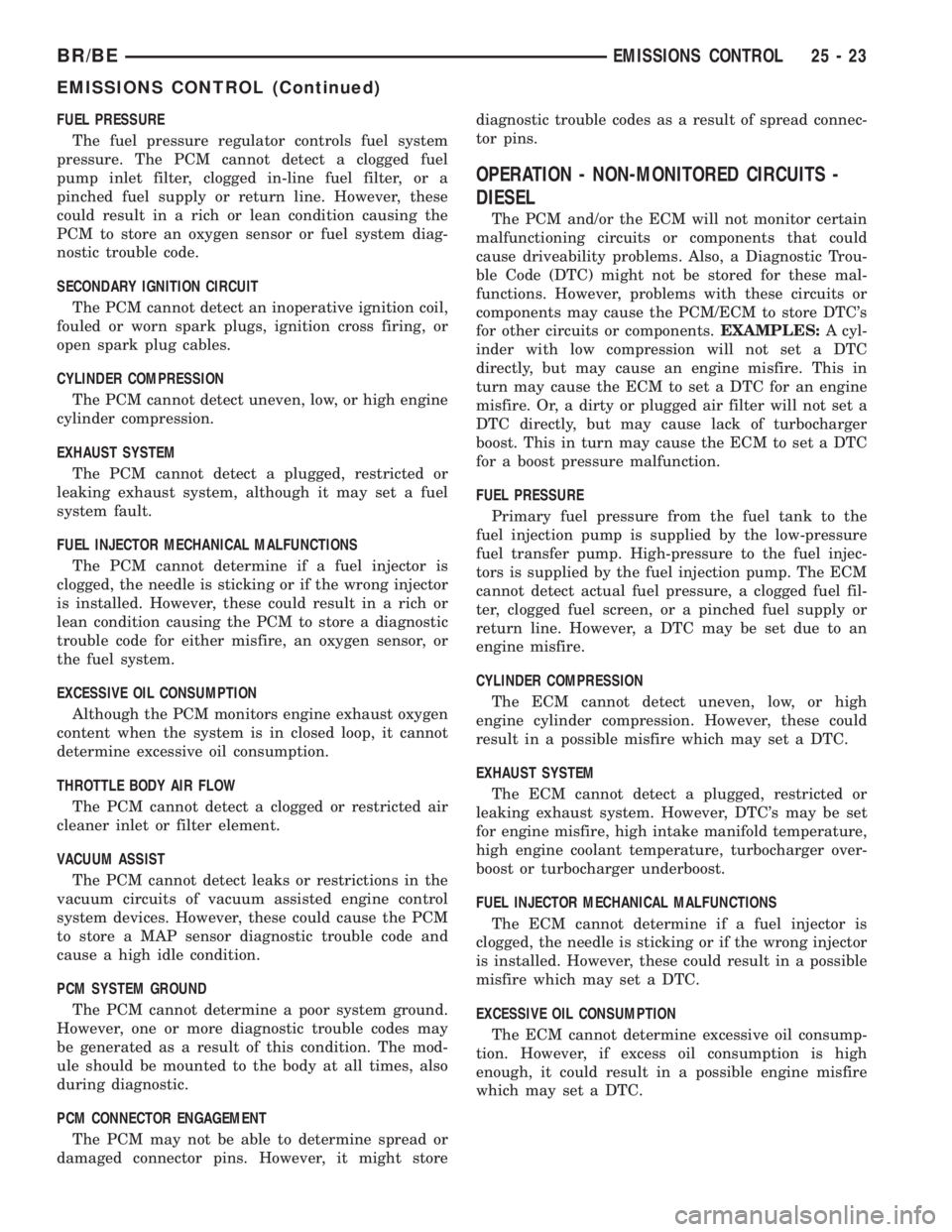
FUEL PRESSURE
The fuel pressure regulator controls fuel system
pressure. The PCM cannot detect a clogged fuel
pump inlet filter, clogged in-line fuel filter, or a
pinched fuel supply or return line. However, these
could result in a rich or lean condition causing the
PCM to store an oxygen sensor or fuel system diag-
nostic trouble code.
SECONDARY IGNITION CIRCUIT
The PCM cannot detect an inoperative ignition coil,
fouled or worn spark plugs, ignition cross firing, or
open spark plug cables.
CYLINDER COMPRESSION
The PCM cannot detect uneven, low, or high engine
cylinder compression.
EXHAUST SYSTEM
The PCM cannot detect a plugged, restricted or
leaking exhaust system, although it may set a fuel
system fault.
FUEL INJECTOR MECHANICAL MALFUNCTIONS
The PCM cannot determine if a fuel injector is
clogged, the needle is sticking or if the wrong injector
is installed. However, these could result in a rich or
lean condition causing the PCM to store a diagnostic
trouble code for either misfire, an oxygen sensor, or
the fuel system.
EXCESSIVE OIL CONSUMPTION
Although the PCM monitors engine exhaust oxygen
content when the system is in closed loop, it cannot
determine excessive oil consumption.
THROTTLE BODY AIR FLOW
The PCM cannot detect a clogged or restricted air
cleaner inlet or filter element.
VACUUM ASSIST
The PCM cannot detect leaks or restrictions in the
vacuum circuits of vacuum assisted engine control
system devices. However, these could cause the PCM
to store a MAP sensor diagnostic trouble code and
cause a high idle condition.
PCM SYSTEM GROUND
The PCM cannot determine a poor system ground.
However, one or more diagnostic trouble codes may
be generated as a result of this condition. The mod-
ule should be mounted to the body at all times, also
during diagnostic.
PCM CONNECTOR ENGAGEMENT
The PCM may not be able to determine spread or
damaged connector pins. However, it might storediagnostic trouble codes as a result of spread connec-
tor pins.
OPERATION - NON-MONITORED CIRCUITS -
DIESEL
The PCM and/or the ECM will not monitor certain
malfunctioning circuits or components that could
cause driveability problems. Also, a Diagnostic Trou-
ble Code (DTC) might not be stored for these mal-
functions. However, problems with these circuits or
components may cause the PCM/ECM to store DTC's
for other circuits or components.EXAMPLES:A cyl-
inder with low compression will not set a DTC
directly, but may cause an engine misfire. This in
turn may cause the ECM to set a DTC for an engine
misfire. Or, a dirty or plugged air filter will not set a
DTC directly, but may cause lack of turbocharger
boost. This in turn may cause the ECM to set a DTC
for a boost pressure malfunction.
FUEL PRESSURE
Primary fuel pressure from the fuel tank to the
fuel injection pump is supplied by the low-pressure
fuel transfer pump. High-pressure to the fuel injec-
tors is supplied by the fuel injection pump. The ECM
cannot detect actual fuel pressure, a clogged fuel fil-
ter, clogged fuel screen, or a pinched fuel supply or
return line. However, a DTC may be set due to an
engine misfire.
CYLINDER COMPRESSION
The ECM cannot detect uneven, low, or high
engine cylinder compression. However, these could
result in a possible misfire which may set a DTC.
EXHAUST SYSTEM
The ECM cannot detect a plugged, restricted or
leaking exhaust system. However, DTC's may be set
for engine misfire, high intake manifold temperature,
high engine coolant temperature, turbocharger over-
boost or turbocharger underboost.
FUEL INJECTOR MECHANICAL MALFUNCTIONS
The ECM cannot determine if a fuel injector is
clogged, the needle is sticking or if the wrong injector
is installed. However, these could result in a possible
misfire which may set a DTC.
EXCESSIVE OIL CONSUMPTION
The ECM cannot determine excessive oil consump-
tion. However, if excess oil consumption is high
enough, it could result in a possible engine misfire
which may set a DTC.
BR/BEEMISSIONS CONTROL 25 - 23
EMISSIONS CONTROL (Continued)
Page 2832 of 2889
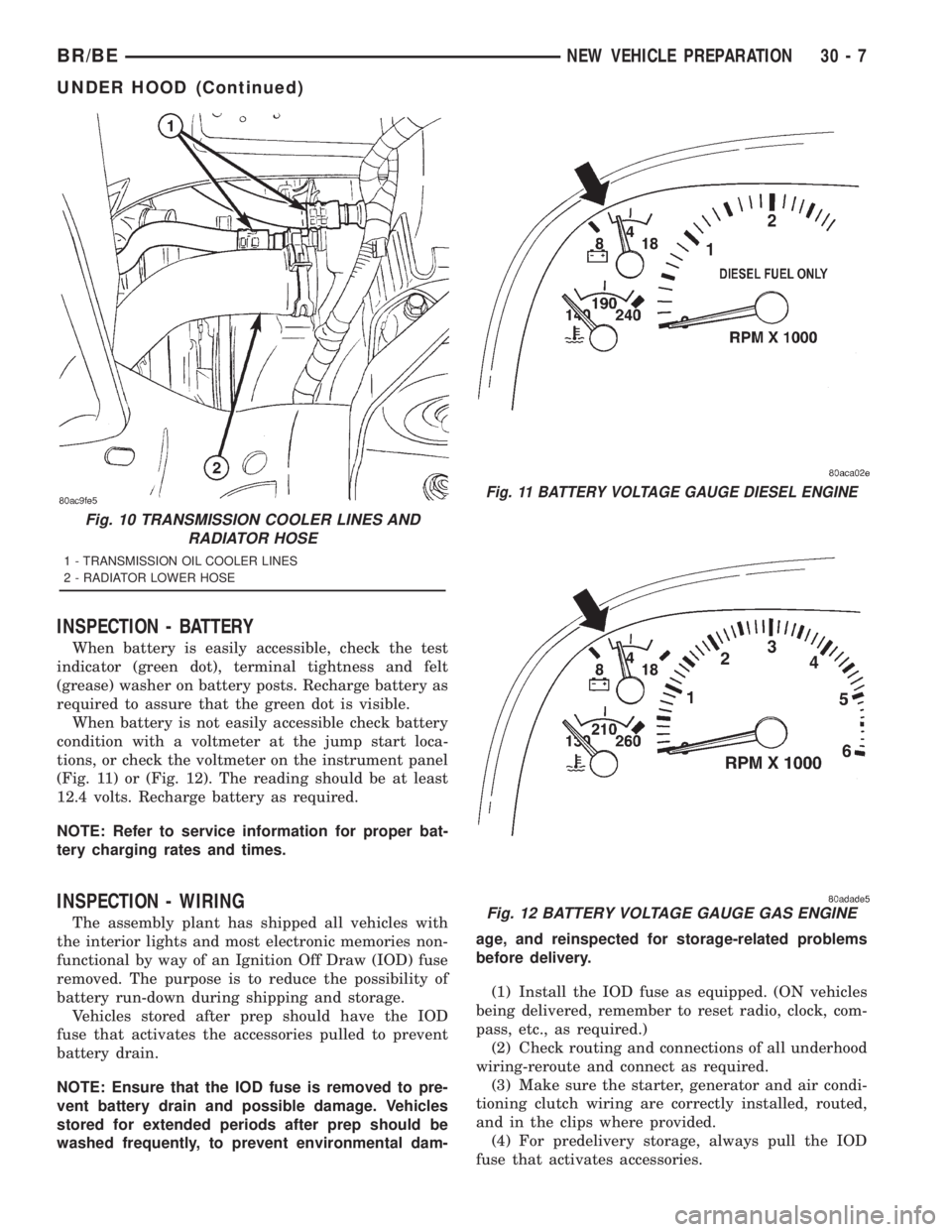
INSPECTION - BATTERY
When battery is easily accessible, check the test
indicator (green dot), terminal tightness and felt
(grease) washer on battery posts. Recharge battery as
required to assure that the green dot is visible.
When battery is not easily accessible check battery
condition with a voltmeter at the jump start loca-
tions, or check the voltmeter on the instrument panel
(Fig. 11) or (Fig. 12). The reading should be at least
12.4 volts. Recharge battery as required.
NOTE: Refer to service information for proper bat-
tery charging rates and times.
INSPECTION - WIRING
The assembly plant has shipped all vehicles with
the interior lights and most electronic memories non-
functional by way of an Ignition Off Draw (IOD) fuse
removed. The purpose is to reduce the possibility of
battery run-down during shipping and storage.
Vehicles stored after prep should have the IOD
fuse that activates the accessories pulled to prevent
battery drain.
NOTE: Ensure that the IOD fuse is removed to pre-
vent battery drain and possible damage. Vehicles
stored for extended periods after prep should be
washed frequently, to prevent environmental dam-age, and reinspected for storage-related problems
before delivery.
(1) Install the IOD fuse as equipped. (ON vehicles
being delivered, remember to reset radio, clock, com-
pass, etc., as required.)
(2) Check routing and connections of all underhood
wiring-reroute and connect as required.
(3) Make sure the starter, generator and air condi-
tioning clutch wiring are correctly installed, routed,
and in the clips where provided.
(4) For predelivery storage, always pull the IOD
fuse that activates accessories.
Fig. 10 TRANSMISSION COOLER LINES AND
RADIATOR HOSE
1 - TRANSMISSION OIL COOLER LINES
2 - RADIATOR LOWER HOSE
Fig. 11 BATTERY VOLTAGE GAUGE DIESEL ENGINE
Fig. 12 BATTERY VOLTAGE GAUGE GAS ENGINE
BR/BENEW VEHICLE PREPARATION 30 - 7
UNDER HOOD (Continued)
Page 2837 of 2889
BODY INTERIOR
INSPECTION - COMPASS
NOTE: Set variance after calibration.
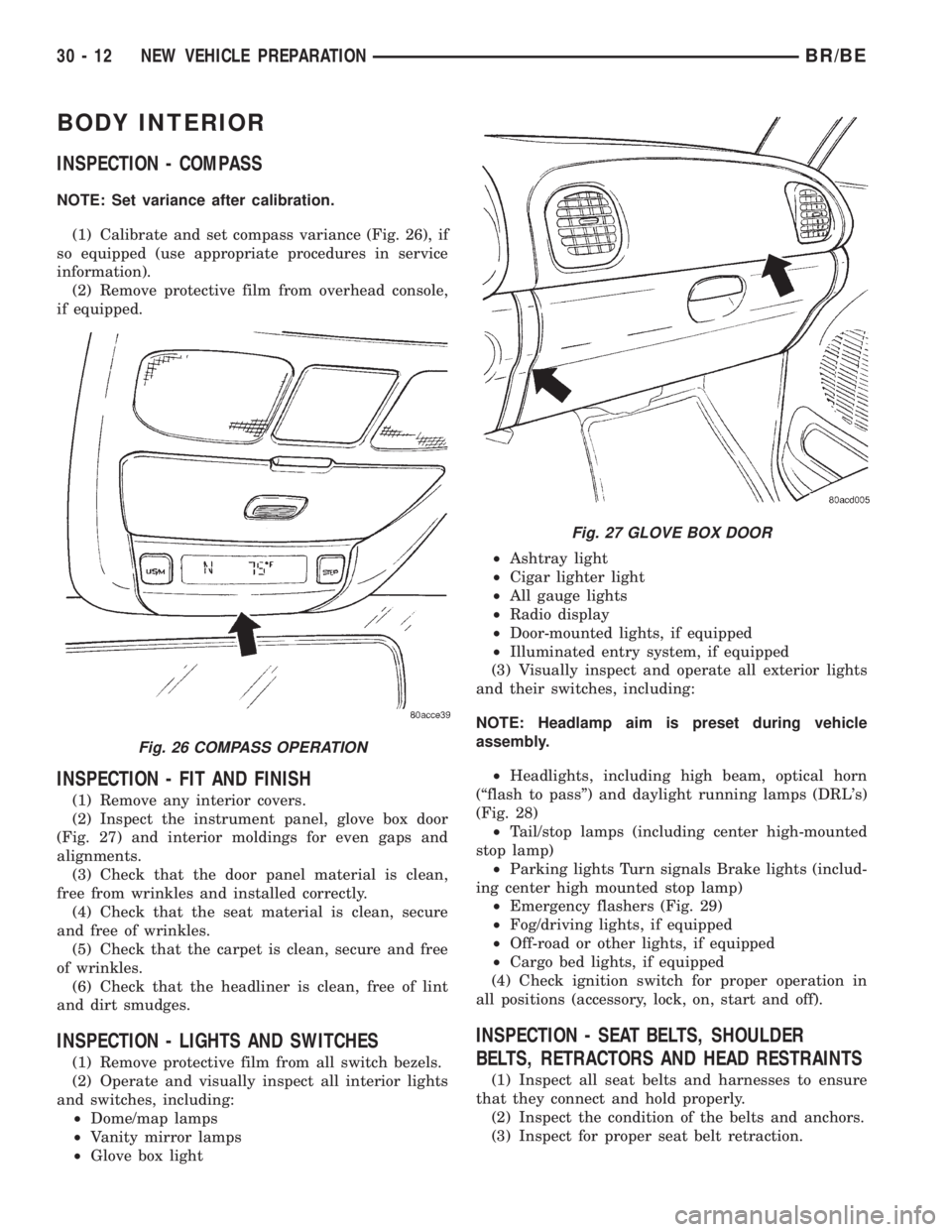
(1) Calibrate and set compass variance (Fig. 26), if
so equipped (use appropriate procedures in service
information).
(2) Remove protective film from overhead console,
if equipped.
INSPECTION - FIT AND FINISH
(1) Remove any interior covers.
(2) Inspect the instrument panel, glove box door
(Fig. 27) and interior moldings for even gaps and
alignments.
(3) Check that the door panel material is clean,
free from wrinkles and installed correctly.
(4) Check that the seat material is clean, secure
and free of wrinkles.
(5) Check that the carpet is clean, secure and free
of wrinkles.
(6) Check that the headliner is clean, free of lint
and dirt smudges.
INSPECTION - LIGHTS AND SWITCHES
(1) Remove protective film from all switch bezels.
(2) Operate and visually inspect all interior lights
and switches, including:
²Dome/map lamps
²Vanity mirror lamps
²Glove box light²Ashtray light
²Cigar lighter light
²All gauge lights
²Radio display
²Door-mounted lights, if equipped
²Illuminated entry system, if equipped
(3) Visually inspect and operate all exterior lights
and their switches, including:
NOTE: Headlamp aim is preset during vehicle
assembly.
²Headlights, including high beam, optical horn
(ªflash to passº) and daylight running lamps (DRL's)
(Fig. 28)
²Tail/stop lamps (including center high-mounted
stop lamp)
²Parking lights Turn signals Brake lights (includ-
ing center high mounted stop lamp)
²Emergency flashers (Fig. 29)
²Fog/driving lights, if equipped
²Off-road or other lights, if equipped
²Cargo bed lights, if equipped
(4) Check ignition switch for proper operation in
all positions (accessory, lock, on, start and off).
INSPECTION - SEAT BELTS, SHOULDER
BELTS, RETRACTORS AND HEAD RESTRAINTS
(1) Inspect all seat belts and harnesses to ensure
that they connect and hold properly.
(2) Inspect the condition of the belts and anchors.
(3) Inspect for proper seat belt retraction.
Fig. 26 COMPASS OPERATION
Fig. 27 GLOVE BOX DOOR
30 - 12 NEW VEHICLE PREPARATIONBR/BE
Page 2841 of 2889
4X4 TRANSFER CASE
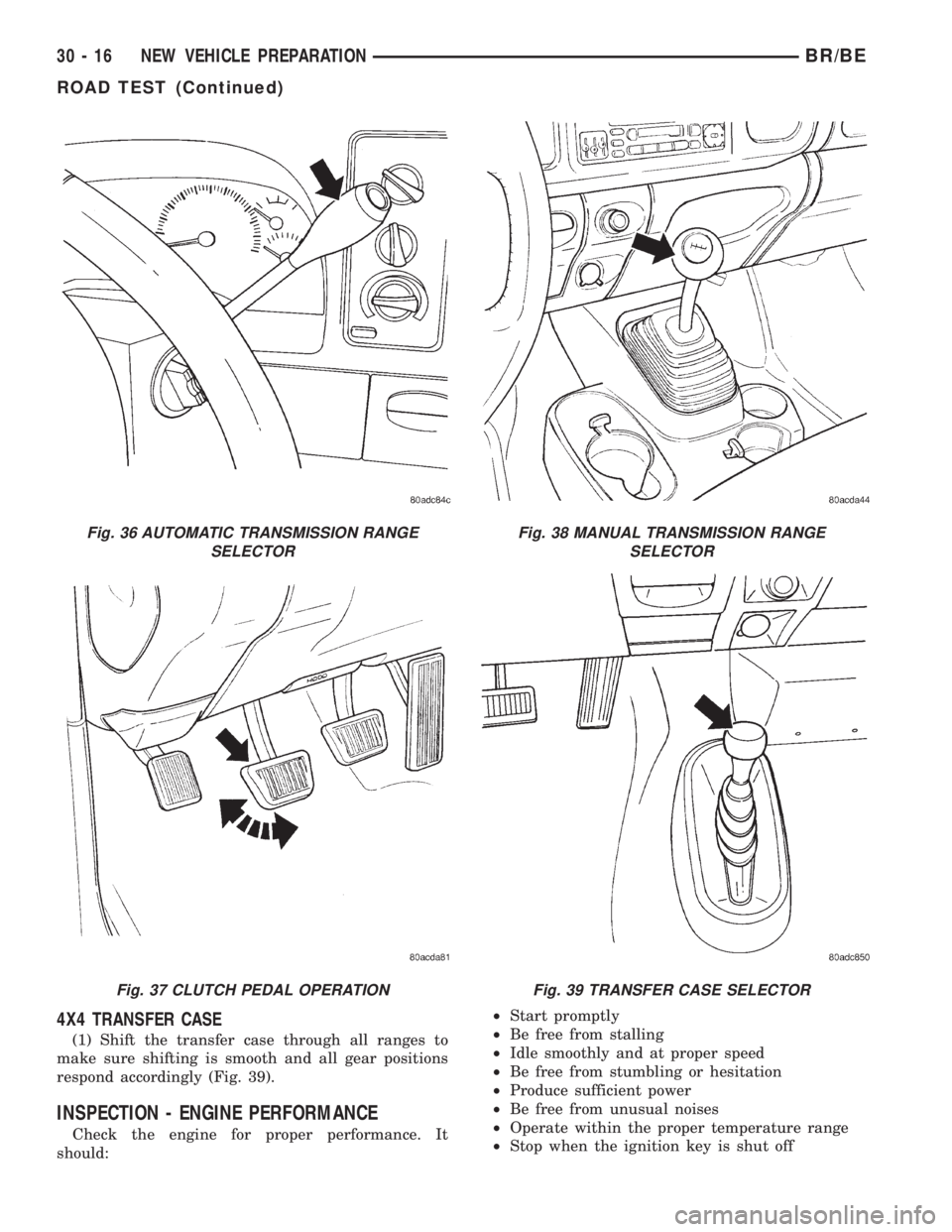
(1) Shift the transfer case through all ranges to
make sure shifting is smooth and all gear positions
respond accordingly (Fig. 39).
INSPECTION - ENGINE PERFORMANCE
Check the engine for proper performance. It
should:²Start promptly
²Be free from stalling
²Idle smoothly and at proper speed
²Be free from stumbling or hesitation
²Produce sufficient power
²Be free from unusual noises
²Operate within the proper temperature range
²Stop when the ignition key is shut off
Fig. 36 AUTOMATIC TRANSMISSION RANGE
SELECTOR
Fig. 37 CLUTCH PEDAL OPERATION
Fig. 38 MANUAL TRANSMISSION RANGE
SELECTOR
Fig. 39 TRANSFER CASE SELECTOR
30 - 16 NEW VEHICLE PREPARATIONBR/BE
ROAD TEST (Continued)
Page 2846 of 2889

Remote Keyless Entry (RKE). The horn chirps when
the vehicle is locked with the RKE transmitter.
HEADLAMP FLASH
NOTE: This feature can be enabled with or without
the horn chirp feature.
The headlamp flash function is a feature that can
be enabled or disabled on vehicles equipped with
Remote Keyless Entry (RKE). The headlamps flash
once when the vehicle is locked with the RKE trans-
mitter, and flash twice when the vehicle is unlocked
with the RKE transmitter.
LOW FUEL CHIME
All vehicles equipped with the audible low fuel
chime are shipped with this feature enabled.
REMOTE KEYLESS ENTRY (RKE) DOOR UNLOCK
SEQUENCE
Two door unlock sequences are provided on vehi-
cles equipped with this feature. When using the RKE
transmitter to unlock the doors, pressing the unlock
button once when the feature is enabled unlocks only
the driver's door. Pushing the RKE transmitter
unlock button a second time unlocks the remaining
doors. When the RKE door unlock feature is disabled,
all doors unlock with one press of the RKE transmit-
ter unlock button.
HEADLIGHTS ON AUTOMATICALLY WITH WIPERS
This feature appears on vehicles that have, as an
option, automatic headlights. When the windshield
wipers are turned on, the headlights automatically
turn on.
12V POWER OUTLET
This feature currently appears on Caravan/Voyag-
er/Town and Country vehicles. The vehicles are
shipped with the 12V power outlets turned off with
the ignition key. The relay can be changed to make
the outlets powered at all times. This feature may be
of interest to customers with cell phones.
TURN SIGNAL CHIME
This feature is an audible turn signal warning
chime. The chime sounds if the turn signal is on, the
vehicle has traveled one mile and vehicle speed has
exceeded 40 Km/h (25 mph).
REMOTE UNLOCK
The remote unlock function is a feature that can be
enabled or disabled on vehicles equipped with
Remote Keyless Entry (RKE). With the first press of
the RKE transmitter to unlock the doors, the driver's
door only unlocks. With the second press of the RKEtransmitter, the remaining doors and the liftgate
unlock. With the remote unlock feature enabled, the
first press of the RKE transmitter unlocks all doors.
REMOTE LINKED TO MEMORY
The remote linked to memory function is currently
only available only on Jeep Grand Cherokee Limited
vehicles. When enabled, this feature recalls a mem-
ory of seats, mirror and radio presets and positions
when unlocking the vehicle with the RKE transmit-
ter.
HEADLAMP DELAY
Currently available only on Jeep Grand Cherokee
vehicles, the headlamp delay timeout can be set to
30, 60 or 90 seconds. This timeout only occurs when
the ignition is turned off prior to turning the head-
lamps off, or when leaving the headlamps in AUTO
mode.
SERVICE INTERVAL
Currently available only on Jeep Grand Cherokee
vehicles, the interval for the service reminder mes-
sage can be set from 3,219 kilometers to 12,070 kilo-
meters (2,000 miles to 7,500 miles).
EASY EXIT SEAT
Currently available only on Jeep Grand Cherokee
Limited vehicles, the driver's seat will reposition
55mm (2.1 inches) rearward, or the end of travel if
less than 55mm (2.1 inches) and full downward when
the key is removed from the ignition. This feature
allows ease of exiting the vehicle. The seat will repo-
sition itself to the memory location when the vehicle
is unlocked using the RKE transmitter or by pressing
the memory buttons on the door panel.
APPEARANCE TIPS
CLEANING
(1) Before delivering the new vehicle to the cus-
tomer, the following checks on appearance details are
recommended:
²Wash the vehicle to remove all traces of road
grime and other dirt on the car from new vehicle
preparation operations
²Clean the tire sidewalls
²Clean exterior and interior glass surfaces
²Remove all protective covers
²Remove undercoat overspray, excess window
sealer, and excess weatherstrip adhesive
²Inspect interior trim, seats, carpeting, and mold-
ings. Clean as necessary
²Remove shipping and inspection stickers
BR/BENEW VEHICLE PREPARATION 30 - 21
PROGRAMMABLE ELECTRONIC FEATURES (Continued)