2001 DODGE RAM warning
[x] Cancel search: warningPage 2784 of 2889
STANDARD PROCEDURE) Install plugs in, or tape
over all of the opened refrigerant line fittings.
(7) Pull the accumulator out of the retaining band.
(8) Remove the accumulator from the engine com-
partment.
INSTALLATION
WARNING: REVIEW THE WARNINGS AND CAU-
TIONS IN THE FRONT OF THIS SECTION BEFORE
PERFORMING THE FOLLOWING OPERATION.
(Refer to 24 - HEATING & AIR CONDITIONING/
PLUMBING - WARNING) (Refer to 24 - HEATING &
AIR CONDITIONING/PLUMBING - CAUTION)(Refer to
24 - HEATING & AIR CONDITIONING/PLUMBING -
CAUTION - REFRIGERANT HOSES/LINES/TUBES
PRECAUTIONS)(1) Install the accumulator in the retaining band.
(2) Remove the tape or plugs from the refrigerant
line fittings on the accumulator inlet and the evapo-
rator outlet. Connect the accumulator inlet refriger-
ant line coupler to the evaporator outlet. (Refer to 24
- HEATING & AIR CONDITIONING/PLUMBING -
STANDARD PROCEDURE - A/C LINE COUPLERS)
(3) Tighten the accumulator retaining band screw
to 4.5 N´m (40 in. lbs.).
(4) Remove the tape or plugs from the refrigerant
line fittings on the suction line and the accumulator
outlet. Connect the suction line refrigerant line cou-
pler to the accumulator outlet. (Refer to 24 - HEAT-
ING & AIR CONDITIONING/PLUMBING -
STANDARD PROCEDURE - A/C LINE COUPLERS)
(5) Reinstall the a/c low pressure switch on the
accumulator. (Refer to 24 - HEATING & AIR CON-
DITIONING/CONTROLS/A/C LOW PRESSURE
SWITCH - INSTALLATION)
(6) Connect the battery negative cable.
(7) Evacuate the refrigerant system. (Refer to 24 -
HEATING & AIR CONDITIONING/PLUMBING -
STANDARD PROCEDURE - REFRIGERANT SYS-
TEM EVACUATE)
(8) Charge the refrigerant system. (Refer to 24 -
HEATING & AIR CONDITIONING/PLUMBING -
STANDARD PROCEDURE - REFRIGERANT SYS-
TEM CHARGE)
NOTE: If the accumulator is replaced, add 60 milli-
liters (2 fluid ounces) of refrigerant oil to the refrig-
erant system. Use only refrigerant oil of the type
recommended for the compressor in the vehicle.
HEATER CORE
DESCRIPTION
The heater core is located in the HVAC housing,
under the instrument panel. It is a heat exchanger
made of rows of tubes and fins.
OPERATION
Engine coolant is circulated through heater hoses
to the heater core at all times. As the coolant flows
through the heater core, heat removed from the
engine is transferred to the heater core fins and
tubes. Air directed through the heater core picks up
the heat from the heater core fins. The blend door
allows control of the heater output air temperature
by controlling how much of the air flowing through
the HVAC housing is directed through the heater
core. The blower motor speed controls the volume of
air flowing through the HVAC housing.
The heater core cannot be repaired and, if faulty or
damaged, it must be replaced. Refer to Cooling for
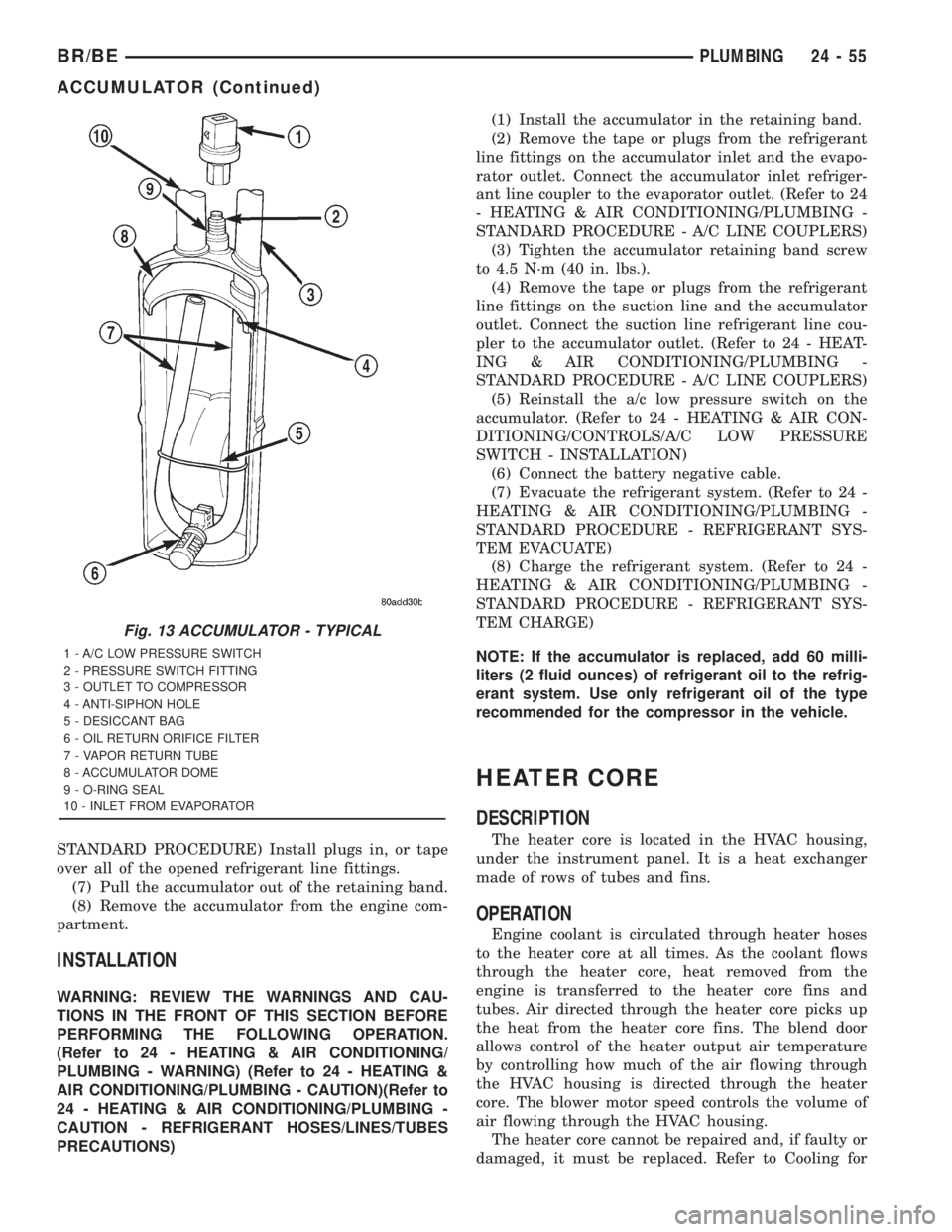
Fig. 13 ACCUMULATOR - TYPICAL
1 - A/C LOW PRESSURE SWITCH
2 - PRESSURE SWITCH FITTING
3 - OUTLET TO COMPRESSOR
4 - ANTI-SIPHON HOLE
5 - DESICCANT BAG
6 - OIL RETURN ORIFICE FILTER
7 - VAPOR RETURN TUBE
8 - ACCUMULATOR DOME
9 - O-RING SEAL
10 - INLET FROM EVAPORATOR
BR/BEPLUMBING 24 - 55
ACCUMULATOR (Continued)
Page 2808 of 2889
DTC Self Erasure
With one trip components or systems, the MIL is
illuminated upon test failure and DTCs are stored.
Two trip monitors are components requiring failure
in two consecutive trips for MIL illumination. Upon
failure of the first test, the Task Manager enters a
maturing code. If the component fails the test for a
second time the code matures and a DTC is set.
After three good trips the MIL is extinguished and
the Task Manager automatically switches the trip
counter to a warm-up cycle counter. DTCs are auto-
matically erased following 40 warm-up cycles if the
component does not fail again.
For misfire and fuel system monitors, the compo-
nent must pass the test under a Similar Conditions
Window in order to record a good trip. A Similar Con-
ditions Window is when engine RPM is within6375
RPM and load is within610% of when the fault
occurred.
NOTE: It is important to understand that a compo-
nent does not have to fail under a similar window of
operation to mature. It must pass the test under a
Similar Conditions Window when it failed to record
a Good Trip for DTC erasure for misfire and fuel
system monitors.
DTCs can be erased anytime with a DRB III. Eras-
ing the DTC with the DRB III erases all OBD II
information. The DRB III automatically displays a
warning that erasing the DTC will also erase all
OBD II monitor data. This includes all counter infor-
mation for warm-up cycles, trips and Freeze Frame.
Trip Indicator
TheTripis essential for running monitors and
extinguishing the MIL. In OBD II terms, a trip is a
set of vehicle operating conditions that must be met
for a specific monitor to run. All trips begin with a
key cycle.
Good Trip
The Good Trip counters are as follows:
²Specific Good Trip
²Fuel System Good Trip
²Misfire Good Trip
²Alternate Good Trip (appears as a Global Good
Trip on DRB III)
²Comprehensive Components
²Major Monitor
²Warm-Up Cycles
Specific Good Trip
The term Good Trip has different meanings
depending on the circumstances:
²If the MIL is OFF, a trip is defined as when the
Oxygen Sensor Monitor and the Catalyst Monitor
have been completed in the same drive cycle.²If the MIL is ON and a DTC was set by the Fuel
Monitor or Misfire Monitor (both continuous moni-
tors), the vehicle must be operated in the Similar
Condition Window for a specified amount of time.
²If the MIL is ON and a DTC was set by a Task
Manager commanded once-per-trip monitor (such as
the Oxygen Sensor Monitor, Catalyst Monitor, Purge
Flow Monitor, Leak Detection Pump Monitor, EGR
Monitor or Oxygen Sensor Heater Monitor), a good
trip is when the monitor is passed on the next start-
up.
²If the MIL is ON and any other emissions DTC
was set (not an OBD II monitor), a good trip occurs
when the Oxygen Sensor Monitor and Catalyst Mon-
itor have been completed, or two minutes of engine
run time if the Oxygen Sensor Monitor and Catalyst
Monitor have been stopped from running.
Fuel System Good Trip
To count a good trip (three required) and turn off
the MIL, the following conditions must occur:
²Engine in closed loop
²Operating in Similar Conditions Window
²Short Term multiplied by Long Term less than
threshold
²Less than threshold for a predetermined time
If all of the previous criteria are met, the PCM will
count a good trip (three required) and turn off the
MIL.
Misfire Good Trip
If the following conditions are met the PCM will
count one good trip (three required) in order to turn
off the MIL:
²Operating in Similar Condition Window
²1000 engine revolutions with no misfire
Warm-Up Cycles
Once the MIL has been extinguished by the Good
Trip Counter, the PCM automatically switches to a
Warm-Up Cycle Counter that can be viewed on the
DRB III. Warm-Up Cycles are used to erase DTCs
and Freeze Frames. Forty Warm-Up cycles must
occur in order for the PCM to self-erase a DTC and
Freeze Frame. A Warm-Up Cycle is defined as fol-
lows:
²Engine coolant temperature must start below
and rise above 160É F
²Engine coolant temperature must rise by 40É F
²No further faults occur
Freeze Frame Data Storage
Once a failure occurs, the Task Manager records
several engine operating conditions and stores it in a
Freeze Frame. The Freeze Frame is considered one
frame of information taken by an on-board data
recorder. When a fault occurs, the PCM stores the
input data from various sensors so that technicians
BR/BEEMISSIONS CONTROL 25 - 21
EMISSIONS CONTROL (Continued)
Page 2831 of 2889
Check windshield washer solvent reservoir and fill
as necessary (Fig. 6).
NOTE: When using concentrated solvent such as
MoparTAll-Weather Windshield Washer Solution,
dilute per container directions.
COOLING SYSTEM RESERVOIR
WARNING: DO NOT REMOVE RADIATOR CAP
WHILE COOLING SYSTEM IS UNDER PRESSURE.
NOTE: Add coolant only to plastic reserve tank if it is
required. Engine must be at normal operating temper-
ature before adding coolant to reserve tank. In cold
climates, coolant in reserve tank may appear low; do
not add coolant until normal temperature is reached.
Check coolant level with engine idling at normal
operating temperature. Coolant level in plastic
reserve tank must be between the minimum and
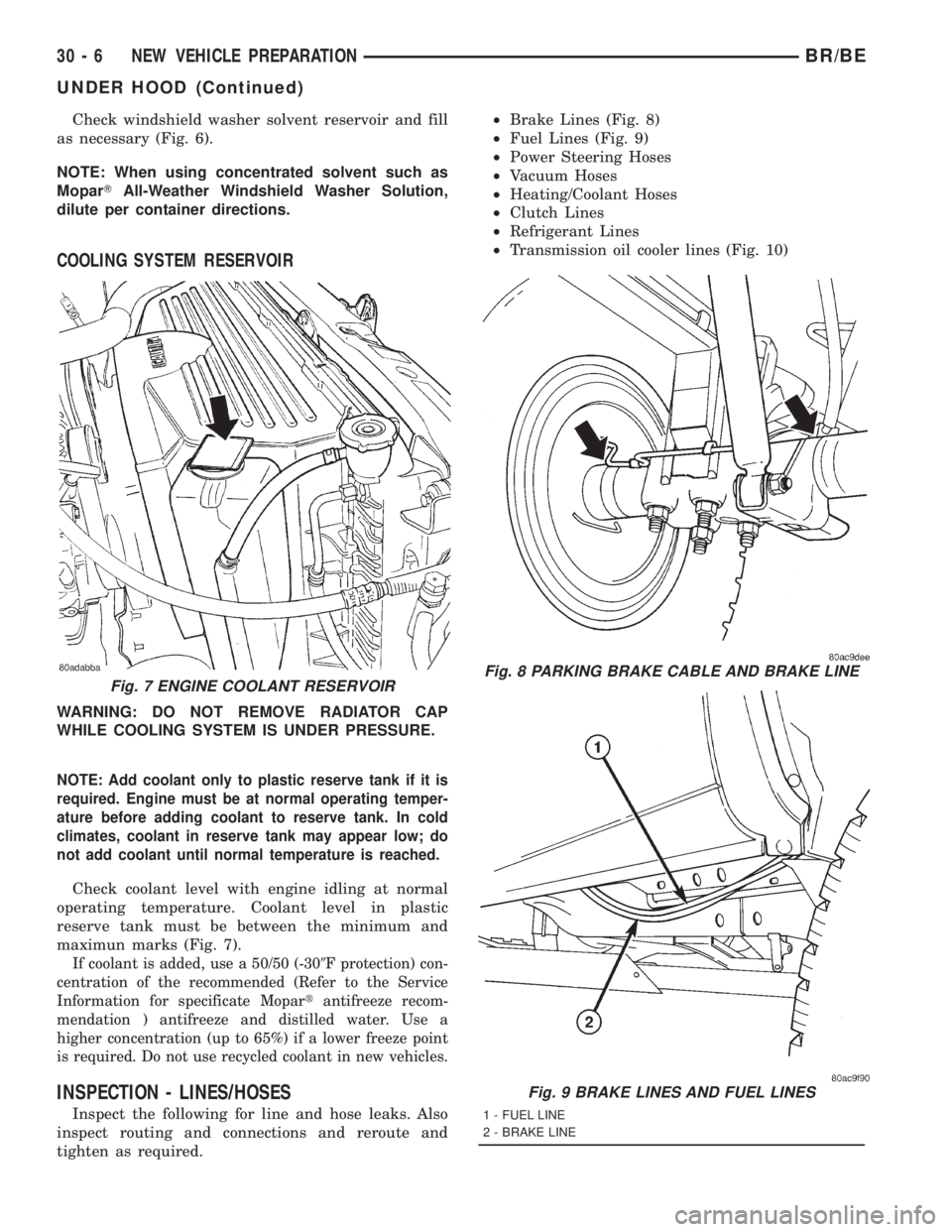
maximun marks (Fig. 7).
If coolant is added, use a 50/50 (-309F protection) con-
centration of the recommended (Refer to the Service
Information for specificate Mopartantifreeze recom-
mendation ) antifreeze and distilled water. Use a
higher concentration (up to 65%) if a lower freeze point
is required. Do not use recycled coolant in new vehicles.
INSPECTION - LINES/HOSES
Inspect the following for line and hose leaks. Also
inspect routing and connections and reroute and
tighten as required.²Brake Lines (Fig. 8)
²Fuel Lines (Fig. 9)
²Power Steering Hoses
²Vacuum Hoses
²Heating/Coolant Hoses
²Clutch Lines
²Refrigerant Lines
²Transmission oil cooler lines (Fig. 10)
Fig. 7 ENGINE COOLANT RESERVOIRFig. 8 PARKING BRAKE CABLE AND BRAKE LINE
Fig. 9 BRAKE LINES AND FUEL LINES
1 - FUEL LINE
2 - BRAKE LINE
30 - 6 NEW VEHICLE PREPARATIONBR/BE
UNDER HOOD (Continued)
Page 2840 of 2889
ROAD TEST
DESCRIPTION - ROAD TEST INSPECTION
The following items must be inspected during the
road test portion of the new vehicle inspection.
²Check neutral safety switch operation
²Check operation of shift/clutch interlock system
²Check operation of gauges and warning lights
²Check horn operation
²Check operation of turn signals and emergency
flashers
²Check all mirror adjustments, including day/
night function
²Check windshield wipers for proper wipe pattern
and intermittent mode (if equipped)
²Check washer spray pattern
²Check heater, defroster and air conditioning for
proper operation
²Check that the fan operates quietly
²Check the rear window defroster (if equipped)
²Leave air selection lever in the fresh air position
²Check the rear heater and air conditioning for
proper operation
²Check the rear air register locations
²Check that the indicator lamps operate properly
²Check the operation of the radio, cassette and/or
compact disc player, and that sound quality is good
²Ensure that the clock displays the correct time
²Check that the trip computer/maintenance
reminder operates in all modes
²Check all speed control functions
²Check the service brakes to ensure that they
stop the vehicle in a straight line, without noise,
shudder or vibration
²Check the brake warning light
²Check the parking brake operation
²Check the engine's performance
²Check the transmission's performance for
smooth, quiet operation. If the vehicle is a 4x4, check
that the transfer case shifts easily among all ranges
²Check Autostick function (if equipped)
²Check the vehicle's steering and handling
²The steering wheel should be centered when
traveling in a straight line
²The vehicle should not pull or vibrate
²Check for squeaks, rattles and wind noise
²Check any other vehicle aspects you believe are
important, but that may not be included on the New
Vehicle Preparation Form
²Fill fuel tank with specified grade of fuel
INSPECTION - FUEL
Fill fuel tank with specified grade of gasoline (reg-
ular, midgrade or premium).
INSPECTION - OTHER
As part of DaimlerChrysler's Customer One philos-
ophy, the ªOtherº blank is provided on the New Vehi-
cle Preparation Form. This is designed to encourage
you to check any aspects of vehicle operation that
you believe are important to your customers, but that
do not appear elsewhere on the form.
INSPECTION - SQUEAKS, RATTLES AND WIND
NOISE
(1) Make sure that the instrument panel, glove
box, seats, steering wheel and column are free from
squeaks and rattles. Tighten any obvious loose fas-
teners.
(2) Check that the windows and doors are free
from squeaks, rattles and wind noise.
(3) Check that the vehicle exterior is free from
squeaks, rattles and noise, front and rear.
(4) Make sure that all interior panels are free from
squeaks and rattles.
INSPECTION - STEERING AND HANDLING
(1) Check that the power assist works properly (if
equipped). Steering should not require excessive
effort.
(2) Make sure the steering wheel does not vibrate
at idle or road speed.
(3) Ensure that the steering wheel is centered
when traveling straight ahead.
(4) Check that the vehicle does not drift to one
side.
(5) Make sure that the vehicle does not vibrate/
shake.
INSPECTION - TRANSMISSION/TRANSFER
CASE
AUTOMATIC TRANSMISSION
(1) Make sure that the park lock holds the vehicle
With the vehicle on a grade, put automatic trans-
mission in PARK and slowly release the service
brake to see if park lock holds. If it does not hold, the
transmission requires further service.
(2) Make sure shift lever operates easily/ smoothly
(Fig. 36).
Check for smooth shifting. Check for proper
upshifting and downshifting.
MANUAL TRANSMISSION
(1) Check that the shifter operates easily (Fig. 38).
(2) Make sure that the clutch operates smoothly
(Fig. 37).
(3) Look for proper synchronization.
The gears should not grind.
BR/BENEW VEHICLE PREPARATION 30 - 15
Page 2842 of 2889
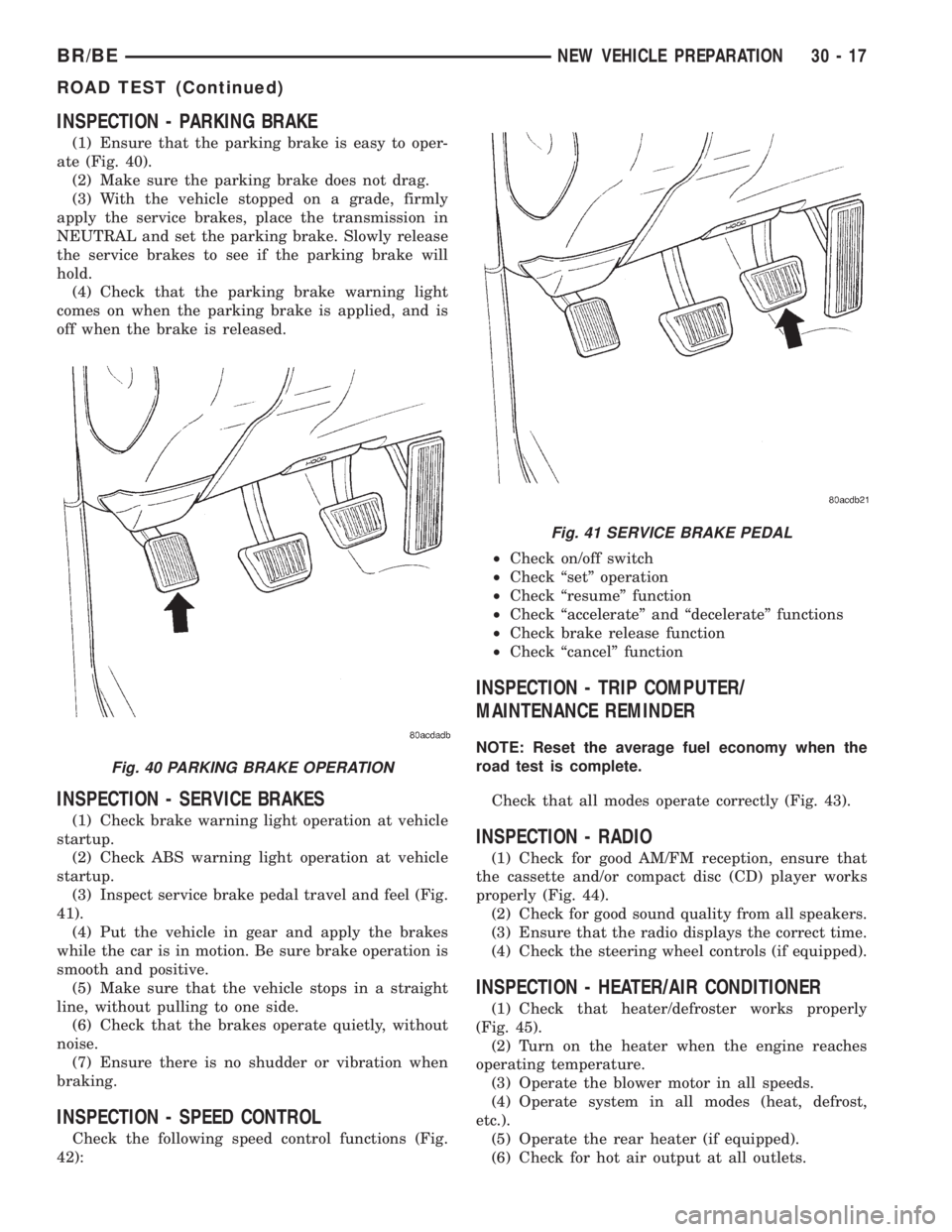
INSPECTION - PARKING BRAKE
(1) Ensure that the parking brake is easy to oper-
ate (Fig. 40).
(2) Make sure the parking brake does not drag.
(3) With the vehicle stopped on a grade, firmly
apply the service brakes, place the transmission in
NEUTRAL and set the parking brake. Slowly release
the service brakes to see if the parking brake will
hold.
(4) Check that the parking brake warning light
comes on when the parking brake is applied, and is
off when the brake is released.
INSPECTION - SERVICE BRAKES
(1) Check brake warning light operation at vehicle
startup.
(2) Check ABS warning light operation at vehicle
startup.
(3) Inspect service brake pedal travel and feel (Fig.
41).
(4) Put the vehicle in gear and apply the brakes
while the car is in motion. Be sure brake operation is
smooth and positive.
(5) Make sure that the vehicle stops in a straight
line, without pulling to one side.
(6) Check that the brakes operate quietly, without
noise.
(7) Ensure there is no shudder or vibration when
braking.
INSPECTION - SPEED CONTROL
Check the following speed control functions (Fig.
42):²Check on/off switch
²Check ªsetº operation
²Check ªresumeº function
²Check ªaccelerateº and ªdecelerateº functions
²Check brake release function
²Check ªcancelº function
INSPECTION - TRIP COMPUTER/
MAINTENANCE REMINDER
NOTE: Reset the average fuel economy when the
road test is complete.
Check that all modes operate correctly (Fig. 43).
INSPECTION - RADIO
(1) Check for good AM/FM reception, ensure that
the cassette and/or compact disc (CD) player works
properly (Fig. 44).
(2) Check for good sound quality from all speakers.
(3) Ensure that the radio displays the correct time.
(4) Check the steering wheel controls (if equipped).
INSPECTION - HEATER/AIR CONDITIONER
(1) Check that heater/defroster works properly
(Fig. 45).
(2) Turn on the heater when the engine reaches
operating temperature.
(3) Operate the blower motor in all speeds.
(4) Operate system in all modes (heat, defrost,
etc.).
(5) Operate the rear heater (if equipped).
(6) Check for hot air output at all outlets.
Fig. 40 PARKING BRAKE OPERATION
Fig. 41 SERVICE BRAKE PEDAL
BR/BENEW VEHICLE PREPARATION 30 - 17
ROAD TEST (Continued)
Page 2844 of 2889
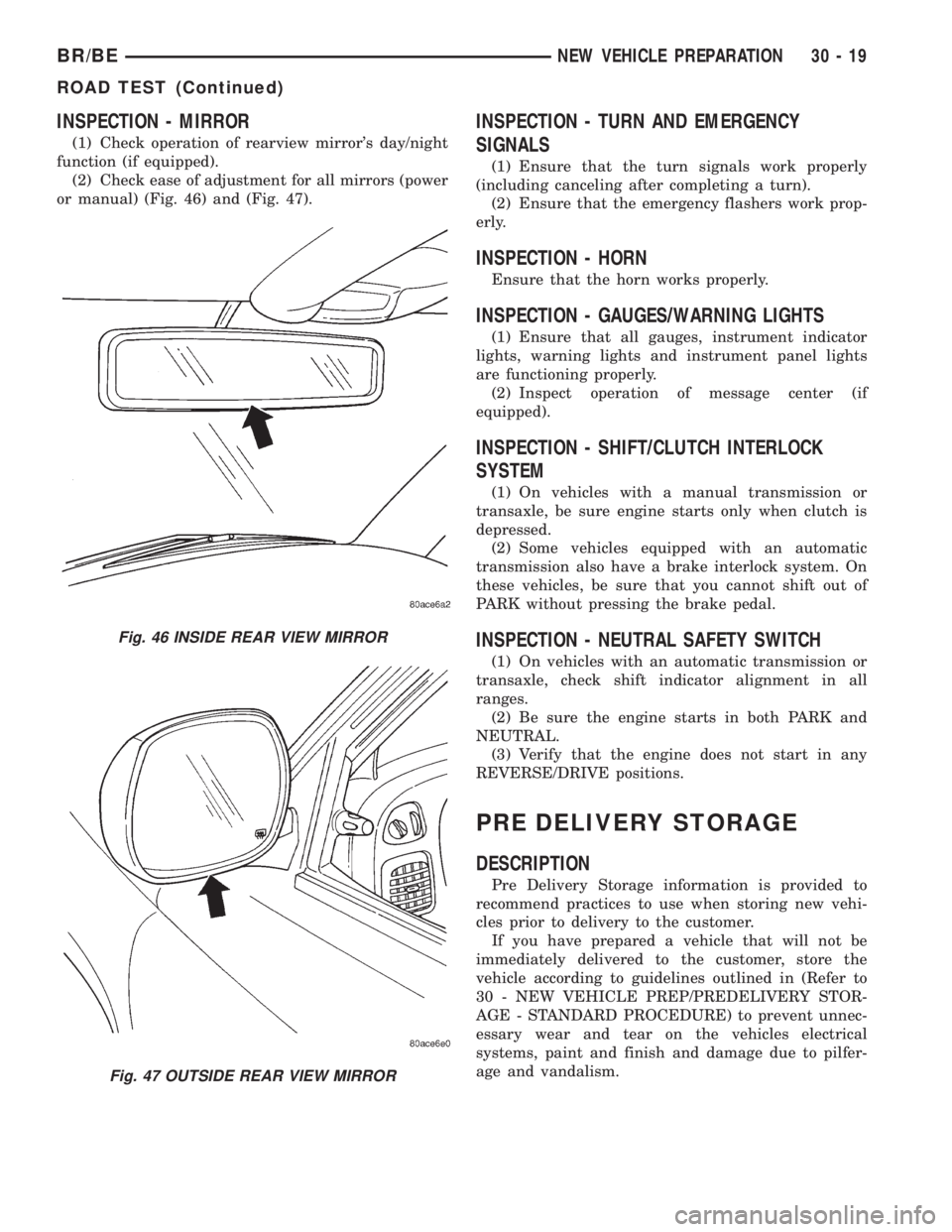
INSPECTION - MIRROR
(1) Check operation of rearview mirror's day/night
function (if equipped).
(2) Check ease of adjustment for all mirrors (power
or manual) (Fig. 46) and (Fig. 47).
INSPECTION - TURN AND EMERGENCY
SIGNALS
(1) Ensure that the turn signals work properly
(including canceling after completing a turn).
(2) Ensure that the emergency flashers work prop-
erly.
INSPECTION - HORN
Ensure that the horn works properly.
INSPECTION - GAUGES/WARNING LIGHTS
(1) Ensure that all gauges, instrument indicator
lights, warning lights and instrument panel lights
are functioning properly.
(2) Inspect operation of message center (if
equipped).
INSPECTION - SHIFT/CLUTCH INTERLOCK
SYSTEM
(1) On vehicles with a manual transmission or
transaxle, be sure engine starts only when clutch is
depressed.
(2) Some vehicles equipped with an automatic
transmission also have a brake interlock system. On
these vehicles, be sure that you cannot shift out of
PARK without pressing the brake pedal.
INSPECTION - NEUTRAL SAFETY SWITCH
(1) On vehicles with an automatic transmission or
transaxle, check shift indicator alignment in all
ranges.
(2) Be sure the engine starts in both PARK and
NEUTRAL.
(3) Verify that the engine does not start in any
REVERSE/DRIVE positions.
PRE DELIVERY STORAGE
DESCRIPTION
Pre Delivery Storage information is provided to
recommend practices to use when storing new vehi-
cles prior to delivery to the customer.
If you have prepared a vehicle that will not be
immediately delivered to the customer, store the
vehicle according to guidelines outlined in (Refer to
30 - NEW VEHICLE PREP/PREDELIVERY STOR-
AGE - STANDARD PROCEDURE) to prevent unnec-
essary wear and tear on the vehicles electrical
systems, paint and finish and damage due to pilfer-
age and vandalism.
Fig. 46 INSIDE REAR VIEW MIRROR
Fig. 47 OUTSIDE REAR VIEW MIRROR
BR/BENEW VEHICLE PREPARATION 30 - 19
ROAD TEST (Continued)
Page 2846 of 2889

Remote Keyless Entry (RKE). The horn chirps when
the vehicle is locked with the RKE transmitter.
HEADLAMP FLASH
NOTE: This feature can be enabled with or without
the horn chirp feature.
The headlamp flash function is a feature that can
be enabled or disabled on vehicles equipped with
Remote Keyless Entry (RKE). The headlamps flash
once when the vehicle is locked with the RKE trans-
mitter, and flash twice when the vehicle is unlocked
with the RKE transmitter.
LOW FUEL CHIME
All vehicles equipped with the audible low fuel
chime are shipped with this feature enabled.
REMOTE KEYLESS ENTRY (RKE) DOOR UNLOCK
SEQUENCE
Two door unlock sequences are provided on vehi-
cles equipped with this feature. When using the RKE
transmitter to unlock the doors, pressing the unlock
button once when the feature is enabled unlocks only
the driver's door. Pushing the RKE transmitter
unlock button a second time unlocks the remaining
doors. When the RKE door unlock feature is disabled,
all doors unlock with one press of the RKE transmit-
ter unlock button.
HEADLIGHTS ON AUTOMATICALLY WITH WIPERS
This feature appears on vehicles that have, as an
option, automatic headlights. When the windshield
wipers are turned on, the headlights automatically
turn on.
12V POWER OUTLET
This feature currently appears on Caravan/Voyag-
er/Town and Country vehicles. The vehicles are
shipped with the 12V power outlets turned off with
the ignition key. The relay can be changed to make
the outlets powered at all times. This feature may be
of interest to customers with cell phones.
TURN SIGNAL CHIME
This feature is an audible turn signal warning
chime. The chime sounds if the turn signal is on, the
vehicle has traveled one mile and vehicle speed has
exceeded 40 Km/h (25 mph).
REMOTE UNLOCK
The remote unlock function is a feature that can be
enabled or disabled on vehicles equipped with
Remote Keyless Entry (RKE). With the first press of
the RKE transmitter to unlock the doors, the driver's
door only unlocks. With the second press of the RKEtransmitter, the remaining doors and the liftgate
unlock. With the remote unlock feature enabled, the
first press of the RKE transmitter unlocks all doors.
REMOTE LINKED TO MEMORY
The remote linked to memory function is currently
only available only on Jeep Grand Cherokee Limited
vehicles. When enabled, this feature recalls a mem-
ory of seats, mirror and radio presets and positions
when unlocking the vehicle with the RKE transmit-
ter.
HEADLAMP DELAY
Currently available only on Jeep Grand Cherokee
vehicles, the headlamp delay timeout can be set to
30, 60 or 90 seconds. This timeout only occurs when
the ignition is turned off prior to turning the head-
lamps off, or when leaving the headlamps in AUTO
mode.
SERVICE INTERVAL
Currently available only on Jeep Grand Cherokee
vehicles, the interval for the service reminder mes-
sage can be set from 3,219 kilometers to 12,070 kilo-
meters (2,000 miles to 7,500 miles).
EASY EXIT SEAT
Currently available only on Jeep Grand Cherokee
Limited vehicles, the driver's seat will reposition
55mm (2.1 inches) rearward, or the end of travel if
less than 55mm (2.1 inches) and full downward when
the key is removed from the ignition. This feature
allows ease of exiting the vehicle. The seat will repo-
sition itself to the memory location when the vehicle
is unlocked using the RKE transmitter or by pressing
the memory buttons on the door panel.
APPEARANCE TIPS
CLEANING
(1) Before delivering the new vehicle to the cus-
tomer, the following checks on appearance details are
recommended:
²Wash the vehicle to remove all traces of road
grime and other dirt on the car from new vehicle
preparation operations
²Clean the tire sidewalls
²Clean exterior and interior glass surfaces
²Remove all protective covers
²Remove undercoat overspray, excess window
sealer, and excess weatherstrip adhesive
²Inspect interior trim, seats, carpeting, and mold-
ings. Clean as necessary
²Remove shipping and inspection stickers
BR/BENEW VEHICLE PREPARATION 30 - 21
PROGRAMMABLE ELECTRONIC FEATURES (Continued)
Page 2851 of 2889
BEARING FITTING, CONNECTING ROD
BEARINGS - STANDARD PROCEDURE-
CONNECTING ROD....................9-31
BEARINGS - DESCRIPTION,
CRANKSHAFT MAIN..........9-146,9-32,9-90
BEARINGS - INSTALLATION, AXLE . . 3-125,3-156,
3-185,3-95
BEARINGS - INSTALLATION, CAMSHAFT . . 9-144,
9-201,9-273,9-29,9-87
BEARINGS - INSTALLATION,
CRANKSHAFT MAIN.....9-147,9-204,9-34,9-90
BEARINGS - INSTALLATION,
DIFFERENTIAL CASE . . 3-103,3-134,3-164,3-192,
3-39,3-71
BEARINGS - OPERATION, CRANKSHAFT
MAIN......................9-146,9-32,9-90
BEARINGS - REMOVAL, AXLE.....3-125,3-156,
3-185,3-94
BEARINGS - REMOVAL, CAMSHAFT.....9-143,
9-200,9-268,9-29,9-86
BEARINGS - REMOVAL, CRANKSHAFT
MAIN.................9-147,9-204,9-33,9-90
BEARINGS - REMOVAL, DIFFERENTIAL
CASE.......3-103,3-134,3-164,3-192,3-39,3-71
BEARINGS - STANDARD PROCEDURE-
CONNECTING ROD BEARING FITTING,
CONNECTING ROD....................9-31
BEARINGS (IN BLOCK) - INSPECTION,
CAMSHAFT.........................9-272
BED GROUND STRAP - INSTALLATION,
CAB-TO............................8A-14
BED GROUND STRAP - REMOVAL,
CAB-TO............................8A-14
BELT / CHAIN COVER(S) -
INSTALLATION, TIMING. . . 9-113,9-169,9-226,9-56
BELT / CHAIN COVER(S) - REMOVAL,
TIMING..............9-113,9-169,9-225,9-56
BELT - DIAGNOSIS AND TESTING,
ACCESSORY DRIVE............7-24,7-27,7-31
BELT & RETRACTOR - INSTALLATION,
REAR SEAT.........................8O-26
BELT & RETRACTOR - REMOVAL, REAR
SEAT ..............................8O-26
BELT BUCKLE - INSTALLATION, FRONT
SEAT ..............................8O-20
BELT BUCKLE - INSTALLATION, REAR
SEAT ..............................8O-27
BELT BUCKLE - REMOVAL, FRONT SEAT . . 8O-20
BELT BUCKLE - REMOVAL, REAR SEAT . . . 8O-27
BELT SWITCH - DESCRIPTION, SEAT.....8O-28
BELT SWITCH - DIAGNOSIS AND
TESTING, SEAT......................8O-28
BELT SWITCH - OPERATION, SEAT.......8O-28
BELT TENSIONERS - 3.9L/5.2L/5.9L -
DESCRIPTION........................7-19
BELT TENSIONERS - 3.9L/5.2L/5.9L -
INSTALLATION........................7-20
BELT TENSIONERS - 3.9L/5.2L/5.9L -
OPERATION..........................7-19
BELT TENSIONERS - 3.9L/5.2L/5.9L -
REMOVAL...........................7-20
BELT TENSIONERS - 5.9L DIESEL -
DESCRIPTION........................7-23
BELT TENSIONERS - 5.9L DIESEL -
INSTALLATION
........................7-23
BELT TENSIONERS - 5.9L DIESEL -
OPERATION
..........................7-23
BELT TENSIONERS - 5.9L DIESEL -
REMOVAL
...........................7-23
BELT TENSIONERS - 8.0L -
DESCRIPTION
........................7-20
BELT TENSIONERS - 8.0L -
INSTALLATION
........................7-22
BELT TENSIONERS - 8.0L - OPERATION
....7-20
BELT TENSIONERS - 8.0L - REMOVAL
.....7-21
BELT TURNING LOOP ADJUSTER -
INSTALLATION, SEAT
.................8O-29
BELT TURNING LOOP ADJUSTER -
REMOVAL, SEAT
.....................8O-29
BELT WEATHERSTRIP - INSTALLATION,
FRONT DOOR INNER
.................23-154
BELT WEATHERSTRIP - INSTALLATION,
FRONT DOOR OUTER
................23-154
BELT WEATHERSTRIP - REMOVAL,
FRONT DOOR INNER
.................23-154
BELT WEATHERSTRIP - REMOVAL,
FRONT DOOR OUTER
................23-154BELT/CHAIN AND SPROCKETS -
INSTALLATION, TIMING . 9-115,9-170,9-227,9-58
BELT/CHAIN AND SPROCKETS -
REMOVAL, TIMING.....9-114,9-170,9-226,9-57
BELT/CHAIN TENSIONER - DESCRIPTION,
TIMING.............................9-57
BELT/CHAIN TENSIONER - OPERATION,
TIMING.............................9-57
BELTS - 3.9L/5.2L/5.9L - INSTALLATION,
DRIVE..............................7-27
BELTS - 3.9L/5.2L/5.9L - REMOVAL,
DRIVE..............................7-26
BELTS - 5.9L DIESEL - INSTALLATION,
DRIVE..............................7-34
BELTS - 5.9L DIESEL - REMOVAL, DRIVE . . 7-33
BELTS - 8.0L - INSTALLATION, DRIVE.....7-30
BELTS - 8.0L - REMOVAL, DRIVE.........7-30
BELTS, RETRACTORS AND HEAD
RESTRAINTS - INSPECTION, SEAT
BELTS, SHOULDER...................30-12
BELTS, SHOULDER BELTS, RETRACTORS
AND HEAD RESTRAINTS -
INSPECTION, SEAT...................30-12
BENCH - INSTALLATION, SEAT - SPLIT . . 23-134
BENCH - INSTALLATION, SEAT BACK -
SPLIT.............................23-136
BENCH - INSTALLATION, SEAT BACK
COVER - SPLIT.....................23-138
BENCH - INSTALLATION, SEAT CUSHION
COVER - SPLIT.....................23-140
BENCH - INSTALLATION, SEAT TRACK -
SPLIT.............................23-142
BENCH - REMOVAL, SEAT - SPLIT........23-134
BENCH - REMOVAL, SEAT BACK - SPLIT . 23-135
BENCH - REMOVAL, SEAT BACK COVER
- SPLIT...........................23-137
BENCH - REMOVAL, SEAT CUSHION
COVER - SPLIT.....................23-139
BENCH - REMOVAL, SEAT TRACK -
SPLIT.............................23-142
BENCH SEAT - INSTALLATION, SEAT....23-133
BENCH SEAT - INSTALLATION, SEAT
BACK.............................23-135
BENCH SEAT - REMOVAL, SEAT........23-133
BENCH SEAT - REMOVAL, SEAT BACK . . . 23-135
BETTS - INSTALLATION, CONNECTOR -
THOMAS........................8W-01-10
BETTS - REMOVAL, CONNECTOR -
THOMAS.........................8W-01-9
BEZEL - INSTALLATION, CLUSTER......23-110
BEZEL - REMOVAL, CLUSTER..........23-109
BIN - INSTALLATION, CUBBY..........23-110
BIN - INSTALLATION, STORAGE........23-116
BIN - REMOVAL, CUBBY..............23-110
BIN - REMOVAL, STORAGE............23-116
BLADE - DESCRIPTION, WIPER.........8R-12
BLADE - INSTALLATION, WIPER.........8R-13
BLADE - OPERATION, WIPER...........8R-13
BLADE - REMOVAL, WIPER............8R-13
BLEED - STANDARD PROCEDURE, AIR....14-57
BLEEDING - STANDARD PROCEDURE......5-19
BLEEDING - STANDARD PROCEDURE,
MANUAL.............................5-7
BLEEDING - STANDARD PROCEDURE,
MASTER CYLINDER...................5-30
BLEEDING - STANDARD PROCEDURE,
PRESSURE...........................5-8
BLEND DOOR - INSTALLATION
..........24-38
BLEND DOOR - REMOVAL
.............24-38
BLEND DOOR ACTUATOR -
INSTALLATION
.......................24-26
BLEND DOOR ACTUATOR - REMOVAL
....24-25
BLOCK - CLEANING, ENGINE
. . 9-142,9-200,9-28,
9-86
BLOCK - DESCRIPTION, BLOWER
MOTOR RESISTOR
...................24-23
BLOCK - DESCRIPTION, JUNCTION
....8W-97-6
BLOCK - DIAGNOSIS AND TESTING,
BLOWER MOTOR RESISTOR
............24-24
BLOCK - INSPECTION, ENGINE
....9-142,9-200,
9-267,9-28,9-86
BLOCK - INSTALLATION, BLOWER
MOTOR RESISTOR
...................24-24
BLOCK - INSTALLATION, JUNCTION
....8W-97-7
BLOCK - OPERATION, BLOWER MOTOR
RESISTOR
..........................24-23
BLOCK - OPERATION, JUNCTION
......8W-97-6BLOCK - REMOVAL, BLOWER MOTOR
RESISTOR..........................24-24
BLOCK - REMOVAL, JUNCTION.......8W-97-6
BLOCK - STANDARD PROCEDURE-
CYLINDER BLOCK REFACING, ENGINE....9-263
BLOCK HEATER - 3.9L/5.2L/5.9L -
DESCRIPTION, ENGINE.................7-45
BLOCK HEATER - 3.9L/5.2L/5.9L -
INSTALLATION, ENGINE................7-45
BLOCK HEATER - 3.9L/5.2L/5.9L -
OPERATION, ENGINE...................7-45
BLOCK HEATER - 3.9L/5.2L/5.9L -
REMOVAL, ENGINE....................7-45
BLOCK HEATER - 5.9L DIESEL -
DESCRIPTION, ENGINE.................7-47
BLOCK HEATER - 5.9L DIESEL -
INSTALLATION, ENGINE................7-47
BLOCK HEATER - 5.9L DIESEL -
OPERATION, ENGINE...................7-47
BLOCK HEATER - 5.9L DIESEL -
REMOVAL, ENGINE....................7-47
BLOCK HEATER - 8.0L - DESCRIPTION,
ENGINE.............................7-46
BLOCK HEATER - 8.0L - INSTALLATION,
ENGINE.............................7-46
BLOCK HEATER - 8.0L - OPERATION,
ENGINE.............................7-46
BLOCK HEATER - 8.0L - REMOVAL,
ENGINE.............................7-46
BLOCK REFACING, ENGINE BLOCK -
STANDARD PROCEDURE-CYLINDER......9-263
BLOWER MOTOR - DESCRIPTION.......24-32
BLOWER MOTOR - DIAGNOSIS AND
TESTING...........................24-33
BLOWER MOTOR - INSTALLATION.......24-33
BLOWER MOTOR - OPERATION.........24-32
BLOWER MOTOR - REMOVAL...........24-33
BLOWER MOTOR RELAY - DESCRIPTION . . 24-22
BLOWER MOTOR RELAY - DIAGNOSIS
AND TESTING.......................24-22
BLOWER MOTOR RELAY -
INSTALLATION.......................24-23
BLOWER MOTOR RELAY - OPERATION . . . 24-22
BLOWER MOTOR RELAY - REMOVAL.....24-23
BLOWER MOTOR RESISTOR BLOCK -
DESCRIPTION.......................24-23
BLOWER MOTOR RESISTOR BLOCK -
DIAGNOSIS AND TESTING.............24-24
BLOWER MOTOR RESISTOR BLOCK -
INSTALLATION.......................24-24
BLOWER MOTOR RESISTOR BLOCK -
OPERATION.........................24-23
BLOWER MOTOR RESISTOR BLOCK -
REMOVAL..........................24-24
BLOWER MOTOR SWITCH -
DESCRIPTION.......................24-24
BLOWER MOTOR SWITCH - DIAGNOSIS
AND TESTING.......................24-25
BLOWER MOTOR SWITCH - OPERATION . . 24-25
BLOWER MOTOR SWITCH - REMOVAL . . . 24-25
BODY - ADJUSTMENTS, VALVE . . 21-304,21-476,
21-646,21-818
BODY - ASSEMBLY, VALVE......21-294,21-466,
21-638,21-810
BODY & CABLE - DESCRIPTION,
ANTENNA...........................8A-4
BODY & CABLE - OPERATION, ANTENNA . . . 8A-4
BODY - CLEANING, VALVE......21-293,21-465,
21-637,21-808
BODY - DESCRIPTION, THROTTLE.......14-48
BODY - DESCRIPTION, VALVE . . . 21-263,21-433,
21-607,21-780
BODY - DISASSEMBLY, VALVE . . . 21-282,21-453,
21-626,21-799
BODY - INSPECTION, VALVE....21-293,21-465,
21-637,21-809
BODY - INSTALLATION, VALVE . . . 21-303,21-475,
21-645,21-818
BODY - OPERATION, THROTTLE.........14-48
BODY - OPERATION, VALVE
.....21-267,21-438,
21-611,21-783
BODY - REMOVAL, VALVE
......21-281,21-452,
21-625,21-798
BODY - SAFETY PRECAUTIONS AND
WARNINGS
..........................23-1
BODY CODE PLATE - DESCRIPTION
.....Intro.-1
BODY CONTROL/CENTRAL TIMER
MODULE - DESCRIPTION
...............8E-1
4 INDEXBR/BE
Description Group-Page Description Group-Page Description Group-Page