2001 DODGE RAM ECU
[x] Cancel search: ECUPage 1561 of 2889
the fuel injection pump and the fuel injectors. Also
refer to High-Pressure Fuel Lines Description/Opera-
tion.
DESCRIPTIONÐHIGH PRESSURE FUEL LINES
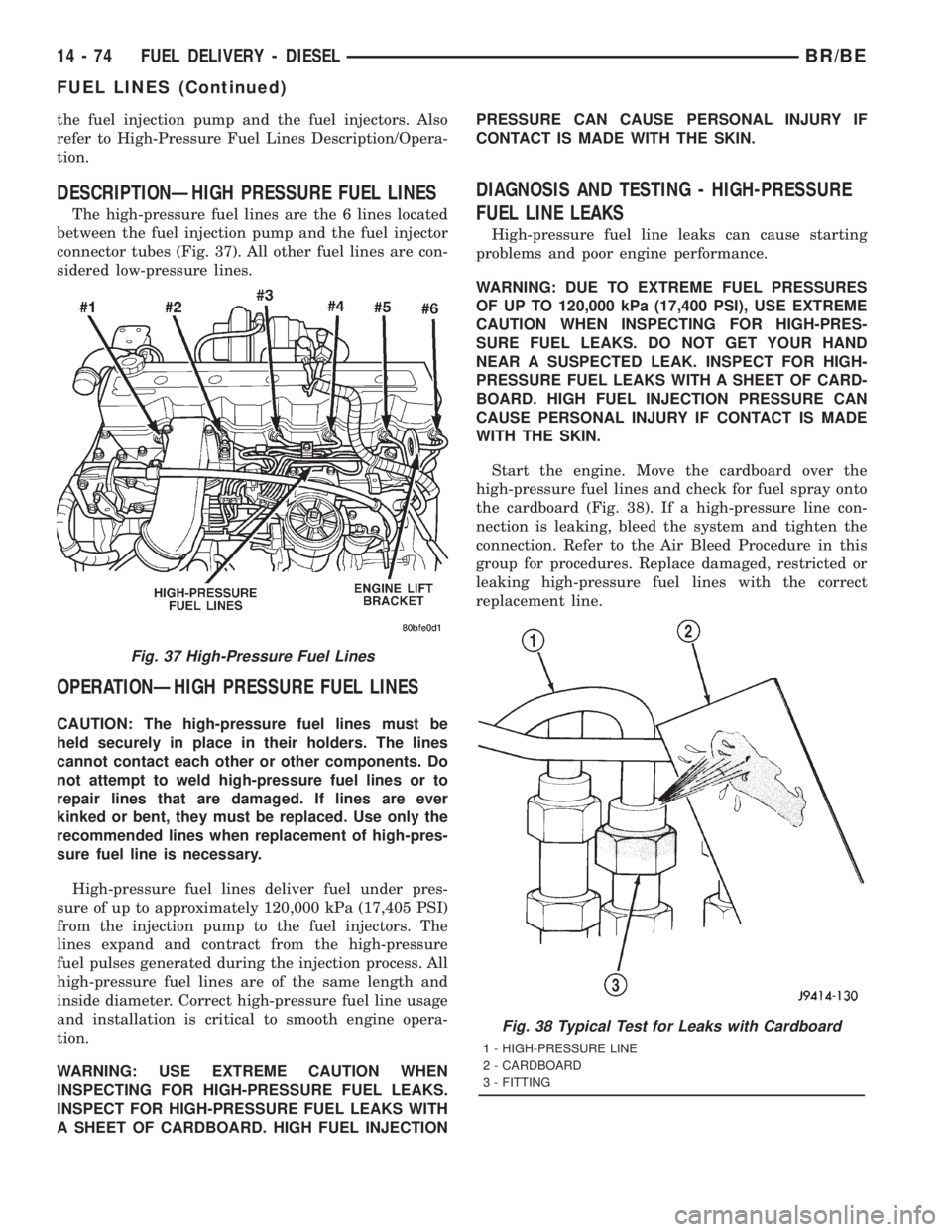
The high-pressure fuel lines are the 6 lines located
between the fuel injection pump and the fuel injector
connector tubes (Fig. 37). All other fuel lines are con-
sidered low-pressure lines.
OPERATIONÐHIGH PRESSURE FUEL LINES
CAUTION: The high-pressure fuel lines must be
held securely in place in their holders. The lines
cannot contact each other or other components. Do
not attempt to weld high-pressure fuel lines or to
repair lines that are damaged. If lines are ever
kinked or bent, they must be replaced. Use only the
recommended lines when replacement of high-pres-
sure fuel line is necessary.
High-pressure fuel lines deliver fuel under pres-
sure of up to approximately 120,000 kPa (17,405 PSI)
from the injection pump to the fuel injectors. The
lines expand and contract from the high-pressure
fuel pulses generated during the injection process. All
high-pressure fuel lines are of the same length and
inside diameter. Correct high-pressure fuel line usage
and installation is critical to smooth engine opera-
tion.
WARNING: USE EXTREME CAUTION WHEN
INSPECTING FOR HIGH-PRESSURE FUEL LEAKS.
INSPECT FOR HIGH-PRESSURE FUEL LEAKS WITH
A SHEET OF CARDBOARD. HIGH FUEL INJECTIONPRESSURE CAN CAUSE PERSONAL INJURY IF
CONTACT IS MADE WITH THE SKIN.
DIAGNOSIS AND TESTING - HIGH-PRESSURE
FUEL LINE LEAKS
High-pressure fuel line leaks can cause starting
problems and poor engine performance.
WARNING: DUE TO EXTREME FUEL PRESSURES
OF UP TO 120,000 kPa (17,400 PSI), USE EXTREME
CAUTION WHEN INSPECTING FOR HIGH-PRES-
SURE FUEL LEAKS. DO NOT GET YOUR HAND
NEAR A SUSPECTED LEAK. INSPECT FOR HIGH-
PRESSURE FUEL LEAKS WITH A SHEET OF CARD-
BOARD. HIGH FUEL INJECTION PRESSURE CAN
CAUSE PERSONAL INJURY IF CONTACT IS MADE
WITH THE SKIN.
Start the engine. Move the cardboard over the
high-pressure fuel lines and check for fuel spray onto
the cardboard (Fig. 38). If a high-pressure line con-
nection is leaking, bleed the system and tighten the
connection. Refer to the Air Bleed Procedure in this
group for procedures. Replace damaged, restricted or
leaking high-pressure fuel lines with the correct
replacement line.
Fig. 37 High-Pressure Fuel Lines
Fig. 38 Typical Test for Leaks with Cardboard
1 - HIGH-PRESSURE LINE
2 - CARDBOARD
3 - FITTING
14 - 74 FUEL DELIVERY - DIESELBR/BE
FUEL LINES (Continued)
Page 1562 of 2889
CAUTION: The high-pressure fuel lines must be
clamped securely in place in the holders. The lines
cannot contact each other or other components. Do
not attempt to weld high-pressure fuel lines or to
repair lines that are damaged. Only use the recom-
mended lines when replacement of high-pressure
fuel line is necessary.
REMOVAL
High-pressure lines are used between the fuel
injection pump and the fuel injectors only. All high-
pressure fuel lines are of the same length and inside
diameter. Correct high-pressure fuel line usage and
installation is critical to smooth engine operation.
CAUTION: Refer to Cleaning Fuel System Parts.
(1) Disconnect both negative battery cables from
both batteries. Cover and isolate ends of cables.
(2) Thoroughly clean fuel lines at cylinder head
and injection pump ends.
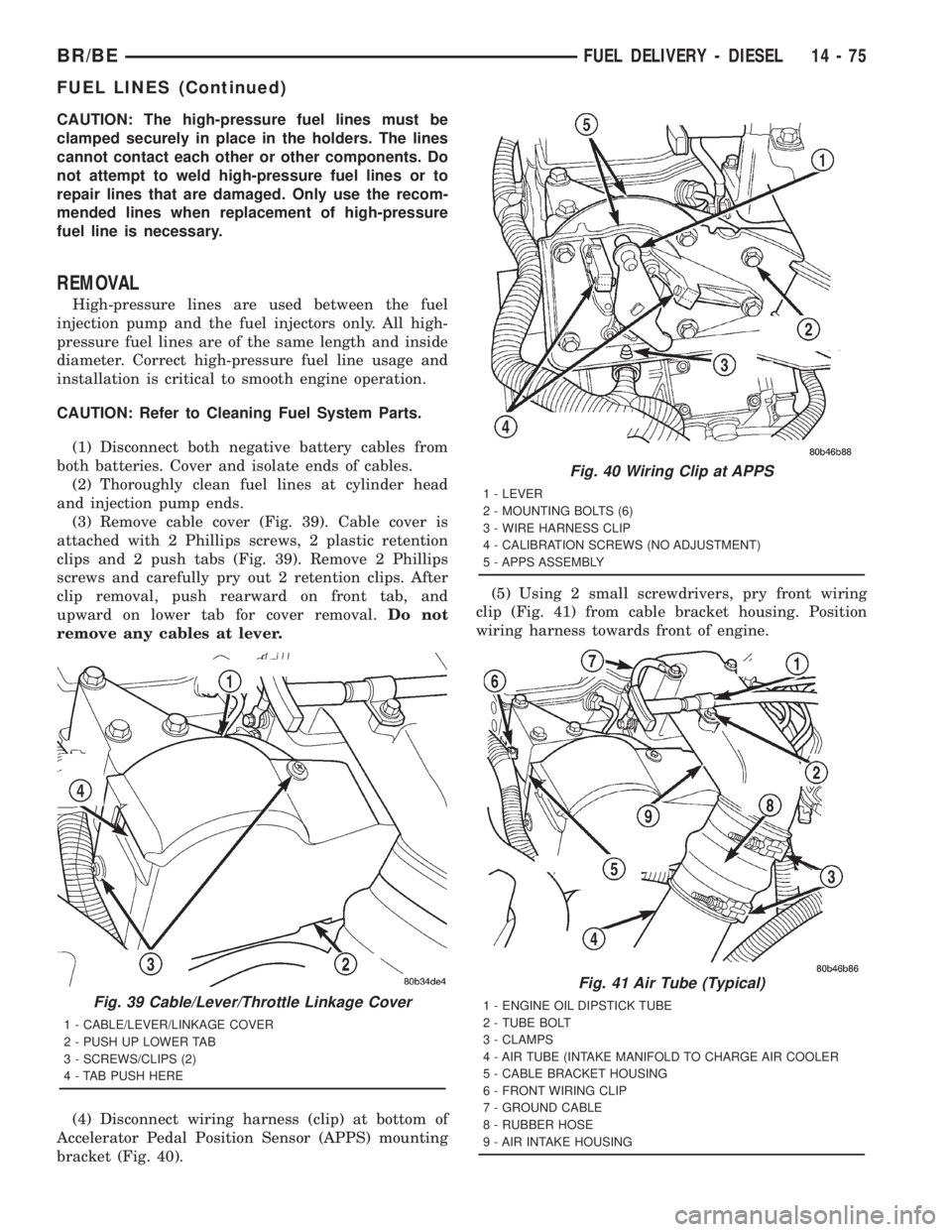
(3) Remove cable cover (Fig. 39). Cable cover is
attached with 2 Phillips screws, 2 plastic retention
clips and 2 push tabs (Fig. 39). Remove 2 Phillips
screws and carefully pry out 2 retention clips. After
clip removal, push rearward on front tab, and
upward on lower tab for cover removal.Do not
remove any cables at lever.
(4) Disconnect wiring harness (clip) at bottom of
Accelerator Pedal Position Sensor (APPS) mounting
bracket (Fig. 40).(5) Using 2 small screwdrivers, pry front wiring
clip (Fig. 41) from cable bracket housing. Position
wiring harness towards front of engine.
Fig. 39 Cable/Lever/Throttle Linkage Cover
1 - CABLE/LEVER/LINKAGE COVER
2 - PUSH UP LOWER TAB
3 - SCREWS/CLIPS (2)
4 - TAB PUSH HERE
Fig. 40 Wiring Clip at APPS
1 - LEVER
2 - MOUNTING BOLTS (6)
3 - WIRE HARNESS CLIP
4 - CALIBRATION SCREWS (NO ADJUSTMENT)
5 - APPS ASSEMBLY
Fig. 41 Air Tube (Typical)
1 - ENGINE OIL DIPSTICK TUBE
2 - TUBE BOLT
3 - CLAMPS
4 - AIR TUBE (INTAKE MANIFOLD TO CHARGE AIR COOLER
5 - CABLE BRACKET HOUSING
6 - FRONT WIRING CLIP
7 - GROUND CABLE
8 - RUBBER HOSE
9 - AIR INTAKE HOUSING
BR/BEFUEL DELIVERY - DIESEL 14 - 75
FUEL LINES (Continued)
Page 1580 of 2889
(1) Disconnect both negative battery cables at both
batteries.
(2) Remove cable cover (Fig. 6). Cable cover is
attached with 2 Phillips screws, 2 plastic retention
clips and 2 push tabs (Fig. 6). Remove 2 Phillips
screws and carefully pry out 2 retention clips. After
clip removal, push rearward on front tab, and
upward on lower tab for cover removal.
(3) Using finger pressure only, disconnect end of
speed control servo cable from throttle lever pin by
pulling forward on connector while holding lever
rearward (Fig. 7).DO NOT try to pull connector
off perpendicular to lever pin. Connector will
be broken.
(4) Using two small screwdrivers, pry throttle
cable connector socket from throttle lever ball (Fig.
7).Be very careful not to bend throttle lever
arm.
(5) Disconnect transmission control cable at lever
arm (if equipped). Refer to 21, Transmission.
(6) Squeeze pinch tabs on speed control cable (Fig.
7) and pull cable rearward to remove from cable
mounting bracket.
(7) Squeeze pinch tabs on throttle cable (Fig. 7)
and pull cable rearward to remove from cable mount-
ing bracket.
(8) If equipped with an automatic transmission,
refer to 21, Transmission for transmission control
cable removal procedures.
(9) Disconnect wiring harness clip (Fig. 8) at bot-
tom of bracket.
(10) Remove 6 mounting bolts (Fig. 8) and par-
tially remove APPS assembly from engine. After
assembly is partially removed, disconnect electrical
connector from bottom of sensor by pushing on con-
nector tab (Fig. 9).
(11) Remove APPS assembly from engine.
INSTALLATION
The APPS is serviced (replaced) as one assembly
including the lever, brackets and sensor. The APPS is
calibrated to its mounting bracket. The APPS assem-
bly is located at left-front of engine below plastic
cable/lever/linkage cover (Fig. 6).
(1) Snap electrical connector into bottom of sensor.
(2) Position APPS assembly to engine and install 6
bolts. Tighten bolts to 12 N´m (105 in. lbs.) torque.
(3) Connect wiring harness clip (Fig. 8) at bottom
of bracket.
(4) If equipped with an automatic transmission,
refer to Group 21, Transmission for transmission con-
trol cable installation procedures.
(5) Install speed control cable into mounting
bracket. Be sure pinch tabs (Fig. 7) have secured
cable.(6) Install throttle cable into mounting bracket. Be
sure pinch tabs (Fig. 7) have secured cable.
(7) Connect throttle cable at lever (snaps on).
(8) Connect speed control cable to lever by pushing
cable connector rearward onto lever pin while hold-
ing lever forward.
(9) Install cable cover.
(10) Connect both negative battery cables to both
batteries.
(11)ECM Calibration:Turn key to ON position.
Without starting engine, slowly press throttle pedal
to floor and then slowly release. This step must be
done (one time) to ensure accelerator pedal position
sensor calibration has been learned by ECM. If not
done, possible DTC's may be set.
(12) Use DRB scan tool to erase any DTC's from
ECM/PCM.
FUEL INJECTOR
DESCRIPTION
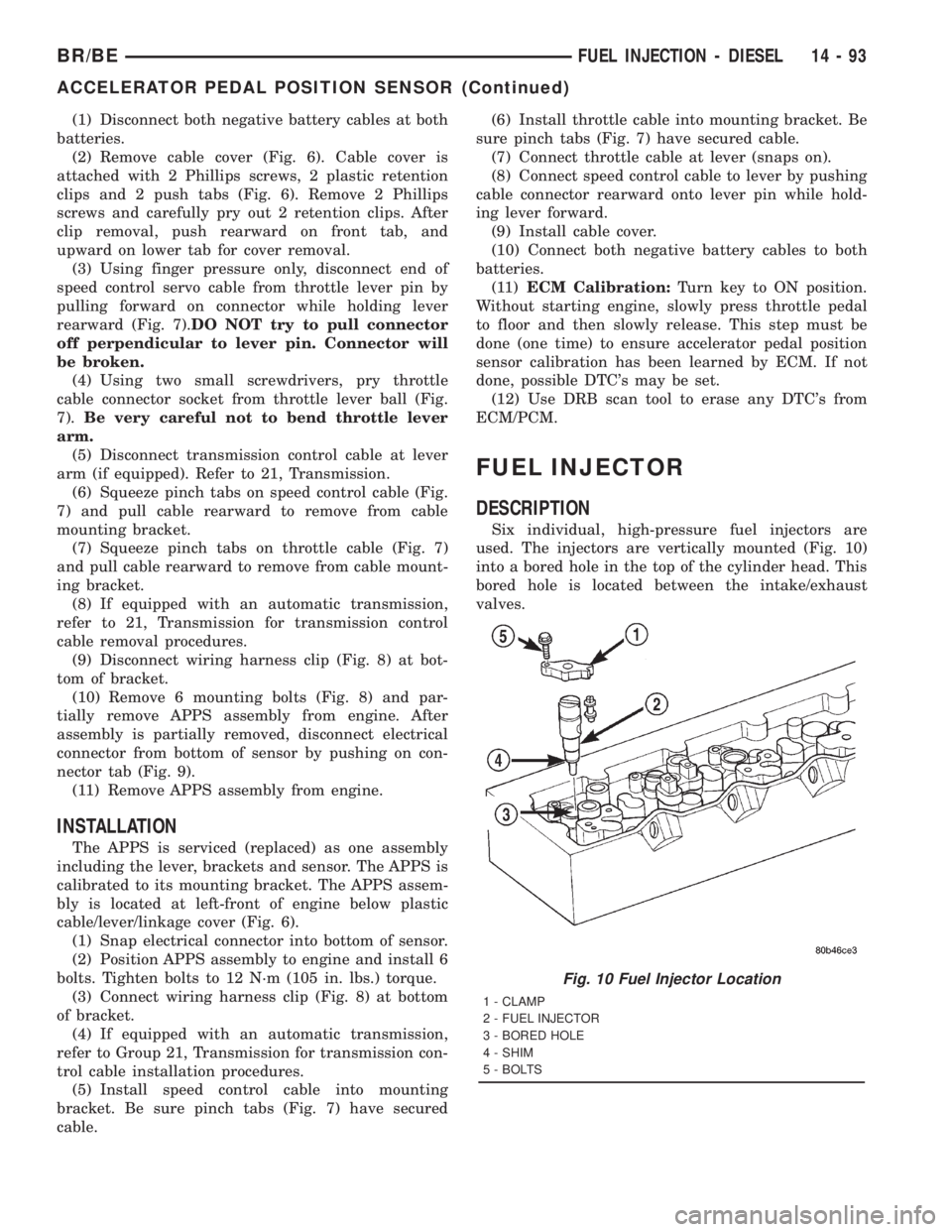
Six individual, high-pressure fuel injectors are
used. The injectors are vertically mounted (Fig. 10)
into a bored hole in the top of the cylinder head. This
bored hole is located between the intake/exhaust
valves.
Fig. 10 Fuel Injector Location
1 - CLAMP
2 - FUEL INJECTOR
3 - BORED HOLE
4 - SHIM
5 - BOLTS
BR/BEFUEL INJECTION - DIESEL 14 - 93
ACCELERATOR PEDAL POSITION SENSOR (Continued)
Page 1592 of 2889
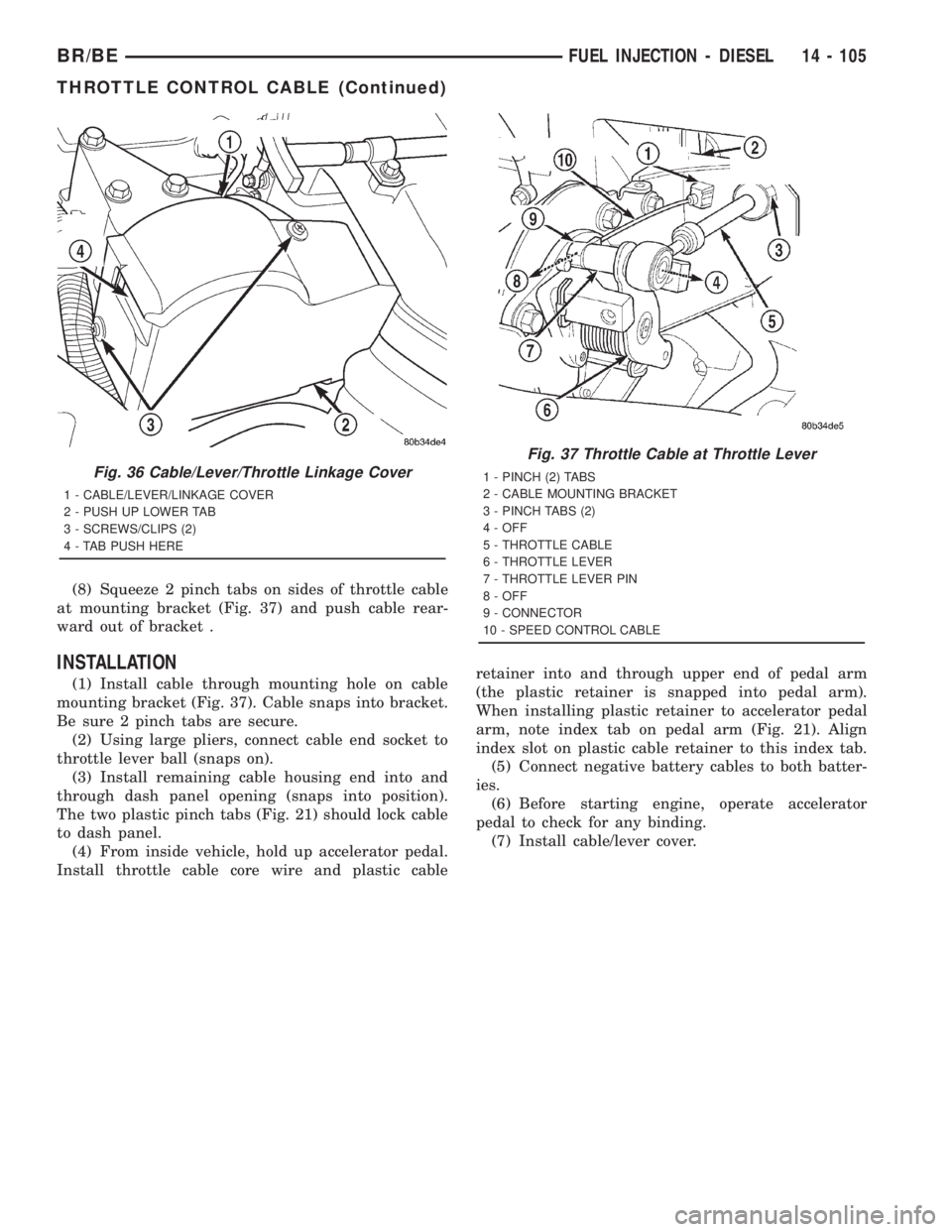
(8) Squeeze 2 pinch tabs on sides of throttle cable
at mounting bracket (Fig. 37) and push cable rear-
ward out of bracket .
INSTALLATION
(1) Install cable through mounting hole on cable
mounting bracket (Fig. 37). Cable snaps into bracket.
Be sure 2 pinch tabs are secure.
(2) Using large pliers, connect cable end socket to
throttle lever ball (snaps on).
(3) Install remaining cable housing end into and
through dash panel opening (snaps into position).
The two plastic pinch tabs (Fig. 21) should lock cable
to dash panel.
(4) From inside vehicle, hold up accelerator pedal.
Install throttle cable core wire and plastic cableretainer into and through upper end of pedal arm
(the plastic retainer is snapped into pedal arm).
When installing plastic retainer to accelerator pedal
arm, note index tab on pedal arm (Fig. 21). Align
index slot on plastic cable retainer to this index tab.
(5) Connect negative battery cables to both batter-
ies.
(6) Before starting engine, operate accelerator
pedal to check for any binding.
(7) Install cable/lever cover.
Fig. 36 Cable/Lever/Throttle Linkage Cover
1 - CABLE/LEVER/LINKAGE COVER
2 - PUSH UP LOWER TAB
3 - SCREWS/CLIPS (2)
4 - TAB PUSH HERE
Fig. 37 Throttle Cable at Throttle Lever
1 - PINCH (2) TABS
2 - CABLE MOUNTING BRACKET
3 - PINCH TABS (2)
4 - OFF
5 - THROTTLE CABLE
6 - THROTTLE LEVER
7 - THROTTLE LEVER PIN
8 - OFF
9 - CONNECTOR
10 - SPEED CONTROL CABLE
BR/BEFUEL INJECTION - DIESEL 14 - 105
THROTTLE CONTROL CABLE (Continued)
Page 1639 of 2889
TWO WHEEL DRIVE
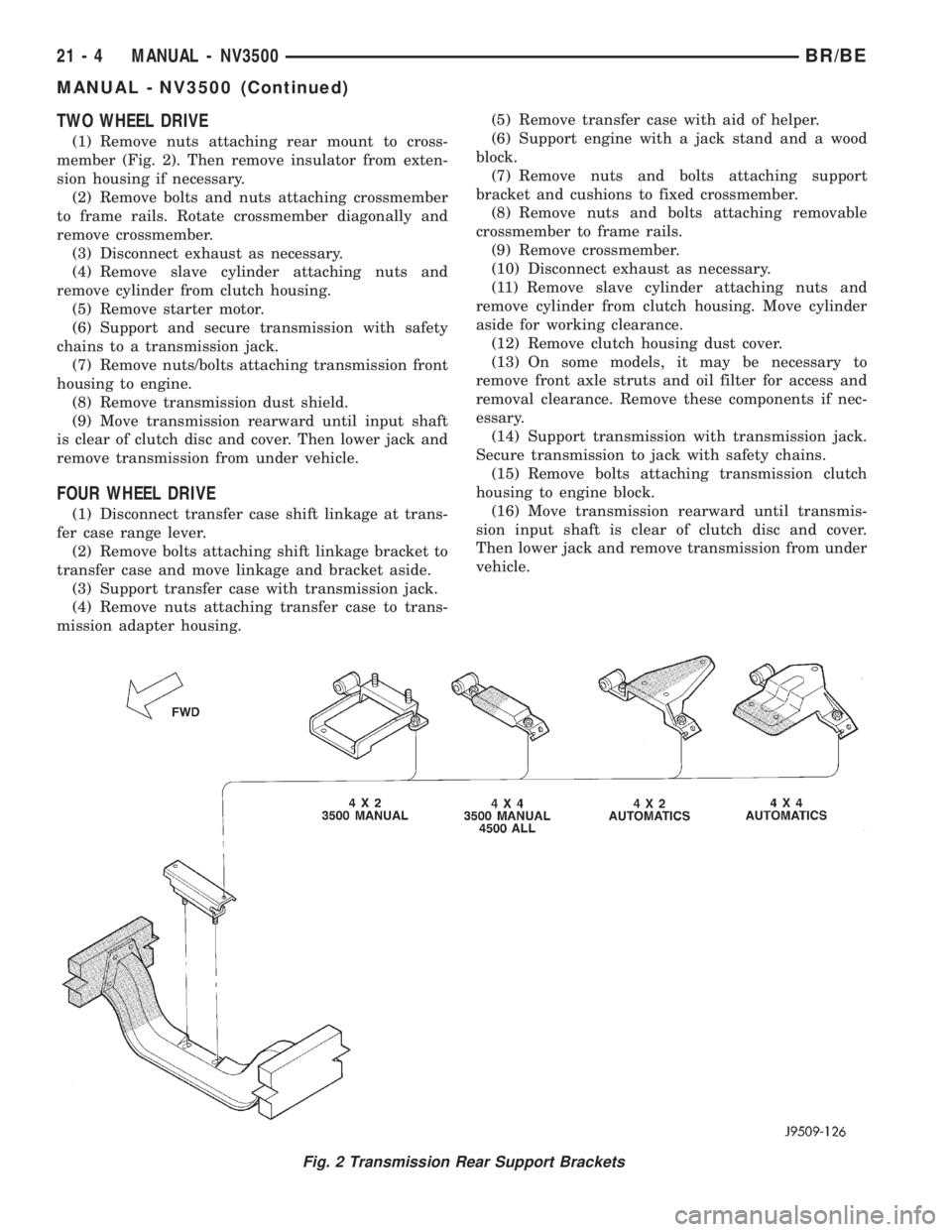
(1) Remove nuts attaching rear mount to cross-
member (Fig. 2). Then remove insulator from exten-
sion housing if necessary.
(2) Remove bolts and nuts attaching crossmember
to frame rails. Rotate crossmember diagonally and
remove crossmember.
(3) Disconnect exhaust as necessary.
(4) Remove slave cylinder attaching nuts and
remove cylinder from clutch housing.
(5) Remove starter motor.
(6) Support and secure transmission with safety
chains to a transmission jack.
(7) Remove nuts/bolts attaching transmission front
housing to engine.
(8) Remove transmission dust shield.
(9) Move transmission rearward until input shaft
is clear of clutch disc and cover. Then lower jack and
remove transmission from under vehicle.
FOUR WHEEL DRIVE
(1) Disconnect transfer case shift linkage at trans-
fer case range lever.
(2) Remove bolts attaching shift linkage bracket to
transfer case and move linkage and bracket aside.
(3) Support transfer case with transmission jack.
(4) Remove nuts attaching transfer case to trans-
mission adapter housing.(5) Remove transfer case with aid of helper.
(6) Support engine with a jack stand and a wood
block.
(7) Remove nuts and bolts attaching support
bracket and cushions to fixed crossmember.
(8) Remove nuts and bolts attaching removable
crossmember to frame rails.
(9) Remove crossmember.
(10) Disconnect exhaust as necessary.
(11) Remove slave cylinder attaching nuts and
remove cylinder from clutch housing. Move cylinder
aside for working clearance.
(12) Remove clutch housing dust cover.
(13) On some models, it may be necessary to
remove front axle struts and oil filter for access and
removal clearance. Remove these components if nec-
essary.
(14) Support transmission with transmission jack.
Secure transmission to jack with safety chains.
(15) Remove bolts attaching transmission clutch
housing to engine block.
(16) Move transmission rearward until transmis-
sion input shaft is clear of clutch disc and cover.
Then lower jack and remove transmission from under
vehicle.
Fig. 2 Transmission Rear Support Brackets
21 - 4 MANUAL - NV3500BR/BE
MANUAL - NV3500 (Continued)
Page 1640 of 2889
DISASSEMBLY
FRONT HOUSING
(1) Shift transmission into Neutral.
(2) If lubricant was not drained out of transmis-
sion during removal, remove drain plug and drain
lubricant.
(3) Inspect drain plug magnet for debris.
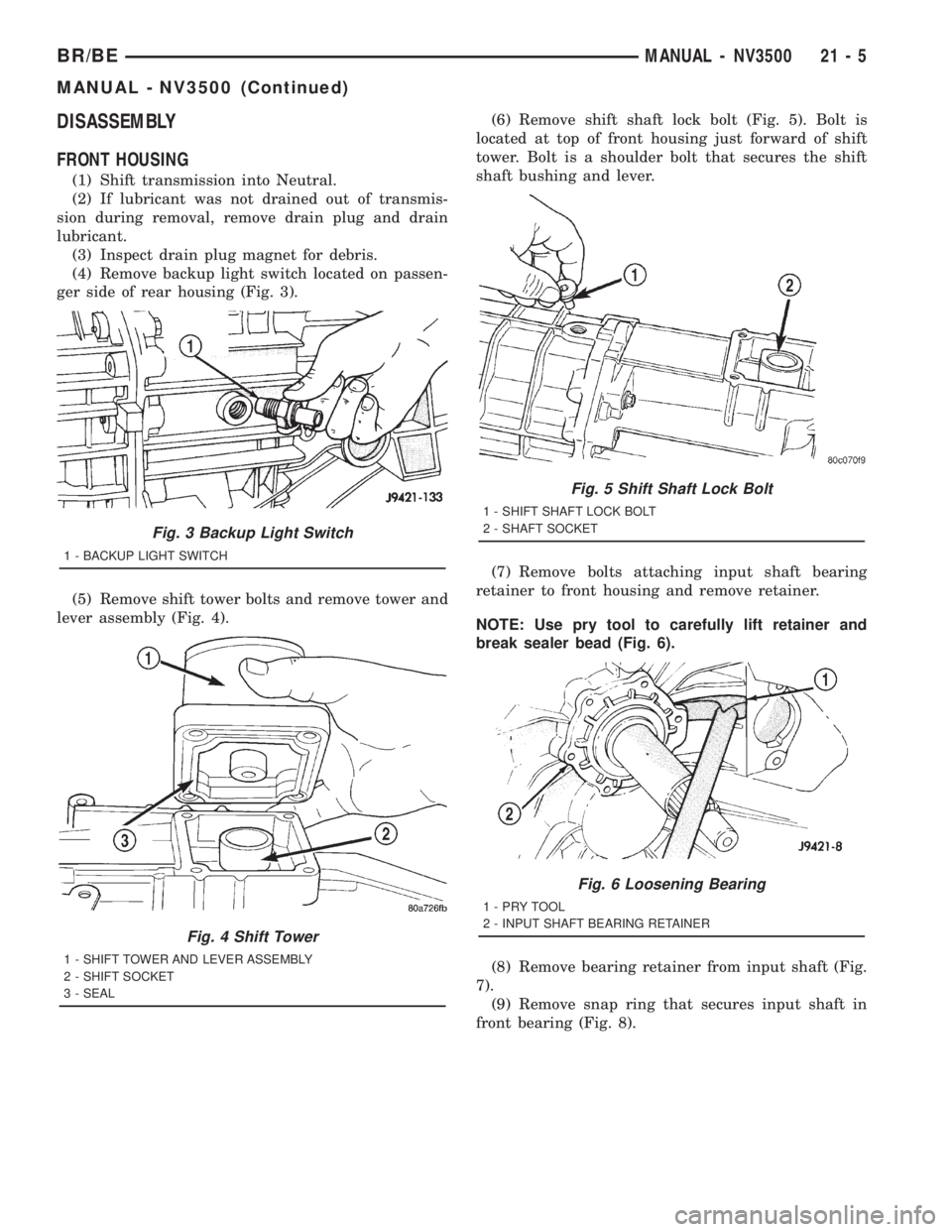
(4) Remove backup light switch located on passen-
ger side of rear housing (Fig. 3).
(5) Remove shift tower bolts and remove tower and
lever assembly (Fig. 4).(6) Remove shift shaft lock bolt (Fig. 5). Bolt is
located at top of front housing just forward of shift
tower. Bolt is a shoulder bolt that secures the shift
shaft bushing and lever.
(7) Remove bolts attaching input shaft bearing
retainer to front housing and remove retainer.
NOTE: Use pry tool to carefully lift retainer and
break sealer bead (Fig. 6).
(8) Remove bearing retainer from input shaft (Fig.
7).
(9) Remove snap ring that secures input shaft in
front bearing (Fig. 8).
Fig. 3 Backup Light Switch
1 - BACKUP LIGHT SWITCH
Fig. 4 Shift Tower
1 - SHIFT TOWER AND LEVER ASSEMBLY
2 - SHIFT SOCKET
3 - SEAL
Fig. 5 Shift Shaft Lock Bolt
1 - SHIFT SHAFT LOCK BOLT
2 - SHAFT SOCKET
Fig. 6 Loosening Bearing
1-PRYTOOL
2 - INPUT SHAFT BEARING RETAINER
BR/BEMANUAL - NV3500 21 - 5
MANUAL - NV3500 (Continued)
Page 1647 of 2889
GEARTRAIN FROM FIXTURE
(1) Remove reverse idler gear assembly from
assembly fixture cup.
(2) Remove 1-2 and fifth-reverse forks from syn-
chro sleeves.
(3) Slide countershaft out of fixture tool.
(4) Remove output shaft bearing retainer from
rear surface of fifth gear (retainer will drop onto gear
after bolts are removed).
(5) Lift and remove output shaft and gears off
input shaft.
(6) Lift and remove input shaft, pilot bearing and
fourth gear synchro ring from assembly fixture tool.
OUTPUT SHAFT
NOTE: The synchronizer hubs and sleeves are dif-
ferent and must not be intermixed. Remove each
synchronizer unit as an assembly to avoid intermix-
ing parts. Mark each synchro hub and sleeve with a
scriber or paint for correct assembly reference.(1) Remove snap ring that secures 3-4 synchro hub
on output shaft.
(2) Remove 3-4 synchro assembly, third gear syn-
chro ring and third gear with shop press and Bearing
Splitter 1130. Position splitter between second and
third gears.
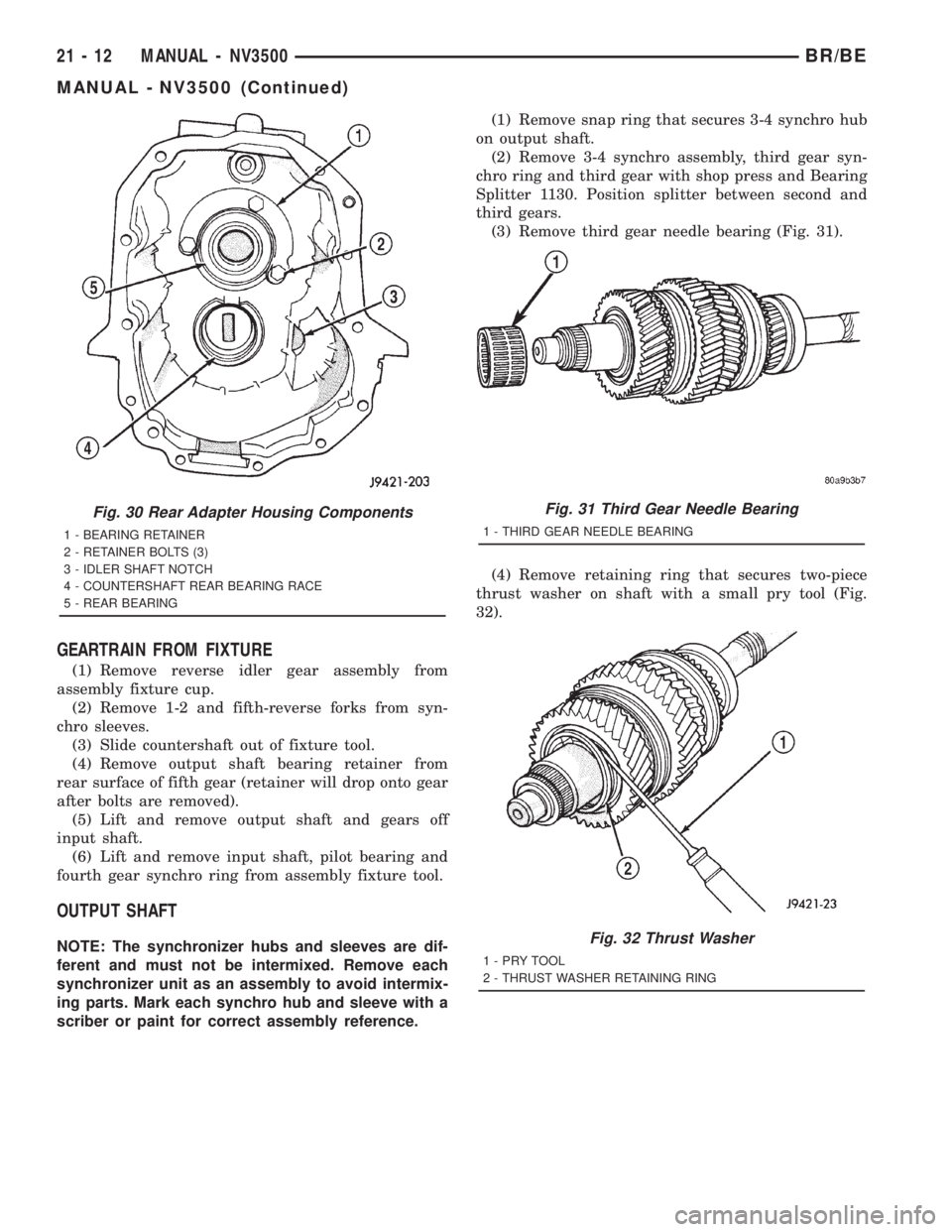
(3) Remove third gear needle bearing (Fig. 31).
(4) Remove retaining ring that secures two-piece
thrust washer on shaft with a small pry tool (Fig.
32).
Fig. 30 Rear Adapter Housing Components
1 - BEARING RETAINER
2 - RETAINER BOLTS (3)
3 - IDLER SHAFT NOTCH
4 - COUNTERSHAFT REAR BEARING RACE
5 - REAR BEARING
Fig. 31 Third Gear Needle Bearing
1 - THIRD GEAR NEEDLE BEARING
Fig. 32 Thrust Washer
1-PRYTOOL
2 - THRUST WASHER RETAINING RING
21 - 12 MANUAL - NV3500BR/BE
MANUAL - NV3500 (Continued)
Page 1650 of 2889
REVERSE IDLER
(1) Remove idler gear snap rings (Fig. 44).
(2) Remove thrust washer, wave washer, thrust
plate and idler gear from shaft.
(3) Remove idler gear needle bearing from shaft.
CLEANING
Clean the gears, shafts, shift components and trans-
mission housings with a standard parts cleaning sol-
vent. Do not use acid or corrosive base solvents. Dry
all parts except bearings with compressed air.
Clean the shaft bearings with a mild solvent such
as Mopartdegreasing solvent, Gunk, or similar sol-
vents. Do not dry the bearings with compressed air.
Allow the bearings to either air dry, or wipe them dry
with clean shop towels.
INSPECTION
SHIFT LEVER ASSEMBLY
The shift lever assembly is not serviceable. Replace
the lever and shift tower as an assembly if the tower,
lever, lever ball, or internal components are worn, or
damaged.
SHIFT SHAFT AND FORKS
Inspect the shift fork interlock arms and synchro
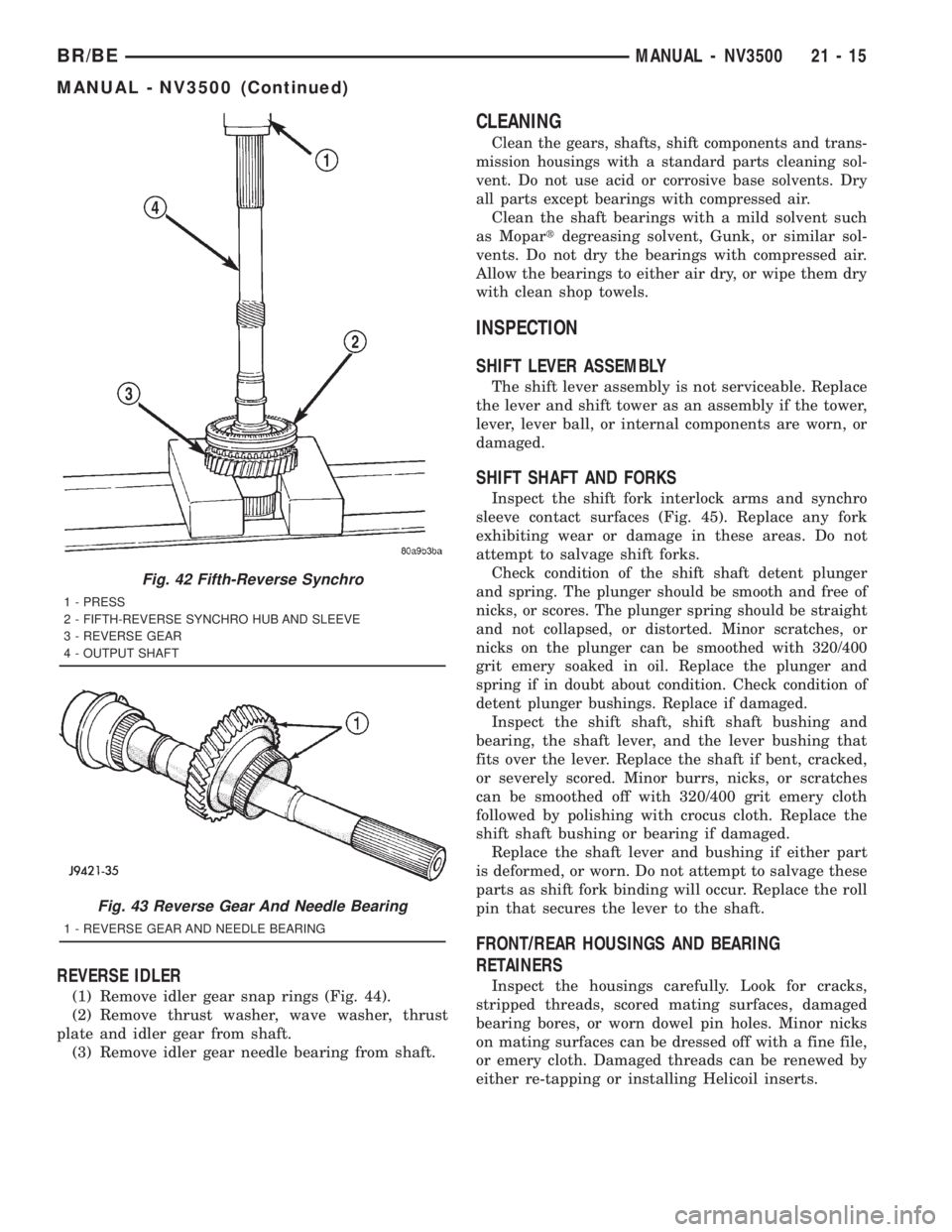
sleeve contact surfaces (Fig. 45). Replace any fork
exhibiting wear or damage in these areas. Do not
attempt to salvage shift forks.
Check condition of the shift shaft detent plunger
and spring. The plunger should be smooth and free of
nicks, or scores. The plunger spring should be straight
and not collapsed, or distorted. Minor scratches, or
nicks on the plunger can be smoothed with 320/400
grit emery soaked in oil. Replace the plunger and
spring if in doubt about condition. Check condition of
detent plunger bushings. Replace if damaged.
Inspect the shift shaft, shift shaft bushing and
bearing, the shaft lever, and the lever bushing that
fits over the lever. Replace the shaft if bent, cracked,
or severely scored. Minor burrs, nicks, or scratches
can be smoothed off with 320/400 grit emery cloth
followed by polishing with crocus cloth. Replace the
shift shaft bushing or bearing if damaged.
Replace the shaft lever and bushing if either part
is deformed, or worn. Do not attempt to salvage these
parts as shift fork binding will occur. Replace the roll
pin that secures the lever to the shaft.
FRONT/REAR HOUSINGS AND BEARING
RETAINERS
Inspect the housings carefully. Look for cracks,
stripped threads, scored mating surfaces, damaged
bearing bores, or worn dowel pin holes. Minor nicks
on mating surfaces can be dressed off with a fine file,
or emery cloth. Damaged threads can be renewed by
either re-tapping or installing Helicoil inserts.
Fig. 42 Fifth-Reverse Synchro
1 - PRESS
2 - FIFTH-REVERSE SYNCHRO HUB AND SLEEVE
3 - REVERSE GEAR
4 - OUTPUT SHAFT
Fig. 43 Reverse Gear And Needle Bearing
1 - REVERSE GEAR AND NEEDLE BEARING
BR/BEMANUAL - NV3500 21 - 15
MANUAL - NV3500 (Continued)