2001 DODGE RAM load capacity
[x] Cancel search: load capacityPage 484 of 2889
(3) Multiply the result from Step 2 by the temper-
ature correction factor (0.004):7 X 0.004 = 0.028
(4) The temperature at testing was below 26.7É C
(80É F); therefore, the temperature correction factor
is subtracted:1.240 - 0.028 = 1.212
(5) The corrected specific gravity of the battery cell
in this example is 1.212.
Test the specific gravity of the electrolyte in each
battery cell. If the specific gravity of all cells is above
1.235, but the variation between cells is more than
fifty points (0.050), the battery should be replaced. If
the specific gravity of one or more cells is less than
1.235, charge the battery at a rate of approximately
five amperes. Continue charging the battery until
three consecutive specific gravity tests, taken at one-
hour intervals, are constant. If the cell specific grav-
ity variation is more than fifty points (0.050) at the
end of the charge period, replace the battery.
When the specific gravity of all cells is above 1.235,
and the cell variation is less than fifty points (0.050),
the battery may be load tested to determine its
cranking capacity. Refer to Standard Procedures for
the proper battery load test procedures.
STANDARD PROCEDURE - OPEN-CIRCUIT
VOLTAGE TEST
A battery open-circuit voltage (no load) test will
show the approximate state-of-charge of a battery.
This test can be used in place of the hydrometer test
when a hydrometer is not available, or for mainte-
nance-free batteries with non-removable cell caps.
WARNING: IF THE BATTERY SHOWS SIGNS OF
FREEZING, LEAKING OR LOOSE POSTS, DO NOT
TEST, ASSIST-BOOST, OR CHARGE. THE BATTERY
MAY ARC INTERNALLY AND EXPLODE. PERSONAL
INJURY AND/OR VEHICLE DAMAGE MAY RESULT.
WARNING: EXPLOSIVE HYDROGEN GAS FORMS IN
AND AROUND THE BATTERY. DO NOT SMOKE,
USE FLAME, OR CREATE SPARKS NEAR THE BAT-
TERY. PERSONAL INJURY AND/OR VEHICLE DAM-
AGE MAY RESULT.
WARNING: THE BATTERY CONTAINS SULFURIC
ACID, WHICH IS POISONOUS AND CAUSTIC. AVOID
CONTACT WITH THE SKIN, EYES, OR CLOTHING.
IN THE EVENT OF CONTACT, FLUSH WITH WATER
AND CALL A PHYSICIAN IMMEDIATELY. KEEP OUT
OF THE REACH OF CHILDREN.
WARNING: IF THE BATTERY IS EQUIPPED WITH
REMOVABLE CELL CAPS, BE CERTAIN THAT EACH
OF THE CELL CAPS IS IN PLACE AND TIGHT
BEFORE THE BATTERY IS RETURNED TO SER-
VICE. PERSONAL INJURY AND/OR VEHICLE DAM-
AGE MAY RESULT FROM LOOSE OR MISSING
CELL CAPS.
Before proceeding with this test, completely charge
the battery. Refer to Standard Procedures for the
proper battery charging procedures.
(1) Before measuring the open-circuit voltage, the
surface charge must be removed from the battery.
Turn on the headlamps for fifteen seconds, then
allow up to five minutes for the battery voltage to
stabilize.
(2) Disconnect and isolate both battery cables, neg-
ative cable first.
(3) Using a voltmeter connected to the battery
posts (see the instructions provided by the manufac-
turer of the voltmeter), measure the open-circuit volt-
age (Fig. 11).
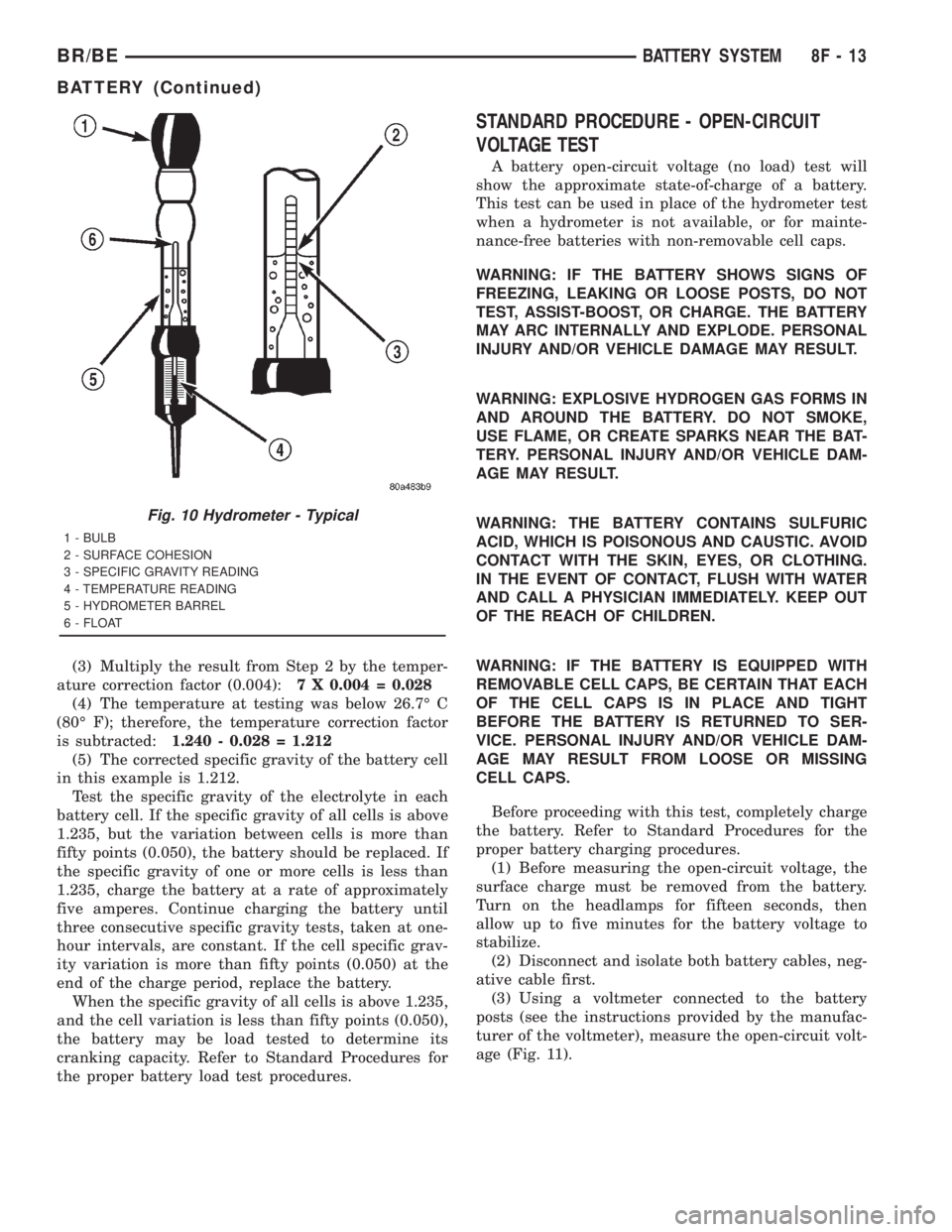
Fig. 10 Hydrometer - Typical
1 - BULB
2 - SURFACE COHESION
3 - SPECIFIC GRAVITY READING
4 - TEMPERATURE READING
5 - HYDROMETER BARREL
6 - FLOAT
BR/BEBATTERY SYSTEM 8F - 13
BATTERY (Continued)
Page 485 of 2889
See the Open-Circuit Voltage Table. This voltage
reading will indicate the battery state-of-charge, but
will not reveal its cranking capacity. If a battery has
an open-circuit voltage reading of 12.4 volts or
greater, it may be load tested to reveal its cranking
capacity. Refer to Standard Procedures for the proper
battery load test procedures.
OPEN CIRCUIT VOLTAGE TABLE
Open Circuit Voltage Charge Percentage
11.7 volts or less 0%
12.0 volts 25%
12.2 volts 50%
12.4 volts 75%
12.6 volts or more 100%
STANDARD PROCEDURE - LOAD TEST
A battery load test will verify the battery cranking
capacity. The test is based on the Cold Cranking
Amperage (CCA) rating of the battery. To determine
the battery CCA rating, see the label affixed to the
battery case or refer to Battery Specifications for the
proper factory-installed specifications.
WARNING: IF THE BATTERY SHOWS SIGNS OF
FREEZING, LEAKING OR LOOSE POSTS, DO NOT
TEST, ASSIST-BOOST, OR CHARGE. THE BATTERY
MAY ARC INTERNALLY AND EXPLODE. PERSONAL
INJURY AND/OR VEHICLE DAMAGE MAY RESULT.
WARNING: EXPLOSIVE HYDROGEN GAS FORMS IN
AND AROUND THE BATTERY. DO NOT SMOKE,
USE FLAME, OR CREATE SPARKS NEAR THE BAT-
TERY. PERSONAL INJURY AND/OR VEHICLE DAM-
AGE MAY RESULT.WARNING: THE BATTERY CONTAINS SULFURIC
ACID, WHICH IS POISONOUS AND CAUSTIC. AVOID
CONTACT WITH THE SKIN, EYES, OR CLOTHING.
IN THE EVENT OF CONTACT, FLUSH WITH WATER
AND CALL A PHYSICIAN IMMEDIATELY. KEEP OUT
OF THE REACH OF CHILDREN.
WARNING: IF THE BATTERY IS EQUIPPED WITH
REMOVABLE CELL CAPS, BE CERTAIN THAT EACH
OF THE CELL CAPS IS IN PLACE AND TIGHT
BEFORE THE BATTERY IS RETURNED TO SER-
VICE. PERSONAL INJURY AND/OR VEHICLE DAM-
AGE MAY RESULT FROM LOOSE OR MISSING
CELL CAPS.
Before proceeding with this test, completely charge
the battery. Refer to Standard Procedures for the
proper battery charging procedures.
(1) Disconnect and isolate both battery cables, neg-
ative cable first. The battery top and posts should be
clean. Refer to Battery System Cleaning for the
proper cleaning procedures.
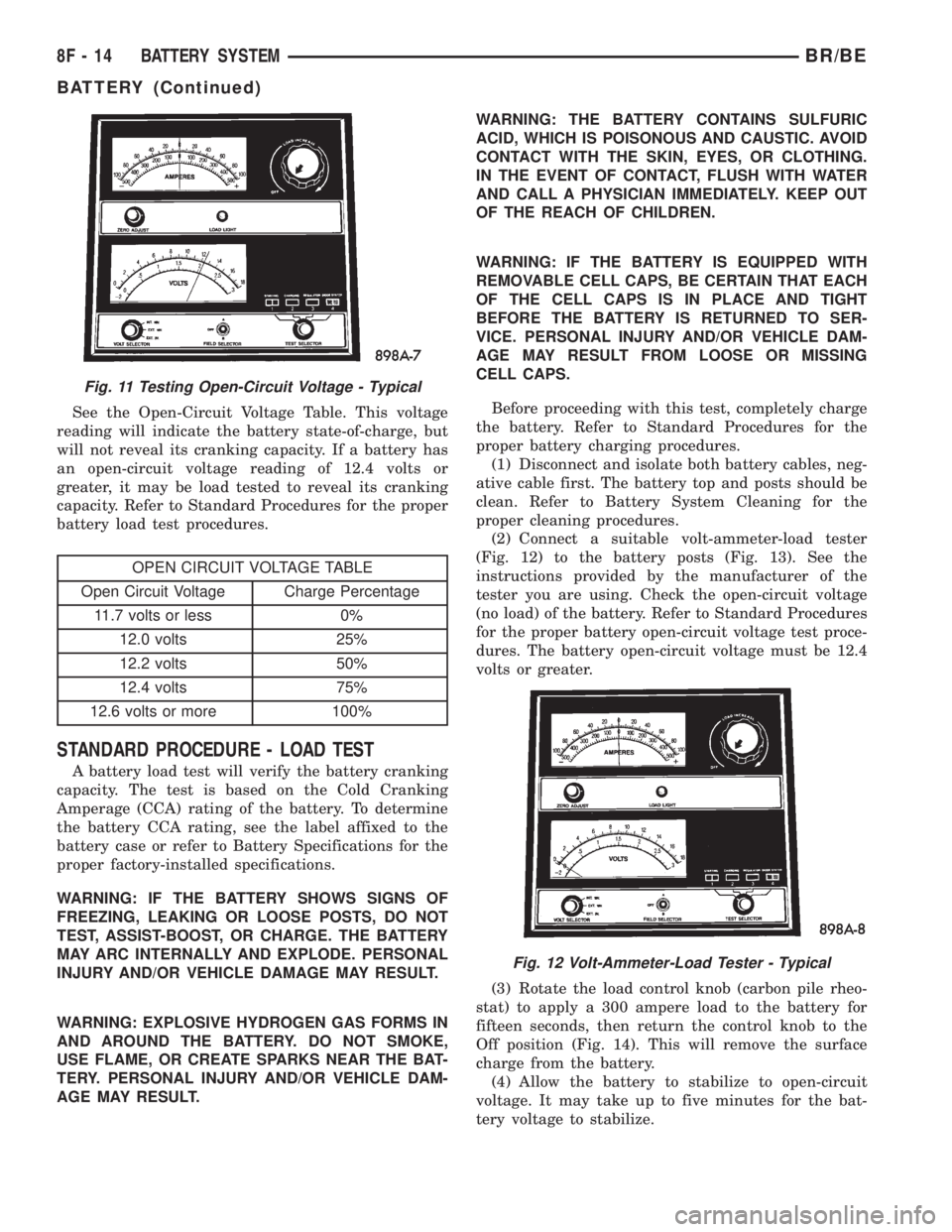
(2) Connect a suitable volt-ammeter-load tester
(Fig. 12) to the battery posts (Fig. 13). See the
instructions provided by the manufacturer of the
tester you are using. Check the open-circuit voltage
(no load) of the battery. Refer to Standard Procedures
for the proper battery open-circuit voltage test proce-
dures. The battery open-circuit voltage must be 12.4
volts or greater.
(3) Rotate the load control knob (carbon pile rheo-
stat) to apply a 300 ampere load to the battery for
fifteen seconds, then return the control knob to the
Off position (Fig. 14). This will remove the surface
charge from the battery.
(4) Allow the battery to stabilize to open-circuit
voltage. It may take up to five minutes for the bat-
tery voltage to stabilize.
Fig. 11 Testing Open-Circuit Voltage - Typical
Fig. 12 Volt-Ammeter-Load Tester - Typical
8F - 14 BATTERY SYSTEMBR/BE
BATTERY (Continued)
Page 505 of 2889
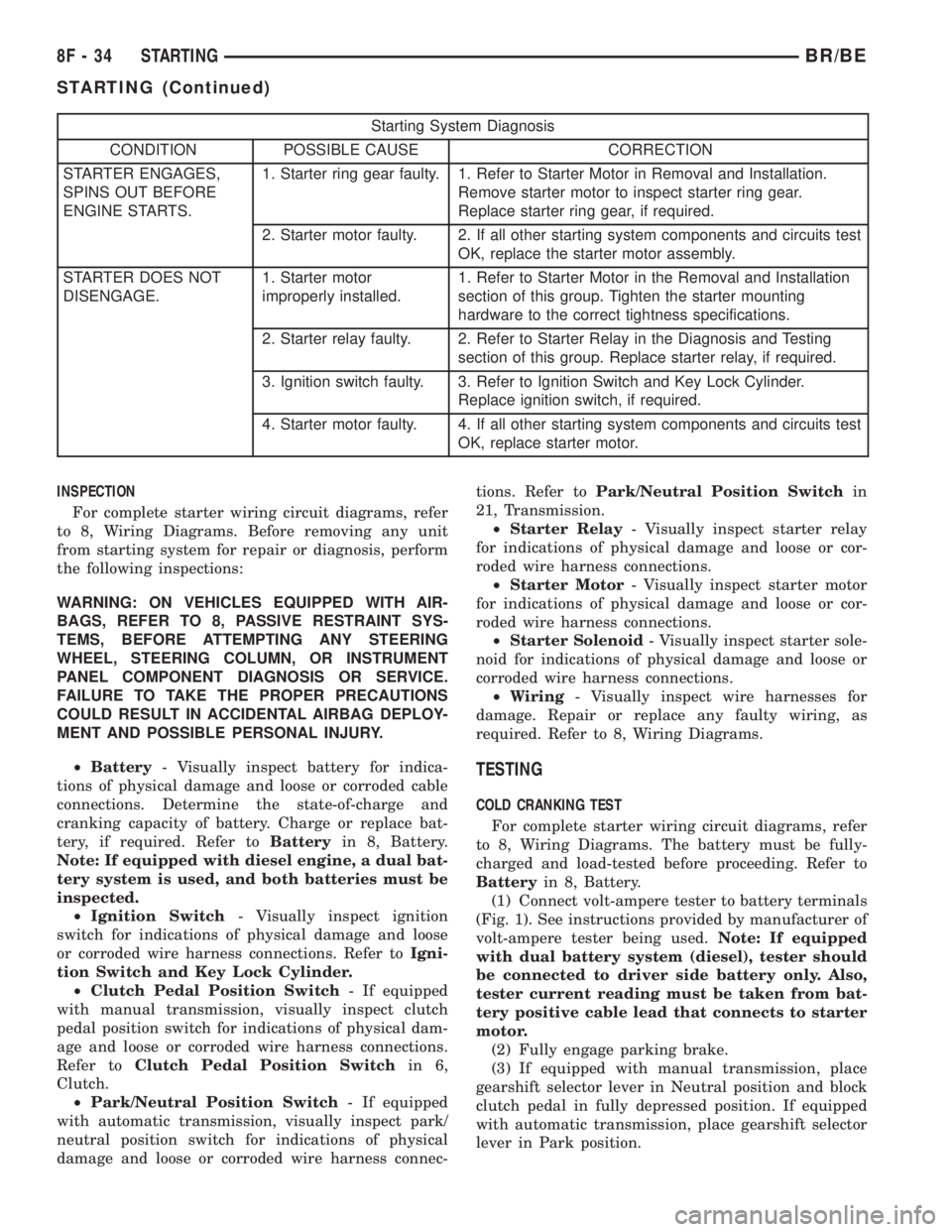
Starting System Diagnosis
CONDITION POSSIBLE CAUSE CORRECTION
STARTER ENGAGES,
SPINS OUT BEFORE
ENGINE STARTS.1. Starter ring gear faulty. 1. Refer to Starter Motor in Removal and Installation.
Remove starter motor to inspect starter ring gear.
Replace starter ring gear, if required.
2. Starter motor faulty. 2. If all other starting system components and circuits test
OK, replace the starter motor assembly.
STARTER DOES NOT
DISENGAGE.1. Starter motor
improperly installed.1. Refer to Starter Motor in the Removal and Installation
section of this group. Tighten the starter mounting
hardware to the correct tightness specifications.
2. Starter relay faulty. 2. Refer to Starter Relay in the Diagnosis and Testing
section of this group. Replace starter relay, if required.
3. Ignition switch faulty. 3. Refer to Ignition Switch and Key Lock Cylinder.
Replace ignition switch, if required.
4. Starter motor faulty. 4. If all other starting system components and circuits test
OK, replace starter motor.
INSPECTION
For complete starter wiring circuit diagrams, refer
to 8, Wiring Diagrams. Before removing any unit
from starting system for repair or diagnosis, perform
the following inspections:
WARNING: ON VEHICLES EQUIPPED WITH AIR-
BAGS, REFER TO 8, PASSIVE RESTRAINT SYS-
TEMS, BEFORE ATTEMPTING ANY STEERING
WHEEL, STEERING COLUMN, OR INSTRUMENT
PANEL COMPONENT DIAGNOSIS OR SERVICE.
FAILURE TO TAKE THE PROPER PRECAUTIONS
COULD RESULT IN ACCIDENTAL AIRBAG DEPLOY-
MENT AND POSSIBLE PERSONAL INJURY.
²Battery- Visually inspect battery for indica-
tions of physical damage and loose or corroded cable
connections. Determine the state-of-charge and
cranking capacity of battery. Charge or replace bat-
tery, if required. Refer toBatteryin 8, Battery.
Note: If equipped with diesel engine, a dual bat-
tery system is used, and both batteries must be
inspected.
²Ignition Switch- Visually inspect ignition
switch for indications of physical damage and loose
or corroded wire harness connections. Refer toIgni-
tion Switch and Key Lock Cylinder.
²Clutch Pedal Position Switch- If equipped
with manual transmission, visually inspect clutch
pedal position switch for indications of physical dam-
age and loose or corroded wire harness connections.
Refer toClutch Pedal Position Switchin 6,
Clutch.
²Park/Neutral Position Switch- If equipped
with automatic transmission, visually inspect park/
neutral position switch for indications of physical
damage and loose or corroded wire harness connec-tions. Refer toPark/Neutral Position Switchin
21, Transmission.
²Starter Relay- Visually inspect starter relay
for indications of physical damage and loose or cor-
roded wire harness connections.
²Starter Motor- Visually inspect starter motor
for indications of physical damage and loose or cor-
roded wire harness connections.
²Starter Solenoid- Visually inspect starter sole-
noid for indications of physical damage and loose or
corroded wire harness connections.
²Wiring- Visually inspect wire harnesses for
damage. Repair or replace any faulty wiring, as
required. Refer to 8, Wiring Diagrams.
TESTING
COLD CRANKING TEST
For complete starter wiring circuit diagrams, refer
to 8, Wiring Diagrams. The battery must be fully-
charged and load-tested before proceeding. Refer to
Batteryin 8, Battery.
(1) Connect volt-ampere tester to battery terminals
(Fig. 1). See instructions provided by manufacturer of
volt-ampere tester being used.Note: If equipped
with dual battery system (diesel), tester should
be connected to driver side battery only. Also,
tester current reading must be taken from bat-
tery positive cable lead that connects to starter
motor.
(2) Fully engage parking brake.
(3) If equipped with manual transmission, place
gearshift selector lever in Neutral position and block
clutch pedal in fully depressed position. If equipped
with automatic transmission, place gearshift selector
lever in Park position.
8F - 34 STARTINGBR/BE
STARTING (Continued)
Page 2567 of 2889
DESCRIPTION
Radial-ply tires improve handling, tread life and
ride quality, and decrease rolling resistance.
Radial-ply tires must always be used in sets of
four. Under no circumstances should they be used on
the front only. They may be mixed with temporary
spare tires when necessary. A maximum speed of 50
MPH is recommended while a temporary spare is in
use.
Radial-ply tires have the same load-carrying capac-
ity as other types of tires of the same size. They also
use the same recommended inflation pressures.
The use of oversized tires, either in the front or
rear of the vehicle, can cause vehicle drive train fail-
ure. This could also cause inaccurate wheel speed
signals when the vehicle is equipped with Anti-Lock
Brakes.
The use of tires from different manufactures on the
same vehicle is NOT recommended. The proper tire
pressure should be maintained on all four tires.
DESCRIPTION
Where speed limits allow the vehicle to be driven
at high speeds, correct tire inflation pressure is very
important. For speeds up to and including 120 km/h
(75 mph), tires must be inflated to the pressures
shown on the tire placard. For continuous speeds inexcess of 120 km/h (75 mph), tires must be inflated
to the maximum pressure specified on the tire side-
wall.
Vehicles loaded to the maximum capacity should
not be driven at continuous speeds above 75 mph
(120 km/h).
For emergency vehicles that are driven at speeds
over 90 mph (144 km/h), special high speed tires
must be used. Consult tire manufacturer for correct
inflation pressure recommendations.
DESCRIPTION
The original equipment tires provide a proper bal-
ance of many characteristics such as:
²Ride
²Noise
²Handling
²Durability
²Tread life
²Traction
²Rolling resistance
²Speed capability
It is recommended that tires equivalent to the orig-
inal equipment tires be used when replacement is
needed.
Failure to use equivalent replacement tires may
adversely affect the safety and handling of the vehi-
cle.
The use of oversize tires may cause interference
with vehicle components. Under extremes of suspen-
sion and steering travel, interference with vehicle
components may cause tire damage.
WARNING: FAILURE TO EQUIP THE VEHICLE WITH
TIRES HAVING ADEQUATE SPEED CAPABILITY
CAN RESULT IN SUDDEN TIRE FAILURE.
DESCRIPTION
Under inflation will cause rapid shoulder wear, tire
flexing, and possible tire failure (Fig. 12) .
Over inflation will cause rapid center wear and
loss of the tire's ability to cushion shocks (Fig. 13) .
Improper inflation can cause:
²Uneven wear patterns
²Reduced tread life
²Reduced fuel economy
²Unsatisfactory ride
²Vehicle drift
For proper tire pressure specification refer to the
Tire Inflation Pressure Chart provided with the vehi-
cles Owners Manual. A Certification Label on the
drivers side door pillar provides the minimum tire
and rim size for the vehicle. The label also list the
cold inflation pressure for these tires at full load
operation
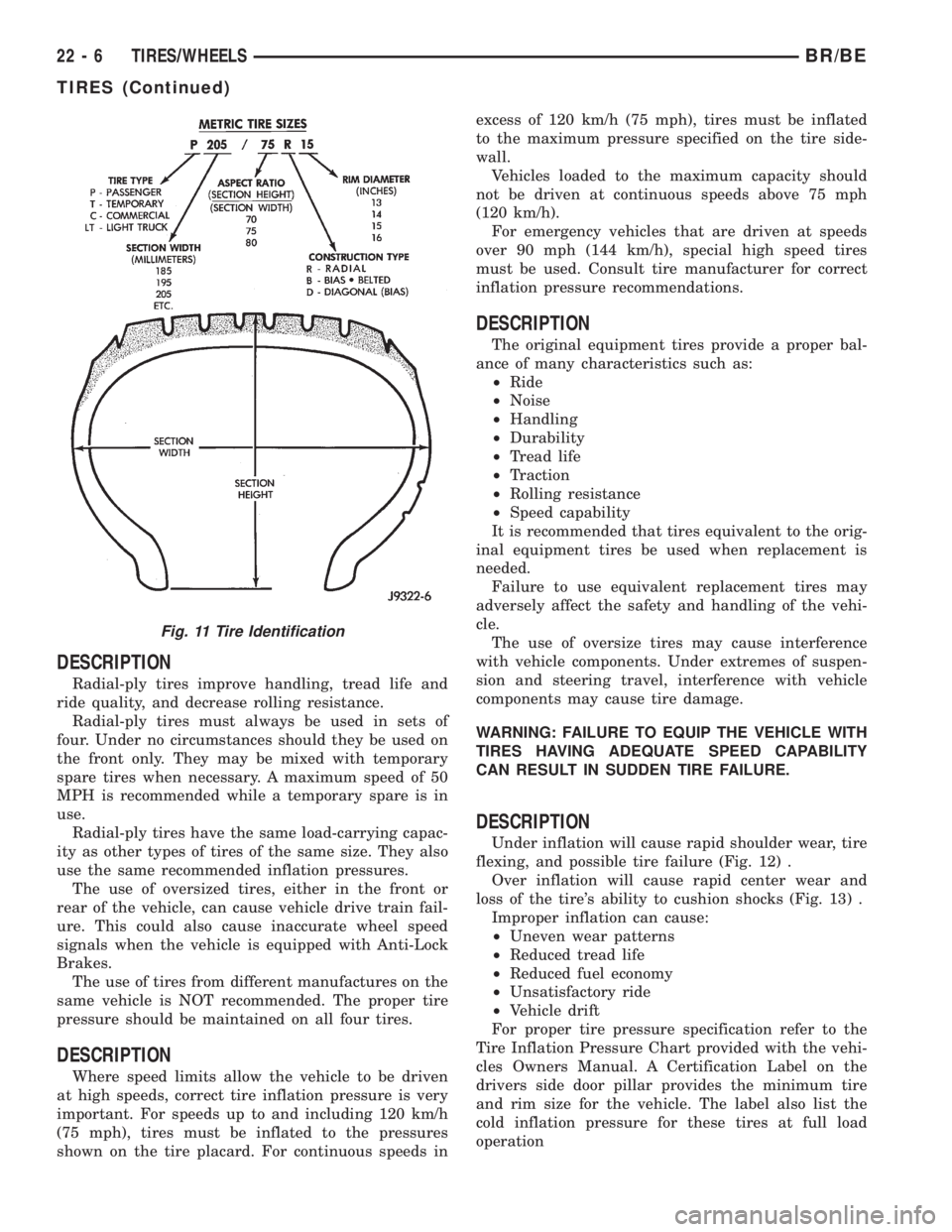
Fig. 11 Tire Identification
22 - 6 TIRES/WHEELSBR/BE
TIRES (Continued)
Page 2571 of 2889
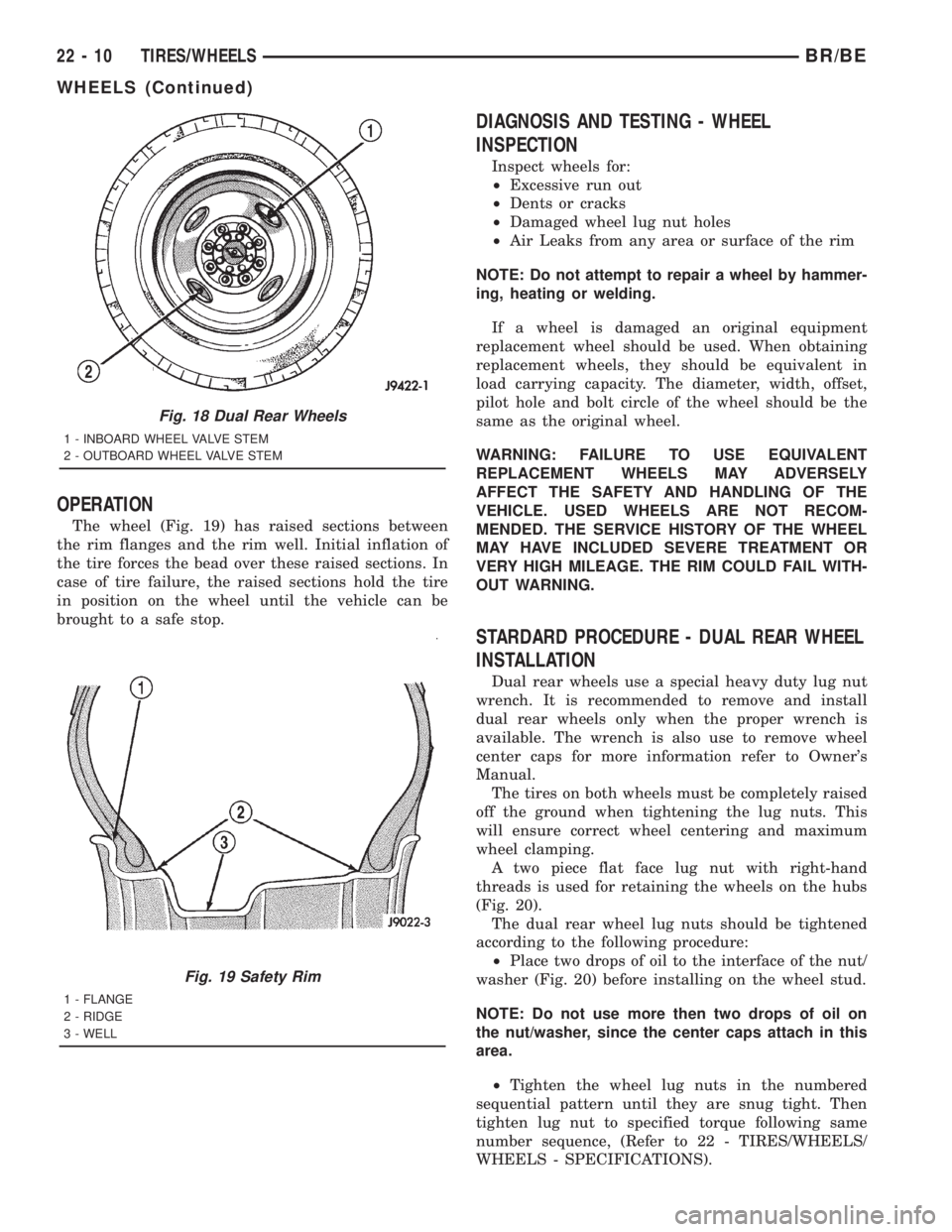
OPERATION
The wheel (Fig. 19) has raised sections between
the rim flanges and the rim well. Initial inflation of
the tire forces the bead over these raised sections. In
case of tire failure, the raised sections hold the tire
in position on the wheel until the vehicle can be
brought to a safe stop.
DIAGNOSIS AND TESTING - WHEEL
INSPECTION
Inspect wheels for:
²Excessive run out
²Dents or cracks
²Damaged wheel lug nut holes
²Air Leaks from any area or surface of the rim
NOTE: Do not attempt to repair a wheel by hammer-
ing, heating or welding.
If a wheel is damaged an original equipment
replacement wheel should be used. When obtaining
replacement wheels, they should be equivalent in
load carrying capacity. The diameter, width, offset,
pilot hole and bolt circle of the wheel should be the
same as the original wheel.
WARNING: FAILURE TO USE EQUIVALENT
REPLACEMENT WHEELS MAY ADVERSELY
AFFECT THE SAFETY AND HANDLING OF THE
VEHICLE. USED WHEELS ARE NOT RECOM-
MENDED. THE SERVICE HISTORY OF THE WHEEL
MAY HAVE INCLUDED SEVERE TREATMENT OR
VERY HIGH MILEAGE. THE RIM COULD FAIL WITH-
OUT WARNING.
STARDARD PROCEDURE - DUAL REAR WHEEL
INSTALLATION
Dual rear wheels use a special heavy duty lug nut
wrench. It is recommended to remove and install
dual rear wheels only when the proper wrench is
available. The wrench is also use to remove wheel
center caps for more information refer to Owner's
Manual.
The tires on both wheels must be completely raised
off the ground when tightening the lug nuts. This
will ensure correct wheel centering and maximum
wheel clamping.
A two piece flat face lug nut with right-hand
threads is used for retaining the wheels on the hubs
(Fig. 20).
The dual rear wheel lug nuts should be tightened
according to the following procedure:
²Place two drops of oil to the interface of the nut/
washer (Fig. 20) before installing on the wheel stud.
NOTE: Do not use more then two drops of oil on
the nut/washer, since the center caps attach in this
area.
²Tighten the wheel lug nuts in the numbered
sequential pattern until they are snug tight. Then
tighten lug nut to specified torque following same
number sequence, (Refer to 22 - TIRES/WHEELS/
WHEELS - SPECIFICATIONS).
Fig. 18 Dual Rear Wheels
1 - INBOARD WHEEL VALVE STEM
2 - OUTBOARD WHEEL VALVE STEM
Fig. 19 Safety Rim
1 - FLANGE
2 - RIDGE
3 - WELL
22 - 10 TIRES/WHEELSBR/BE
WHEELS (Continued)
Page 2882 of 2889
TANK MODULE - DESCRIPTION, FUEL....14-78
TANK MODULE - INSTALLATION, FUEL....14-79
TANK MODULE - OPERATION, FUEL......14-78
TANK MODULE - REMOVAL, FUEL.......14-78
TAPE STRIPE - INSTALLATION..........23-88
TAPE STRIPE - REMOVAL..............23-88
TAPPETS - DIAGNOSIS AND TESTING,
HYDRAULIC............9-151,9-206,9-38,9-95
TASK MANAGER - DESCRIPTION........25-15
TASK MANAGER - OPERATION..........25-19
TEMP SENSOR - 3.9L/5.2L/5.9L -
DESCRIPTION, ENGINE COOLANT.........7-48
TEMP SENSOR - 3.9L/5.2L/5.9L -
INSTALLATION, ENGINE COOLANT........7-48
TEMP SENSOR - 3.9L/5.2L/5.9L -
OPERATION, ENGINE COOLANT..........7-48
TEMP SENSOR - 3.9L/5.2L/5.9L -
REMOVAL, ENGINE COOLANT............7-48
TEMP SENSOR - DESCRIPTION,
AMBIENT..........................8M-11
TEMP SENSOR - INSTALLATION,
AMBIENT..........................8M-13
TEMP SENSOR - OPERATION, AMBIENT . . 8M-11
TEMP SENSOR - REMOVAL, AMBIENT . . . 8M-12
TEMPERATURE GAUGE - DESCRIPTION,
ENGINE............................8J-19
TEMPERATURE GAUGE - OPERATION,
ENGINE............................8J-19
TEMPERATURE SENSOR - DESCRIPTION,
BATTERY...........................8F-29
TEMPERATURE SENSOR - DESCRIPTION,
FUEL..............................14-99
TEMPERATURE SENSOR - DESCRIPTION,
TRANSMISSION . . . 21-262,21-433,21-606,21-779
TEMPERATURE SENSOR - DIAGNOSIS &
TESTING, AMBIENT..................8M-12
TEMPERATURE SENSOR -
INSTALLATION, BATTERY..............8F-29
TEMPERATURE SENSOR - OPERATION,
BATTERY...........................8F-29
TEMPERATURE SENSOR - OPERATION,
FUEL.............................14-100
TEMPERATURE SENSOR - OPERATION,
TRANSMISSION . . . 21-262,21-433,21-606,21-779
TEMPERATURE SENSOR - REMOVAL,
BATTERY...........................8F-29
TENSIONER - ADJUSTMENT, CABLE.......5-40
TENSIONER - DESCRIPTION, TIMING
BELT/CHAIN..........................9-57
TENSIONER - OPERATION, TIMING
BELT/CHAIN..........................9-57
TENSIONERS - 3.9L/5.2L/5.9L -
DESCRIPTION, BELT...................7-19
TENSIONERS - 3.9L/5.2L/5.9L -
INSTALLATION, BELT...................7-20
TENSIONERS - 3.9L/5.2L/5.9L -
OPERATION, BELT.....................7-19
TENSIONERS - 3.9L/5.2L/5.9L -
REMOVAL, BELT......................7-20
TENSIONERS - 5.9L DIESEL -
DESCRIPTION, BELT...................7-23
TENSIONERS - 5.9L DIESEL -
INSTALLATION, BELT...................7-23
TENSIONERS - 5.9L DIESEL -
OPERATION, BELT.....................7-23
TENSIONERS - 5.9L DIESEL - REMOVAL,
BELT ...............................7-23
TENSIONERS - 8.0L - DESCRIPTION,
BELT ...............................7-20
TENSIONERS - 8.0L - INSTALLATION,
BELT ...............................7-22
TENSIONERS - 8.0L - OPERATION, BELT . . . 7-20
TENSIONERS - 8.0L - REMOVAL, BELT.....7-21
TERMINAL - INSTALLATION.........8W-01-11
TERMINAL - REMOVAL.............8W-01-11
TEST - DIAGNOSIS AND TESTING, FUEL
INJECTOR.....................14-53,14-95
TEST - DIAGNOSIS AND TESTING, FUEL
PRESSURE LEAK DOWN
................14-2
TEST - DIAGNOSIS AND TESTING, FUEL
PUMP AMPERAGE
....................14-10
TEST - DIAGNOSIS AND TESTING, FUEL
PUMP CAPACITY
......................14-9
TEST - DIAGNOSIS AND TESTING, FUEL
PUMP PRESSURE
....................14-10
TEST - DIAGNOSIS AND TESTING,
HYDRAULIC PRESSURE
. . 21-144,21-315,21-487,
21-658TEST - DIAGNOSIS AND TESTING,
POWR-LOKY........................3-161
TEST - DIAGNOSIS AND TESTING, ROAD . . . 8P-3
TEST - INSPECTION WINDSHIELD
WIPERS/WASHERS, ROAD.............30-18
TEST - STANDARD PROCEDURE,
BUILT-IN INDICATOR..................8F-11
TEST - STANDARD PROCEDURE,
HYDROMETER.......................8F-12
TEST - STANDARD PROCEDURE,
IGNITION-OFF DRAW..................8F-15
TEST - STANDARD PROCEDURE, LOAD . . . 8F-14
TEST - STANDARD PROCEDURE,
OPEN-CIRCUIT VOLTAGE...............8F-13
TEST - STANDARD PROCEDURE,
VERIFICATION........................8O-5
TEST INSPECTION - DESCRIPTION,
ROAD..............................30-15
TEST MODE - DESCRIPTION, CIRCUIT
ACTUATION..........................25-1
TEST MODE - DESCRIPTION, STATE
DISPLAY............................25-1
TETHER - INSTALLATION, CHILD.........8O-9
TETHER - REMOVAL, CHILD.............8O-9
THEFT SECURITY - DESCRIPTION,
VEHICLE............................8Q-1
THEFT SECURITY - OPERATION, VEHICLE . . 8Q-2
THEFT SECURITY SYSTEM - DIAGNOSIS
AND TESTING, VEHICLE................8Q-3
THERMOSTAT - 3.9L/5.2L/5.9L -
DESCRIPTION, ENGINE COOLANT.........7-49
THERMOSTAT - 3.9L/5.2L/5.9L -
INSTALLATION, ENGINE COOLANT........7-50
THERMOSTAT - 3.9L/5.2L/5.9L -
OPERATION, ENGINE COOLANT..........7-49
THERMOSTAT - 3.9L/5.2L/5.9L -
REMOVAL, ENGINE COOLANT............7-49
THERMOSTAT - 5.9L DIESEL -
DESCRIPTION, ENGINE COOLANT.........7-54
THERMOSTAT - 5.9L DIESEL -
INSTALLATION, ENGINE COOLANT........7-55
THERMOSTAT - 5.9L DIESEL -
OPERATION, ENGINE COOLANT..........7-54
THERMOSTAT - 5.9L DIESEL -
REMOVAL, ENGINE COOLANT............7-55
THERMOSTAT - 8.0L - DESCRIPTION,
ENGINE COOLANT.....................7-52
THERMOSTAT - 8.0L - INSTALLATION,
ENGINE COOLANT.....................7-53
THERMOSTAT - 8.0L - OPERATION,
ENGINE COOLANT.....................7-52
THERMOSTAT - 8.0L - REMOVAL,
ENGINE COOLANT.....................7-52
THERMOSTAT - DIAGNOSIS AND
TESTING....................7-49,7-52,7-54
THOMAS AND BETTS - INSTALLATION,
CONNECTOR.....................8W-01-10
THOMAS AND BETTS - REMOVAL,
CONNECTOR......................8W-01-9
THREAD REPAIR - STANDARD
PROCEDURE, ALUMINUM......21-159,21-330,
21-502,21-673
THREADED HOLE REPAIR -
DESCRIPTION......................Intro.-6
THREADS - STANDARD PROCEDURE,
REPAIR DAMAGED OR WORN . 9-11,9-125,9-181,
9-238,9-68
THROTTLE BODY - DESCRIPTION........14-48
THROTTLE BODY - OPERATION.........14-48
THROTTLE CONTROL CABLE -
INSTALLATION.................14-105,14-50
THROTTLE CONTROL CABLE -
REMOVAL....................14-104,14-50
THROTTLE POSITION SENSOR -
DESCRIPTION.......................14-51
THROTTLE POSITION SENSOR -
OPERATION.........................14-51
THROTTLE VALVE CABLE -
ADJUSTMENTS, TRANSMISSION
. 21-254,21-425,
21-598,21-771
THROTTLE VALVE CABLE -
DESCRIPTION
....21-253,21-424,21-597,21-770
TIMER MODULE - DESCRIPTION, BODY
CONTROL/CENTRAL
...................8E-1
TIMER MODULE - DIAGNOSIS AND
TESTING, CENTRAL
....................8E-4
TIMER MODULE - INSTALLATION, BODY
CONTROL/CENTRAL
...................8E-6TIMER MODULE - OPERATION, BODY
CONTROL/CENTRAL...................8E-3
TIMER MODULE - REMOVAL, BODY
CONTROL/CENTRAL...................8E-5
TIMING - DIAGNOSIS AND TESTING,
FUEL INJECTION PUMP...............14-66
TIMING BELT / CHAIN COVER(S) -
INSTALLATION........9-113,9-169,9-226,9-56
TIMING BELT / CHAIN COVER(S) -
REMOVAL............9-113,9-169,9-225,9-56
TIMING BELT/CHAIN AND SPROCKETS -
INSTALLATION........9-115,9-170,9-227,9-58
TIMING BELT/CHAIN AND SPROCKETS -
REMOVAL............9-114,9-170,9-226,9-57
TIMING BELT/CHAIN TENSIONER -
DESCRIPTION........................9-57
TIMING BELT/CHAIN TENSIONER -
OPERATION..........................9-57
TIMING CHAIN STRETCH - INSPECTION,
MEASURING..........9-114,9-170,9-227,9-58
TIMING, SPECIFICATIONS - IGNITION......8I-3
TIPS - CLEANING, APPEARANCE........30-21
TIRE - DESCRIPTION, SPARE............22-9
TIRE AND WHEEL BALANCE -
STANDARD PROCEDURES...............22-4
TIRE AND WHEEL RUNOUT - DIAGNOSIS
AND TESTING........................22-1
TIRE NOISE OR VIBRATION - DIAGNOSIS
AND TESTING........................22-8
TIRE PRESSURES - INSPECTION.........30-8
TIRE REVOLUTIONS PER MILE,
SPECIFICATIONS......................22-9
TIRE ROTATION - STANDARD
PROCEDURES........................22-2
TIRE WEAR PATTERNS - DIAGNOSIS
AND TESTING........................22-7
TIRE WINCH - INSTALLATION, SPARE....13-10
TIRE WINCH - REMOVAL, SPARE........13-10
TIRES - DESCRIPTION.............22-5,22-6
TO GROUND - STANDARD PROCEDURE,
TESTING FOR A SHORT.............8W-01-6
TO GROUND ON FUSES POWERING
SEVERAL LOADS - STANDARD
PROCEDURE, TESTING FOR SHORT....8W-01-7
TO OIL COOLER - INSTALLATION, AIR.....7-88
TO OIL COOLER - REMOVAL, AIR.........7-87
TO OIL COOLER - REMOVAL, WATER......7-87
TO USE WIRING DIAGRAMS -
DESCRIPTION, HOW................8W-01-1
TOOLS - 5.2L ENGINE, SPECIAL..........9-77
TOOLS - 5.9L DIESEL ENGINE, SPECIAL . . 9-244
TOOLS - 5.9L ENGINE, SPECIAL.........9-134
TOOLS - 8.0L ENGINE, SPECIAL.........9-188
TOOLS - AUDIO SYSTEMS, SPECIAL......8A-4
TOOLS - BASE BRAKES, SPECIAL.........5-4
TOOLS - COOLING, SPECIAL.............7-18
TOOLS - DIESEL FUEL SYSTEM,
SPECIAL...........................14-59
TOOLS - FRONT AXLE, SPECIAL..........3-58
TOOLS - FRONT AXLES, SPECIAL.........3-25
TOOLS - FUEL SYSTEM, SPECIAL . . . 14-36,14-4
TOOLS - HEADLAMP ALIGNMENT,
SPECIAL............................8L-4
TOOLS - INDEPENDENT FRONT
SUSPENSION, SPECIAL..................2-9
TOOLS - LINK/COIL SUSPENSION,
SPECIAL
............................2-16
TOOLS - NV5600 MANUAL
TRANSMISSION, SPECIAL
.............21-127
TOOLS - OVERHEAD CONSOLE
SYSTEMS, SPECIAL
...................8M-8
TOOLS - POWER DISTRIBUTION
SYSTEMS, SPECIAL
................8W-97-2
TOOLS - POWER STEERING GEAR,
SPECIAL
...........................19-20
TOOLS - POWER STEERING PUMP,
SPECIAL
...........................19-36
TOOLS - PROPELLER SHAFT, SPECIAL
......3-8
TOOLS - RE TRANSMISSION, SPECIAL
. . 21-534,
21-704
TOOLS - RE TRANSMISSIONS, SPECIAL
. 21-188,
21-359
TOOLS - STEERING LINKAGE, SPECIAL
. . . 19-39,
19-42
TOOLS - SUSPENSION-REAR, SPECIAL
....2-28
TOOLS, AIRBAG SYSTEM - SPECIAL
......8O-6
TOOLS, WIRING/TERMINAL - SPECIAL
. 8W-01-8
BR/BEINDEX 35
Description Group-Page Description Group-Page Description Group-Page