2001 CHRYSLER VOYAGER battery replacement
[x] Cancel search: battery replacementPage 348 of 4284

TEST ACTION APPLICABILITY
1WARNING: DO NOT OPERATE THE DCHA IN AN ENCLOSED AREA SUCH
AS A GARAGE THAT DOES NOT HAVE EXHAUST VENTILATION FACILI-
TIES. ALWAYS VENT THE DCHA's EXHAUST WHEN OPERATING THE
DCHA. FAILURE TO FOLLOW THESE INSTRUCTIONS MAY RESULT IN
PERSONAL INJURY OR DEATH.
WARNING: ALLOW THE DCHA ASSEMBLY TO COOL BEFORE PERFORM-
ING A COMPONENT INSPECTION/REPAIR/REPLACEMENT. FAILURE TO
FOLLOW THESE INSTRUCTIONS MAY RESULT IN PERSONAL INJURY.
CAUTION: DO NOT PERFORM THIS TEST UNLESS DIRECTED HERE BY
THE CABIN HEATER PRE-TEST. ALWAYS PERFORM THE CABIN HEATER
PRE-TEST PRIOR TO PERFORMING ANY OTHER CABIN HEATER TEST
FOR THE RESULT TO BE VALID.
NOTE: If present, diagnose and repair DTC B1811 Heater Overheated and
any other conditions relating to overheating before diagnosing this DTC.
Turn the ignition off.
NOTE: Check connectors - Clean/repair as necessary.
Disconnect the Dosing Pump harness connector.
Turn the ignition on.
Set the Blend Control to the max cool position.
Turn the A/C - Heater Control Module's Power switch off.
With the DRBIIIt, erase Cabin Heater DTCs.
Start the engine.
Allow the engine to idle.
Turn the A/C - Heater Control Module's Power switch on.
Turn the Blower switch to the high speed position.
CAUTION: Do not activate the DCHA Field Mode Test with the engine off.
Failure to follow these instructions may result in internal damage to the
DCHA Heater Module.
NOTE: Do not disconnect the vehicle's battery or the DCHA's main power
supply while the DCHA is in operation or in run-down mode. Failure to
follow these instructions may result in excess emissions from the DCHA
during heater operation.
With the DRBIIItin Cabin Heater, Systems Tests, select Field Mode and press Enter.
Set the Blend Control to the max heat position. Upon completion of the Field Mode
Test, proceed as follows:
With the DRBIIIt, read Cabin Heater DTCs.
Turn the Blower switch off and turn the A/C - Heater Control Module's Power switch
off.
Turn the engine off.
Is DTC B1820 Dosing Pump Circuit: Short to Ground present?All
Ye s®Go To 2
No®Replace the Dosing Pump in accordance with the Service Infor-
mation.
Perform CABIN HEATER VERIFICATION TEST - VER 1.
319
CABIN HEATER
B1820 DOSING PUMP CIRCUIT: SHORT TO GROUND ÐContinued
Page 349 of 4284

TEST ACTION APPLICABILITY
2WARNING: DO NOT OPERATE THE DCHA IN AN ENCLOSED AREA SUCH
AS A GARAGE THAT DOES NOT HAVE EXHAUST VENTILATION FACILI-
TIES. ALWAYS VENT THE DCHA's EXHAUST WHEN OPERATING THE
DCHA. FAILURE TO FOLLOW THESE INSTRUCTIONS MAY RESULT IN
PERSONAL INJURY OR DEATH.
CAUTION: ALLOW THE DCHA ASSEMBLY TO COOL BEFORE PERFORM-
ING A COMPONENT INSPECTION/REPAIR/REPLACEMENT. FAILURE TO
FOLLOW THESE INSTRUCTIONS MAY RESULT IN PERSONAL INJURY.
Turn the ignition off.
Disconnect the battery in accordance with the Service information.
NOTE: Check connectors - Clean/repair as necessary.
Disconnect the Dosing Pump harness connector.
NOTE: Check connectors - Clean/repair as necessary.
Disconnect the Cabin Heater Assist C1 and C2 harness connectors.
Measure the resistance between the Dosing Pump Control circuit and the Ground
circuit.
Is the resistance below 10K ohms?All
Ye s®Repair the Dosing Pump Control circuit for a short to the Ground
circuit.
Perform CABIN HEATER VERIFICATION TEST - VER 1.
No®Go To 3
3WARNING: DO NOT OPERATE THE DCHA IN AN ENCLOSED AREA SUCH
AS A GARAGE THAT DOES NOT HAVE EXHAUST VENTILATION FACILI-
TIES. ALWAYS VENT THE DCHA's EXHAUST WHEN OPERATING THE
DCHA. FAILURE TO FOLLOW THESE INSTRUCTIONS MAY RESULT IN
PERSONAL INJURY OR DEATH.
WARNING: ALLOW THE DCHA ASSEMBLY TO COOL BEFORE PERFORM-
ING A COMPONENT INSPECTION/REPAIR/REPLACEMENT. FAILURE TO
FOLLOW THESE INSTRUCTIONS MAY RESULT IN PERSONAL INJURY.
Turn the ignition off.
Disconnect the battery in accordance with the Service information.
NOTE: Check connectors - Clean/repair as necessary.
Disconnect the Dosing Pump harness connector.
NOTE: Check connectors - Clean/repair as necessary.
Disconnect the Cabin Heater Assist C1 harness connector.
Measure the resistance between ground and the Dosing Pump Control circuit.
Is the resistance below 10K ohms?All
Ye s®Repair the Dosing Pump Control circuit for a short to ground.
Perform CABIN HEATER VERIFICATION TEST - VER 1.
No®Replace the DCHA Heater Module in accordance with the Service
Information.
Perform CABIN HEATER VERIFICATION TEST - VER 1.
320
CABIN HEATER
B1820 DOSING PUMP CIRCUIT: SHORT TO GROUND ÐContinued
Page 356 of 4284
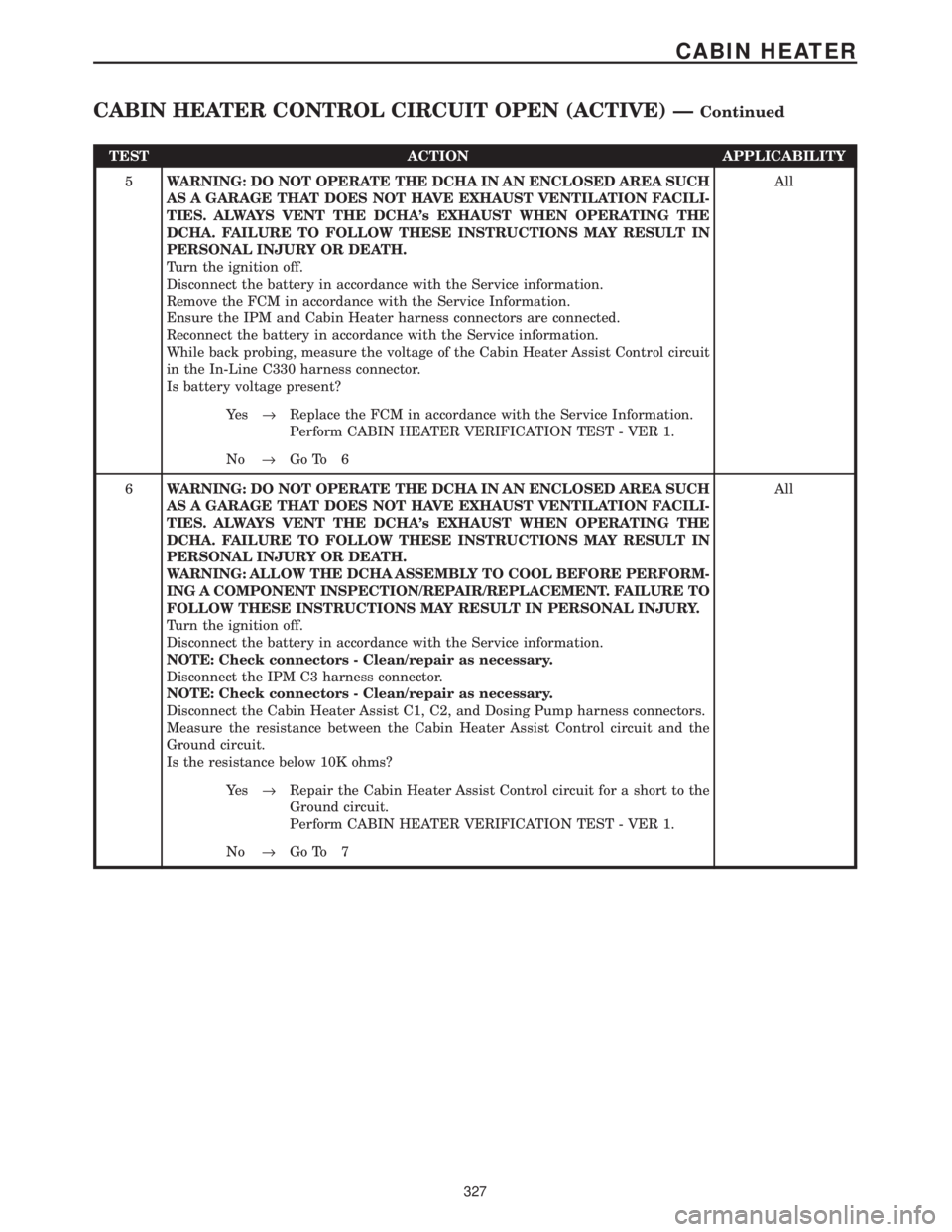
TEST ACTION APPLICABILITY
5WARNING: DO NOT OPERATE THE DCHA IN AN ENCLOSED AREA SUCH
AS A GARAGE THAT DOES NOT HAVE EXHAUST VENTILATION FACILI-
TIES. ALWAYS VENT THE DCHA's EXHAUST WHEN OPERATING THE
DCHA. FAILURE TO FOLLOW THESE INSTRUCTIONS MAY RESULT IN
PERSONAL INJURY OR DEATH.
Turn the ignition off.
Disconnect the battery in accordance with the Service information.
Remove the FCM in accordance with the Service Information.
Ensure the IPM and Cabin Heater harness connectors are connected.
Reconnect the battery in accordance with the Service information.
While back probing, measure the voltage of the Cabin Heater Assist Control circuit
in the In-Line C330 harness connector.
Is battery voltage present?All
Ye s®Replace the FCM in accordance with the Service Information.
Perform CABIN HEATER VERIFICATION TEST - VER 1.
No®Go To 6
6WARNING: DO NOT OPERATE THE DCHA IN AN ENCLOSED AREA SUCH
AS A GARAGE THAT DOES NOT HAVE EXHAUST VENTILATION FACILI-
TIES. ALWAYS VENT THE DCHA's EXHAUST WHEN OPERATING THE
DCHA. FAILURE TO FOLLOW THESE INSTRUCTIONS MAY RESULT IN
PERSONAL INJURY OR DEATH.
WARNING: ALLOW THE DCHA ASSEMBLY TO COOL BEFORE PERFORM-
ING A COMPONENT INSPECTION/REPAIR/REPLACEMENT. FAILURE TO
FOLLOW THESE INSTRUCTIONS MAY RESULT IN PERSONAL INJURY.
Turn the ignition off.
Disconnect the battery in accordance with the Service information.
NOTE: Check connectors - Clean/repair as necessary.
Disconnect the IPM C3 harness connector.
NOTE: Check connectors - Clean/repair as necessary.
Disconnect the Cabin Heater Assist C1, C2, and Dosing Pump harness connectors.
Measure the resistance between the Cabin Heater Assist Control circuit and the
Ground circuit.
Is the resistance below 10K ohms?All
Ye s®Repair the Cabin Heater Assist Control circuit for a short to the
Ground circuit.
Perform CABIN HEATER VERIFICATION TEST - VER 1.
No®Go To 7
327
CABIN HEATER
CABIN HEATER CONTROL CIRCUIT OPEN (ACTIVE) ÐContinued
Page 357 of 4284
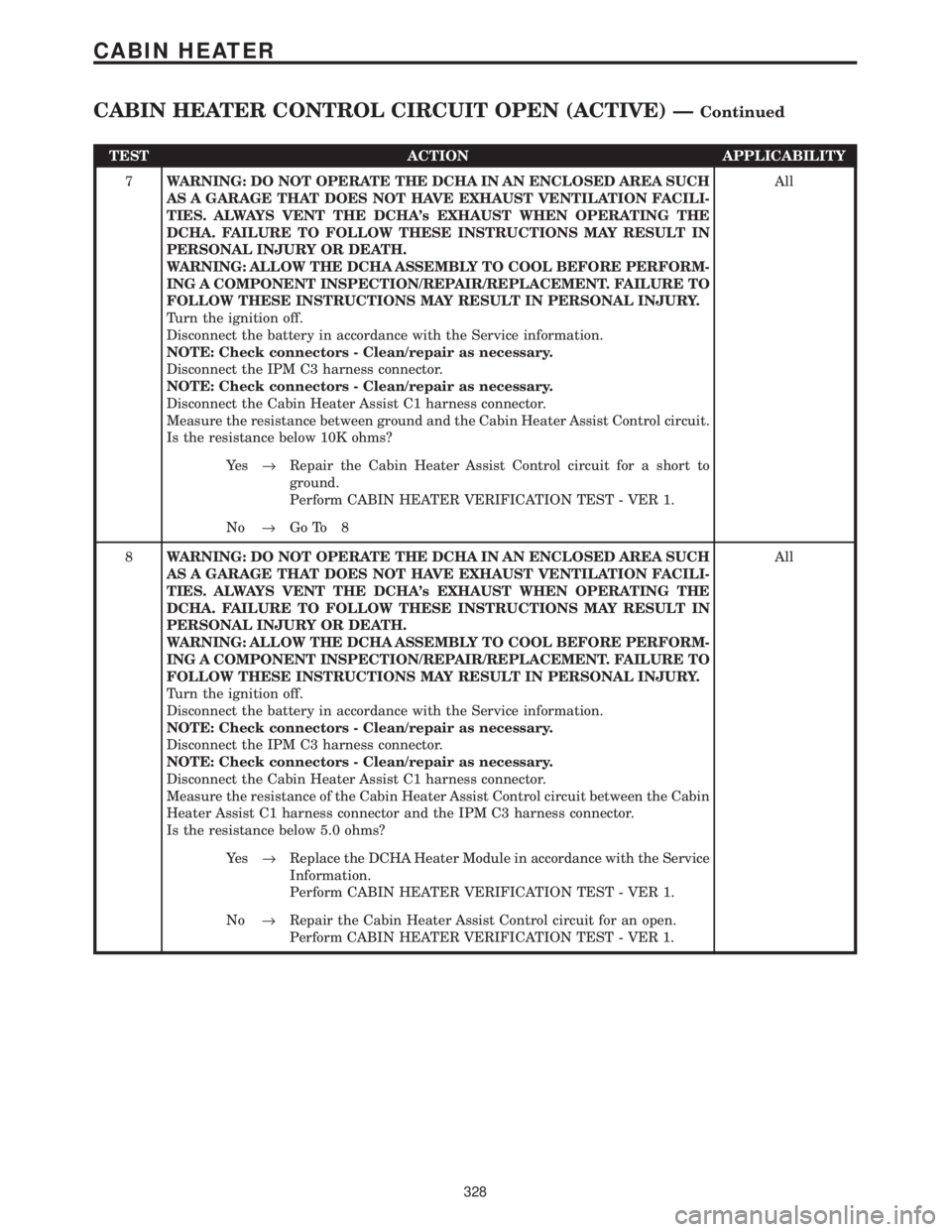
TEST ACTION APPLICABILITY
7WARNING: DO NOT OPERATE THE DCHA IN AN ENCLOSED AREA SUCH
AS A GARAGE THAT DOES NOT HAVE EXHAUST VENTILATION FACILI-
TIES. ALWAYS VENT THE DCHA's EXHAUST WHEN OPERATING THE
DCHA. FAILURE TO FOLLOW THESE INSTRUCTIONS MAY RESULT IN
PERSONAL INJURY OR DEATH.
WARNING: ALLOW THE DCHA ASSEMBLY TO COOL BEFORE PERFORM-
ING A COMPONENT INSPECTION/REPAIR/REPLACEMENT. FAILURE TO
FOLLOW THESE INSTRUCTIONS MAY RESULT IN PERSONAL INJURY.
Turn the ignition off.
Disconnect the battery in accordance with the Service information.
NOTE: Check connectors - Clean/repair as necessary.
Disconnect the IPM C3 harness connector.
NOTE: Check connectors - Clean/repair as necessary.
Disconnect the Cabin Heater Assist C1 harness connector.
Measure the resistance between ground and the Cabin Heater Assist Control circuit.
Is the resistance below 10K ohms?All
Ye s®Repair the Cabin Heater Assist Control circuit for a short to
ground.
Perform CABIN HEATER VERIFICATION TEST - VER 1.
No®Go To 8
8WARNING: DO NOT OPERATE THE DCHA IN AN ENCLOSED AREA SUCH
AS A GARAGE THAT DOES NOT HAVE EXHAUST VENTILATION FACILI-
TIES. ALWAYS VENT THE DCHA's EXHAUST WHEN OPERATING THE
DCHA. FAILURE TO FOLLOW THESE INSTRUCTIONS MAY RESULT IN
PERSONAL INJURY OR DEATH.
WARNING: ALLOW THE DCHA ASSEMBLY TO COOL BEFORE PERFORM-
ING A COMPONENT INSPECTION/REPAIR/REPLACEMENT. FAILURE TO
FOLLOW THESE INSTRUCTIONS MAY RESULT IN PERSONAL INJURY.
Turn the ignition off.
Disconnect the battery in accordance with the Service information.
NOTE: Check connectors - Clean/repair as necessary.
Disconnect the IPM C3 harness connector.
NOTE: Check connectors - Clean/repair as necessary.
Disconnect the Cabin Heater Assist C1 harness connector.
Measure the resistance of the Cabin Heater Assist Control circuit between the Cabin
Heater Assist C1 harness connector and the IPM C3 harness connector.
Is the resistance below 5.0 ohms?All
Ye s®Replace the DCHA Heater Module in accordance with the Service
Information.
Perform CABIN HEATER VERIFICATION TEST - VER 1.
No®Repair the Cabin Heater Assist Control circuit for an open.
Perform CABIN HEATER VERIFICATION TEST - VER 1.
328
CABIN HEATER
CABIN HEATER CONTROL CIRCUIT OPEN (ACTIVE) ÐContinued
Page 358 of 4284

Symptom:
CABIN HEATER CONTROL CIRCUIT SHORT TO BATTERY (AC-
TIVE)
When Monitored and Set Condition:
CABIN HEATER CONTROL CIRCUIT SHORT TO BATTERY (ACTIVE)
When Monitored: During DCHA activation and operation.
Set Condition: This DTC will set if the FCM sees a voltage between 5.0 and 15.0 volts on
the Cabin Heater Assist Control circuit.
POSSIBLE CAUSES
DCHA CONTROL UNIT FAULT
CABIN HEATER ASSIST CONTROL CIRCUIT SHORTED TO THE FUSED B(+) CIRCUIT
FCM FAULT
CABIN HEATER ASSIST CONTROL CIRCUIT SHORTED HIGH
TEST ACTION APPLICABILITY
1WARNING: DO NOT OPERATE THE DCHA IN AN ENCLOSED AREA SUCH
AS A GARAGE THAT DOES NOT HAVE EXHAUST VENTILATION FACILI-
TIES. ALWAYS VENT THE DCHA's EXHAUST WHEN OPERATING THE
DCHA. FAILURE TO FOLLOW THESE INSTRUCTIONS MAY RESULT IN
PERSONAL INJURY OR DEATH.
WARNING: ALLOW THE DCHA ASSEMBLY TO COOL BEFORE PERFORM-
ING A COMPONENT INSPECTION/REPAIR/REPLACEMENT. FAILURE TO
FOLLOW THESE INSTRUCTIONS MAY RESULT IN PERSONAL INJURY.
Turn the ignition off.
NOTE: Check connectors - Clean/repair as necessary.
Disconnect the Cabin Heater Assist C1 harness connector.
Turn the ignition on.
With the DRBIIItin FCM, read the active DTCs.
Is the Cabin Heater Relay Short To Battery DTC still active?All
Ye s®Go To 2
No®Replace the DCHA Heater Module in accordance with the Service
Information.
Perform CABIN HEATER VERIFICATION TEST - VER 1.
329
CABIN HEATER
Page 359 of 4284
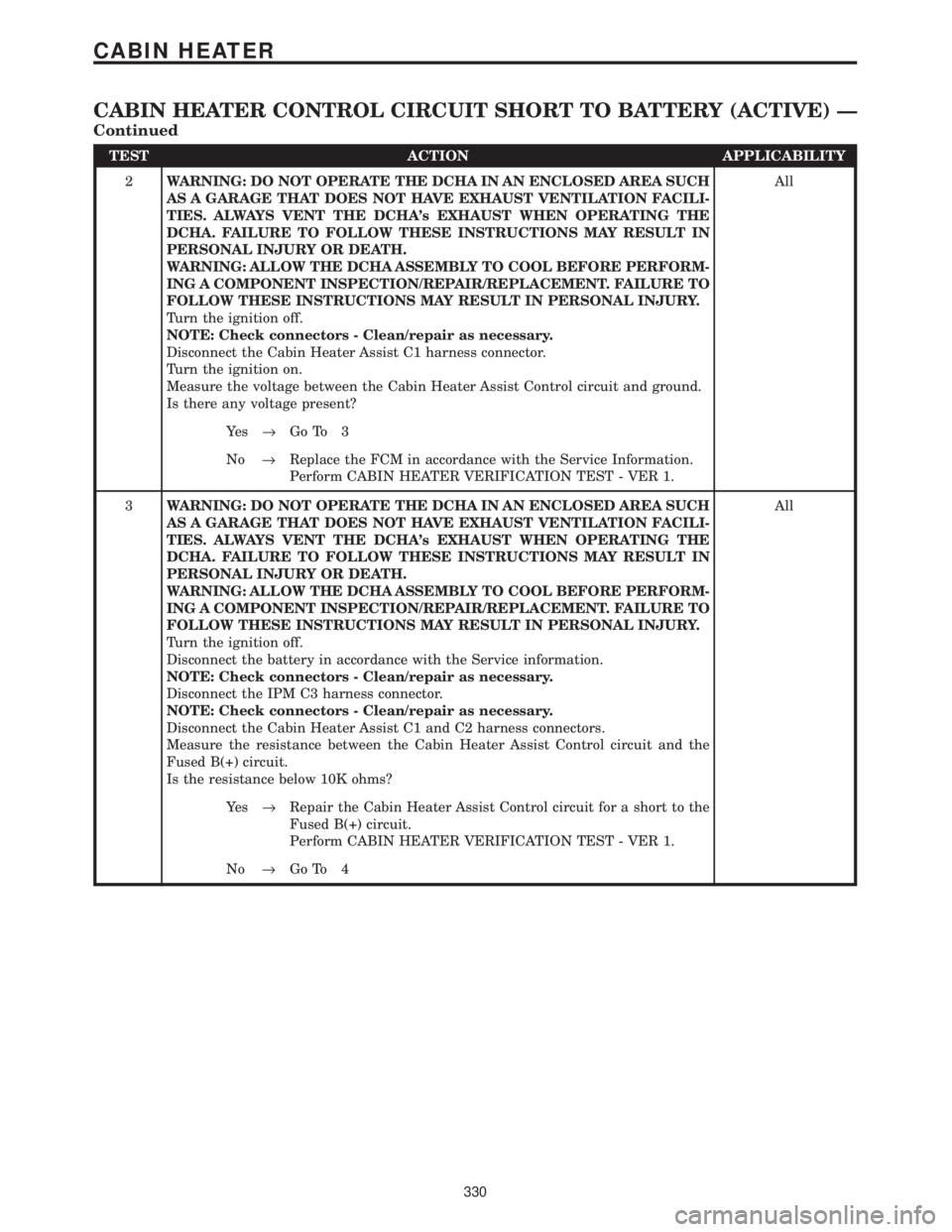
TEST ACTION APPLICABILITY
2WARNING: DO NOT OPERATE THE DCHA IN AN ENCLOSED AREA SUCH
AS A GARAGE THAT DOES NOT HAVE EXHAUST VENTILATION FACILI-
TIES. ALWAYS VENT THE DCHA's EXHAUST WHEN OPERATING THE
DCHA. FAILURE TO FOLLOW THESE INSTRUCTIONS MAY RESULT IN
PERSONAL INJURY OR DEATH.
WARNING: ALLOW THE DCHA ASSEMBLY TO COOL BEFORE PERFORM-
ING A COMPONENT INSPECTION/REPAIR/REPLACEMENT. FAILURE TO
FOLLOW THESE INSTRUCTIONS MAY RESULT IN PERSONAL INJURY.
Turn the ignition off.
NOTE: Check connectors - Clean/repair as necessary.
Disconnect the Cabin Heater Assist C1 harness connector.
Turn the ignition on.
Measure the voltage between the Cabin Heater Assist Control circuit and ground.
Is there any voltage present?All
Ye s®Go To 3
No®Replace the FCM in accordance with the Service Information.
Perform CABIN HEATER VERIFICATION TEST - VER 1.
3WARNING: DO NOT OPERATE THE DCHA IN AN ENCLOSED AREA SUCH
AS A GARAGE THAT DOES NOT HAVE EXHAUST VENTILATION FACILI-
TIES. ALWAYS VENT THE DCHA's EXHAUST WHEN OPERATING THE
DCHA. FAILURE TO FOLLOW THESE INSTRUCTIONS MAY RESULT IN
PERSONAL INJURY OR DEATH.
WARNING: ALLOW THE DCHA ASSEMBLY TO COOL BEFORE PERFORM-
ING A COMPONENT INSPECTION/REPAIR/REPLACEMENT. FAILURE TO
FOLLOW THESE INSTRUCTIONS MAY RESULT IN PERSONAL INJURY.
Turn the ignition off.
Disconnect the battery in accordance with the Service information.
NOTE: Check connectors - Clean/repair as necessary.
Disconnect the IPM C3 harness connector.
NOTE: Check connectors - Clean/repair as necessary.
Disconnect the Cabin Heater Assist C1 and C2 harness connectors.
Measure the resistance between the Cabin Heater Assist Control circuit and the
Fused B(+) circuit.
Is the resistance below 10K ohms?All
Ye s®Repair the Cabin Heater Assist Control circuit for a short to the
Fused B(+) circuit.
Perform CABIN HEATER VERIFICATION TEST - VER 1.
No®Go To 4
330
CABIN HEATER
CABIN HEATER CONTROL CIRCUIT SHORT TO BATTERY (ACTIVE) Ð
Continued
Page 360 of 4284
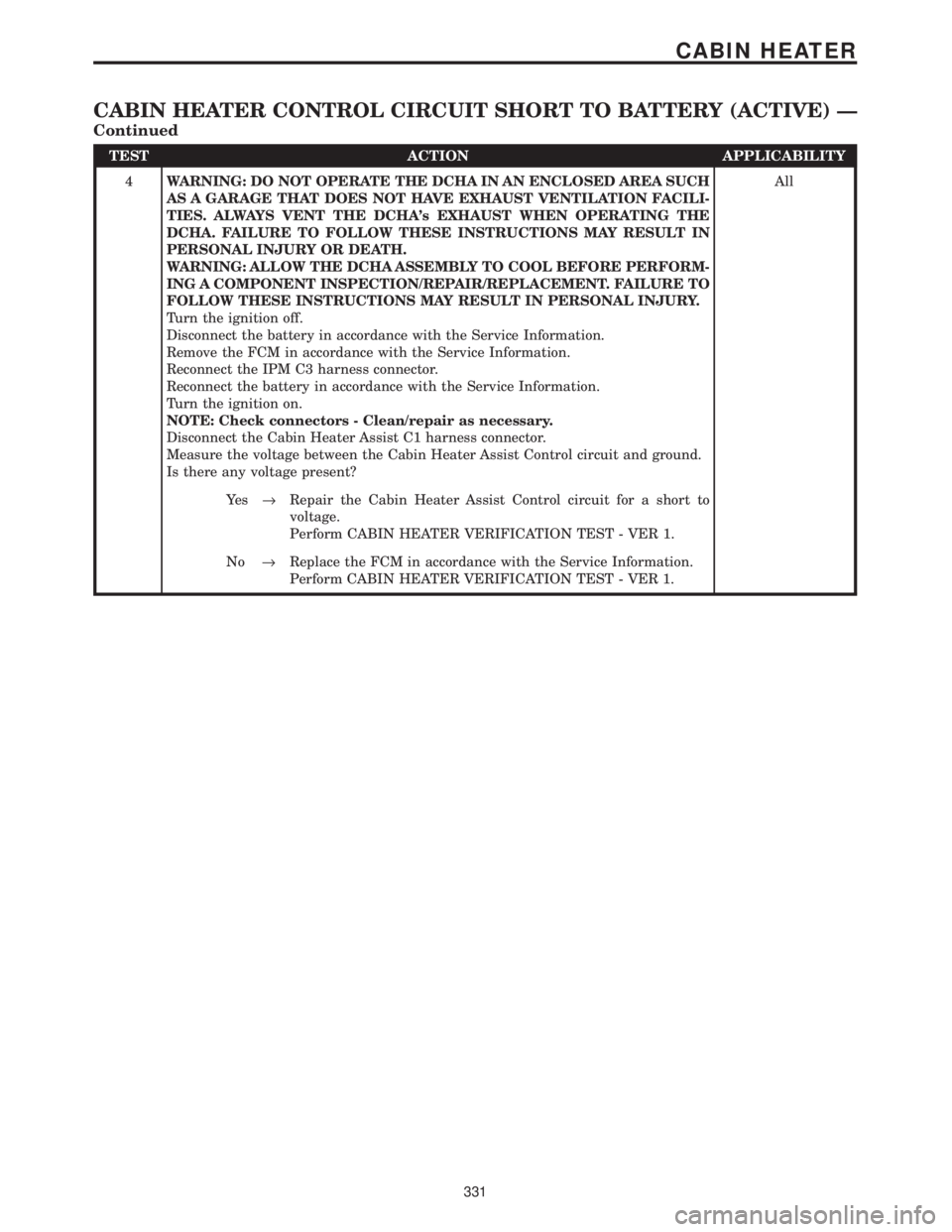
TEST ACTION APPLICABILITY
4WARNING: DO NOT OPERATE THE DCHA IN AN ENCLOSED AREA SUCH
AS A GARAGE THAT DOES NOT HAVE EXHAUST VENTILATION FACILI-
TIES. ALWAYS VENT THE DCHA's EXHAUST WHEN OPERATING THE
DCHA. FAILURE TO FOLLOW THESE INSTRUCTIONS MAY RESULT IN
PERSONAL INJURY OR DEATH.
WARNING: ALLOW THE DCHA ASSEMBLY TO COOL BEFORE PERFORM-
ING A COMPONENT INSPECTION/REPAIR/REPLACEMENT. FAILURE TO
FOLLOW THESE INSTRUCTIONS MAY RESULT IN PERSONAL INJURY.
Turn the ignition off.
Disconnect the battery in accordance with the Service Information.
Remove the FCM in accordance with the Service Information.
Reconnect the IPM C3 harness connector.
Reconnect the battery in accordance with the Service Information.
Turn the ignition on.
NOTE: Check connectors - Clean/repair as necessary.
Disconnect the Cabin Heater Assist C1 harness connector.
Measure the voltage between the Cabin Heater Assist Control circuit and ground.
Is there any voltage present?All
Ye s®Repair the Cabin Heater Assist Control circuit for a short to
voltage.
Perform CABIN HEATER VERIFICATION TEST - VER 1.
No®Replace the FCM in accordance with the Service Information.
Perform CABIN HEATER VERIFICATION TEST - VER 1.
331
CABIN HEATER
CABIN HEATER CONTROL CIRCUIT SHORT TO BATTERY (ACTIVE) Ð
Continued
Page 1020 of 4284
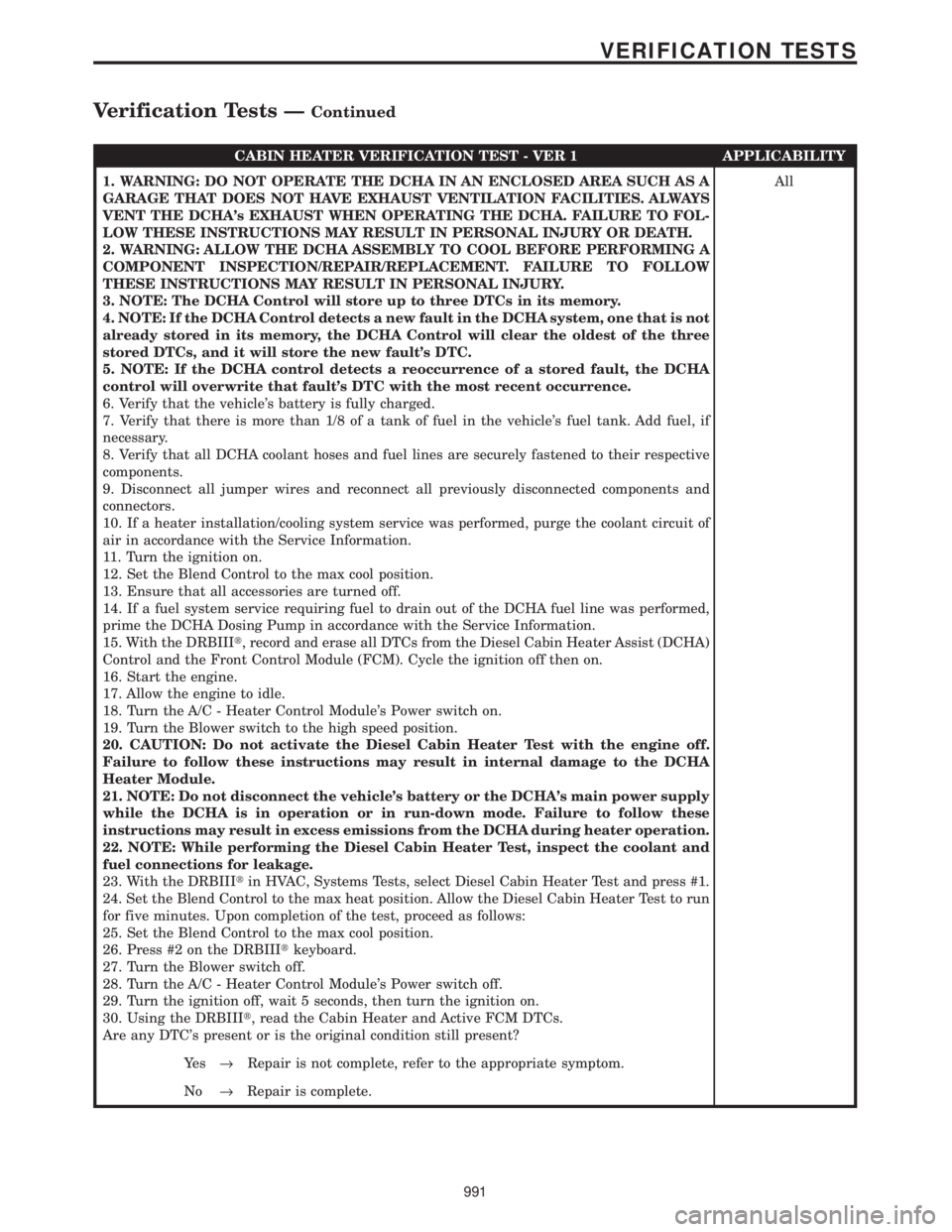
CABIN HEATER VERIFICATION TEST - VER 1 APPLICABILITY
1. WARNING: DO NOT OPERATE THE DCHA IN AN ENCLOSED AREA SUCH AS A
GARAGE THAT DOES NOT HAVE EXHAUST VENTILATION FACILITIES. ALWAYS
VENT THE DCHA's EXHAUST WHEN OPERATING THE DCHA. FAILURE TO FOL-
LOW THESE INSTRUCTIONS MAY RESULT IN PERSONAL INJURY OR DEATH.
2. WARNING: ALLOW THE DCHA ASSEMBLY TO COOL BEFORE PERFORMING A
COMPONENT INSPECTION/REPAIR/REPLACEMENT. FAILURE TO FOLLOW
THESE INSTRUCTIONS MAY RESULT IN PERSONAL INJURY.
3. NOTE: The DCHA Control will store up to three DTCs in its memory.
4. NOTE: If the DCHA Control detects a new fault in the DCHA system, one that is not
already stored in its memory, the DCHA Control will clear the oldest of the three
stored DTCs, and it will store the new fault's DTC.
5. NOTE: If the DCHA control detects a reoccurrence of a stored fault, the DCHA
control will overwrite that fault's DTC with the most recent occurrence.
6. Verify that the vehicle's battery is fully charged.
7. Verify that there is more than 1/8 of a tank of fuel in the vehicle's fuel tank. Add fuel, if
necessary.
8. Verify that all DCHA coolant hoses and fuel lines are securely fastened to their respective
components.
9. Disconnect all jumper wires and reconnect all previously disconnected components and
connectors.
10. If a heater installation/cooling system service was performed, purge the coolant circuit of
air in accordance with the Service Information.
11. Turn the ignition on.
12. Set the Blend Control to the max cool position.
13. Ensure that all accessories are turned off.
14. If a fuel system service requiring fuel to drain out of the DCHA fuel line was performed,
prime the DCHA Dosing Pump in accordance with the Service Information.
15. With the DRBIIIt, record and erase all DTCs from the Diesel Cabin Heater Assist (DCHA)
Control and the Front Control Module (FCM). Cycle the ignition off then on.
16. Start the engine.
17. Allow the engine to idle.
18. Turn the A/C - Heater Control Module's Power switch on.
19. Turn the Blower switch to the high speed position.
20. CAUTION: Do not activate the Diesel Cabin Heater Test with the engine off.
Failure to follow these instructions may result in internal damage to the DCHA
Heater Module.
21. NOTE: Do not disconnect the vehicle's battery or the DCHA's main power supply
while the DCHA is in operation or in run-down mode. Failure to follow these
instructions may result in excess emissions from the DCHA during heater operation.
22. NOTE: While performing the Diesel Cabin Heater Test, inspect the coolant and
fuel connections for leakage.
23. With the DRBIIItin HVAC, Systems Tests, select Diesel Cabin Heater Test and press #1.
24. Set the Blend Control to the max heat position. Allow the Diesel Cabin Heater Test to run
for five minutes. Upon completion of the test, proceed as follows:
25. Set the Blend Control to the max cool position.
26. Press #2 on the DRBIIItkeyboard.
27. Turn the Blower switch off.
28. Turn the A/C - Heater Control Module's Power switch off.
29. Turn the ignition off, wait 5 seconds, then turn the ignition on.
30. Using the DRBIIIt, read the Cabin Heater and Active FCM DTCs.
Are any DTC's present or is the original condition still present?All
Ye s®Repair is not complete, refer to the appropriate symptom.
No®Repair is complete.
991
VERIFICATION TESTS
Verification Tests ÐContinued