Page 339 of 468
5-33
A. Hoist Assembly
B. Wheel Wrench
C. Extensions
D. Hoist ShaftE. Valve Stem,
Pointed Down
F. Flat or Spare Tire
G. Retainer
H. Hoist Cable
5. Raise the tire fully against the underside of the
vehicle. Continue turning the wheel wrench until the
tire is secure and the cable is tight. The spare tire
hoist cannot be overtightened.
6. Make sure the tire is stored securely. Push, pull, and
then try to rotate or turn the tire. If the tire moves,
use the wheel wrench/hoist shaft to tighten the cable.
Replace the jack, tools and spare tire lock.
Page 396 of 468

6-54 Tire Inspection and Rotation
Tires should be rotated every 6,000 to 8,000 miles
(10 000 to 13 000 km). Any time you notice unusual
wear, rotate your tires as soon as possible and check
wheel alignment. Also check for damaged tires or
wheels. See ªWhen It's Time for New Tiresº and
ªWheel Replacementº later in this section for more
information. Make sure the spare tire is stored securely.
Push, pull, and then try to rotate or turn the tire.
If it moves, use the wheel wrench/hoist shaft to tighten
the cable. See ªStoring a Flat or Spare Tire and Toolsº
in the Index.
The purpose of regular rotation is to achieve more
uniform wear for all tires on the vehicle. The first
rotation is the most important. See ªScheduled
Maintenance Servicesº in the Index for scheduled
rotation intervals.
If your vehicle has single rear wheels and the tread
design for your front tires is the same as your rear tires,
always use one of the correct rotation patterns shown
here when rotating your tires.
If your vehicle has front tires with different tread designs
(such as all season vs. on/off road) than the rear tires,
don't rotate your tires front to rear.
Page 398 of 468
6-56
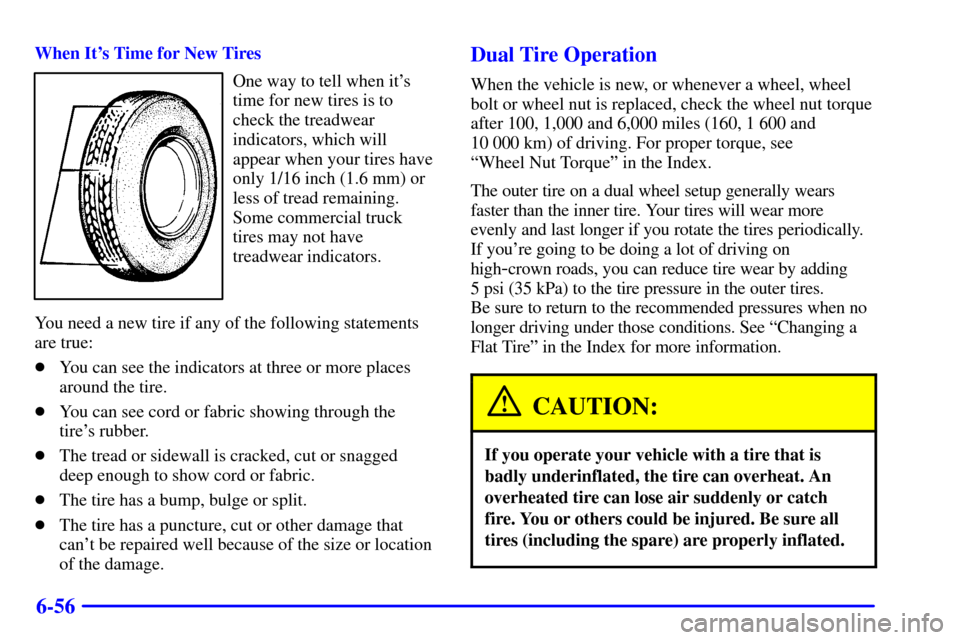
When It's Time for New Tires
One way to tell when it's
time for new tires is to
check the treadwear
indicators, which will
appear when your tires have
only 1/16 inch (1.6 mm) or
less of tread remaining.
Some commercial truck
tires may not have
treadwear indicators.
You need a new tire if any of the following statements
are true:
�You can see the indicators at three or more places
around the tire.
�You can see cord or fabric showing through the
tire's rubber.
�The tread or sidewall is cracked, cut or snagged
deep enough to show cord or fabric.
�The tire has a bump, bulge or split.
�The tire has a puncture, cut or other damage that
can't be repaired well because of the size or location
of the damage.
Dual Tire Operation
When the vehicle is new, or whenever a wheel, wheel
bolt or wheel nut is replaced, check the wheel nut torque
after 100, 1,000 and 6,000 miles (160, 1 600 and
10 000 km) of driving. For proper torque, see
ªWheel Nut Torqueº in the Index.
The outer tire on a dual wheel setup generally wears
faster than the inner tire. Your tires will wear more
evenly and last longer if you rotate the tires periodically.
If you're going to be doing a lot of driving on
high
-crown roads, you can reduce tire wear by adding
5 psi (35 kPa) to the tire pressure in the outer tires.
Be sure to return to the recommended pressures when no
longer driving under those conditions. See ªChanging a
Flat Tireº in the Index for more information.
CAUTION:
If you operate your vehicle with a tire that is
badly underinflated, the tire can overheat. An
overheated tire can lose air suddenly or catch
fire. You or others could be injured. Be sure all
tires (including the spare) are properly inflated.
Page 443 of 468
7-18
Part B: Owner Checks and Services
Listed in this part are owner checks and services which
should be performed at the intervals specified to help
ensure the safety, dependability and emission control
performance of your vehicle.
Be sure any necessary repairs are completed at once.
Whenever any fluids or lubricants are added to your
vehicle, make sure they are the proper ones, as shown
in Part D.
At the First 100, 1,000 and 6,000 Miles
(160, 1 600 and 10 000 km)
Check dual wheel nut torque. For proper torque, see
ªWheel Nut Torqueº in the Index.
At Each Fuel Fill
It is important for you or a service station attendant
to perform these underhood checks at each fuel fill.
Engine Oil Level Check
Check the engine oil level and add the proper oil if
necessary. See ªEngine Oilº in the Index for
further details.Engine Coolant Level Check
Check the engine coolant level and add DEX
-COOL�
coolant mixture if necessary. See ªEngine Coolantº in
the Index for further details.
Windshield Washer Fluid Level Check
Check the windshield washer fluid level in the
windshield washer tank and add the proper fluid if
necessary. See ªWindshield Washer Fluidº in the
Index for further details.
At Least Once a Month
Tire Inflation Check
Make sure tires are inflated to the correct pressures.
Don't forget to check your spare tire. See ªTiresº in
the Index for further details.
Cassette Deck Service
Clean cassette deck. Cleaning should be done every
50 hours of tape play. See ªAudio Systemsº in the
Index for further details.
Page 444 of 468

7-19 At Least Twice a Year
Restraint System Check
Make sure the safety belt reminder light and all your
belts, buckles, latch plates, retractors and anchorages are
working properly. Look for any other loose or damaged
safety belt system parts. If you see anything that might
keep a safety belt system from doing its job, have it
repaired. Have any torn or frayed safety belts replaced.
Also look for any opened or broken air bag coverings,
and have them repaired or replaced. (The air bag system
does not need regular maintenance.)
Wiper Blade Check
Inspect wiper blades for wear or cracking. Replace blade
inserts that appear worn or damaged or that streak or
miss areas of the windshield. Also see ªWiper Blades,
Cleaningº in the Index.Spare Tire Check
At least twice a year, after the monthly inflation check
of the spare tire determines that the spare is inflated to
the correct tire inflation pressure, make sure that the
spare tire is stored securely. Push, pull, and then try
to rotate or turn the tire. If it moves, use the wheel
wrench/ratchet to tighten the cable. See ªStoring the
Spare Tire and Toolsº in the Index.
Engine Air Cleaner Filter Restriction Indicator Check
Your vehicle has an indicator located on the air cleaner
in the engine compartment that lets you know when the
air cleaner filter is dirty and needs to be changed. Check
indicator at least twice a year or when your engine oil is
changed, whichever occurs first. See ªAir Cleanerº in
the Index for more information. Inspect your air cleaner
filter restriction indicator more often if the vehicle is
used in dusty areas or under off road conditions.