Page 6 of 321
iv
Maintenance Schedule Service and Appearance Care
Section
7
Section
6
Scheduled Maintenance
Owner Checks and Services
Periodic Maintenance InspectionsRecommended Fluids and Lubricants
Maintenance Records Fuel
Checking Fluids and Lubricants
Engine Air Cleaner/Filter
Brakes
Bulb Replacement
Windshield Wiper Blade ReplacementTires and Wheels
Appearance Care
Electrical System/Fuses and Circuit Breakers
Capacities and Specifications
Normal Maintenance Replacement Parts
Page 78 of 321

2-29
Turn Signal/Multifunction Lever
The lever on the left side of the steering column
includes the following:
�Turn and Lane Change Signals
�Headlamp High/Low
-Beam Changer
�Windshield Wipers
�Windshield Washer
�Cruise Control (If Equipped)
Turn and Lane Change Signals
The turn signal has two upward (for right) and
two downward (for left) positions. These positions
allow you to signal a turn or a lane change.
To signal a turn, move the lever all the way up or down.
When the turn is finished, the lever will return automatically.
An arrow located on the
instrument panel cluster will
flash in the direction of the
turn or lane change.
To signal a lane change, just raise or lower the lever
until the arrow starts to flash. Hold it there until you
complete your lane change. The lever will return by
itself when you release it.
If you move the lever all the way up or down, and the
arrow flashes at twice the normal rate, a signal bulb
may be burned out and other drivers may not see your
turn signal.
If a bulb is burned out, replace it to help avoid an
accident. If the arrows don't go on at all when you
signal a turn, check for burned
-out bulbs and a blown
fuse (see ªFuses and Circuit Breakersº in the Index).
Page 157 of 321
4-36 Backing Up
Hold the bottom of the steering wheel with one hand.
Then, to move the trailer to the left, just move that hand
to the left. To move the trailer to the right, move your
hand to the right. Always back up slowly and, if
possible, have someone guide you.
Making Turns
NOTICE:
Making very sharp turns while trailering could
cause the trailer to come in contact with the
vehicle. Your vehicle could be damaged. Avoid
making very sharp turns while trailering.
When you're turning with a trailer, make wider turns than
normal. Do this so your trailer won't strike soft shoulders,
curbs, road signs, trees or other objects. Avoid jerky or
sudden maneuvers. Signal well in advance.
Turn Signals When Towing a Trailer
The arrows on your instrument panel will flash
whenever you signal a turn or lane change. Properly
hooked up, the trailer lamps will also flash, telling other
drivers you're about to turn, change lanes or stop.
When towing a trailer, the arrows on your instrument
panel will flash for turns even if the bulbs on the trailer
are burned out. Thus, you may think drivers behind
you are seeing your signal when they are not. It's
important to check occasionally to be sure the trailer
bulbs are still working.
Driving On Grades
Reduce speed and shift to a lower gear before you start
down a long or steep downgrade. If you don't shift
down, you might have to use your brakes so much
that they would get hot and no longer work well.
If you have an automatic transmission, you can tow in
AUTOMATIC OVERDRIVE (�). You may want to
shift the transmission to THIRD (3) or, if necessary, a
lower gear selection if the transmission shifts too often
(e.g., under heavy loads and/or hilly conditions).
Page 184 of 321

6-
6-1
Section 6 Service and Appearance Care
Here you will find information about the care of your vehicle. This section begins with service and fuel information,
and then it shows how to check important fluid and lubricant levels. There is also technical information about your
vehicle, and a part devoted to its appearance care.
6
-2 Service
6
-3 Fuel (Gasoline Engine)
6
-5 Fuels in Foreign Countries (Gasoline Engines)
6
-5 Filling Your Tank (Gasoline Engine)
6
-7 Filling a Portable Fuel Container
6
-7 Checking Things Under the Hood
6
-10 Noise Control System
6
-11 Engine Oil (Gasoline Engine)
6
-15 Engine Air Cleaner/Filter (Gasoline Engines)
6
-17 Automatic Transmission Fluid
6
-20 Manual Transmission Fluid
6
-21 Hydraulic Clutch
6
-22 Rear Axle
6
-23 Engine Coolant
6
-27 Radiator Pressure Cap (Gasoline Engine)
6
-27 Power Steering Fluid6
-28 Windshield Washer Fluid
6
-29 Brakes
6
-33 Battery
6
-33 Bulb Replacement
6
-40 Windshield Wiper Blade Replacement
6
-41 Tires
6
-51 Appearance Care
6
-52 Cleaning the Inside of Your Vehicle
6
-55 Cleaning the Outside of Your Vehicle
6
-58 GM Vehicle Care/Appearance Materials
6
-59 Vehicle Identification Number (VIN)
6
-59 Electrical System
6
-65 Replacement Bulbs
6
-66 Capacities and Specifications
6
-67 Normal Maintenance Replacement Parts
Page 216 of 321
6-33
Battery
Your new vehicle comes with a maintenance free
ACDelco� battery. When it's time for a new battery,
get one that has the replacement number shown on the
original battery's label. We recommend an ACDelco
battery. See ªEngine Compartment Overviewº in the
Index for battery location.
WARNING: Battery posts, terminals and related
accessories contain lead and lead compounds, chemicals
known to the State of California to cause cancer and
reproductive harm. Wash hands after handling.
Vehicle Storage
If you're not going to drive your vehicle for 25 days or more,
remove the black, negative (
-) cable from the battery.
This will help keep your battery from running down.
CAUTION:
Batteries have acid that can burn you and gas
that can explode. You can be badly hurt if you
aren't careful. See ªJump Startingº in the Index
for tips on working around a battery without
getting hurt.
Contact your dealer to learn how to prepare your vehicle
for longer storage periods.
Bulb Replacement
For any bulb changing procedure not listed in this
section, contact your GM dealership service department.
Before you replace any bulbs, be sure that all the lamps
are off and the engine isn't running. See ªReplacement
Bulbsº in the Index for the proper types of bulbs to use.
Halogen Bulbs
CAUTION:
Halogen bulbs have pressurized gas inside and
can burst if you drop or scratch the bulb. You or
others could be injured. Be sure to read and
follow the instructions on the bulb package.
Page 218 of 321
6-35
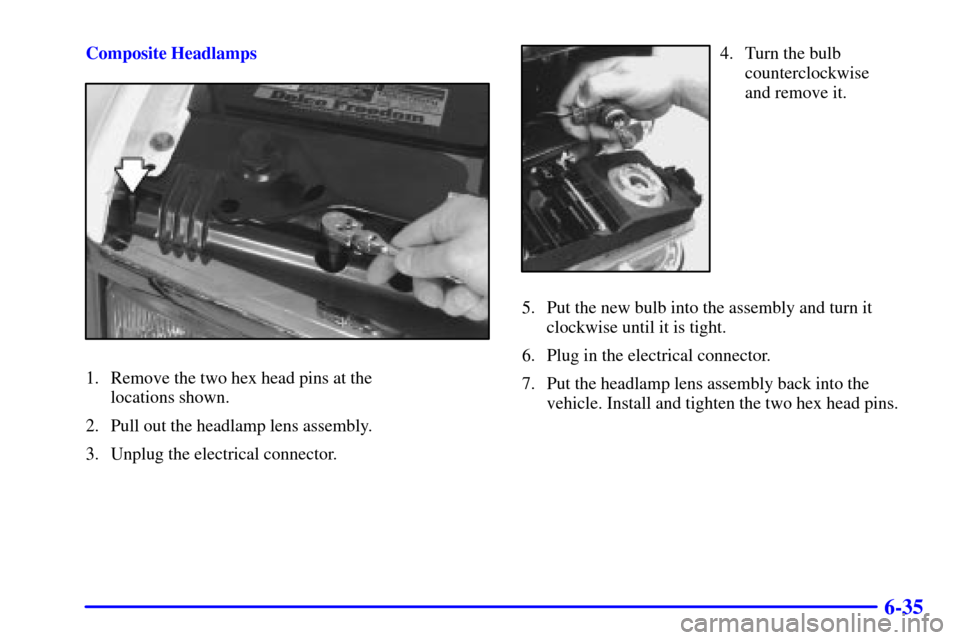
Composite Headlamps
1. Remove the two hex head pins at the
locations shown.
2. Pull out the headlamp lens assembly.
3. Unplug the electrical connector.
4. Turn the bulb
counterclockwise
and remove it.
5. Put the new bulb into the assembly and turn it
clockwise until it is tight.
6. Plug in the electrical connector.
7. Put the headlamp lens assembly back into the
vehicle. Install and tighten the two hex head pins.
Page 219 of 321
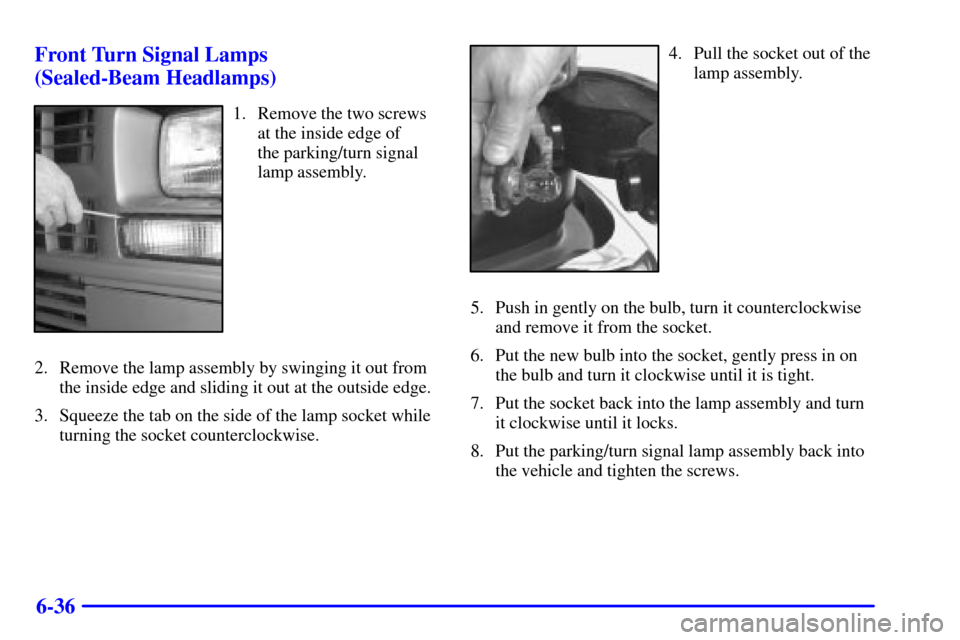
6-36 Front Turn Signal Lamps
(Sealed-Beam Headlamps)
1. Remove the two screws
at the inside edge of
the parking/turn signal
lamp assembly.
2. Remove the lamp assembly by swinging it out from
the inside edge and sliding it out at the outside edge.
3. Squeeze the tab on the side of the lamp socket while
turning the socket counterclockwise.
4. Pull the socket out of the
lamp assembly.
5. Push in gently on the bulb, turn it counterclockwise
and remove it from the socket.
6. Put the new bulb into the socket, gently press in on
the bulb and turn it clockwise until it is tight.
7. Put the socket back into the lamp assembly and turn
it clockwise until it locks.
8. Put the parking/turn signal lamp assembly back into
the vehicle and tighten the screws.
Page 220 of 321
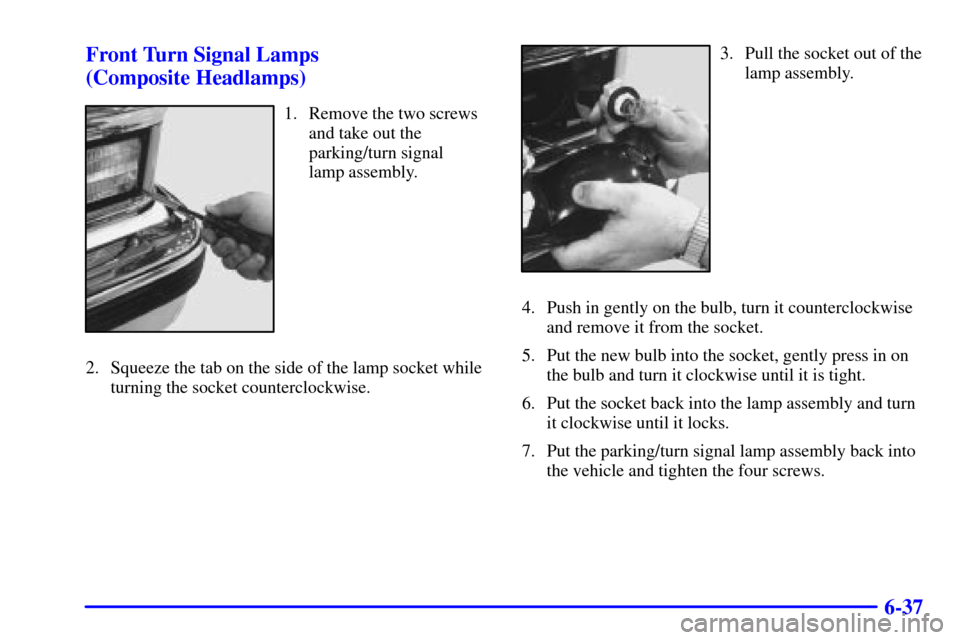
6-37 Front Turn Signal Lamps
(Composite Headlamps)
1. Remove the two screws
and take out the
parking/turn signal
lamp assembly.
2. Squeeze the tab on the side of the lamp socket while
turning the socket counterclockwise.
3. Pull the socket out of the
lamp assembly.
4. Push in gently on the bulb, turn it counterclockwise
and remove it from the socket.
5. Put the new bulb into the socket, gently press in on
the bulb and turn it clockwise until it is tight.
6. Put the socket back into the lamp assembly and turn
it clockwise until it locks.
7. Put the parking/turn signal lamp assembly back into
the vehicle and tighten the four screws.