Page 4 of 321
Table of Contents
Windows
Keys and Door Locks
Keyless Entry System
Automatic Transmission
Manual Transmission
Parking Brake
Tilt Wheel
Turn Signal/Multifunction LeverWindshield Wipers
Cruise Control
Exterior and Interior Lamps
Mirrors
Storage Compartments
Accessory Power Outlets
Instrument Panel, Warning Lights and Gages Seats and Seat Controls
Safety BeltsRestraint Systems for Children
Section
1
Section
2
Seats and Restraint Systems
Features and Controls
ii
Page 6 of 321
iv
Maintenance Schedule Service and Appearance Care
Section
7
Section
6
Scheduled Maintenance
Owner Checks and Services
Periodic Maintenance InspectionsRecommended Fluids and Lubricants
Maintenance Records Fuel
Checking Fluids and Lubricants
Engine Air Cleaner/Filter
Brakes
Bulb Replacement
Windshield Wiper Blade ReplacementTires and Wheels
Appearance Care
Electrical System/Fuses and Circuit Breakers
Capacities and Specifications
Normal Maintenance Replacement Parts
Page 20 of 321
1-7
In most states and Canadian provinces, the law says to
wear safety belts. Here's why: They work.
You never know if you'll be in a crash. If you do have
a crash, you don't know if it will be a bad one.
A few crashes are mild, and some crashes can be so
serious that even buckled up a person wouldn't survive.
But most crashes are in between. In many of them,
people who buckle up can survive and sometimes
walk away. Without belts they could have been badly
hurt or killed.
After more than 30 years of safety belts in vehicles,
the facts are clear. In most crashes buckling up does
matter ... a lot!Why Safety Belts Work
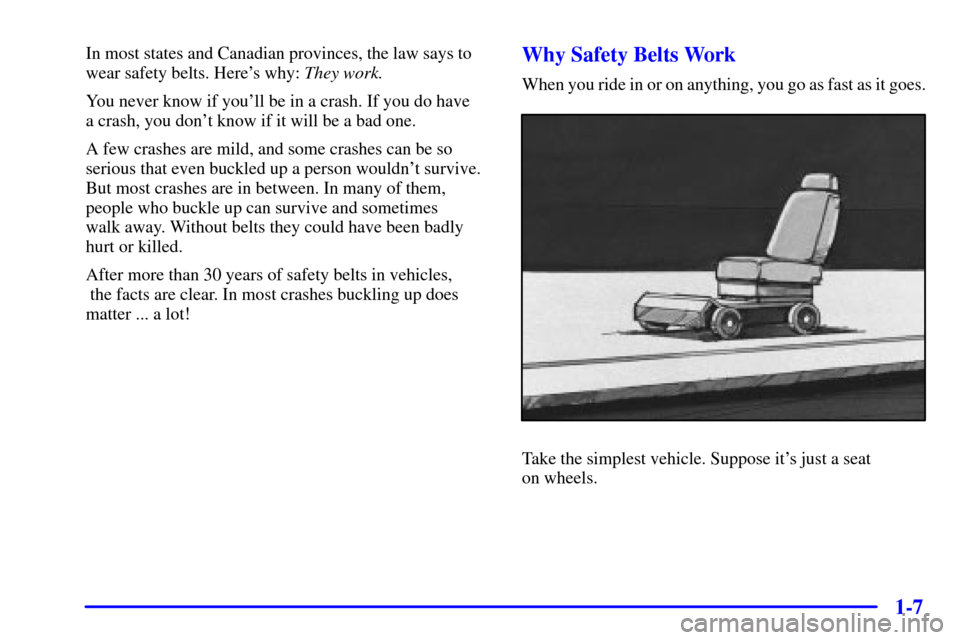
When you ride in or on anything, you go as fast as it goes.
Take the simplest vehicle. Suppose it's just a seat
on wheels.
Page 50 of 321
2-
2-1
Section 2 Features and Controls
Here you can learn about the many standard and optional features on your vehicle, and information on starting,
shifting and braking. Also explained are the instrument panel and the warning systems that tell you if everything is
working properly
-- and what to do if you have a problem.
2
-2 Windows
2
-4 Keys
2
-5 Door Locks
2
-7 Keyless Entry System (If Equipped)
2
-10 Theft
2
-11 Passlock�
2-11 New Vehicle ªBreak-Inº
2
-12 Ignition Positions
2
-13 Starting Your Gasoline Engine
2
-15 Engine Coolant Heater (If Equipped)
2
-16 Automatic Transmission Operation
2
-19 Manual Transmission Operation
2
-22 Parking Brake
2
-23 Shifting Into PARK (P)
(Automatic Transmission Only)
2
-25 Shifting Out of PARK (P)
(Automatic Transmission Only)2
-26 Parking Your Vehicle
(Manual Transmission Models Only)
2
-26 Parking Over Things That Burn
2
-27 Engine Exhaust
2
-27 Running Your Engine While You're Parked
(Automatic Transmission)
2
-28 Tilt Wheel (If Equipped)
2
-29 Turn Signal/Multifunction Lever
2
-34 Exterior Lamps
2
-36 Interior Lamps
2
-38 Mirrors
2
-41 Storage Compartments
2
-44 Instrument Panel - Your Information System
2
-46 Instrument Panel Cluster
2
-48 Warning Lights, Gages and Indicators
Page 59 of 321

2-10 Resynchronization
Resynchronization may be necessary due to the security
method used by this system. The transmitter does not
send the same signal twice to the receiver. The receiver
will not respond to a signal it has been sent previously.
This prevents anyone from recording and playing back
the signal from the transmitter.
To resynchronize your transmitter, stand close to your
vehicle and simultaneously press and hold the LOCK
and UNLOCK buttons on the transmitter for at least
five seconds. The door locks should cycle to confirm
synchronization. If the locks do not cycle, see your
dealer for service.
Theft
Vehicle theft is big business, especially in some cities.
Although your vehicle has a number of theft
-deterrent
features, we know that nothing we put on it can make
it impossible to steal. However, there are ways you
can help.
Key in the Ignition
If you leave your vehicle with the keys inside, it's an
easy target for joy riders or professional thieves
-- so
don't do it.When you park your vehicle and open the driver's door,
you'll hear a tone reminding you to remove your key
from the ignition and take it with you. Always do this.
Your steering wheel will be locked, and so will your
ignition. If you have an automatic transmission, taking
your key out also locks your transmission. Also
remember to lock the doors.
Parking at Night
Park in a lighted spot, close all windows and lock your
vehicle. Remember to keep your valuables out of sight.
Put them in a storage area, or take them with you.
Parking Lots
Even if you park in a lot where someone will be
watching your vehicle, it's still best to lock it up and
take your keys. But what if you have to leave your
ignition key? What if you have to leave something
valuable in your vehicle?
�Put your valuables in a storage area, like your
glove box.
�If your vehicle has a remote keyless entry system,
take the transmitter with you.
�Lock all the doors except the driver's.
Page 61 of 321
2-12
Ignition Positions
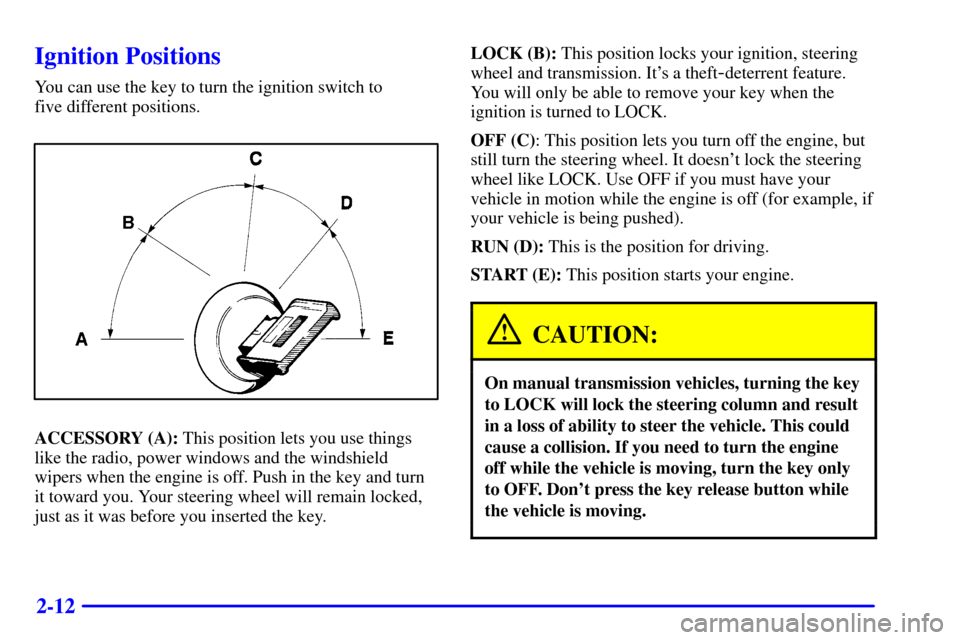
You can use the key to turn the ignition switch to
five different positions.
ACCESSORY (A): This position lets you use things
like the radio, power windows and the windshield
wipers when the engine is off. Push in the key and turn
it toward you. Your steering wheel will remain locked,
just as it was before you inserted the key.LOCK (B): This position locks your ignition, steering
wheel and transmission. It's a theft
-deterrent feature.
You will only be able to remove your key when the
ignition is turned to LOCK.
OFF (C): This position lets you turn off the engine, but
still turn the steering wheel. It doesn't lock the steering
wheel like LOCK. Use OFF if you must have your
vehicle in motion while the engine is off (for example, if
your vehicle is being pushed).
RUN (D): This is the position for driving.
START (E): This position starts your engine.
CAUTION:
On manual transmission vehicles, turning the key
to LOCK will lock the steering column and result
in a loss of ability to steer the vehicle. This could
cause a collision. If you need to turn the engine
off while the vehicle is moving, turn the key only
to OFF. Don't press the key release button while
the vehicle is moving.
Page 62 of 321
2-13
NOTICE:
If your key seems stuck in LOCK and you can't
turn it, be sure you are using the correct key; if
so, is it all the way in? If it is, then turn the
steering wheel left and right while you turn the
key hard. But turn the key only with your hand.
Using a tool to force it could break the key or the
ignition switch. If none of this works, then your
vehicle needs service.
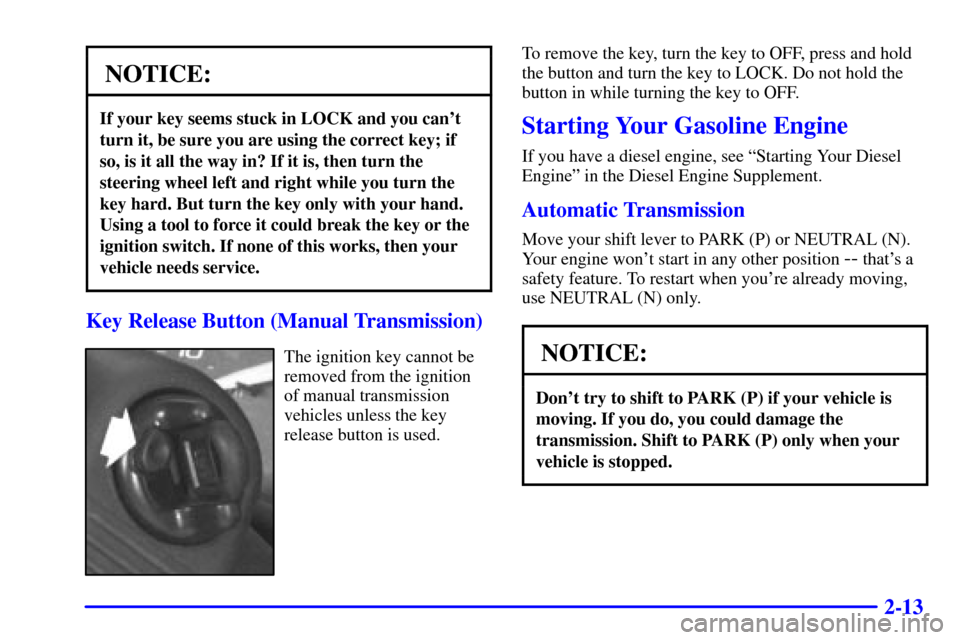
Key Release Button (Manual Transmission)
The ignition key cannot be
removed from the ignition
of manual transmission
vehicles unless the key
release button is used.To remove the key, turn the key to OFF, press and hold
the button and turn the key to LOCK. Do not hold the
button in while turning the key to OFF.
Starting Your Gasoline Engine
If you have a diesel engine, see ªStarting Your Diesel
Engineº in the Diesel Engine Supplement.
Automatic Transmission
Move your shift lever to PARK (P) or NEUTRAL (N).
Your engine won't start in any other position
-- that's a
safety feature. To restart when you're already moving,
use NEUTRAL (N) only.
NOTICE:
Don't try to shift to PARK (P) if your vehicle is
moving. If you do, you could damage the
transmission. Shift to PARK (P) only when your
vehicle is stopped.
Page 65 of 321

2-16
Automatic Transmission Operation
There are several different positions for your shift lever.
If your vehicle is equipped with an automatic
transmission, it features an electronic shift position
indicator within the instrument panel cluster. This
display must be powered any time the shift lever is
capable of being moved out of PARK (P). This means
that if your key is in OFF, rather than LOCK, there will
be a small current drain on your battery which could
discharge your battery over a period of time. If you have
to leave your key in the ignition in OFF for an extended
period, it is recommended that you disconnect the
battery cable from the battery to prevent discharging
your battery.PARK (P): This position locks your rear wheels. It's the
best position to use when you start your engine because
your vehicle can't move easily.
CAUTION:
It is dangerous to get out of your vehicle if the
shift lever is not fully in PARK (P) with the
parking brake firmly set. Your vehicle can roll.
Don't leave your vehicle when the engine is
running unless you have to. If you have left the
engine running, the vehicle can move suddenly.
You or others could be injured. To be sure your
vehicle won't move, even when you're on fairly
level ground, always set your parking brake and
move the shift lever to PARK (P).
See ªShifting Into PARK (P)º in the Index. If
you're pulling a trailer, see ªTowing a Trailerº in
the Index.