Page 4 of 321
Table of Contents
Windows
Keys and Door Locks
Keyless Entry System
Automatic Transmission
Manual Transmission
Parking Brake
Tilt Wheel
Turn Signal/Multifunction LeverWindshield Wipers
Cruise Control
Exterior and Interior Lamps
Mirrors
Storage Compartments
Accessory Power Outlets
Instrument Panel, Warning Lights and Gages Seats and Seat Controls
Safety BeltsRestraint Systems for Children
Section
1
Section
2
Seats and Restraint Systems
Features and Controls
ii
Page 22 of 321
1-9
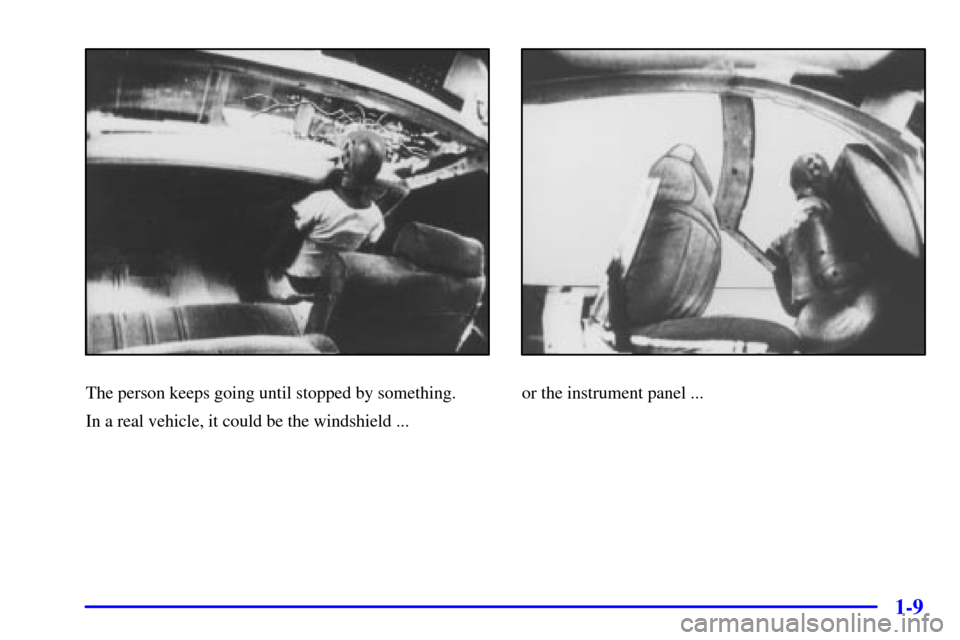
The person keeps going until stopped by something.
In a real vehicle, it could be the windshield ...or the instrument panel ...
Page 50 of 321
2-
2-1
Section 2 Features and Controls
Here you can learn about the many standard and optional features on your vehicle, and information on starting,
shifting and braking. Also explained are the instrument panel and the warning systems that tell you if everything is
working properly
-- and what to do if you have a problem.
2
-2 Windows
2
-4 Keys
2
-5 Door Locks
2
-7 Keyless Entry System (If Equipped)
2
-10 Theft
2
-11 Passlock�
2-11 New Vehicle ªBreak-Inº
2
-12 Ignition Positions
2
-13 Starting Your Gasoline Engine
2
-15 Engine Coolant Heater (If Equipped)
2
-16 Automatic Transmission Operation
2
-19 Manual Transmission Operation
2
-22 Parking Brake
2
-23 Shifting Into PARK (P)
(Automatic Transmission Only)
2
-25 Shifting Out of PARK (P)
(Automatic Transmission Only)2
-26 Parking Your Vehicle
(Manual Transmission Models Only)
2
-26 Parking Over Things That Burn
2
-27 Engine Exhaust
2
-27 Running Your Engine While You're Parked
(Automatic Transmission)
2
-28 Tilt Wheel (If Equipped)
2
-29 Turn Signal/Multifunction Lever
2
-34 Exterior Lamps
2
-36 Interior Lamps
2
-38 Mirrors
2
-41 Storage Compartments
2
-44 Instrument Panel - Your Information System
2
-46 Instrument Panel Cluster
2
-48 Warning Lights, Gages and Indicators
Page 65 of 321

2-16
Automatic Transmission Operation
There are several different positions for your shift lever.
If your vehicle is equipped with an automatic
transmission, it features an electronic shift position
indicator within the instrument panel cluster. This
display must be powered any time the shift lever is
capable of being moved out of PARK (P). This means
that if your key is in OFF, rather than LOCK, there will
be a small current drain on your battery which could
discharge your battery over a period of time. If you have
to leave your key in the ignition in OFF for an extended
period, it is recommended that you disconnect the
battery cable from the battery to prevent discharging
your battery.PARK (P): This position locks your rear wheels. It's the
best position to use when you start your engine because
your vehicle can't move easily.
CAUTION:
It is dangerous to get out of your vehicle if the
shift lever is not fully in PARK (P) with the
parking brake firmly set. Your vehicle can roll.
Don't leave your vehicle when the engine is
running unless you have to. If you have left the
engine running, the vehicle can move suddenly.
You or others could be injured. To be sure your
vehicle won't move, even when you're on fairly
level ground, always set your parking brake and
move the shift lever to PARK (P).
See ªShifting Into PARK (P)º in the Index. If
you're pulling a trailer, see ªTowing a Trailerº in
the Index.
Page 78 of 321
2-29
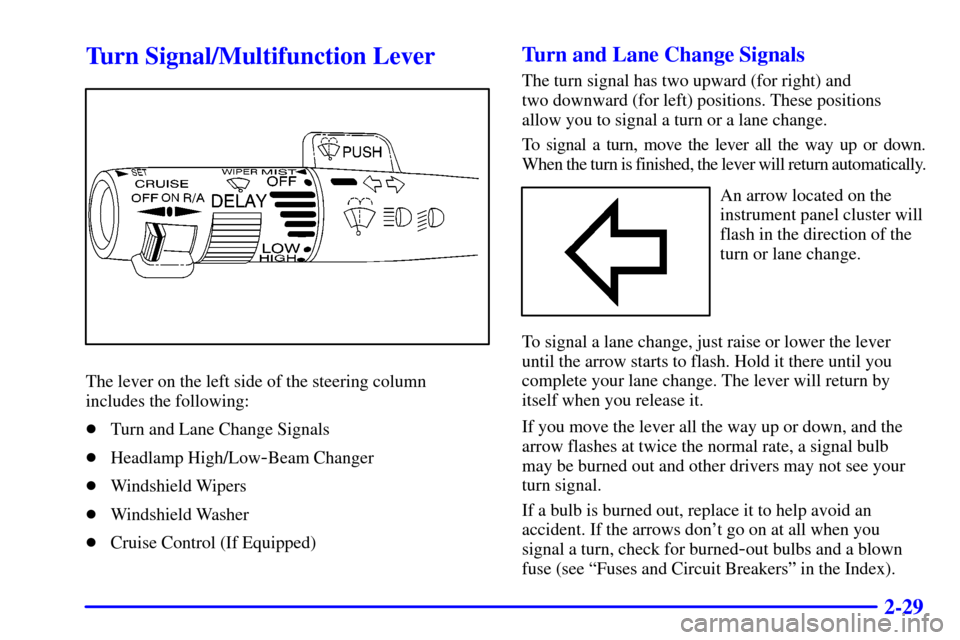
Turn Signal/Multifunction Lever
The lever on the left side of the steering column
includes the following:
�Turn and Lane Change Signals
�Headlamp High/Low
-Beam Changer
�Windshield Wipers
�Windshield Washer
�Cruise Control (If Equipped)
Turn and Lane Change Signals
The turn signal has two upward (for right) and
two downward (for left) positions. These positions
allow you to signal a turn or a lane change.
To signal a turn, move the lever all the way up or down.
When the turn is finished, the lever will return automatically.
An arrow located on the
instrument panel cluster will
flash in the direction of the
turn or lane change.
To signal a lane change, just raise or lower the lever
until the arrow starts to flash. Hold it there until you
complete your lane change. The lever will return by
itself when you release it.
If you move the lever all the way up or down, and the
arrow flashes at twice the normal rate, a signal bulb
may be burned out and other drivers may not see your
turn signal.
If a bulb is burned out, replace it to help avoid an
accident. If the arrows don't go on at all when you
signal a turn, check for burned
-out bulbs and a blown
fuse (see ªFuses and Circuit Breakersº in the Index).
Page 79 of 321
2-30 Headlamp High/Low-Beam Changer
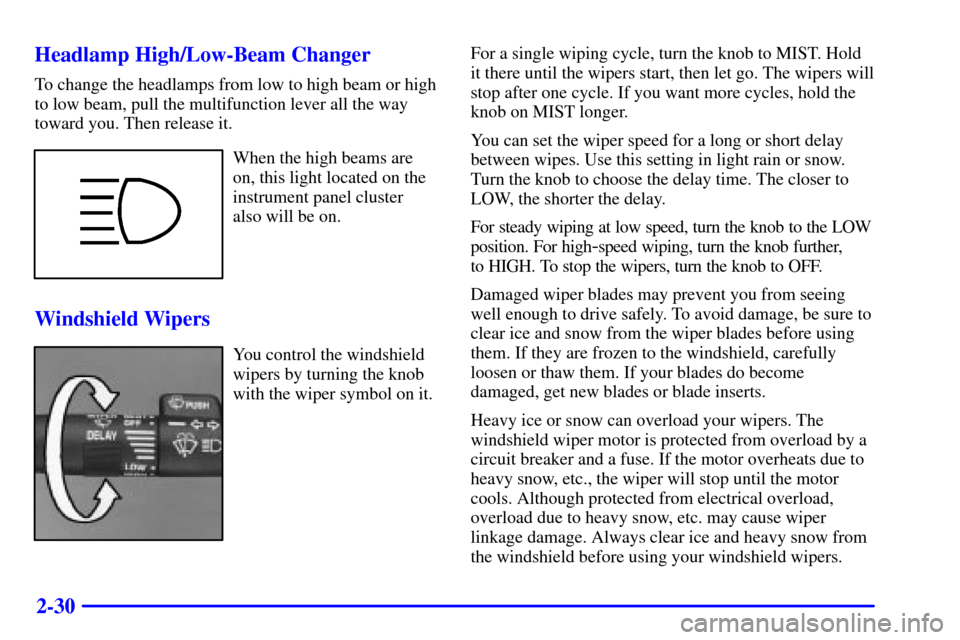
To change the headlamps from low to high beam or high
to low beam, pull the multifunction lever all the way
toward you. Then release it.
When the high beams are
on, this light located on the
instrument panel cluster
also will be on.
Windshield Wipers
You control the windshield
wipers by turning the knob
with the wiper symbol on it.For a single wiping cycle, turn the knob to MIST. Hold
it there until the wipers start, then let go. The wipers will
stop after one cycle. If you want more cycles, hold the
knob on MIST longer.
You can set the wiper speed for a long or short delay
between wipes. Use this setting in light rain or snow.
Turn the knob to choose the delay time. The closer to
LOW, the shorter the delay.
For steady wiping at low speed, turn the knob to the LOW
position. For high
-speed wiping, turn the knob further,
to HIGH. To stop the wipers, turn the knob to OFF.
Damaged wiper blades may prevent you from seeing
well enough to drive safely. To avoid damage, be sure to
clear ice and snow from the wiper blades before using
them. If they are frozen to the windshield, carefully
loosen or thaw them. If your blades do become
damaged, get new blades or blade inserts.
Heavy ice or snow can overload your wipers. The
windshield wiper motor is protected from overload by a
circuit breaker and a fuse. If the motor overheats due to
heavy snow, etc., the wiper will stop until the motor
cools. Although protected from electrical overload,
overload due to heavy snow, etc. may cause wiper
linkage damage. Always clear ice and heavy snow from
the windshield before using your windshield wipers.
Page 83 of 321
2-34
Using Cruise Control on Hills
How well your cruise control will work on hills depends
upon your speed, load and the steepness of the hills.
When going up steep hills, you may have to step on the
accelerator pedal to maintain your speed. If the
steepness of the hill causes the vehicle speed to drop
more than 15 mph (24 km/h) below the set speed, your
cruise control will automatically disengage. When going
downhill, you may have to brake or shift to a lower gear
to keep your speed down. Of course, applying the brake
takes you out of cruise control. Many drivers find this to
be too much trouble and don't use cruise control on
steep hills.
Ending Cruise Control
There are two ways to turn off the cruise control:
�Step lightly on the brake pedal or
�move the cruise switch to OFF.
Erasing Speed Memory
When you turn off the cruise control or the ignition,
your cruise control set speed memory is erased.Exterior Lamps
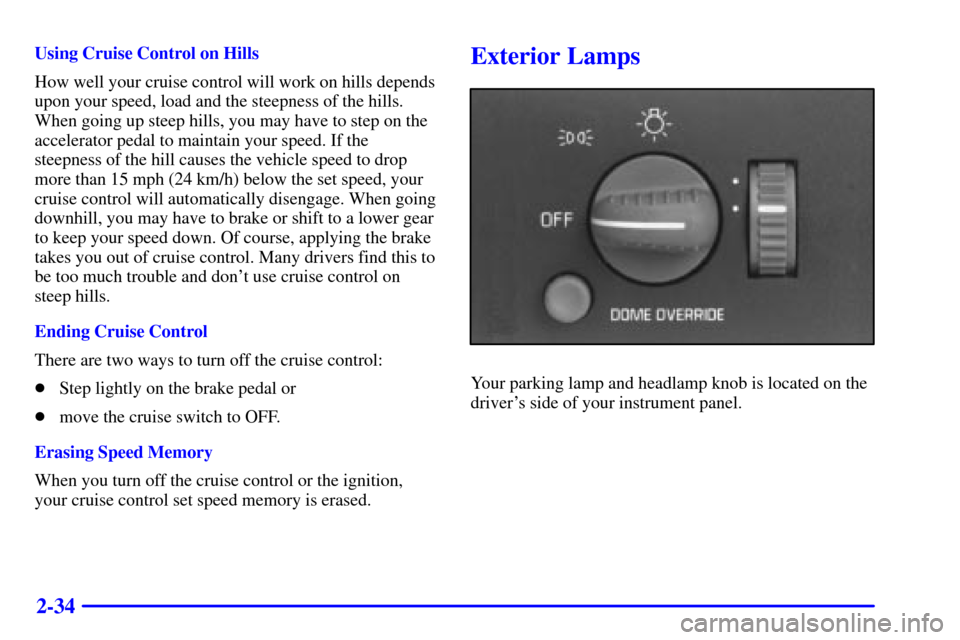
Your parking lamp and headlamp knob is located on the
driver's side of your instrument panel.
Page 84 of 321
2-35
Turn the knob clockwise to the parking lamp symbol, to
turn on the following:
�Parking Lamps
�Sidemarker Lamps
�Clearance Lamps
�Taillamps
�License Plate Lamps
�Instrument Panel Lights
Turn the knob clockwise again to the master lighting
symbol to turn on all the lamps listed as well as
the headlamps.
Turn the knob counterclockwise, to OFF, to turn off
your lamps.
You can turn your headlamps from high to low beams
by pulling on the turn signal/multifunction lever.
Headlamps On Reminder
A tone will sound when your headlamps are turned on
and the key is turned to OFF, LOCK or ACCESSORY.
If you need to use your headlamps when the key is
turned to OFF, LOCK or ACCESSORY, the buzzer can
be turned off by turning the thumbwheel next to the
parking lamp/headlamp knob all the way down.
Daytime Running Lamps
Daytime Running Lamps (DRL) can make it easier for
others to see the front of your vehicle during the day.
DRL can be helpful in many different driving
conditions, but they can be especially helpful in the
short periods after dawn and before sunset. Fully
functional daytime running lights are required on all
vehicles first sold in Canada.
The DRL system will make your headlamps come on
at a reduced brightness when the following conditions
are met:
�the ignition is on,
�the headlamp switch is off and
�the parking brake is released.
When the DRL are on, only your headlamps will be on.
The taillamps, sidemarker and other lamps won't be on.
Your instrument panel won't be lit up either.
When it begins to get dark, your DRL indicator light is a
reminder to turn your headlamp knob on. The other lamps
that come on with your headlamps will also come on.