Page 5 of 321
iii
Section
3
Comfort Controls and Audio Systems
Section
4
Your Driving and the Road
Section
5
Table of Contents (cont'd)
Defensive Driving
Drunken Driving
Control of a Vehicle
Braking
SteeringDriving Tips for Various Road Conditions
Recreational Vehicle Towing
Loading Your Vehicle
Towing a Trailer Heating and Air Conditioning
Setting the Radio ClockRadio/Cassette Player
Hazard Warning Flashers
Jump Starting
Towing Your VehicleEngine Overheating
Changing a Flat Tire
If You're Stuck
Problems on the Road
Page 108 of 321
3-
3-1
Section 3 Comfort Controls and Audio Systems
In this section, you'll find out how to operate the comfort control and audio systems offered with your vehicle.
Be sure to read about the particular systems supplied with your vehicle.
3
-2 Comfort Controls
3
-4 Air Conditioning
3
-4 Heating
3
-4 Defogging and Defrosting
3
-5 Ventilation System
3
-6 Audio Systems
3
-6 Setting the Clock3
-7AM-FM Stereo
3
-9AM-FM Stereo with Cassette Tape Player
(If Equipped)
3
-12 Understanding Radio Reception
3
-12 Tips About Your Audio System
3
-13 Care of Your Cassette Tape Player
3
-14 Fixed Mast Antenna
Page 110 of 321
3-3 Heater and Air Conditioning Control
System (If Equipped)
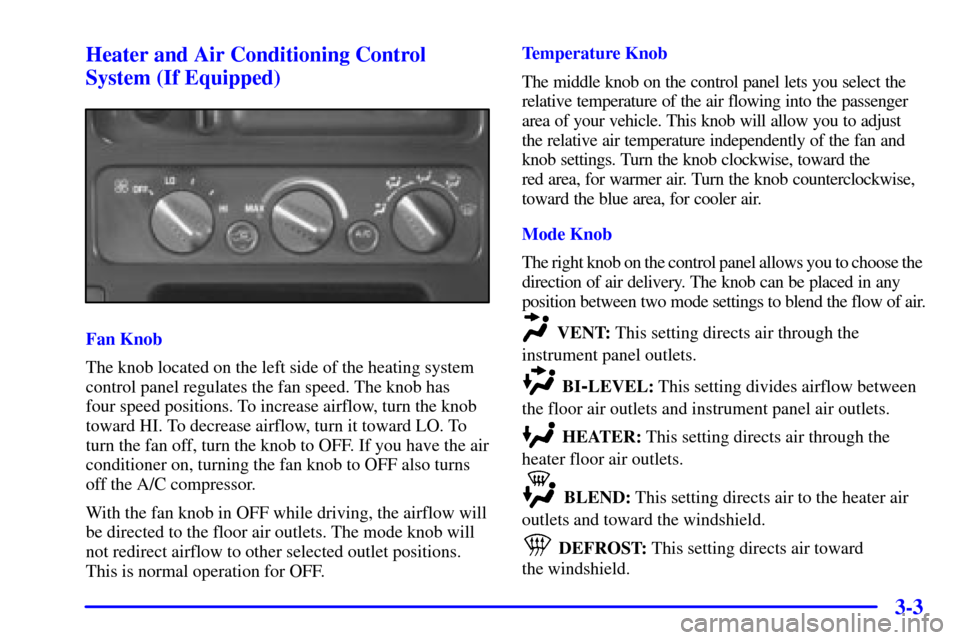
Fan Knob
The knob located on the left side of the heating system
control panel regulates the fan speed. The knob has
four speed positions. To increase airflow, turn the knob
toward HI. To decrease airflow, turn it toward LO. To
turn the fan off, turn the knob to OFF. If you have the air
conditioner on, turning the fan knob to OFF also turns
off the A/C compressor.
With the fan knob in OFF while driving, the airflow will
be directed to the floor air outlets. The mode knob will
not redirect airflow to other selected outlet positions.
This is normal operation for OFF.Temperature Knob
The middle knob on the control panel lets you select the
relative temperature of the air flowing into the passenger
area of your vehicle. This knob will allow you to adjust
the relative air temperature independently of the fan and
knob settings. Turn the knob clockwise, toward the
red area, for warmer air. Turn the knob counterclockwise,
toward the blue area, for cooler air.
Mode Knob
The right knob on the control panel allows you to choose the
direction of air delivery. The knob can be placed in any
position between two mode settings to blend the flow of air. VENT: This setting directs air through the
instrument panel outlets.
BI-LEVEL: This setting divides airflow between
the floor air outlets and instrument panel air outlets.
HEATER: This setting directs air through the
heater floor air outlets.
BLEND: This setting directs air to the heater air
outlets and toward the windshield.
DEFROST: This setting directs air toward
the windshield.
Page 111 of 321

3-4 Air Conditioning
On hot days, open the windows long enough to let hot
air inside escape. This reduces the time it takes for your
vehicle to cool down. Then keep your windows closed
for the air conditioner to work its best.
A/C: Press this button to turn the air conditioning on
and off. The system will cool and dehumidify the air
inside the vehicle when the A/C light is on.
Air conditioning will be automatically disabled when
the outside temperature drops below a level at which air
conditioning is ineffective.
With the A/C on, turn the temperature knob to MAX for
maximum cooling. This setting also puts the system in
the recirculation mode and helps to maximize your air
conditioner's performance and your vehicle's fuel economy.
RECIRCULATION: Pressing the
RECIRCULATION button limits the amount of outside
dust and odors entering your vehicle. This button will be
automatically disabled anytime the mode knob is turned to
BLEND or DEFROST mode. (The recirculation indicator
light will come on even though the recirculation button is
not selected). This setting also cools the air the fastest.
After the vehicle's interior reaches a comfortable
temperature, turn the temperature knob clockwise, to
place the air conditioning system in the normal mode.
Heating
The heater works best if you keep your windows closed
while using it. On cold days, use the HEATER or BI
-LEVEL
setting with the temperature knob in the red area.
If you use the engine coolant heater before starting your
engine in cold weather, 20�F (
-8�C) or lower, your
heating system will produce warmer air faster, to heat
the passenger compartment in cold weather.
The use of an engine coolant heater also reduces the
time it takes for the engine to reach normal operating
temperature, and shortens the time it takes the heater to
reach full output. For more information, see
ªEngine Coolant Heaterº in the Index.
Defogging and Defrosting
On cool, humid days, use BLEND to keep the windshield
and side windows clear. Use DEFROST to remove fog or
ice from the windshield in extremely humid or cold
conditions. Use DEFROST with the temperature knob
toward the red area and the fan control toward HI.
Page 112 of 321
3-5 Ventilation System
For mild outside temperatures when little heating or
cooling is needed, use VENT to direct outside air
through your vehicle. Air will flow through the
instrument panel outlets.
Your vehicle's ventilation system supplies outside air to
the inside of your vehicle when it is moving. With the side
windows closed, air will flow into the front air inlet grilles,
through the vehicle, and out the air exhaust valves.
Outside air will also enter the vehicle when the heater or
the air conditioning fan is running, unless you have the
recirculation button pushed in. For more information on
the recirculation button, see ªAir Conditioningº earlier
in this section.
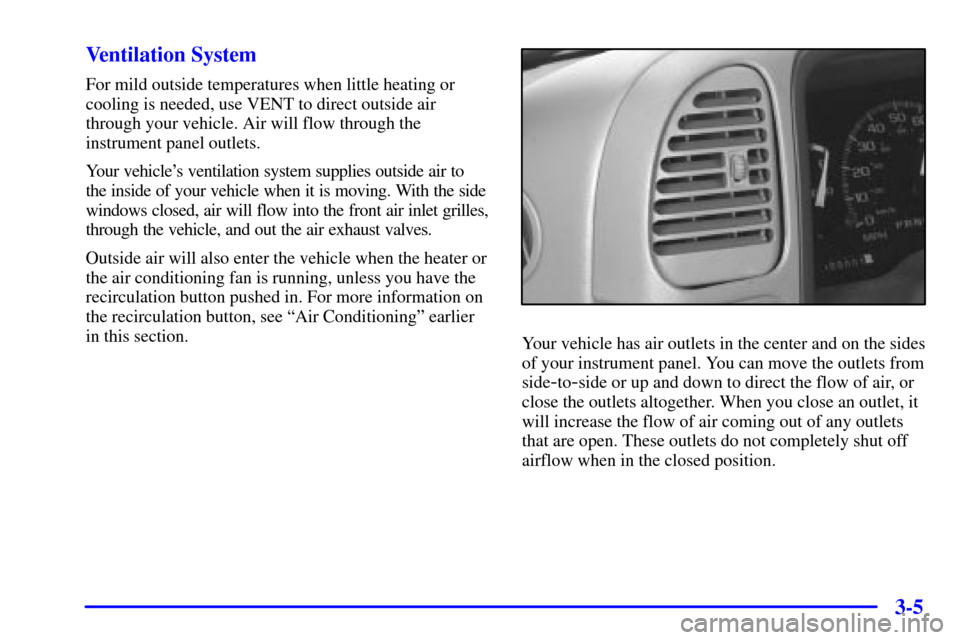
Your vehicle has air outlets in the center and on the sides
of your instrument panel. You can move the outlets from
side
-to-side or up and down to direct the flow of air, or
close the outlets altogether. When you close an outlet, it
will increase the flow of air coming out of any outlets
that are open. These outlets do not completely shut off
airflow when in the closed position.
Page 113 of 321

3-6
Ventilation Tips
�Keep the hood and front air inlet free of ice, snow or
any other obstruction (such as leaves). The heater
and defroster will work far better, reducing the
chance of fogging the inside of your windows.
�When you enter a vehicle in cold weather, turn
the fan to HI for a few moments before driving.
This helps clear the intake ducts of snow and
moisture, and reduces the chance of fogging the
inside of your windows.
�Keep the air path under the front seats clear of objects.
This helps air to circulate throughout your vehicle.
�The use of hood air deflectors may adversely affect the
performance of the heating and air conditioning system.Audio Systems
Your audio system has been designed to operate easily
and give years of listening pleasure. You will get the
most enjoyment out of it if you acquaint yourself with it
first. Find out what your audio system can do and how
to operate all its controls, to be sure you're getting the
most out of the advanced engineering that went into it.
Setting the Clock
Press SET. Within five seconds, press and hold the
SEEK right arrow until the correct minute appears on
the display. Press and hold the SEEK left arrow until the
correct hour appears on the display.
Page 166 of 321
5-4
1. Check the other vehicle. It must have a 12-volt
battery with a negative ground system.
NOTICE:
If the other system isn't a 12-volt system with a
negative ground, both vehicles can be damaged.
2. Get the vehicles close enough so the jumper cables
can reach, but be sure the vehicles aren't touching
each other. If they are, it could cause a ground
connection you don't want. You wouldn't be able
to start your vehicle, and the bad grounding could
damage the electrical systems.
3. To avoid the possibility of the vehicles rolling, set
the parking brake firmly on both vehicles involved
in the jump start procedure. Put an automatic
transmission in PARK (P) or a manual transmission
in NEUTRAL.
4. Turn off the ignition on both vehicles. Unplug
unnecessary accessories plugged into the cigarette
lighter or accessory power outlets. Turn off all lamps
that aren't needed as well as radios. This will avoid
sparks and help save both batteries. In addition, it
could save your radio!
NOTICE:
If you leave your radio on, it could be badly
damaged. The repairs wouldn't be covered by
your warranty.
5. Open the hoods and locate the batteries. Find the
positive (+) and negative (
-) terminals on
each battery.
CAUTION:
If your vehicle has air conditioning, the auxiliary
electric fan under the hood can start up even
when the engine is not running and can injure
you. Keep hands, clothing and tools away from
any underhood electric fan.
Page 173 of 321
5-11
Cooling System (Gasoline Engine)
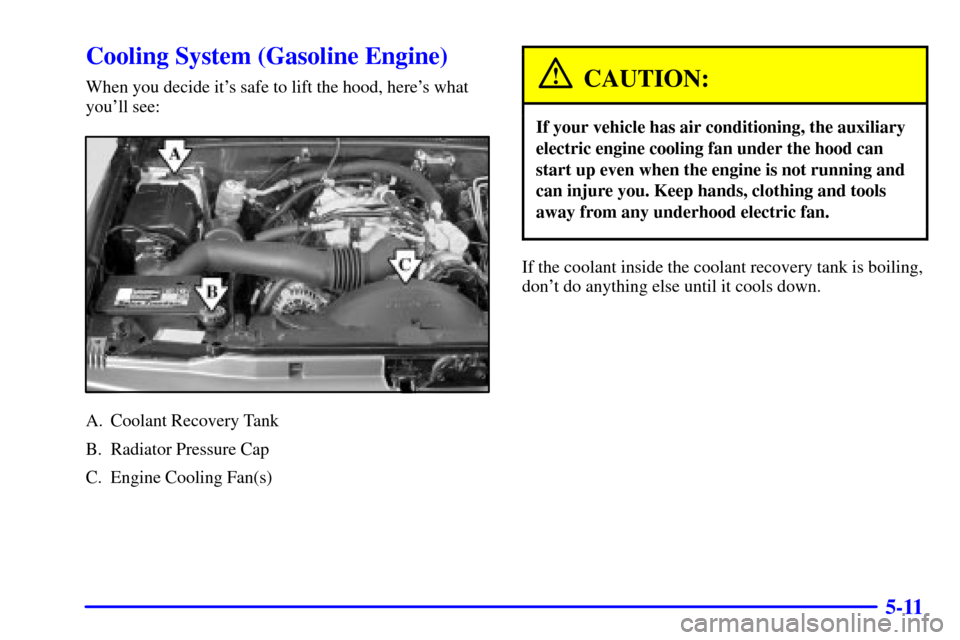
When you decide it's safe to lift the hood, here's what
you'll see:
A. Coolant Recovery Tank
B. Radiator Pressure Cap
C. Engine Cooling Fan(s)
CAUTION:
If your vehicle has air conditioning, the auxiliary
electric engine cooling fan under the hood can
start up even when the engine is not running and
can injure you. Keep hands, clothing and tools
away from any underhood electric fan.
If the coolant inside the coolant recovery tank is boiling,
don't do anything else until it cools down.