Page 232 of 335
5-8
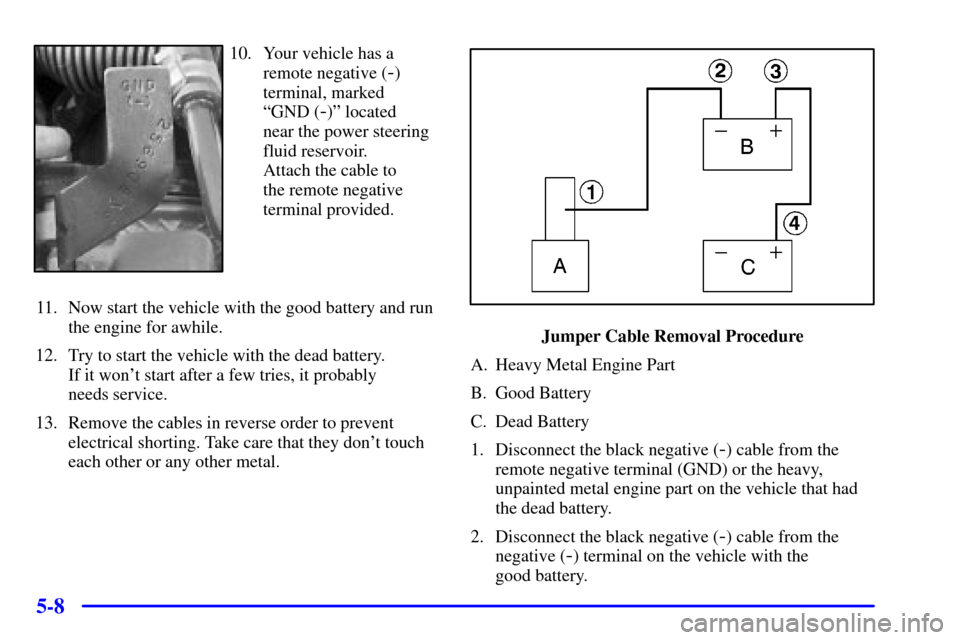
10. Your vehicle has a
remote negative (
-)
terminal, marked
ªGND (
-)º located
near the power steering
fluid reservoir.
Attach the cable to
the remote negative
terminal provided.
11. Now start the vehicle with the good battery and run
the engine for awhile.
12. Try to start the vehicle with the dead battery.
If it won't start after a few tries, it probably
needs service.
13. Remove the cables in reverse order to prevent
electrical shorting. Take care that they don't touch
each other or any other metal.
Jumper Cable Removal Procedure
A. Heavy Metal Engine Part
B. Good Battery
C. Dead Battery
1. Disconnect the black negative (
-) cable from the
remote negative terminal (GND) or the heavy,
unpainted metal engine part on the vehicle that had
the dead battery.
2. Disconnect the black negative (
-) cable from the
negative (
-) terminal on the vehicle with the
good battery.
Page 264 of 335
6-10 Engine Compartment Overview
When you open the hood, you'll see:
A. Battery
B. Engine Coolant Surge Tank
C. Power Steering Fluid
D. Engine Oil Fill LocationE. Engine Oil Dipstick
F. Brake Master Cylinder
G. Transaxle Dipstick/Fluid
Fill LocationH. Engine Air Cleaner/Filter
I. Windshield Washer
Fluid Reservoir
Page 281 of 335
6-27
Power Steering Fluid
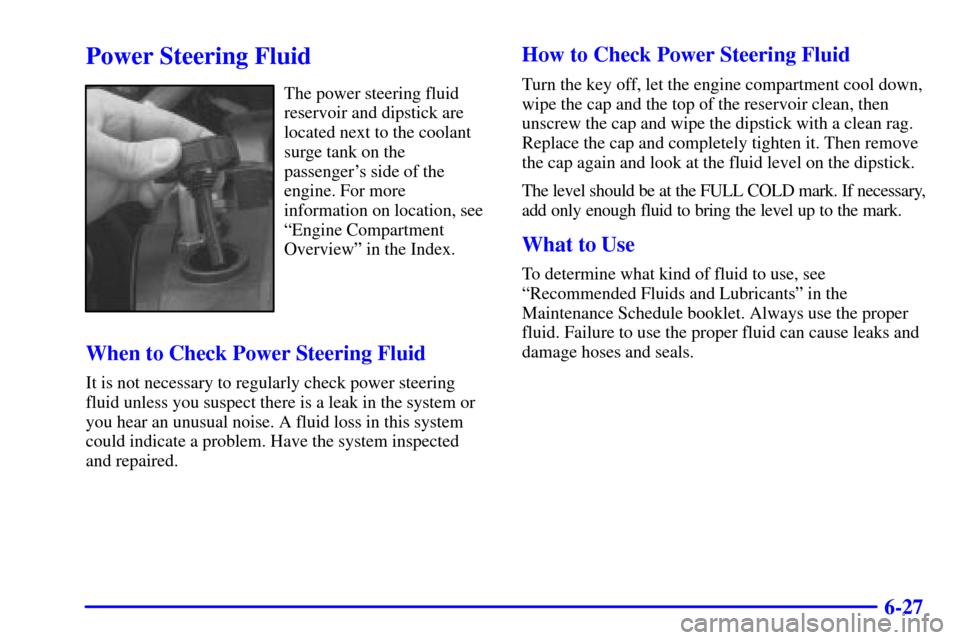
The power steering fluid
reservoir and dipstick are
located next to the coolant
surge tank on the
passenger's side of the
engine. For more
information on location, see
ªEngine Compartment
Overviewº in the Index.
When to Check Power Steering Fluid
It is not necessary to regularly check power steering
fluid unless you suspect there is a leak in the system or
you hear an unusual noise. A fluid loss in this system
could indicate a problem. Have the system inspected
and repaired.
How to Check Power Steering Fluid
Turn the key off, let the engine compartment cool down,
wipe the cap and the top of the reservoir clean, then
unscrew the cap and wipe the dipstick with a clean rag.
Replace the cap and completely tighten it. Then remove
the cap again and look at the fluid level on the dipstick.
The level should be at the FULL COLD mark. If necessary,
add only enough fluid to bring the level up to the mark.
What to Use
To determine what kind of fluid to use, see
ªRecommended Fluids and Lubricantsº in the
Maintenance Schedule booklet. Always use the proper
fluid. Failure to use the proper fluid can cause leaks and
damage hoses and seals.