2001 CADILLAC ELDORADO battery
[x] Cancel search: batteryPage 135 of 335

2-74
Emissions Inspection and Maintenance Programs
Some state/provincial and local governments have
or may begin programs to inspect the emission
control equipment on your vehicle. Failure to pass
this inspection could prevent you from getting a
vehicle registration.
Here are some things you need to know in order to help
your vehicle pass an inspection:
Your vehicle will not pass this inspection if the
SERVICE ENGINE SOON light is on or not
working properly.
Your vehicle will not pass this inspection if the OBD
(on
-board diagnostic) system determines that critical
emission control systems have not been completely
diagnosed by the system. The vehicle would be
considered not ready for inspection. This can happen if
you have recently replaced your battery or if your
battery has run down. The diagnostic system is designed
to evaluate critical emission control systems during
normal driving. This may take several days of routine
driving. If you have done this and your vehicle still does
not pass the inspection for lack of OBD system
readiness, see your dealer or qualified service center to
prepare the vehicle for inspection.
Oil Pressure Light
This light tells you if there
could be a problem with
your engine oil pressure.
The light goes on when you turn your key to RUN or
START. It goes off once you start your engine. That's a
check to be sure the light works. If it doesn't come on,
be sure to have it fixed so it will be there to warn you if
something goes wrong.
When the light comes on and stays on, it means that
oil isn't flowing through your engine properly. You
could be low on oil and you might have some other
system problem.
Page 137 of 335
2-76 Fuel Data Display
Everything you need to know about the fuel economy
and how far you can travel with your vehicle's
remaining fuel is displayed. Fuel data can be obtained
by pressing the INFO (SKIP) button. See ªDIC Controls
and Displaysº later in this section.
Driver Information Center (DIC)
This display gives you the status of many of your
vehicle's systems. The DIC is also used to display driver
personalization features and warning/status messages.
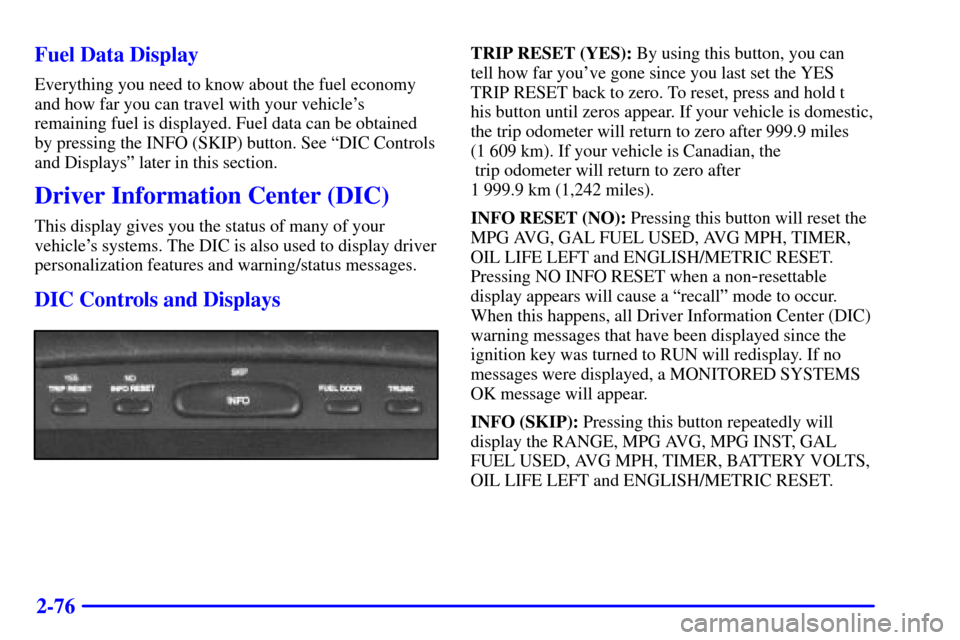
DIC Controls and Displays
TRIP RESET (YES): By using this button, you can
tell how far you've gone since you last set the YES
TRIP RESET back to zero. To reset, press and hold t
his button until zeros appear. If your vehicle is domestic,
the trip odometer will return to zero after 999.9 miles
(1 609 km). If your vehicle is Canadian, the
trip odometer will return to zero after
1 999.9 km (1,242 miles).
INFO RESET (NO): Pressing this button will reset the
MPG AVG, GAL FUEL USED, AVG MPH, TIMER,
OIL LIFE LEFT and ENGLISH/METRIC RESET.
Pressing NO INFO RESET when a non
-resettable
display appears will cause a ªrecallº mode to occur.
When this happens, all Driver Information Center (DIC)
warning messages that have been displayed since the
ignition key was turned to RUN will redisplay. If no
messages were displayed, a MONITORED SYSTEMS
OK message will appear.
INFO (SKIP): Pressing this button repeatedly will
display the RANGE, MPG AVG, MPG INST, GAL
FUEL USED, AVG MPH, TIMER, BATTERY VOLTS,
OIL LIFE LEFT and ENGLISH/METRIC RESET.
Page 139 of 335

2-78 DIC Messages
These messages will appear if there is a problem sensed
in one of your vehicle's systems. Vehicles that are first
sold in Canada will have a number after each message.
This number helps to identify the message which is only
displayed in English.
Pressing the INFO or INFO RESET button(s) will
remove most of the following messages from the
DIC display:
APPLY BRAKE TO SHIFT
- 46: This message will
appear if your vehicle is in PARK (P) for about
15 seconds and the brake is not pressed. On the climate
control panel, press the OFF button (next to the MODE
button) and the down arrow on the PASS TEMP button
for about five seconds. Hold the same two buttons to
display the message again.
BATTERY NOT CHARGING
- 7: This message will
appear if the battery is not being charged. Have the
electrical system checked by your dealership at your
earliest convenience.BATTERY VOLTAGE HIGH
- 8: This message
shows that the electrical charging system is
overcharging (more than 16 volts). To avoid being
stranded, have the electrical system checked by your
dealership. You can reduce the charging overload by
using the accessories. Turn on the lamps and radio, set
the climate control on AUTO and the fan speed on HI,
and turn the rear window defogger on. You can monitor
battery voltage on the DIC by pressing the INFO (SKIP)
button. The normal range is 11.5 to 15.5 volts when the
engine is running.
BATTERY VOLTAGE LOW
- 6: This message will
appear when the electrical system is charging less than
10 volts or if the battery has been drained. If this
message appears immediately after starting, it is possible
that the generator can still recharge the battery. The
battery should recharge and may take a few hours to do
so. Consider using an auxiliary charger to boost the
battery after returning home or to a final destination.
(Be sure to follow the manufacturer's instructions when
using a battery charger.)
Page 140 of 335

2-79
If this message appears and stays on while driving or
after starting your vehicle, have it checked immediately
to determine the cause of this problem. To help the
generator recharge the battery quickly, you can reduce
the load on the electrical system by turning off the
accessories. You can monitor battery voltage on the
DIC by pressing the INFO (SKIP) button. The normal
range is 11.5 to 15.5 volts.
CHANGE ENGINE OIL
- 82: This means that the
life of the engine oil has expired and it should be
changed within 200 miles (322 km). See ªEngine Oilº
and ªFilter Recommendationsº in the Maintenance
Schedule booklet. After an oil change, the Oil Life
Indicator must be reset. See ªOil Life Indicator, How to
Resetº in the Index.
CHANGE TRANS FLUID
- 47: This message will
appear when it is time to replace the transaxle fluid. See
the Maintenance Schedule booklet for the proper fluid
and change intervals.
CHECK BRAKE FLUID LEVEL
- 37: This message
will display if the ignition is in RUN to inform the
driver that the brake fluid level is low. Have the brake
system serviced by a technician as soon as possible.
See ªBrake System Warning Lightº in the Index.CHECK COOLANT LEVEL
- 2: This message
will appear when there is a low level of engine coolant.
Have the cooling system serviced by a technician as
soon as possible.
CHECK FUEL GAUGE
- 39: This message will
appear when the fuel supply is less than 3.5 gallons
(13.2 L) remaining. A single chime will also sound
when this message is displayed.
CHECK GAS CAP
- 61: This message will appear if
the gas cap has not been fully tightened. You should
recheck your gas cap to ensure that it's fully tightened.
CHECK OIL LEVEL
- 36: For correct operation of
the low oil sensing system, your vehicle should be on a
level surface. A false CHECK OIL LEVEL message
may appear if the vehicle is parked on grades. The oil
level sensing system does not check for actual oil level
if the engine has been off for a short period of time, and
the oil level is never sensed while the engine is running.
If the CHECK OIL LEVEL message appears and your
vehicle has been parked on level ground with the engine
off for at least 30 minutes, the oil level should be
checked by observing the oil dipstick. Prior to checking
the oil level, be sure the engine has been off for
five minutes and your vehicle is on a level surface. Then
check the dipstick and add oil if necessary. See ªEngine
Oilº in the Index.
Page 151 of 335

2-90
FEATURE ON appears when a yes response is made
and FEATURE OFF shows when a no response is made.
Since this is the last personalization feature available, a
yes or no response will end out of the Driver
Information Center (DIC) display.
Once the battery guard has been programmed, your
vehicle will enter the storage mode about 20 minutes
after the ignition key has been turned off.
Your vehicle will stay in the storage mode until the
ignition key is turned out of LOCK. The system will
ªwake
-upº when the door key is inserted into the door,
however, your vehicle will remain in the storage mode.
The ignition must be out of LOCK before the battery
guard is disabled.Comfort Controls and Radio System Personalization
These features allow both drivers to personalize their
own climate control settings as well as their radio
settings. For more information, see ªClimate Control
Personalizationº and ªRadio Personalizationº in
the Index.
Continuous Variable Road Sensing
Suspension (CVRSS) (ETC Only)
The CVRSS automatically adjusts the ride of your
vehicle. Automatic ride control is achieved through a
computer used to control and monitor the suspension
system. The controller receives input from various
sensors to determine the proper system response. If the
controller detects a problem within the system, the
Driver Information Center (DIC) will display a
SERVICE RIDE CONTROL message. If this message
appears, have your vehicle serviced at your dealership.
Page 163 of 335

3-11
HR or MN: Display the time with the ignition off by
pressing this button.
DSPL: Press this button to display the radio station
being played.
Finding a Station
BAND: Press this button to select AM, FM1 or FM2.
SEEK
-TUNE: Press and release this button to seek
to the next higher or lower radio station. Pressing and
holding this button until a chime sounds puts the radio
in a tune mode. In this mode, higher or lower radio
stations are advanced to in small increments until
the SEEK
-TUNE button is released. Tuning stops
when you release this button. If you press and hold
the SEEK
-TUNE button again within five seconds
of being in the tune mode, tuning will continue.
Waiting longer than five seconds places the radio
back in the seek mode.
SCAN: Press this button and SCAN will appear on
the display. Use SCAN to listen to stations for a few
seconds. The radio will go to a station, stop for a few
seconds, then go on to the next station. Press this
button again to stop scanning.PUSHBUTTONS: The six numbered pushbuttons let
you return to your favorite stations. You can set up to
18 stations (six AM, six FM1 and six FM2). Just:
1. Turn the radio on.
2. Press BAND to select AM, FM1 or FM2.
3. Tune in the desired station.
4. Press and hold one of the six numbered buttons
for more than two seconds until you hear a beep.
Whenever you press that numbered button for less
than two seconds, the station you set will return.
5. Repeat the steps for each pushbutton.
When battery power is removed and later applied,
you will not have to reset your radio presets because
the radio remembers them.
PRESET SCAN: Press and hold SCAN for two to
three seconds until PRESET SCAN appears on the
display to listen to each of your preset stations for
a few seconds (factory presets which have not been
reprogrammed with your stations will be ignored).
The radio will go to the first preset station stored on
your pushbuttons, stop for a few seconds, then go on
to the next preset station. Press SCAN again to stop
scanning. If a preset station has weak reception, the
radio will not stop at the preset station.
Page 167 of 335

3-15
HR or MN: Display the time with the ignition off by
pressing this button.
SOURCE: Press this button to select a source.
Sources include cassette and compact disc. The audio
source must be loaded to play. Available loaded sources
are shown on the display. If a source is being used, it
will be underlined on the display. If none of the audio
sources are loaded, NO SOURCE LOADED will appear
on the display. Press this button again or press BAND to
switch back to the radio.
Finding a Station
BAND: Press this button to select AM, FM1, FM2
or weather.
TUNE SEEK: When this button is pressed it has
two positions. Press this button to the first position to
manually tune to higher or lower stations. If this button
is held at the first position for a few seconds, the radio
will continue tuning until this button is released. Press
this button to the second position and release to seek
to the next higher or lower radio station.
SCAN: Press this button for less than two seconds
to scan radio stations. The radio will go to a station,
stop for five seconds, then go on to the next station.
Press this button again to stop scanning.PUSHBUTTONS: The six numbered pushbuttons let
you return to your favorite stations and associated tone
and DSP settings. The RDS PTY mode must be off to
use this mode. You can set up to 24 stations (six AM,
six FM1, six FM2 and six weather). Just:
1. Turn the radio on.
2. Press BAND to select AM, FM1, FM2 or weather.
3. Tune in the desired station.
4. Press and hold one of the six numbered buttons for
more than two seconds. Whenever you press that
numbered button for less than two seconds, the
station you set will return.
5. Repeat the steps for each pushbutton.
When battery power is removed and later applied,
you will not have to reset your radio presets because
the radio remembers them.
PRESET SCAN: Press and hold SCAN for more
than two seconds until you hear a beep to listen to each
of your preset stations for five seconds. The radio will
go to the first preset station stored on your pushbuttons,
stop for five seconds, then go on to the next preset
station. Press SCAN again to stop scanning. If a preset
station has weak reception, the radio will not stop at the
preset station.
Page 171 of 335

3-19
PUSHBUTTONS: The six numbered pushbuttons
let you return to your favorite Program Types (PTYs).
These buttons have factory PTY presets. See ªRadio
Data Systems (RDS) Program Type (PTY) Selectionsº
in the Index. You can set up to 12 PTYs (six FM1 and
six FM2). Just:
1. Turn PTY on.
2. Press BAND to select FM1 or FM2.
3. Tune in an RDS station with the PTY you desire.
4. Press and hold one of the six numbered buttons
for more than two seconds until you hear a beep.
Whenever you press that numbered button for less
than two seconds, the PTY you set will return.
5. Repeat the steps for each pushbutton.
When battery power is removed and later applied, you
will not have to reset your RDS presets because the
radio remembers them.HR or MN: Press the RDS SELECT button,
followed by one of these buttons to display the time
for the current station. STATION TIME IS will be
displayed. If a time has not been sent to the radio,
NO STATION TIME will be displayed. If you have
recently tuned to the station, you may need to wait a
minute before the time is available to the radio. To set
the clock to the current displayed station time, press and
hold HR or MN until TIME UPDATED is displayed.
There is a two second delay before the time is updated.
RDS mode does not have to be on to use this function,
but you must be tuned to an FM RDS station.
ALERT: This type of announcement warns of national
or local emergencies. You will not be able to turn off
alert announcements. Alert announcements will come
on even if RDS mode is turned off. ALERT appears on
the display when an alert announcement plays. The radio
uses TA volume during these announcements. To increase
volume, turn the PWR/VOL knob clockwise. Turn it
counterclockwise to decrease volume. TA VOLUME will
appear on the display while the volume is being adjusted.