Page 2 of 328
Courtesy
Transportation
Every
2001 Catera
under warranty is
backed with the
following
services:
Free lockout assistance
Free dead-battery assistance
Free out-of-fuel assistance
Free flat-tire change
Emergency towing
1-800-882-1112
that provides in an emergency:
1-800-882-1112
Page 5 of 328
Section
3
Comfort Controls and Audio Systems
Section
4
Your Driving and the Road
Section
5
Table of Contents (cont'd)
Defensive Driving
Drunken Driving
Control of a Vehicle
BrakingSteering
Driving Tips for Various Road Conditions
Loading Your Vehicle
Towing a Trailer Heating and Air Conditioning
Setting the Radio Clock
Radio/Cassette Player/CD Player (If Equipped)Radio Theft-Deterrent Feature
Steering Wheel Controls
Hazard Warning Flashers
Jump Starting
Towing Your VehicleEngine Overheating
Changing a Flat Tire
If You're Stuck
Problems on the Road
iii
Page 15 of 328

1-3
To raise or lower the seat cushion, press one of the
rocker switch buttons located on the side of the seat
cushion closest to the door. The top button raises
the seat cushion and the bottom button lowers the
seat cushion.
Vehicles with sport seats also include an adjustable seat
cushion which extends outward to provide additional
leg support.
To extend the bottom of the seat cushion, grasp the front
portion of the cushion and pull it towards the front of
the vehicle.When additional support is no longer needed, return the
cushion to its original position by pushing it towards the
rear of the vehicle.
Manual Lumbar Support
The manual lumbar control
is located on the outboard
side of each front seatback.
The control provides
additional support to your
lower back and works
independently of other
seat controls.
Use the seat controls first to get the proper seating
position. Then proceed with the lumbar adjustment.
The upper and lower seatback can be adjusted using the
small hand
-wheel control. Turn the control forward to
increase support and rearward to decrease support.
Keep in mind that as your seating position changes,
as it may during long trips, so should the position
of the lumbar support. Adjust the seat as needed.
Page 44 of 328

1-32
How does an air bag restrain?
In moderate to severe frontal or near frontal collisions,
even belted occupants can contact the steering wheel or
the instrument panel. In moderate to severe side
collisions, even belted occupants can contact the inside
of the vehicle. The air bag supplements the protection
provided by safety belts. Air bags distribute the force of
the impact more evenly over the occupant's upper body,
stopping the occupant more gradually. But the frontal air
bags would not help you in many types of collisions,
including rollovers, rear impacts, and side impacts,
primarily because an occupant's motion is not toward
the air bag. Side impact air bags would not help you in
many types of collisions, including frontal or near
frontal collisions, rollovers, and rear impacts, primarily
because an occupant's motion is not toward those air
bags. Air bags should never be regarded as anything
more than a supplement to safety belts, and then only in
moderate to severe frontal or near
-frontal collisions for
the driver's and right front passenger's frontal air bags,
and only in moderate to severe side collisions for the
driver's and right front passenger's side impact air bags.What will you see after an air bag inflates?
After an air bag inflates, it quickly deflates, so quickly
that some people may not even realize the air bag
inflated. Some components of the air bag module
-- the
steering wheel hub for the driver's air bag, the instrument
panel for the right front passenger's bag, the side of the
seatback closest to the door for the driver and right front
passenger's side impact air bags
-- will be hot for a short
time. The parts of the bag that come into contact with you
may be warm, but not too hot to touch. There will be
some smoke and dust coming from the vents in the
deflated air bags. Air bag inflation doesn't prevent the
driver from seeing or being able to steer the vehicle,
nor does it stop people from leaving the vehicle.
Page 54 of 328
1-42
Restraint Systems for Children
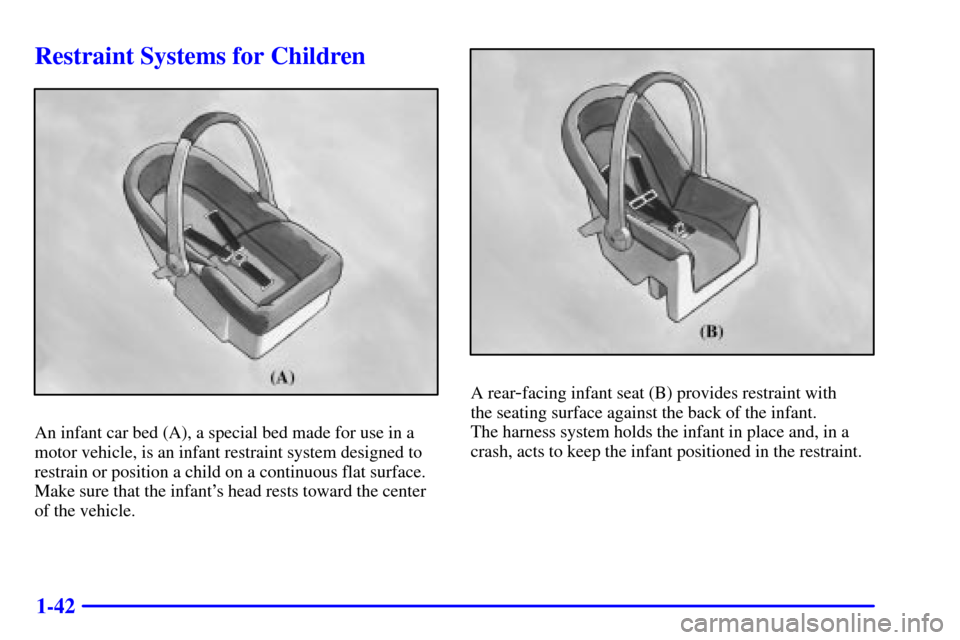
An infant car bed (A), a special bed made for use in a
motor vehicle, is an infant restraint system designed to
restrain or position a child on a continuous flat surface.
Make sure that the infant's head rests toward the center
of the vehicle.
A rear-facing infant seat (B) provides restraint with
the seating surface against the back of the infant.
The harness system holds the infant in place and, in a
crash, acts to keep the infant positioned in the restraint.
Page 65 of 328
1-53
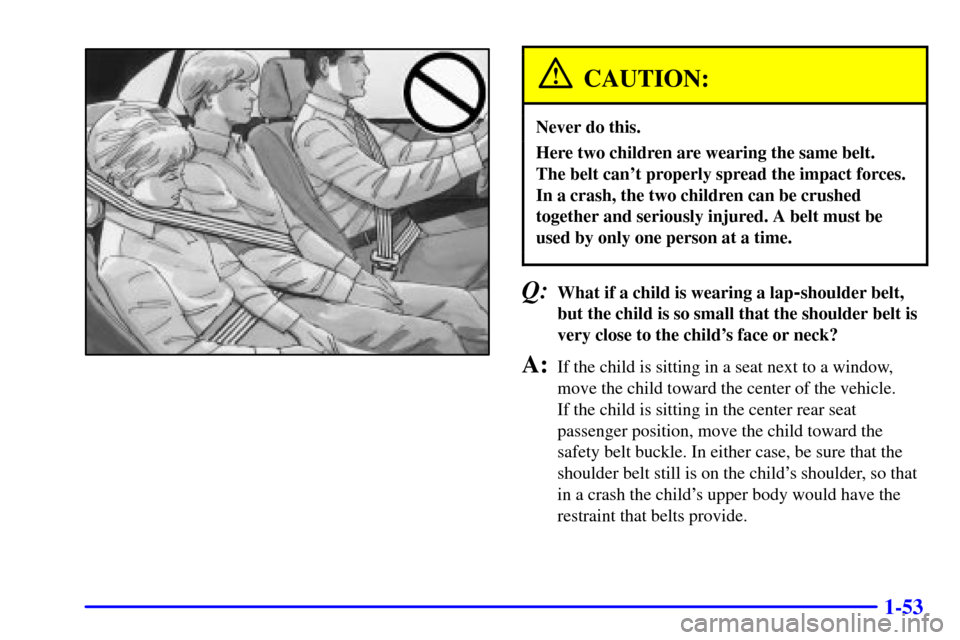
CAUTION:
Never do this.
Here two children are wearing the same belt.
The belt can't properly spread the impact forces.
In a crash, the two children can be crushed
together and seriously injured. A belt must be
used by only one person at a time.
Q:What if a child is wearing a lap-shoulder belt,
but the child is so small that the shoulder belt is
very close to the child's face or neck?
A:If the child is sitting in a seat next to a window,
move the child toward the center of the vehicle.
If the child is sitting in the center rear seat
passenger position, move the child toward the
safety belt buckle. In either case, be sure that the
shoulder belt still is on the child's shoulder, so that
in a crash the child's upper body would have the
restraint that belts provide.
Page 87 of 328

2-20
New Vehicle ªBreak-Inº
NOTICE:
Your vehicle doesn't need an elaborate
ªbreak
-in.º But it will perform better in the
long run if you follow these guidelines:
�Don't drive at any one speed -- fast or
slow
-- for the first 500 miles (805 km).
Don't make full
-throttle starts.
�Avoid making hard stops for the first
200 miles (322 km) or so. During this time
your new brake linings aren't yet broken
in. Hard stops with new linings can mean
premature wear and earlier replacement.
Follow this breaking
-in guideline every
time you get new brake linings.
�Don't tow a trailer during break
-in.
See ªTowing a Trailerº in the Index for
more information.
Ignition Positions
Keep in mind that you may have to turn the steering
wheel as you turn the key in order to turn the ignition
switch from LOCK to START
-- this is normal. Using
extra effort to remove the key from the ignition switch,
as compared to other GM vehicles that you may have
owned, is also normal.
If your key is stuck in the ignition switch and cannot be
turned back to LOCK, your vehicle will need to be
repaired. See your dealer for service.
With the key in the ignition switch, you can turn it to
four different positions.
LOCK (�): This is the only
position from which you
can remove the key. This
position locks the ignition,
steering wheel and
transmission. It's a
theft
-deterrent feature.
Page 92 of 328
2-25
Automatic Transmission Operation
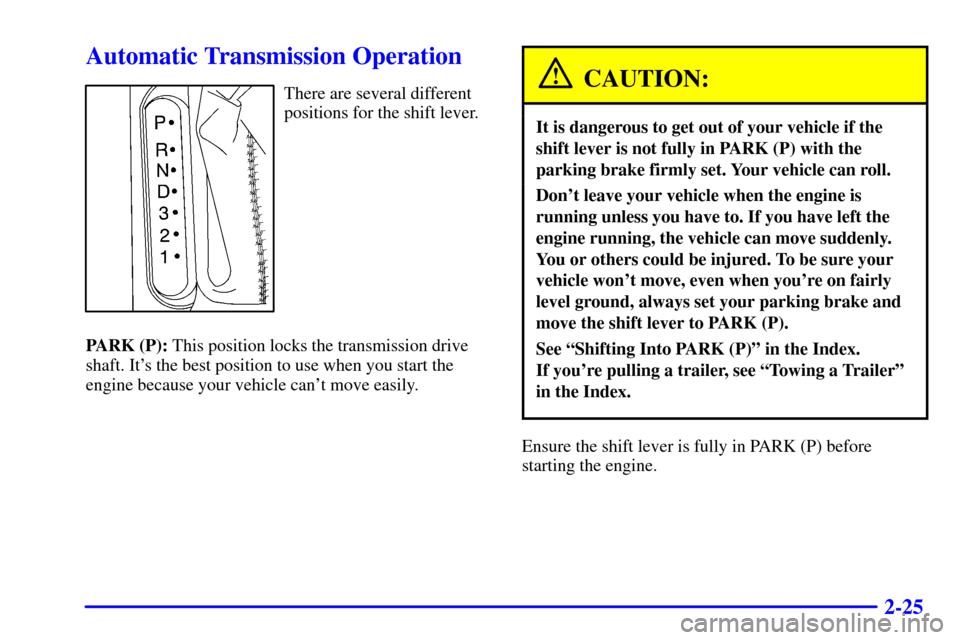
There are several different
positions for the shift lever.
PARK (P): This position locks the transmission drive
shaft. It's the best position to use when you start the
engine because your vehicle can't move easily.CAUTION:
It is dangerous to get out of your vehicle if the
shift lever is not fully in PARK (P) with the
parking brake firmly set. Your vehicle can roll.
Don't leave your vehicle when the engine is
running unless you have to. If you have left the
engine running, the vehicle can move suddenly.
You or others could be injured. To be sure your
vehicle won't move, even when you're on fairly
level ground, always set your parking brake and
move the shift lever to PARK (P).
See ªShifting Into PARK (P)º in the Index.
If you're pulling a trailer, see ªTowing a Trailerº
in the Index.
Ensure the shift lever is fully in PARK (P) before
starting the engine.