Page 93 of 328
2-26
Your vehicle has an automatic transmission shift lock
control system. You have to fully apply the regular
brakes before you can shift from PARK (P) when
the ignition key is in ON. If you cannot shift out of
PARK (P), ease pressure on the shift lever
-- push the
shift lever all the way into PARK (P) as you maintain
brake application. Then move the shift lever into the
gear you wish. See ªShifting Out of PARK (P)º in
this section.
REVERSE (R): Use this gear to back up.
To rock your vehicle back and forth to get out of snow,
ice or sand without damaging the transmission, see
ªStuck: In Sand, Mud, Ice or Snowº in the Index.
NEUTRAL (N): The engine doesn't connect with
the wheels when driving in NEUTRAL (N). Use
NEUTRAL (N) to restart your vehicle when you're
already moving or when your vehicle is being towed.
CAUTION:
Shifting out of PARK (P) or NEUTRAL (N) while
your engine is ªracingº (running at high speed) is
dangerous. Unless your foot is firmly on the
brake pedal, your vehicle could move very
rapidly. You could lose control and hit people or
objects. Don't shift out of PARK (P) or
NEUTRAL (N) while your engine is racing.
NOTICE:
Damage to the transmission caused by shifting
out of PARK (P) or NEUTRAL (N) with the
engine racing isn't covered by your warranty.
Page 94 of 328

2-27
DRIVE (D): Use this for normal driving. If you need
more power for passing, and you're:
�Going less than 35 mph (55 km/h), push the
accelerator pedal about halfway down.
�Going about 35 mph (55 km/h) or more, push the
accelerator all the way down.
The transmission will shift down to the next gear.
THIRD (3): This position is not used for normal
driving. It offers more power and lower fuel economy
than DRIVE (D).
Here are some times you might choose THIRD (3)
instead of DRIVE (D):
�When driving on hilly, winding roads.
�When towing a trailer, so there is less shifting
between gears.
�When going down a steep hill.
SECOND (2): Driving in this position gives you more
power than driving in THIRD (3). Use it on hills. It can
help control your speed as you go down steep mountain
roads, but then you would also want to use the brakes
off and on.FIRST (1): This position gives you more power (but
lower fuel economy) than SECOND (2). You can use it
on very steep hills. If the shift lever is put in FIRST (1),
the transmission won't shift into first gear until the
vehicle is going slowly enough.
NOTICE:
If the rear wheels can't rotate, don't try to drive.
This might happen if you were stuck in very deep
sand or mud or you were up against a solid
object. You could damage the transmission.
Also, if you stop when going uphill, don't hold
your vehicle there with only the accelerator
pedal. This could overheat and damage the
transmission. Use the brakes to hold your vehicle
in position on a hill.
When you start your vehicle and the engine temperature
is below 86�F (30� C), upshifting of the transmission
will be delayed for about one minute. This is normal.
The engine's catalytic converter is warming up during
this time.
Page 95 of 328
2-28
Upshifting and downshifting of the transmission is
automatically modified to prevent undesired shifting
when your vehicle is towing a trailer or when you
are driving in hilly or mountainous terrain.
This is also normal.
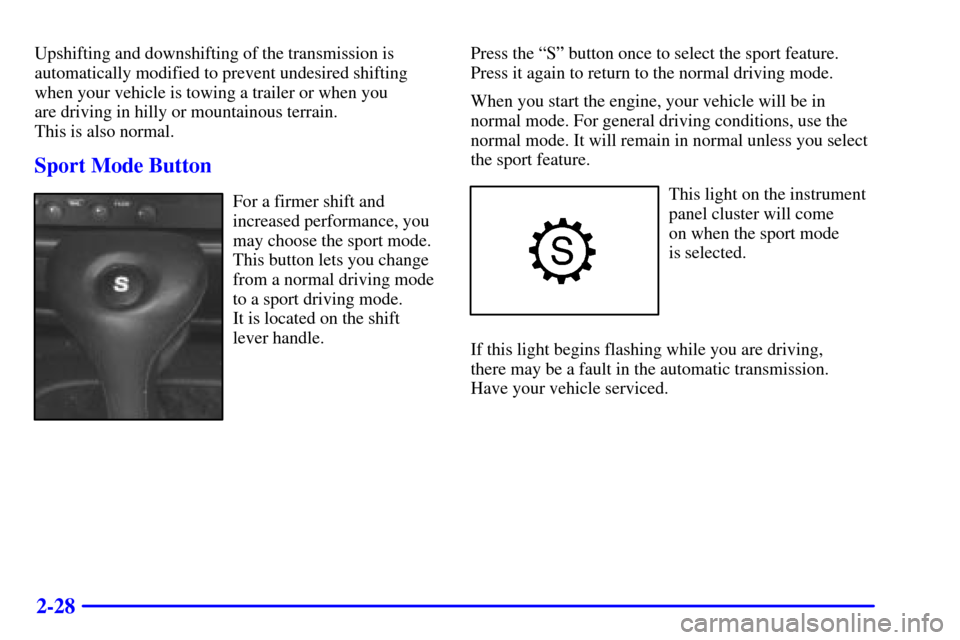
Sport Mode Button
For a firmer shift and
increased performance, you
may choose the sport mode.
This button lets you change
from a normal driving mode
to a sport driving mode.
It is located on the shift
lever handle.Press the ªSº button once to select the sport feature.
Press it again to return to the normal driving mode.
When you start the engine, your vehicle will be in
normal mode. For general driving conditions, use the
normal mode. It will remain in normal unless you select
the sport feature.This light on the instrument
panel cluster will come
on when the sport mode
is selected.
If this light begins flashing while you are driving,
there may be a fault in the automatic transmission.
Have your vehicle serviced.
Page 97 of 328
2-30
Parking Brake
The parking brake is located on the center console
between the front seats.
To set the parking brake, hold the regular brake pedal
down with your foot and pull up on the parking brake
lever. If the ignition is on, the brake system warning
light will come on.If you start to drive with the parking brake set, the
BRAKE warning light stays on. See ªBrake System
Warning Lightº in the Index for more information.
To release the parking brake, hold the brake pedal down
with your foot and pull the parking brake lever up until
you can press the end release button. Hold the release
button in as you move the brake lever all the way down.
NOTICE:
Driving with the parking brake on can cause the
rear brakes to overheat. You may have to replace
them, and you could also damage other parts of
your vehicle.
If you are towing a trailer and are parking on a hill, see
ªTowing a Trailerº in the Index. This section shows
what to do first to keep the trailer from moving.
Page 98 of 328
2-31
Shifting Into PARK (P)
CAUTION:
It can be dangerous to get out of your vehicle if
the shift lever is not fully in PARK (P) with the
parking brake firmly set. Your vehicle can roll.
If you have left the engine running, the vehicle
can move suddenly. You or others could be
injured. To be sure your vehicle won't move, even
when you're on fairly level ground, use the steps
that follow. If you're pulling a trailer, see
ªTowing a Trailerº in the Index.
Console Shift Lever
1. Hold the brake pedal down with your right foot.
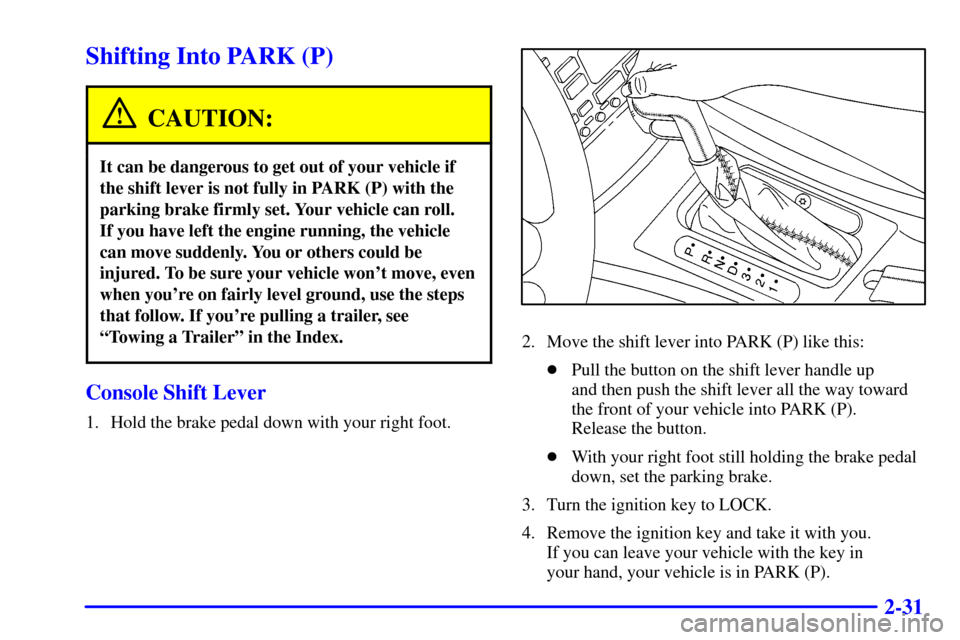
2. Move the shift lever into PARK (P) like this:
�Pull the button on the shift lever handle up
and then push the shift lever all the way toward
the front of your vehicle into PARK (P).
Release the button.
�With your right foot still holding the brake pedal
down, set the parking brake.
3. Turn the ignition key to LOCK.
4. Remove the ignition key and take it with you.
If you can leave your vehicle with the key in
your hand, your vehicle is in PARK (P).
Page 103 of 328
2-36
Running Your Engine While
You're Parked
It's better not to park with the engine running.
But if you ever have to, here are some things to know.
CAUTION:
Idling the engine with the climate control
system off could allow dangerous exhaust into
your vehicle. See the earlier Caution under
ªEngine Exhaust.º
Also, idling in a closed-in place can let deadly
carbon monoxide (CO) into your vehicle even if
the fan switch is at the highest setting. One place
this can happen is a garage. Exhaust
-- with
CO
-- can come in easily. NEVER park in a
garage with the engine running.
Another closed-in place can be a blizzard.
See ªBlizzardº in the Index.
CAUTION:
It can be dangerous to get out of your vehicle if
the shift lever is not fully in PARK (P) with the
parking brake firmly set. Your vehicle can roll.
Don't leave your vehicle when the engine is
running unless you have to. If you've left the
engine running, the vehicle can move suddenly.
You or others could be injured. To be sure your
vehicle won't move, even when you're on fairly
level ground, always set your parking brake after
you move the shift lever to PARK (P).
Follow the proper steps to be sure your vehicle won't
move. See ªShifting Into PARK (P)º in the Index.
If you are parking on a hill and if you're pulling a
trailer, also see ªTowing a Trailerº in the Index.
Horn
The horn can be sounded by pressing either horn symbol
on the steering wheel.
Page 104 of 328
2-37
Tilt Wheel
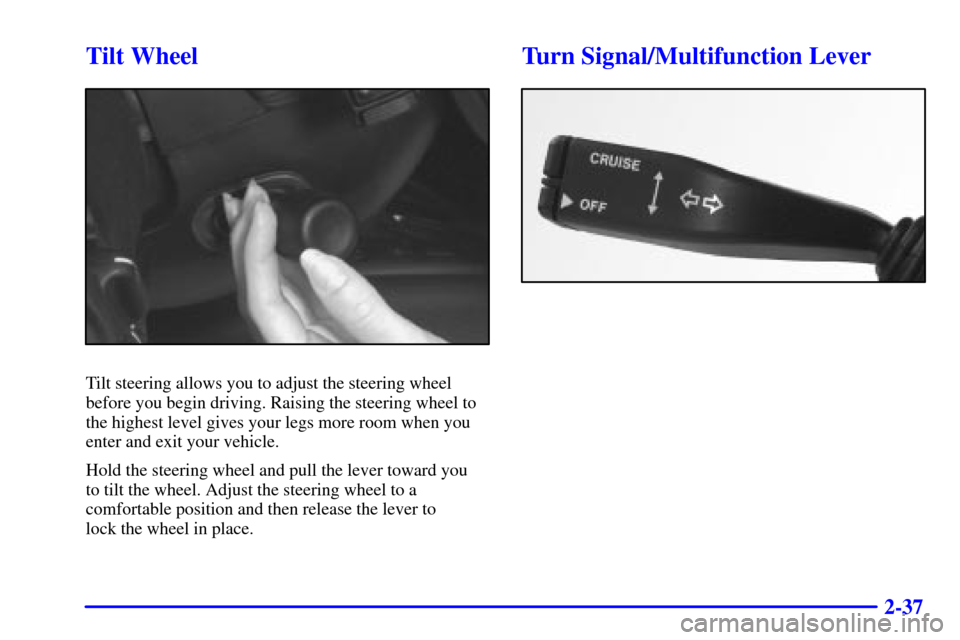
Tilt steering allows you to adjust the steering wheel
before you begin driving. Raising the steering wheel to
the highest level gives your legs more room when you
enter and exit your vehicle.
Hold the steering wheel and pull the lever toward you
to tilt the wheel. Adjust the steering wheel to a
comfortable position and then release the lever to
lock the wheel in place.
Turn Signal/Multifunction Lever
Page 105 of 328

2-38 Turn and Lane Change Signals
To signal a turn, move the turn signal/multifunction
lever all the way up or down. The lever returns
automatically when the turn is complete.
This arrow on the
instrument panel cluster
will flash in the direction of
the turn or lane change.
Raise or lower the lever until the arrow starts to flash to
signal a lane change. Hold it there until the lane change
is complete. The lever returns when it is released.
Arrows that flash rapidly when signaling for a turn or
lane change may be caused by a burned
-out front signal
bulb. (This does not occur with a burned
-out rear bulb).
Other drivers won't see the turn signal. Replace
burned
-out bulbs to help avoid possible accidents.
Check the fuse (see ªFuses and Circuit Breakersº in the
Index) and for burned
-out bulbs if the arrow fails to
work when signaling a turn.
Headlamp High/Low Beam
With the Twilight Sentinel� on or with the lamp
control dial turned to the headlamp position, push the
turn signal/multifunction lever on the driver's side of
the steering wheel away from you to turn on the
high
-beam headlamps.
This light on the instrument
panel cluster will be on,
indicating high
-beam usage.
Pull the lever back to the original position to return to
low
-beam headlamps. For more information, see
ªHeadlampsº in the Index.
Flash-To-Pass
This feature uses the high-beam headlamps to signal the
driver in front of you that you want to pass. This feature
will work with either the headlamps on or off.
To use, pull the turn signal lever toward you and release.