Page 107 of 328
2-40 Windshield Washer
Pull and hold the washer
lever towards you to wash
the windshield. Release the
lever when you have
enough fluid. The wipers
will clear the windshield
and either stop or return to
your preset speed.
CAUTION:
In freezing weather, don't use your washer until
the windshield is warmed. Otherwise the washer
fluid can form ice on the windshield, blocking
your vision.
This light on the instrument
panel cluster will be
displayed when the washer
fluid reaches a low level.
See ªLow Washer Fluid Warning Lightº in the Index for
more information.
Page 112 of 328

2-45
Exterior Lamps
These controls on the left side of the instrument panel
operate the following lamp systems:
Lamp knob (operates all lamps except the Twilight
Sentinel�, fog lamps and brightness control). Pull this
knob toward you to turn on the interior lamps and push
the knob back in to turn the lamps off.
Parking lamps, front and rear sidemarker
lamps, taillamps, license plate lamps, ashtray lamps,
backlighting to the radio controls and instrument
panel lights.
Headlamps.
Fog lamps.
Twilight Sentinel.
Turns the Twilight Sentinel system off.
Instrument panel brightness control.
Turn the lamp knob clockwise (to the first position) to
turn on the parking lamps, front and rear sidemarker
lamps, taillamps, license plate lamps, ashtray lamps,
instrument panel lights and backlighting to the center
console controls. Turn the lamp knob all the way
clockwise (to the second position) to turn on the
low
-beam headlamps.
Turn the lamp knob counterclockwise to turn the
lamps off.
Page 113 of 328

2-46 Headlamps
Turn the lamp knob all the way to the right to turn on
the low
-beam headlamps.
To turn on the high
-beam headlamps, the low-beam
headlamps must already be on. Push the turn signal lever
on the left side of the steering wheel away from you to
engage the high
-beam headlamps. Pull the lever toward
you to return to the low
-beam headlamps. For more
information, see ªHeadlamp High/Low Beamº in
the Index.
Turn the lamp knob all the way to the left to turn the
headlamps off.
If the headlamps are activated while driving and then
you turn your vehicle's ignition off while the lamp knob
is still turned on, the headlamps will turn off. If,
however, you open the driver's door while the lamp
knob is still turned on, a warning chime will sound
reminding you to turn the lamp knob to OFF. This will
stop the warning chime from sounding. (If you want the
headlamps to remain on, you must manually turn the
lamp knob off and then back on to the headlamp
position. The headlamps will stay on until manually
turned off again.)Your vehicle may be equipped with High Intensity
Discharge (HID) headlamps. Your headlamps come
on at a lower intensity and gradually increase to
full brightness.
Wiper
-Activated Headlamps
This feature activates the low
-beam headlamps,
parking lamps, sidemarker lamps and taillamps
after the windshield wipers have been in use for
about 20 seconds.
The wiper
-activated headlamps light the way in poor
weather and also make your vehicle more visible to
other drivers. If the wipers are on and the ignition switch
is turned off, the headlamps will immediately turn off.
The headlamps will also deactivate if the windshield
wipers have been turned off for about 20 seconds.
Perimeter Lighting
This feature turns on the low-beam headlamps, parking
lamps, sidemarker lamps and taillamps for about
20 seconds after the unlock button on the remote
keyless entry transmitter is pressed. Perimeter lighting
immediately ends when your vehicle's ignition is turned
to ON or START.
Page 117 of 328
2-50
Light Sensor
The light sensor for the
Twilight Sentinel is located
in the center of the front
defogger grille.
If you cover the sensor, it will read ªdarkº and the
parking lamps and low
-beam headlamps will come on.
Interior Lamps
Courtesy Lamps
To turn on the courtesy lamps, pull the exterior lamp
knob toward you. To turn the courtesy lamps off,
push the knob back in.
Instrument Panel Brightness Control
This control is located to the right of the fog lamp
button. As you turn the thumbwheel up, the instrument
panel lights will brighten.
Illuminated Entry
This system turns on the courtesy lamps (dome lamps
and door entry lamps) for about 20 seconds when any of
the following occur:
�if you manually unlock your vehicle with the key,
�if any door is opened,
�if you press the unlock button on the remote keyless
entry transmitter, or
�if the last door on your vehicle is closed.
Illuminated entry immediately ends when your vehicle's
ignition is turned to ON or START.
Page 118 of 328
2-51 Rear Reading Lamps
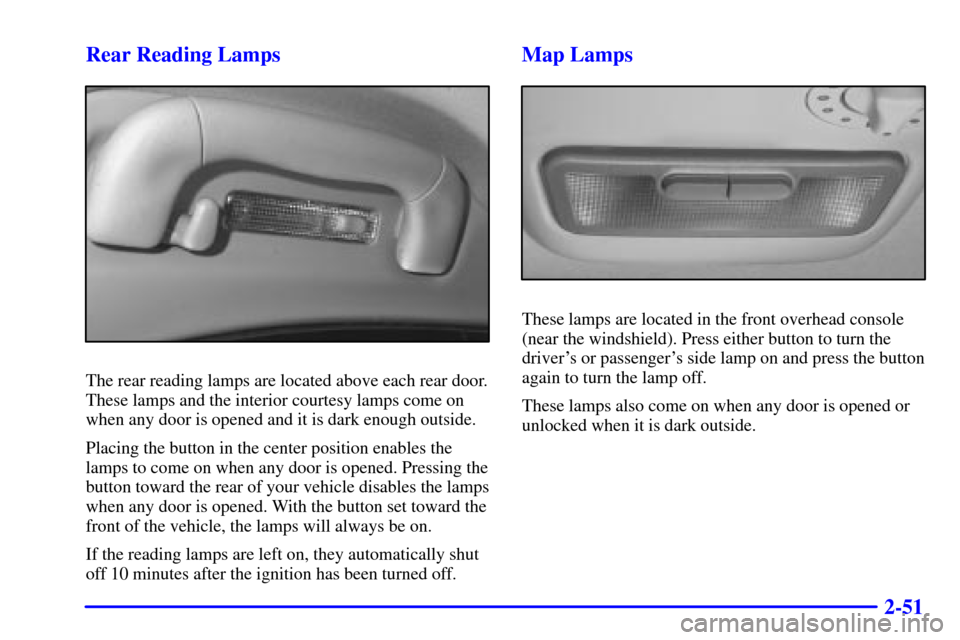
The rear reading lamps are located above each rear door.
These lamps and the interior courtesy lamps come on
when any door is opened and it is dark enough outside.
Placing the button in the center position enables the
lamps to come on when any door is opened. Pressing the
button toward the rear of your vehicle disables the lamps
when any door is opened. With the button set toward the
front of the vehicle, the lamps will always be on.
If the reading lamps are left on, they automatically shut
off 10 minutes after the ignition has been turned off.
Map Lamps
These lamps are located in the front overhead console
(near the windshield). Press either button to turn the
driver's or passenger's side lamp on and press the button
again to turn the lamp off.
These lamps also come on when any door is opened or
unlocked when it is dark outside.
Page 142 of 328
2-75 Brake System Warning Light
Your vehicle's hydraulic brake system is divided into
two parts. If one part isn't working, the other part can
still work and stop you. For good braking, though, you
need both parts working well.
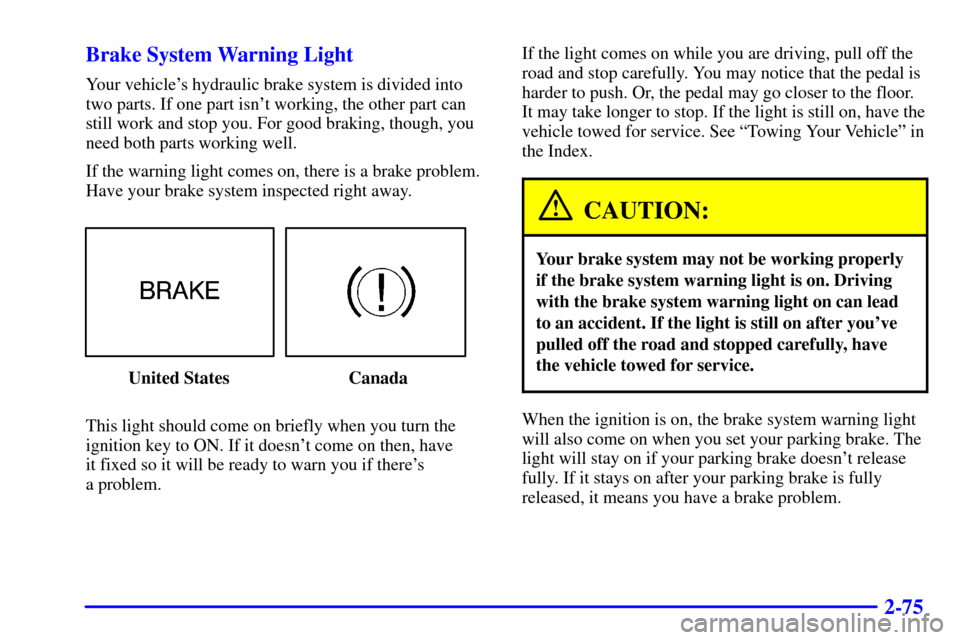
If the warning light comes on, there is a brake problem.
Have your brake system inspected right away.
United States Canada
This light should come on briefly when you turn the
ignition key to ON. If it doesn't come on then, have
it fixed so it will be ready to warn you if there's
a problem.If the light comes on while you are driving, pull off the
road and stop carefully. You may notice that the pedal is
harder to push. Or, the pedal may go closer to the floor.
It may take longer to stop. If the light is still on, have the
vehicle towed for service. See ªTowing Your Vehicleº in
the Index.
CAUTION:
Your brake system may not be working properly
if the brake system warning light is on. Driving
with the brake system warning light on can lead
to an accident. If the light is still on after you've
pulled off the road and stopped carefully, have
the vehicle towed for service.
When the ignition is on, the brake system warning light
will also come on when you set your parking brake. The
light will stay on if your parking brake doesn't release
fully. If it stays on after your parking brake is fully
released, it means you have a brake problem.
Page 146 of 328

2-79
NOTICE:
If you keep driving your vehicle with this light
on, after a while, your emission controls may not
work as well, your fuel economy may not be as
good and your engine may not run as smoothly.
This could lead to costly repairs that may not be
covered by your warranty.
NOTICE:
Modifications made to the engine, transmission,
exhaust, intake or fuel system of your vehicle or
the replacement of the original tires with other
than those of the same Tire Performance Criteria
(TPC) can affect your vehicle's emission controls
and may cause the CHECK ENGINE light to
come on. Modifications to these systems could
lead to costly repairs not covered by your
warranty. This may also result in a failure to pass
a required Emission Inspection/Maintenance test.
This light should come on, as a check to show you it is
working, when the ignition is on and the engine is not
running. If the light doesn't come on, have it repaired.
This light will also come on during a malfunction in one
of two ways:
�Light Flashing
-- A misfire condition has been
detected. A misfire increases vehicle emissions and
may damage the emission control system on your
vehicle. Dealer or qualified service center diagnosis
and service may be required.
�Light On Steady
-- An emission control
system malfunction has been detected on your
vehicle. Dealer or qualified service center diagnosis
and service may be required.
If the Light Is Flashing
The following may prevent more serious damage to
your vehicle:
�Reducing vehicle speed.
�Avoiding hard accelerations.
�Avoiding steep uphill grades.
�If you are towing a trailer, reduce the amount of
cargo being hauled as soon as it is possible.
Page 156 of 328

3-4
In cold weather, when the system senses the need for
heat, airflow will be directed out of the floor outlets. As
the interior temperature approaches a desired setting, the
fan speed will decrease. To maintain interior comfort,
the airflow may move to the instrument panel air outlets
and floor outlets (bi
-level mode). On bright sunny days
in cold weather, the airflow may come out of the air
conditioning outlets (AC mode) to maintain comfort and
prevent stuffiness.
If your vehicle is sitting out on a hot day and you have
the climate control system set for automatic operation,
the air will first flow out of the floor air outlets during
cool down. That is normal. This is to remove hot air
from the air outlets. As the air is cooled, the airflow will
move through the air conditioning outlets.
To avoid blowing cold air in cold weather, the system
will delay turning on the fan until warm air is available.
The length of delay depends on the outside air
temperature, engine coolant temperature or the time
since the engine was last started. As the coolant
warms up, the fan speed will gradually increase and
air will flow from the heater outlets, with some airflow
to the windshield to prevent fogging under most
normal conditions.If you leave your vehicle, the system will remember the
control setting the next time you start your engine,
except for recirculation and rear defrost (heated
backlite). Each ignition cycle cancels recirculation.
Manual Operation
You may manually adjust the air delivery mode or
fan speed.
HEATER/DEFROST: This setting directs air to
the floor outlets and toward the windshield.
AC: This setting directs airflow through the middle
instrument panel outlets.
BI-LEVEL: This setting directs air into your
vehicle in two ways. Cool air is directed to the upper
portion of your body through the middle instrument
panel outlets while warm air is directed to the floor.
HEATER: This setting directs warm air through
the floor outlets. Some warm air is sent to the
windshield to minimize fogging.