2001 BMW M3 CONVERTIBLE light
[x] Cancel search: lightPage 113 of 195
113n
IndexDataTechnologyRepairsCar careControlsOverview
Hardtop
*
It is not necessary to remove the fabric
top even in the winter, when the
hardtop is generally in constant use.
But you can also remove it at any time
with no problem. Before the fabric top
is stored in the convertible top
compartment, it must be absolutely dry
in order to prevent water spots and
mildew from forming.
The hardtop is equipped with reading
lamps in the rear and clothes hooks
operated simply by pressing. In addi-
tion, a roof-rack assembly is available.
In this regard, please contact your
BMW center.
When suspending clothing from
the hooks, ensure that they will
not obstruct the driver's vision. Do not
hang heavy objects on the hooks. If you
do so, they could cause personal injury
during braking or evasive maneuvers.<
Two people are required for installation
or removal. Work with extreme caution
in order to avoid paint damage and
damage to the body or hardtop.
To facilitate hardtop installation or
removal, you can obtain a specially
designed hardtop lift
* or hardtop rack
*
at your BMW center.
Storage
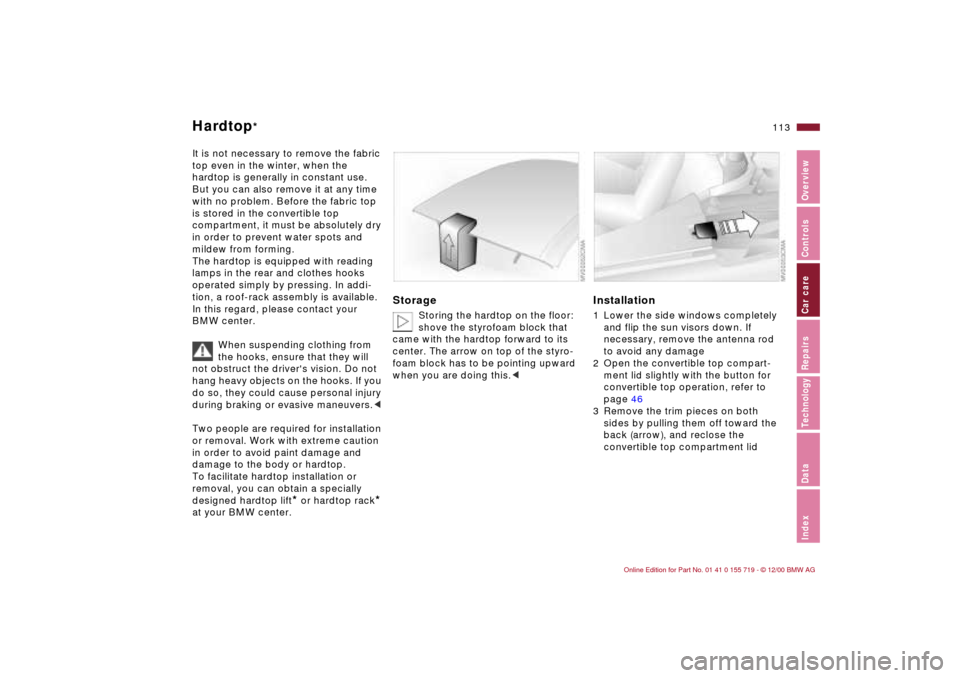
Storing the hardtop on the floor:
shove the styrofoam block that
came with the hardtop forward to its
center. The arrow on top of the styro-
foam block has to be pointing upward
when you are doing this.<
Installation1 Lower the side windows completely
and flip the sun visors down. If
necessary, remove the antenna rod
to avoid any damage
2 Open the convertible top compart-
ment lid slightly with the button for
convertible top operation, refer to
page 46
3 Remove the trim pieces on both
sides by pulling them off toward the
back (arrow), and reclose the
convertible top compartment lid
Page 114 of 195

114n
Hardtop
*
4 Open the two front locking levers on
the hardtop by pressing the buttons
(arrow). The levers will release
slightly. Raise the levers as far as the
stop will allow
5 Before installing, first flip down the
cover panels that are located under-
neath the left and right interior lamps.
To do this, press on the slight bump
on the cover panel. There is a holder
in the cover panel to securely store
the covers 1 that have been removed
6 Open the red release lever 2 as far as
the stop will allow
7 Position the hardtop onto the
supports with the help of a second
person. Be sure to put the mountings
exactly into the proper brackets
Lift the hardtop carefully. Be
extremely careful not to shift the
seals. Seals that have accidentally been
shifted or pulled out cause leaks.<
8 In the back, close the red locking
lever by turning to the inside as far as
the stop located behind the trim will
allow. Flip the cover panels back into
place
9 To lock the hardtop in the front, keep
pressing on the front locking levers
until you hear them engage.RemovalReverse the installation sequence to
install the hardtop.
Page 118 of 195

118n
Wheel and tire combinations The right choice
Only use wheels and tires that
have been approved by BMW for
the corresponding vehicle model, as
otherwise body contact and serious
accidents can result despite the use of
the same nominal size, e.g. due to
tolerances. BMW cannot evaluate non-
approved wheels and tires to determine
if they are suited for use, and therefore
cannot ensure the operating safety of
the vehicle if they are installed.<
For wheel and tire sizes approved by
BMW, refer to page 120.
Failure to use the specified wheel
and tire combinatons can have an
adverse effect on the performance of
various systems such as ABS and DSC.
For this reason, use only tires made by
the same manufacturer and that have
the same tread configuration on the
vehicle. And after a flat tire, for
instance, restore the approved wheel
and tire combination as soon as
possible.<
Codes on the tires and wheels The marking on the tire has the
following meaning.
The codes on radial tires:
The speed rating indicates the
approved maximum speed for the tire.
Summer tires:
S = up to 112 mph (180 km/h)
T = up to 118 mph (190 km/h)
H = up to 130 mph (210 km/h)
V = up to 150 mph (240 km/h)
W = up to 167 mph (270 km/h)
Y = up to 187 mph (300 km/h)
ZR = over 150 mph (240 km/h) Example:
Nominal width
in mm
Aspect
ratio in %
Radial tire ID code
Rim diameter in inches
Load rating
(not on ZR tires)
Speed rating
(before R on ZR tires)
225/45 R
1892W
Winter tires:
Q M+S = up to 100 mph (160 km/h)
T M+S = up to 118 mph (190 km/h)
H M+S = up to 130 mph (210 km/h)
Codes stamped on light-alloy wheels:
Protect tire valve from dirt by using
screw-on valve stem caps. Dirt in the
valves frequently leads to slow leaks. Storage Always store tires in a cool, dry place.
Store them away from light whenever
possible. Protect the tires against
contact with oil, grease and fuel. Example:
Rim width
in inches
Code letter for
flange type
Symbol for full-drop
center rim
Rim diameter in inches
Hump on the 2 rim shoulders
8 x 18 H 2
J
Page 120 of 195

120n
Approved wheel and tire specifications Depending on the tire size, certain tire brands tested by BMW have been
classified and approved as safe in traffic. Contact your BMW center for a list
of these tires.
Observe any country-specific regulations, e.g. on making a corresponding
entry in the vehicle documents.
Tire specifications Light-alloy wheel
BMW M3 convertible
Summer tires
Front: 225/45 ZR 18 8J x 18 EH2
Rear: 255/40 ZR 18 9J x 18 EH2
Front: 225/40 ZR 19 8J x 19 EH2
Rear: 255/35 ZR 19 9.5J x 19 EH2
Winter tires (M+S)
Front: 225/45 R 17 91 H
Rear: 225/45 R 17 91 H7.5J x 17 EH2 IS47
7.5J x 17 EH2 IS25
Snow chains
*
It is not possible to mount snow chains
on tires with 18-/19-inch wheels.
Deactivate the Tire Pressure
Warning system (RDW) when
using snow chains. Malfunction warn-
ings and undetected losses in pressure
are a possibility when driving with snow
chains.
For further information, refer to
page 81.
always remember the different rim
depths on the front and rear wheels.
Failure to mount the tires approved for
each wheel can lead to damage.<
Page 129 of 195
129n
IndexDataTechnologyRepairsCar careControlsOverview
Coolant
Do not add coolant to the cooling
system when the engine is hot. If
you do, escaping coolant can cause
scalds.
To avoid the possibility of damage later
on, never use anything other than
factory-approved, nitrite and amino-
free extended-duty antifreeze with
corrosion inhibitor. Your BMW center is
familiar with the official specifications.
Antifreeze and anticorrosion agents are
hazardous to health. You should always
store it in its original container and in a
location which is out of reach of chil-
dren. Extended-duty antifreeze with
corrosion inhibitor contains ethylene
glycol, a flammable substance. For this
reason, do not spill long-life antifreeze
with corrosion inhibitor on hot engine
parts. It could catch fire and cause
serious burns.<
Checking the coolant level and
adding coolant
Check the coolant level when the
engine is cold (approx. 68 7 or
+20 6). The coolant gauge needle in
the instrument cluster must be located
in the blue field; otherwise you could be
scalded when adding more fluid.
1 Open the cap for the expansion tank
by turning it slightly counterclockwise
to allow accumulated pressure to
escape. Then open.
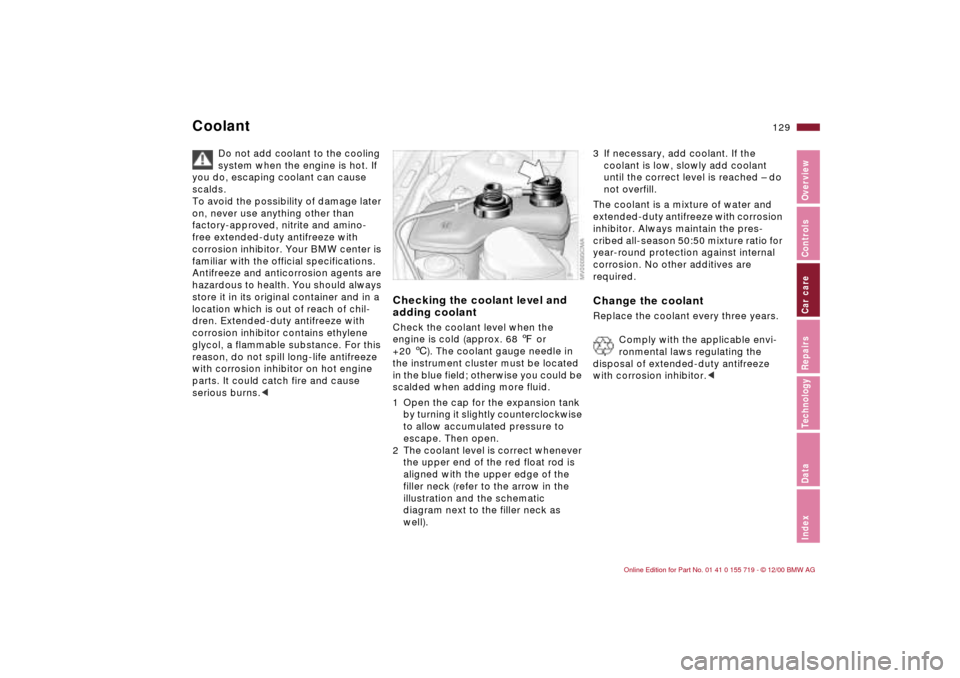
2 The coolant level is correct whenever
the upper end of the red float rod is
aligned with the upper edge of the
filler neck (refer to the arrow in the
illustration and the schematic
diagram next to the filler neck as
well).
3 If necessary, add coolant. If the
coolant is low, slowly add coolant
until the correct level is reached – do
not overfill.
The coolant is a mixture of water and
extended-duty antifreeze with corrosion
inhibitor. Always maintain the pres-
cribed all-season 50:50 mixture ratio for
year-round protection against internal
corrosion. No other additives are
required. Change the coolantReplace the coolant every three years.
Comply with the applicable envi-
ronmental laws regulating the
disposal of extended-duty antifreeze
with corrosion inhibitor.<
Page 132 of 195

132n
Washing your vehicle You can wash your BMW at an auto-
matic car wash, even when it is new.
Car wash systems that do not employ
brushes are preferable.
Wipe away tough dirt and loosen and
remove dead insects before washing
the vehicle.
In order to avoid spots, do not wash the
vehicle when the hood is warm, or
during or immediately after exposure to
strong sunlight.
When using an automatic car wash, be
sure that:
>The car wash system is suited for the
dimensions of your vehicle.
>No damage will occur on vehicles
with attached body accessories (such
as spoilers or antennas). Consult the
car wash operator if necessary.
>The wheels and tires of your vehicle
cannot be damaged by the convey-
ance devices of the car wash system.
>The vehicle is cleaned with minimum
brush pressure, and that plenty of
water is available for washing and
rinsing. Vehicles with rain sensor
*:
Clean the windshield regularly. Wax
from automatic car washes or insects
can cause malfunctions in the rain
sensor
* function.
Turn the rain sensor off (refer to
page 69) when going through an
automatic car wash, otherwise, damage
could occur from unintended wiper
activation.<
Parts of the vehicle that are inacces-
sible to the automatic washer – such as
door sills, door and hood edges, etc. –
should be cleaned by hand.
In the winter months, it is especially
important to be sure that the vehicle is
washed on a regular basis. Large quan-
tities of dirt and road salt are difficult to
remove, and they also damage the
vehicle.
If spray wands or high-pressure
washers are used, be sure to
maintain an adequate distance between
the spray source and the vehicle's
surface. Inadequate distance and
excessive pressure can damage or
weaken the finish, making it more
susceptible to subsequent attack. In
addition, moisture could penetrate to
vehicle components, leading to long-
term damage.<
When cleaning the headlamps,
please observe the following:
>Do not clean by wiping with a dry
cloth (this causes scratches). Never
use abrasives or strong solvents to
clean the covers.
>Remove dirt and contamination (such
as insects) by soaking with BMW Car
Shampoo and then rinsing with plenty
of water.
>Always use a deicer spray to remove
accumulated ice and snow – never
use a scraper.<
After washing the vehicle, apply
the brakes briefly to dry them.
Braking efficiency might otherwise be
reduced by the moisture and the brake
discs could also corrode.<
Caring for your vehicle
Page 133 of 195

133n
IndexDataTechnologyRepairsCar careControlsOverview
Caring for your vehicleExterior finish To provide effective corrosion protec-
tion, multilayer paintwork is applied at
the factory. Cataphoretic immersion
priming techniques are supplemented
with special body-cavity protectants
and application of specially developed
and extensively tested materials.
A layer of flexible PVC is first applied to
the undercarriage. Following this, a
comprehensive undercoating treat-
ment with a wax-based protectant is
applied. Regular maintenance makes
an important contribution to maintaining
the safety and value of your vehicle.
Increasing awareness of the effects of
harmful environmental factors on
vehicle finishes have led paint and
vehicle manufacturers to initiate
ongoing programs designed to further
improve the durability of their finishes.
Despite this, regional environmental
factors can have negative effects on
your vehicle's finish. Consider these
factors in determining the frequency
and extent of your efforts to maintain
the vehicle finish.
Depending upon material and type of
impact (perforation of paint layer), phys-
ical stresses from sand, road salt,
gravel, etc., can cause corrosion to start extending beneath the finish,
starting at the point of impact.
Road dirt, tar spots, dead insects,
animal droppings (strong alkali effect)
and tree excretions (resins and pollen)
all contain substances capable of
causing damage when allowed to
remain on the finish of your vehicle for
any period of time. This includes spots,
etching, flaking, and separations in the
top coat.
In industrial areas, deposits of flue dust,
lime, oily soot, precipitation containing
sulfur-dioxide (acid rain) and other envi-
ronmental pollutants will damage the
vehicle's finish unless adequate care is
provided – even though this is generally
limited to the outside horizontal
surfaces.
In coastal regions, high levels of atmo-
spheric salt and humidity promote
corrosion.
In tropical zones, high humidity and
heavy ultraviolet radiation prevail, in
addition to temperatures of over 105 7
(+40 6) in the shade. Under these
conditions, light paints can reach
temperatures up to 175 7 (+80 6) and
dark ones up to 250 7 (+120 6).
Caring for the vehicle finish Regular washing is a preventive
measure against long-term effects from
substances that are harmful to the
vehicle's finish, especially if you drive
your vehicle in areas with high levels of
air pollution or aggressive natural
substances (tree resins, pollen).
Nevertheless, you should immediately
remove especially aggressive
substances. Failure to do so can lead to
changes in the paint's chemical struc-
ture or to discoloration. Gasoline spilled
during refueling, oil, grease and brake
fluid should always be cleaned away
immediately, as should bird droppings.
Any contamination remaining on the
surface of the vehicle will be especially
conspicuous after washing. Use
cleaning fluid or alcohol with a clean
cloth or cotton pad to remove these
stains. Remove tar spots with tar
remover. After cleaning, the affected
areas should be waxed to ensure
continued protection.
Use the cleaning and car-care
products available at your BMW
center.<
Page 134 of 195

134n
Caring for your vehicleWaxing your car Protect the finish using only carnauba
or synthetic-based waxes.
The best way to determine when the
finish needs to be waxed is by noting
when water stops beading on the
surface.
You can use a glass cleaner to remove
any wax or silicone that may have been
left on the windows during waxing.
Use the cleaning and car-care
products available at your BMW
center.<
Paint damageYou can touch up small areas of paint
damage with a BMW spray paint or a
BMW touchup stick.
The paint color code for your vehicle is
provided on a sticker located on the
right hand side under the hood and on
the first page of your Service and
Warranty Information Booklet (US
models) or Warranty and Service Guide
Booklet (Canadian models).
Damage caused by flying stones,
scratches, etc., must be touched up
without delay to prevent rust from
forming.
If corrosion has started to form in an
area with paint damage, remove all rust
and clean the area. Then prime the area
with a BMW Primer Stick. Finally, apply
the finish coat. Wait a few days, then
polish the repaired area. Finish by
applying a wax preservative.
More extensive paint damage should
be repaired professionally in accor-
dance with the manufacturer's instruc-
tions. Your BMW center uses original
BMW finish materials in accordance
with approved repair procedures.
Window careYou can use window and glass cleaner
to clean inside window surfaces and
mirrors without smearing and streaking.
Never use polishing pastes or abrasive
(quartz) cleansers on mirror lenses.
Clean the wiper blades with soapy
water. The wiper blades should be
replaced twice a year – before and after
the cold season. This is especially
important for vehicles equipped with a
rain sensor
*.
Use only wiper blades approved
by BMW.<
Caring for other vehicle
components and materials Light-alloy wheels should be treated
with alloy wheel cleaner, especially
during the winter months. However, do
not use aggressive products containing
acids, strong alkalis or abrasives. Do
not use steam cleaners operating at
temperatures above 140 7 (+60 6).
Follow the manufacturer's instructions.
If your vehicle has chrome parts
* such
as window moldings, door handles or
similar items, clean these parts carefully
with ample clean water, and possibly a
shampoo additive, especially if there is