2001 BMW M ROADSTER COUPE sat
[x] Cancel search: satPage 3 of 171

Congratulations, and thank you for choosing a BMW.
Thorough familiarity with your vehicle will provide you with enhanced control and
security when you drive it. We therefore have this request:
Please take the time to read this Owner's Manual and familiarize yourself with the
information that we have compiled for you before starting off in your new BMW.
It contains important data and instructions intended to assist you in gaining maxi-
mum use and satisfaction from the unique range of technical features on your BMW.
The manual also contains information on care and maintenance designed to en-
hance operating and driving safety and contribute to maintaining the value of your
vehicle throughout an extended service life.
This manual is supplemented by a Service and Warranty Information Booklet
(US models) or a Warranty and Service Guide Booklet (Canadian models). We
recommend that you read this publication thoroughly.
Your BMW is covered by the following warranties:
– New Vehicle Limited Warranty
– Limited Warranty Rust Perforation
– Federal Emissions System Defect Warranty
– Federal Emissions Performance Warranty
– California Emissions Control System Limited Warranty
Detailed information about these warranties is listed in the Service and Warranty
Information Booklet (US models) or in the Warranty and Service Guide Booklet
(Canadian models).
We wish you an enjoyable driving experience.
BMW M
Preface
ProCarManuals.com
Page 74 of 171
74n
Heating and ventilation/Air conditionerAir distribution
You can direct the airflow onto
the windows , toward the
upper body and into the foot-
well . All intermediate settings are
possible. In position , a small volume
of air is directed onto the windows in
order to keep them free of condensa-
tion.
A "6 o'clock" position is recommended
as the normal operating setting.
Temperature
In order to increase the temper-
ature of the passenger compart-
ment, turn to the right (red). For
rapid heating, turn completely to the
right. Then select an interior tempera-
ture which is pleasant for you.
Air supply
You can select blower speeds
from 1 to 4. Both heating and
ventilation become more effec-
tive as the airflow rate is increased. In
position 0, the blower and the heater
are switched off.
Air conditioner
The air is cooled and dehumidi-
fied and – depending on the
temperature setting – warmed
again when the air conditioner is
switched on.
Depending on the weather, the wind-
shield may fog over briefly when the
engine is started.
At outside temperatures below approx.
41 7 (+5 6), switch off the air condi-
tioner. This will help to prevent the
windows from fogging up.
If the windows fog over directly after
switching the air conditioner off, switch
it on again.
Condensation forms in the air
conditioner system during opera-
tion, which then exits under the vehicle.
Traces of condensed water of this kind
are thus normal.<
Recirculated air mode
If there are unpleasant odors in
the incoming air, you can
temporarily block the airflow.
The system then recirculates the air
currently within the vehicle.
If the windows fog over in the
recirculated air mode, switch this
mode off and increase the air supply as
required.<
ProCarManuals.com
Page 76 of 171
76n
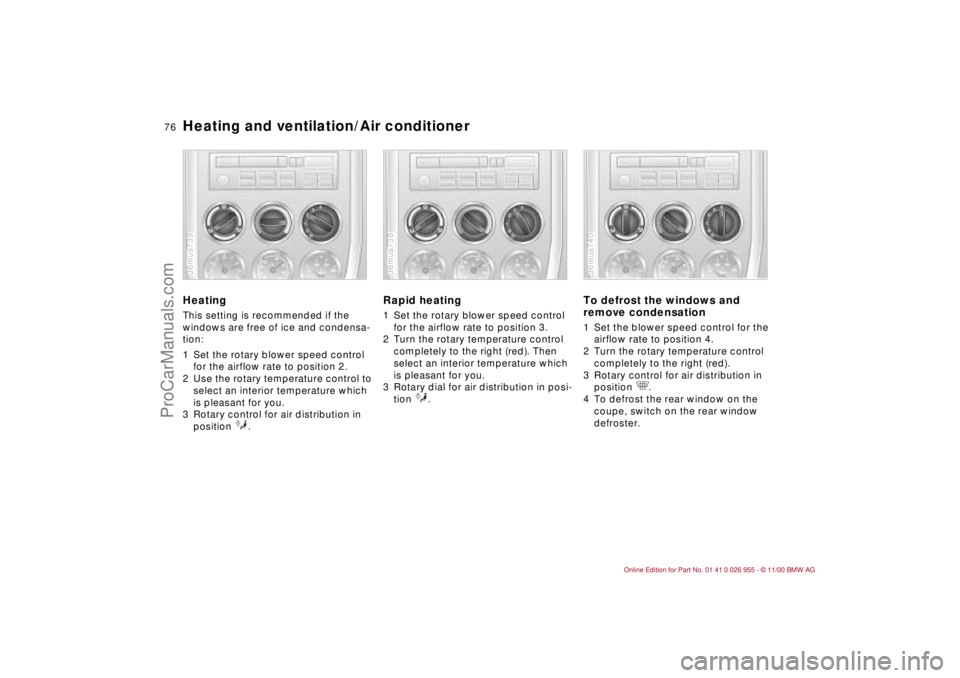
Heating and ventilation/Air conditionerHeatingThis setting is recommended if the
windows are free of ice and condensa-
tion:
1 Set the rotary blower speed control
for the airflow rate to position 2.
2 Use the rotary temperature control to
select an interior temperature which
is pleasant for you.
3 Rotary control for air distribution in
position .36mus739
Rapid heating1 Set the rotary blower speed control
for the airflow rate to position 3.
2 Turn the rotary temperature control
completely to the right (red). Then
select an interior temperature which
is pleasant for you.
3 Rotary dial for air distribution in posi-
tion .36mus738
To defrost the windows and
remove condensation 1 Set the blower speed control for the
airflow rate to position 4.
2 Turn the rotary temperature control
completely to the right (red).
3 Rotary control for air distribution in
position .
4 To defrost the rear window on the
coupe, switch on the rear window
defroster.36mus740
ProCarManuals.com
Page 89 of 171

89n
IndexDataTechnologyRepairsCar careControlsOverview
Antilock Brake System (ABS)The conceptABS increases active safety by
preventing the wheels from locking
when braking. The reason: locked
wheels are dangerous. When the front
wheels slide, the driver loses steering
control over the vehicle. Traction loss at
the rear wheels can cause the rear end
to break into an uncontrolled skid.
The system can achieve the shortest
braking distances possible under most
conditions (on straight-aways, in curves
and on various road surfaces.).
ABS is designed to meet two essential
requirements during every brake appli-
cation:
>To help provide vehicle stability.
>Assured ability to steer and maneuver
on the various road surfaces (asphalt,
concrete, dirt, wet conditions, snow
and ice).
Braking with ABSThe system is operative once the
vehicle exceeds a speed of approx.
6 mph (10 km/h). It is inactive once
again below approx. 4 mph (6 km/h).
Therefore, the wheels could theoreti-
cally tend to lock in the final phase of a
braking action, but this is insignificant in
actual practice.
If you are in a situation which requires
full braking, you will exploit the full
benefits of the ABS system if you apply
maximum brake pressure ("panic stop").
Since the vehicle maintains steering
responsiveness, you can avoid possible
obstacles with a minimum of steering
effort, despite the full brake application.The ABS closed-loop control circuit
cycles in fractions of a second. The
pulsation at the brake pedal, together
with sounds generated by the hydraulic
control system, indicate to you that the
vehicle is approaching its maximum
braking range. It is a reminder to you
that you must adapt the vehicle's road
speed to existing road conditions.
On road surfaces that have a loose
surface layer on a firm base with good
traction (on gravel, deep sand or snow,
for example), braking distances may be
longer than with locked wheels. This
also applies for driving with snow
chains. However, ABS continues to
provide enhanced vehicle stability and
steering response under these condi-
tions.
ProCarManuals.com
Page 91 of 171

91n
IndexDataTechnologyRepairsCar careControlsOverview
Disc brakesDisc brakes furnish optimum decelera-
tion and braking control and greater
fade resistance under heavy use.
When the vehicle is driven only occa-
sionally, during extended periods when
the vehicle is not used at all, or in oper-
ating conditions where brake applica-
tions are less frequent, there is an
increased tendency for corrosion of the
discs and accumulation of contamina-
tion on the brake pads. This occurs
because the minimal pressure which
must be exerted by the pads to clean
the discs by brake applications is not
reached.
If the brake discs are corroded, they will
tend to respond to braking with a
pulsating effect which even extended
application will fail to cure.
For your own safety: use only
brake pads that BMW has
approved for your specific vehicle
model. BMW cannot evaluate non-
approved brake pads to determine if
they are suited for use, and therefore
cannot ensure the operating safety of
the vehicle in the event of their use.<
Driving notesWhile driving in wet conditions and in
heavy rain, it is advisable to apply light
pressure to the brake pedal every few
miles – watch traffic conditions to
ensure that this maneuver does not
endanger other road users. The heat
generated in this braking process helps
dry the brake pads and discs.
Maximum braking force is obtained
while the wheels continue to rotate,
peaking when the wheels remain on the
verge of locking without actually doing
so. ABS maintains this state automati-
cally. If the ABS fails, you should revert
to the staggered braking technique
described on page 94.
Extended or steep mountain descents
should be driven in the gear in which
only minimal periodic brake application
is required. This avoids excessive strain
on the brakes and possible impairment
of the braking effect.
You can increase the engine's braking
effect by selecting progressively lower
gears, downshifting into first gear, if
necessary. Should engine braking prove inade-
quate, you should still avoid extended,
continuous braking. Instead, decelerate
the vehicle with increased pressure on
the brake pedal (watch for following
traffic!), release the pedal and then
repeat the brake application (staggered
braking). This staggered braking tech-
nique allows the brakes to cool in the
intervals between active braking
phases, preventing overheating and
ensuring that full braking capacity
remains available at all times.
Do not drive the vehicle with the
clutch depressed, with the shift
lever in neutral or with the engine shut
off. The engine provides no braking
control when the transmission is in
neutral and there is no power assist for
braking and steering when the engine is
shut off.
Never allow floor mats, carpets or any
other objects to protrude into the area
around the accelerator, clutch and
brake pedals and obstruct their move-
ment.<
ProCarManuals.com
Page 165 of 171

Everything from A to Z
165n
IndexDataTechnologyRepairsCar careControlsOverview
Cigarette lighter80
Cleaning the headlamps60
Cleaning the rear
window60
Cleaning the windshield59
Cockpit16
Code, refer to the Radio
Owner's Manual
Coin box79
Cold start56
Compartments78
Connecting a car vacuum
cleaner80
Controls, cockpit16
Convertible top
care117
electrical defect143t
operation37, 41
weather protection41
Coolant93, 112
antifreeze protection93
Coolant temperature63
Copyright4
Cornering Brake Control
(CBC)90
Cover, convertible
top38, 43
Cruise control61
Cup holder, refer to
beverage holder79
Curb weight158
DDashboard16
Data link connector for
Onboard Diagnostics125
Date, refer to the Radio
Owner's Manual
Daytime running lamps69
Deep water87
Defrost the windows and
remove condensation76
Defrosting
rear window60
mirrors47
Difficult steering94t
Dimensions157
Dipstick, engine oil109
Dirty spots on
paintwork118
Disc brakes91
Displacement156
Display lighting69
Displays18
Disposal
batteries141t
brake fluid113t
engine oil111t
Door key30
Doors
manual operation32
unlocking and locking32
DOT Quality Grades99
Drive belts160Driving notes87
Driving through water87
DSC (Dynamic Stability
Control)65, 151
Dynamic Stability Control
(DSC)65, 151
EElectric convertible top
operation41
Electric power windows35
Electrical defect
convertible top143t
fuel filler door143t
Electrical system160
Electronic immobilizer31
Emergency operation
convertible top143t
doors32t
fuel filler door143t
luggage compartment
lid34t
Engine compartment107
Engine coolant112
adding112t
Engine oil109
adding109t
dipstick109
disposal111t
grades110
level22, 109t
pressure20
viscosity110Engine output156
Engine specifications156
Exterior finish118
FFailure of an electrical
accessory142t
Fan74
Filler cap cover25
Filling the washer
reservoir108t
First-aid kit25
Fittings, tow-starting and
towing145t
Flasher, headlamp58
Flat tire98
Z3 roadster,
Z3 coupe135t
Folding top37
Footbrake91
Front airbags51, 122
Frost protection, radiator93
Fuel26
Fuel filler door
electrical defect143t
emergency
operation143t
Fuel gauge62
Fuel tank capacity159
Fuses142
ProCarManuals.com