2001 BMW M ROADSTER COUPE engine
[x] Cancel search: enginePage 129 of 171
129n
IndexDataTechnologyRepairsCar careControlsOverview
Lamps and bulbsThe lamps and bulbs make essential
contributions to the safety of your
vehicle. Therefore, comply fully with the
following instructions during bulb
replacement. If you are not familiar with
any of the procedures, consult your
BMW center.
Do not touch the glass portion of
a new bulb with your bare hands
since even small amounts of impurities
burn into the surface and reduce the
service life of the bulb. Use a clean
cloth, paper napkin, or a similar mate-
rial, or hold the bulb by its metallic
base.<
A replacement bulb set is available from
your BMW center.
Before performing any work on
the electrical system, switch off
the affected accessories or disconnect
the cable from the negative terminal of
the battery. Failure to do so could result
in short circuits in the electrical system.
To prevent injuries and damage,
comply with any instructions provided
by the bulb manufacturer.<
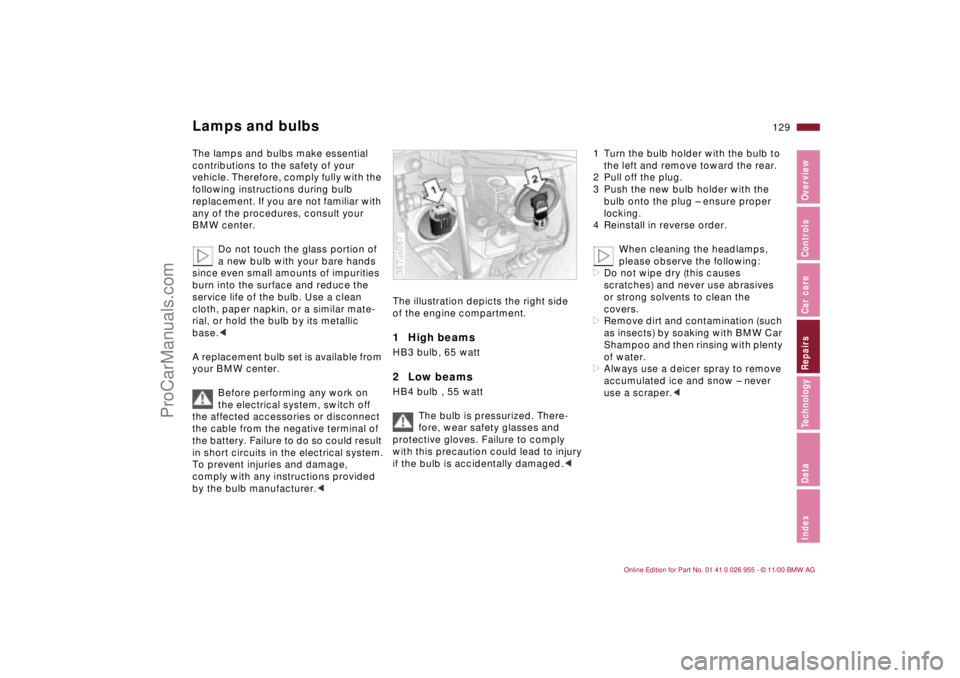
The illustration depicts the right side
of the engine compartment.1 High beams HB3 bulb, 65 watt2 Low beams HB4 bulb , 55 watt
The bulb is pressurized. There-
fore, wear safety glasses and
protective gloves. Failure to comply
with this precaution could lead to injury
if the bulb is accidentally damaged.< 367us067
1 Turn the bulb holder with the bulb to
the left and remove toward the rear.
2 Pull off the plug.
3 Push the new bulb holder with the
bulb onto the plug – ensure proper
locking.
4 Reinstall in reverse order.
When cleaning the headlamps,
please observe the following:
>Do not wipe dry (this causes
scratches) and never use abrasives
or strong solvents to clean the
covers.
>Remove dirt and contamination (such
as insects) by soaking with BMW Car
Shampoo and then rinsing with plenty
of water.
>Always use a deicer spray to remove
accumulated ice and snow – never
use a scraper.<
ProCarManuals.com
Page 141 of 171
141n
IndexDataTechnologyRepairsCar careControlsOverview
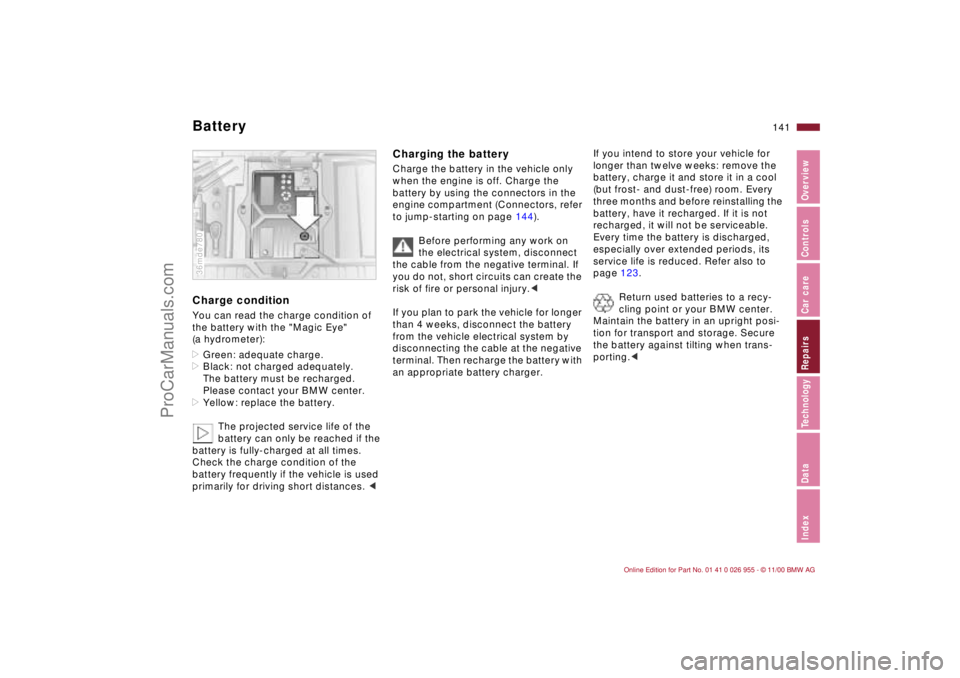
BatteryCharge condition You can read the charge condition of
the battery with the "Magic Eye"
(a hydrometer):
>Green: adequate charge.
>Black: not charged adequately.
The battery must be recharged.
Please contact your BMW center.
>Yellow: replace the battery.
The projected service life of the
battery can only be reached if the
battery is fully-charged at all times.
Check the charge condition of the
battery frequently if the vehicle is used
primarily for driving short distances. < 36mde780
Charging the batteryCharge the battery in the vehicle only
when the engine is off. Charge the
battery by using the connectors in the
engine compartment (Connectors, refer
to jump-starting on page 144).
Before performing any work on
the electrical system, disconnect
the cable from the negative terminal. If
you do not, short circuits can create the
risk of fire or personal injury.<
If you plan to park the vehicle for longer
than 4 weeks, disconnect the battery
from the vehicle electrical system by
disconnecting the cable at the negative
terminal. Then recharge the battery with
an appropriate battery charger.
If you intend to store your vehicle for
longer than twelve weeks: remove the
battery, charge it and store it in a cool
(but frost- and dust-free) room. Every
three months and before reinstalling the
battery, have it recharged. If it is not
recharged, it will not be serviceable.
Every time the battery is discharged,
especially over extended periods, its
service life is reduced. Refer also to
page 123.
Return used batteries to a recy-
cling point or your BMW center.
Maintain the battery in an upright posi-
tion for transport and storage. Secure
the battery against tilting when trans-
porting.<
ProCarManuals.com
Page 142 of 171
142n
Battery FusesRemoval and installation
Do not disconnect the battery
cables when the engine is running.
If you do so, the ensuing voltage surge
will damage the vehicle's onboard elec-
tronics.
Do not make any modifications in the
wires leading to the positive terminal. If
you do so, the battery safety terminal's
safety function will no longer be guaran-
teed. Repair and disposal must be
performed by trained technicians only.<
When removing the battery, disconnect
the cable on the negative terminal first,
then the cable on the positive terminal.
Unscrew the battery retaining clamp.
When installing the battery, connect the
positive terminal first, then connect the
negative terminal.
When installing a battery and
cover, be sure that they are
mounted properly. If this is not done,
the battery will not be adequately
secured in case of an accident.<
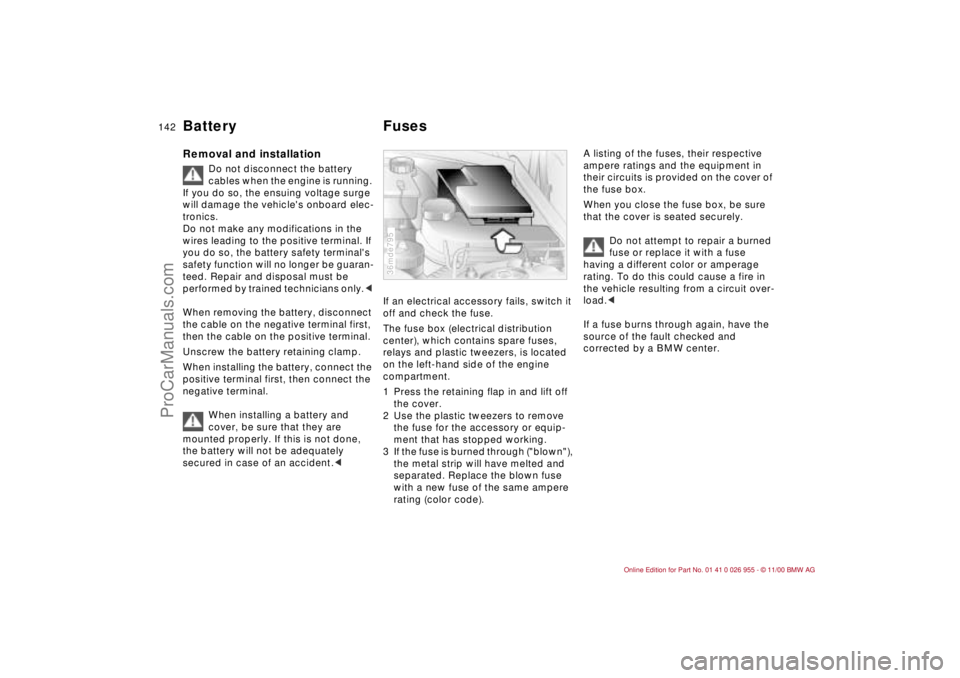
If an electrical accessory fails, switch it
off and check the fuse.
The fuse box (electrical distribution
center), which contains spare fuses,
relays and plastic tweezers, is located
on the left-hand side of the engine
compartment.
1 Press the retaining flap in and lift off
the cover.
2 Use the plastic tweezers to remove
the fuse for the accessory or equip-
ment that has stopped working.
3 If the fuse is burned through ("blown"),
the metal strip will have melted and
separated. Replace the blown fuse
with a new fuse of the same ampere
rating (color code).36mde795
A listing of the fuses, their respective
ampere ratings and the equipment in
their circuits is provided on the cover of
the fuse box.
When you close the fuse box, be sure
that the cover is seated securely.
Do not attempt to repair a burned
fuse or replace it with a fuse
having a different color or amperage
rating. To do this could cause a fire in
the vehicle resulting from a circuit over-
load.<
If a fuse burns through again, have the
source of the fault checked and
corrected by a BMW center.
ProCarManuals.com
Page 144 of 171
144n
Jump-startingNever use spray starter fluids to start
the engine.
If the battery is discharged, the engine
can be started with the use of two
jumper cables and the battery of
another vehicle. Always use jumper
cables with fully insulated handles on
the terminal clamps.
Do not touch voltage-carrying
components when the engine is
running. To do so creates a risk of fatal
injury.<
Carefully comply with the following
instructions to avoid personal injury and
damage to one or both vehicles:
1 Ensure that the battery on the
support vehicle is also rated at
12 volts, and that the capacities of
the two batteries (Ah) are roughly
comparable (printed on casing).
2 Leave the discharged battery
connected to the vehicle electrical
system.
3 Make sure that there is no contact
between the bodywork of the two
vehicles. This creates the risk of
short-circuiting.
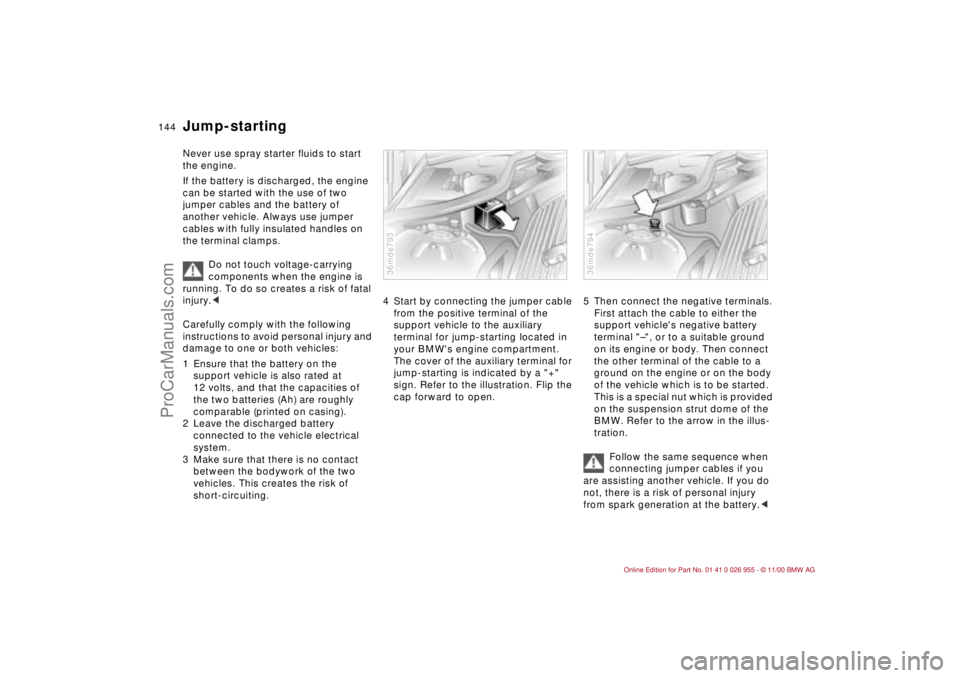
4 Start by connecting the jumper cable
from the positive terminal of the
support vehicle to the auxiliary
terminal for jump-starting located in
your BMW's engine compartment.
The cover of the auxiliary terminal for
jump-starting is indicated by a "+"
sign. Refer to the illustration. Flip the
cap forward to open.36mde793
5 Then connect the negative terminals.
First attach the cable to either the
support vehicle's negative battery
terminal "–", or to a suitable ground
on its engine or body. Then connect
the other terminal of the cable to a
ground on the engine or on the body
of the vehicle which is to be started.
This is a special nut which is provided
on the suspension strut dome of the
BMW. Refer to the arrow in the illus-
tration.
Follow the same sequence when
connecting jumper cables if you
are assisting another vehicle. If you do
not, there is a risk of personal injury
from spark generation at the battery.< 36mde794
ProCarManuals.com
Page 145 of 171
145n
IndexDataTechnologyRepairsCar careControlsOverview
Jump-starting Towing the vehicle6 Start the support vehicle's engine
and let it run.
7 Start the engine on the vehicle
needing the jump-start, and allow it
to run as usual. If the first start
attempt is not successful, wait a few
minutes before another attempt in
order to allow the discharged battery
to recharge.
8 Before disconnecting the jumper
cables from your BMW, turn on the
lamps, set the blower at the highest
speed and run the engine for at least
10 seconds. This will prevent a
voltage surge at the voltage regulator
to the electrical accessories.
9 Then disconnect the jumper cables in
reverse sequence.
If necessary recharge the battery.
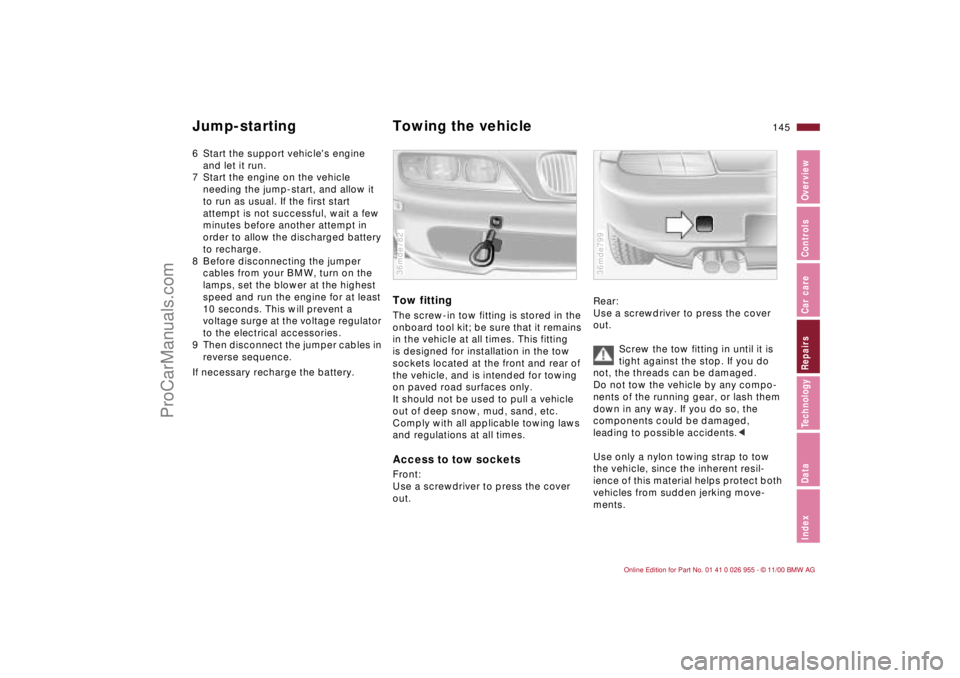
Tow fittingThe screw-in tow fitting is stored in the
onboard tool kit; be sure that it remains
in the vehicle at all times. This fitting
is designed for installation in the tow
sockets located at the front and rear of
the vehicle, and is intended for towing
on paved road surfaces only.
It should not be used to pull a vehicle
out of deep snow, mud, sand, etc.
Comply with all applicable towing laws
and regulations at all times.Access to tow socketsFront:
Use a screwdriver to press the cover
out.36mde782
Rear:
Use a screwdriver to press the cover
out.
Screw the tow fitting in until it is
tight against the stop. If you do
not, the threads can be damaged.
Do not tow the vehicle by any compo-
nents of the running gear, or lash them
down in any way. If you do so, the
components could be damaged,
leading to possible accidents.<
Use only a nylon towing strap to tow
the vehicle, since the inherent resil-
ience of this material helps protect both
vehicles from sudden jerking move-
ments.36mde799
ProCarManuals.com
Page 146 of 171
146n
Towing the vehicle
The towed vehicle should always
be the lighter of the two vehicles.
If this is not the case, it will not be
possible to control vehicle handling.<
Tow-startingFor instructions on jump-starting, refer
to page 144.
Never attempt to use your vehicle to
push another vehicle, since damage to
the energy-absorbing bumpers could
result.
Towing a vehicle 1 Put the manual-shift gear lever in
neutral.
2 Towing speed:
45 mph (70 km/h) maximum.
3 Towing distance:
95 miles (150 km) maximum.
4 Leave the ignition key at position 1 to
ensure that brake lamps, turn signal
indicators, horn and windshield
wipers remain operative, and to
prevent the steering lock from
engaging.
5 Switch on the hazard warning
flashers (observe applicable legal
regulations).
Find some means of identifying the
vehicle in tow, for instance, place a sign
or warning triangle in the rear window.
Make sure that the ignition key
remains in position 1 even when
the electrical system has failed to
prevent the steering lock from
engaging.
The steering and brakes are without
power assist when the engine is off.
This means that increased effort is
required for steering and braking.<
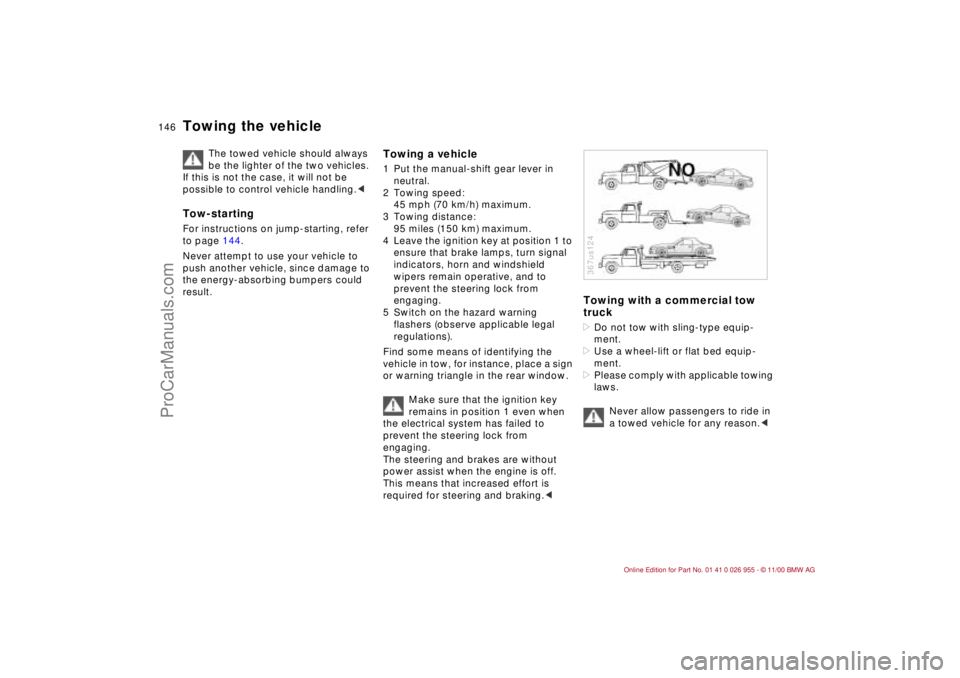
Towing with a commercial tow
truck>Do not tow with sling-type equip-
ment.
>Use a wheel-lift or flat bed equip-
ment.
>Please comply with applicable towing
laws.
Never allow passengers to ride in
a towed vehicle for any reason.< 367us124
ProCarManuals.com
Page 151 of 171
151n
IndexDataTechnologyRepairsCar careControlsOverview
Highly sensitive sensors monitor the
number of revolutions of the wheels,
steering angle, lateral acceleration,
brake pressure and the movement of
the vehicle around its vertical axis.
If differences in wheel revolutions
should occur, the system will recognize
the potential danger this loss of traction
can cause and reduces the drive torque
going to the wheels. The system will
also apply the brakes to all four wheels,
if necessary.
In addition, DSC permanently monitors
the vehicle's current operating condi-
tion and compares it with an ideal
condition that is calculated from the
sensor's signals.
If conditions such as understeering or
oversteering should occur, DSC will
help stabilize the vehicle in fractions of
a second by reducing engine power
output, and applying the brakes to indi-
vidual wheels.
As a result, many dangerous skids can
be prevented even as they are just
beginning, within physically feasible
limits.You may need some time to become
accustomed to this system's interven-
tion. However, it provides optimum
drive force and vehicle stability.
The braking intervention may be
accompanied by a certain degree of
noise.
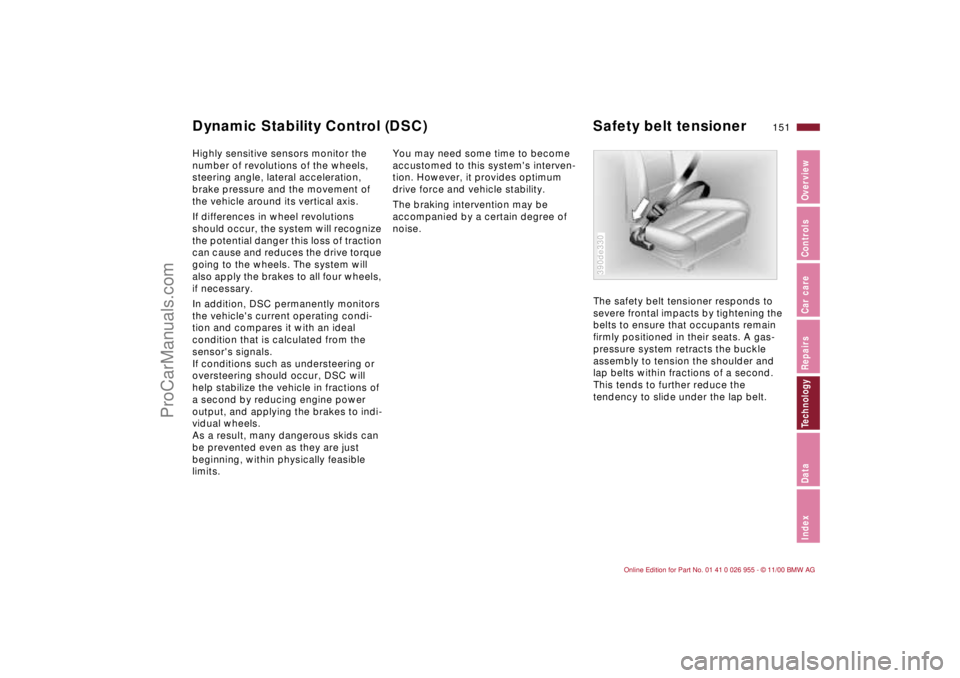
The safety belt tensioner responds to
severe frontal impacts by tightening the
belts to ensure that occupants remain
firmly positioned in their seats. A gas-
pressure system retracts the buckle
assembly to tension the shoulder and
lap belts within fractions of a second.
This tends to further reduce the
tendency to slide under the lap belt.
390de330
Dynamic Stability Control (DSC) Safety belt tensioner
ProCarManuals.com
Page 155 of 171
Overview
Controls and features
Operation, care
and maintenance
Owner service procedures
Technical data
Index Advanced technology
155n
IndexDataTechnologyRepairsCar careControlsOverview
Engine specifications156
Dimensions157
Weights158
Capacities159
Electrical system160
Drive belts160
Data
ProCarManuals.com