Page 10 of 171

Contents
Overview
Controls and features
Cockpit16
Instrument cluster18
Indicator and warning lamps20
Hazard warning flashers24
Warning triangle24
First-aid kit25
Refueling25
Fuel specifications26
Tire inflation pressure26
Tire inflation pressure (table)27
Opening and closing:
Keys30
Electronic vehicle
immobilizer31
Central locking system32
Opening and closing from the
outside32
Opening and closing from the
inside33
Luggage compartment lid34
Electric power windows35
Sunroof – coupe36
Convertible top – roadster37
Adjustments:
Seats46
Mirrors47
Safety systems:
Safety belts49
Airbags51
Transporting children safely53
Driving:
Steering/Ignition lock55
Starting the engine56
Switching off the engine57
Parking brake57
Manual transmission58
Turn signal indicators/High
beams58
Wiper/Washer system59
Rear window defroster60
Cruise control61
Everything under control:
Odometer62
Tachometer62
Fuel gauge62
Coolant temperature gauge63
Engine oil temperature gauge63
Service Interval Display64
Outside temperature64
Clock64
Technology for safety and
driving convenience:
Dynamic Stability Control
(DSC)65
Tire Pressure Warning (RDW)67
Lamps:
Parking lamps/Low beams69
Interior lamps70
Reading lamps71
Controlling the climate
for pleasant driving:
Heating and ventilation/
Air conditioner72
Seat heating77
Contents
ProCarManuals.com
Page 20 of 171
20n
Indicator and warning lamps
Technology that monitors itself
Many of the systems of your BMW
monitor themselves automatically, both
during engine starts and while you are
driving. Indicator and warning lamps
that are identified by "
l
" are tested for
proper functioning whenever the igni-
tion key is turned. They each light up
once for different periods of time.
If a fault should occur in one of these
systems, the corresponding lamp does
not go out after the engine is started or
it lights up while the vehicle is moving.
You will see how to react to this below.
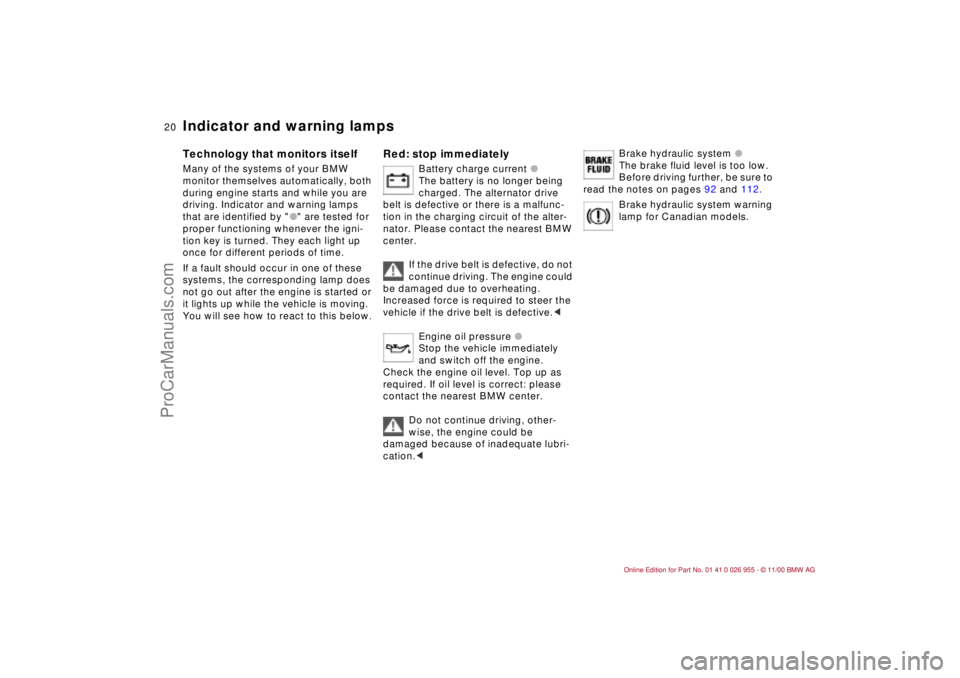
Red: stop immediately
Battery charge current
l
The battery is no longer being
charged. The alternator drive
belt is defective or there is a malfunc-
tion in the charging circuit of the alter-
nator. Please contact the nearest BMW
center.
If the drive belt is defective, do not
continue driving. The engine could
be damaged due to overheating.
Increased force is required to steer the
vehicle if the drive belt is defective.
<
Engine oil pressure
l
Stop the vehicle immediately
and switch off the engine.
Check the engine oil level. Top up as
required. If oil level is correct: please
contact the nearest BMW center.
Do not continue driving, other-
wise, the engine could be
damaged because of inadequate lubri-
cation.
<
Brake hydraulic system
l
The brake fluid level is too low.
Before driving further, be sure to
read the notes on pages 92 and 112.
Brake hydraulic system warning
lamp for Canadian models.
ProCarManuals.com
Page 29 of 171
Overview
Controls and features
Operation, care
and maintenance
Owner service procedures
Technical data
Index Advanced technology
29n
IndexDataTechnologyRepairsCar careControlsOverview
Everything under control:
Odometer62
Tachometer62
Fuel gauge62
Coolant temperature gauge63
Engine oil temperature gauge63
Service Interval Display64
Outside temperature64
Clock64
Technology for safety and
driving convenience:
Dynamic Stability Control
(DSC)65
Tire Pressure Warning (RDW)67
Lamps:
Parking lamps/Low beams69
Interior lamps70
Reading lamps71Controlling the climate
for pleasant driving:
Heating and ventilation/
Air conditioner72
Seat heating77
Cabin convenience:
Glove compartment78
Storage compartments78
Storage boxes78
Beverage holder79
Ashtray79
Cigarette lighter80
Loading and transporting
cargo:
coupe:
Roll-up cover81
Partition net81
Cargo loading82
Roof-mounted luggage
rack83
ProCarManuals.com
Page 35 of 171
35n
IndexDataTechnologyRepairsCar careControlsOverview
Luggage compartment lid Electric power windows
Do not drive with the luggage
compartment lid open, since
exhaust fumes could penetrate the inte-
rior of the vehicle. Should it be abso-
lutely necessary to operate the vehicle
with the luggage compartment lid open
(coupe; roadster with closed convert-
ible top):
>Close all windows. On the coupe,
close the sunroof.
>Increase the air supply of the heating
and ventilation system to a high level.
Refer to page 72.<
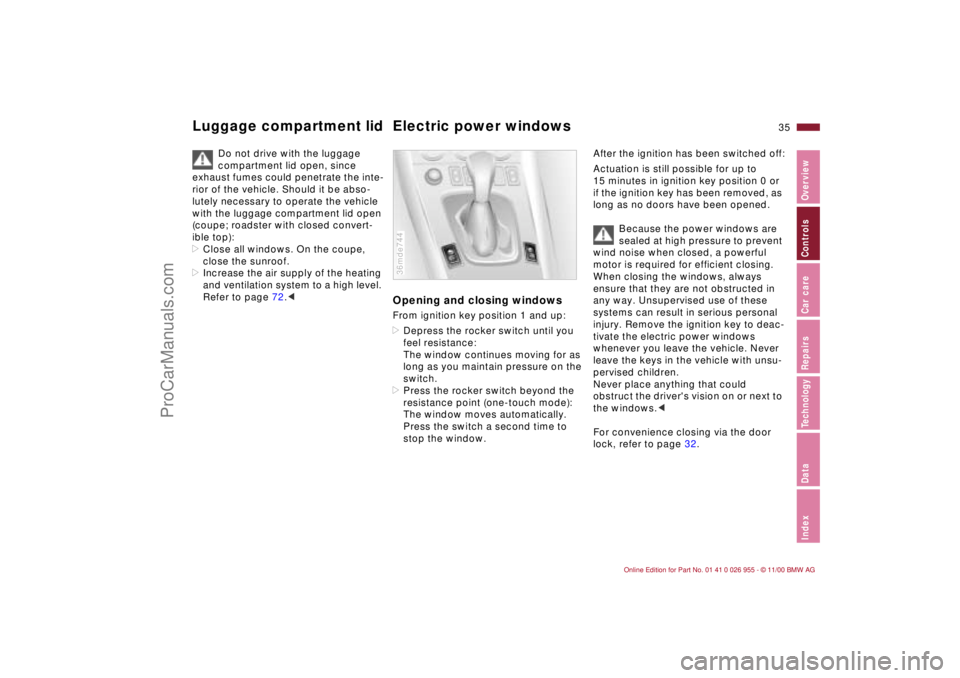
Opening and closing windowsFrom ignition key position 1 and up:
>Depress the rocker switch until you
feel resistance:
The window continues moving for as
long as you maintain pressure on the
switch.
>Press the rocker switch beyond the
resistance point (one-touch mode):
The window moves automatically.
Press the switch a second time to
stop the window.36mde744
After the ignition has been switched off:
Actuation is still possible for up to
15 minutes in ignition key position 0 or
if the ignition key has been removed, as
long as no doors have been opened.
Because the power windows are
sealed at high pressure to prevent
wind noise when closed, a powerful
motor is required for efficient closing.
When closing the windows, always
ensure that they are not obstructed in
any way. Unsupervised use of these
systems can result in serious personal
injury. Remove the ignition key to deac-
tivate the electric power windows
whenever you leave the vehicle. Never
leave the keys in the vehicle with unsu-
pervised children.
Never place anything that could
obstruct the driver's vision on or next to
the windows.<
For convenience closing via the door
lock, refer to page 32.
ProCarManuals.com
Page 72 of 171
72n
36mus748
Heating and ventilation/Air conditioner
ProCarManuals.com
Page 73 of 171
73n
IndexDataTechnologyRepairsCar careControlsOverview
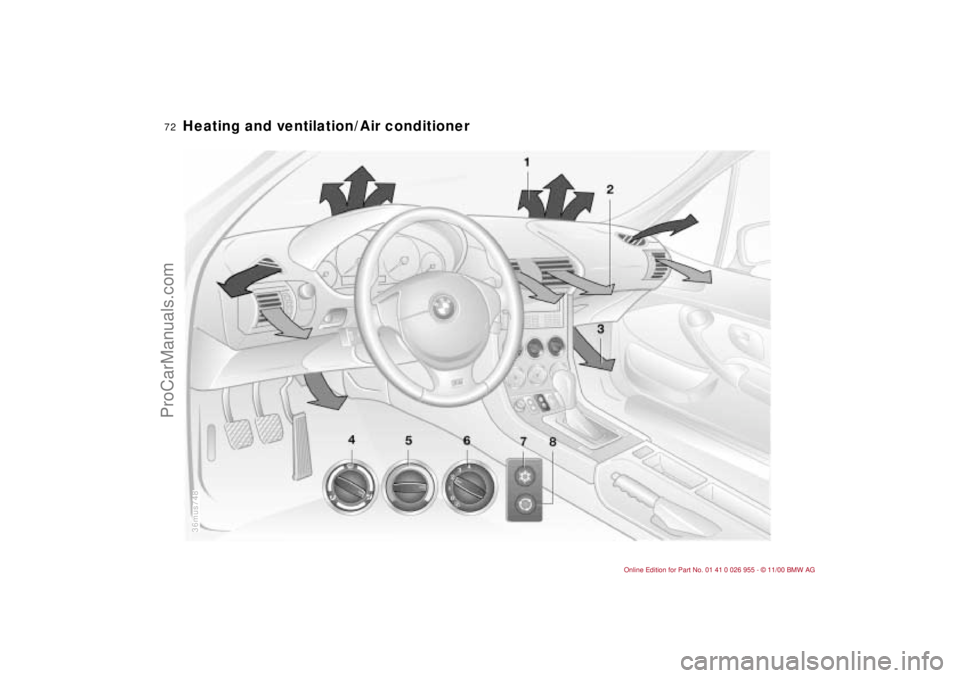
Heating and ventilation/Air conditioner 1 Airflow toward the windshield and
side windows
2 Airflow toward upper body
The rotary dials allow infinitely vari-
able regulation of the air supply. You
can change the airflow direction with
the lever in the center of the vent or
by rotating the vent grille75
3 Front footwell ventilation
4 Air distribution onto the
>windows
>upper body
>footwell
All intermediate settings are
possible74
5 Temperature74
6 Air supply
The heating and ventilation are oper-
ational beginning with position 174
7 Air conditioner74
8 Recirculated air mode74
ProCarManuals.com
Page 74 of 171
74n
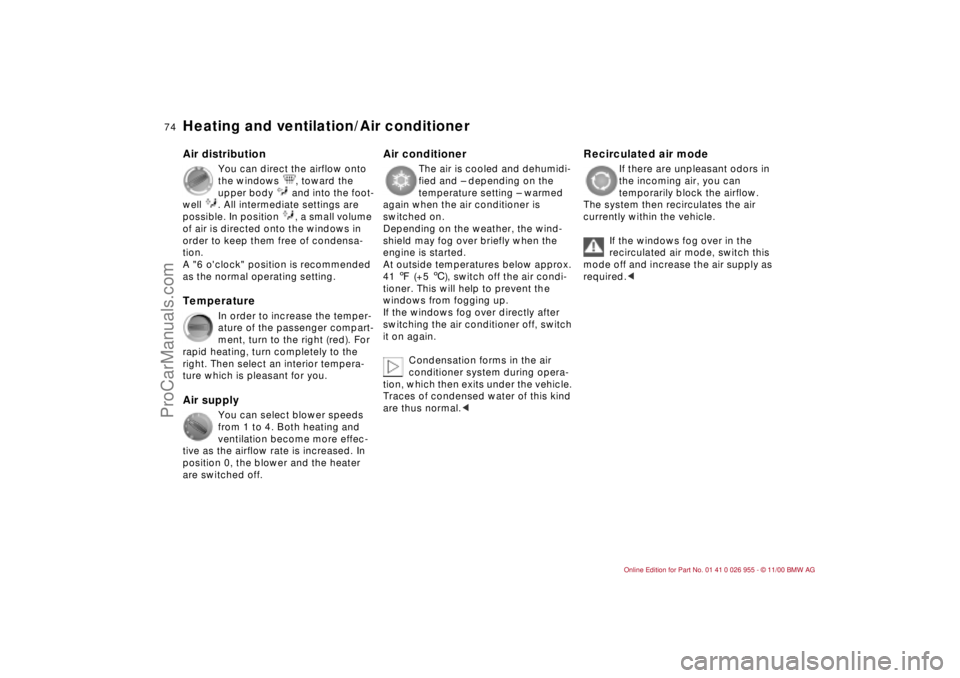
Heating and ventilation/Air conditionerAir distribution
You can direct the airflow onto
the windows , toward the
upper body and into the foot-
well . All intermediate settings are
possible. In position , a small volume
of air is directed onto the windows in
order to keep them free of condensa-
tion.
A "6 o'clock" position is recommended
as the normal operating setting.
Temperature
In order to increase the temper-
ature of the passenger compart-
ment, turn to the right (red). For
rapid heating, turn completely to the
right. Then select an interior tempera-
ture which is pleasant for you.
Air supply
You can select blower speeds
from 1 to 4. Both heating and
ventilation become more effec-
tive as the airflow rate is increased. In
position 0, the blower and the heater
are switched off.
Air conditioner
The air is cooled and dehumidi-
fied and – depending on the
temperature setting – warmed
again when the air conditioner is
switched on.
Depending on the weather, the wind-
shield may fog over briefly when the
engine is started.
At outside temperatures below approx.
41 7 (+5 6), switch off the air condi-
tioner. This will help to prevent the
windows from fogging up.
If the windows fog over directly after
switching the air conditioner off, switch
it on again.
Condensation forms in the air
conditioner system during opera-
tion, which then exits under the vehicle.
Traces of condensed water of this kind
are thus normal.<
Recirculated air mode
If there are unpleasant odors in
the incoming air, you can
temporarily block the airflow.
The system then recirculates the air
currently within the vehicle.
If the windows fog over in the
recirculated air mode, switch this
mode off and increase the air supply as
required.<
ProCarManuals.com
Page 75 of 171
75n
IndexDataTechnologyRepairsCar careControlsOverview
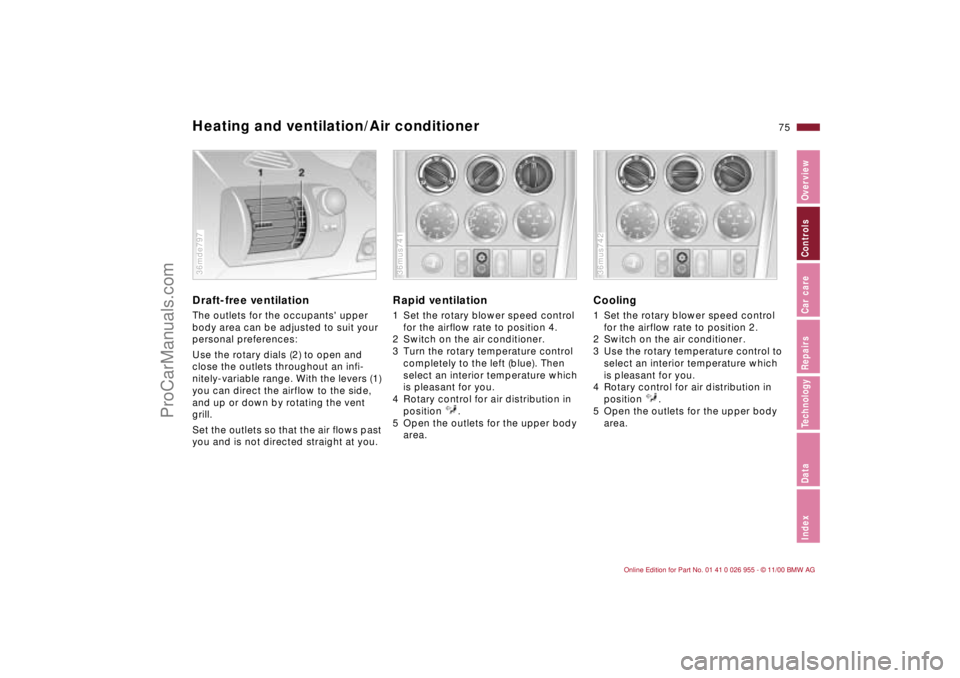
Heating and ventilation/Air conditionerDraft-free ventilationThe outlets for the occupants' upper
body area can be adjusted to suit your
personal preferences:
Use the rotary dials (2) to open and
close the outlets throughout an infi-
nitely-variable range. With the levers (1)
you can direct the airflow to the side,
and up or down by rotating the vent
grill.
Set the outlets so that the air flows past
you and is not directed straight at you.36mde797
Rapid ventilation1 Set the rotary blower speed control
for the airflow rate to position 4.
2 Switch on the air conditioner.
3 Turn the rotary temperature control
completely to the left (blue). Then
select an interior temperature which
is pleasant for you.
4 Rotary control for air distribution in
position .
5 Open the outlets for the upper body
area.36mus741
Cooling1 Set the rotary blower speed control
for the airflow rate to position 2.
2 Switch on the air conditioner.
3 Use the rotary temperature control to
select an interior temperature which
is pleasant for you.
4 Rotary control for air distribution in
position .
5 Open the outlets for the upper body
area.36mus742
ProCarManuals.com