2001 BMW M ROADSTER COUPE engine
[x] Cancel search: enginePage 88 of 171

88n
Catalytic converterThe catalytic converter reduces harmful
exhaust emissions.
It is designed for use with unleaded fuel
only. Even minute quantities of lead
would be enough to permanently
damage both the catalytic converter
and the system's oxygen sensor.
To ensure efficient, trouble-free engine
operation and to avoid potential
damage:
>Be sure to comply with the scheduled
maintenance requirements.
>Fill the fuel tank well before it is
empty.
>Tow-start the vehicle only when the
engine is cold. Tow-starting when the
engine is warm could cause unburned
fuel to ignite to the catalytic converter,
resulting in significant damage. It is
better to start the vehicle with an
outside starting aid.>Avoid any other situations in which
the fuel would not be (completely)
burned, for instance:
Frequent or consecutive extended
starting attempts or repeated starting
attempts when the engine fails to
start. (Shutting down and restarting
an engine which is running properly
does not present a problem.)
Never let the engine run with any of
the spark plug connectors discon-
nected.Be sure to comply with the
instructions above to prevent
unburned fuel from reaching the cata-
lytic converter. This could cause over-
heating, leading to serious damage to
the catalytic converter.
Extreme temperatures occur at the
catalytic converter on this and every
catalyst-equipped vehicle. Heat shields
are installed adjacent to some sections
of the exhaust system. Never remove
these shields; do not apply under-
coating to their surfaces.
When driving, standing while the engine
is idling, or when parking, be careful to
avoid contact between the hot exhaust
system and easily-flammable materials
(hay, dry grass, leaves, etc.). Such
contact could cause a fire, resulting in
personal injuries and property
damage.<
ProCarManuals.com
Page 90 of 171

90n
Antilock Brake System (ABS)Information for your safetyNot even ABS can suspend the laws
of physics. ABS alone cannot prevent
accidents if the brakes are applied
without an adequate, safe distance
between vehicles or if the speed limit
has been exceeded. Nor can it prevent
the hazards of aquaplaning. Responsi-
bility for these types of situations
remains in the hands (and at the feet) of
the driver. You should never allow the
added safety of ABS to lull you into a
false sense of security, or mislead you
into taking increased risks that could
affect your own safety and that of
others.
Do not make any modifications to
the ABS system.
Service procedures on ABS are to be
performed by authorized technicians
only.< Antilock Brake System (ABS)/
Cornering Brake Control (CBC)CBC is an advanced engineering
feature of the ABS. When braking while
cornering at high speed or braking
during high lateral acceleration, or
when braking during a lane change,
vehicle stability is improved and
steering response is enhanced.
In the event of a malfunction
The ABS warning lamp comes
on, refer to page 22. The brake
system then reverts to conven-
tional operation as on vehicles
without ABS. However, have the
brake system checked by your
BMW center as soon as possible. To
prevent undetected defects and cumu-
lative faults from adversely affecting the
brake system, refer any problems to
your BMW center at the earliest oppor-
tunity.
If the red warning lamp for the
brake hydraulic system comes
on together with the yellow indi-
cator lamps for ABS and DSC
(refer to page 21), the entire
ABS, CBC and DSC control
system has failed. Continue to
drive cautiously and defensively.
Avoid full brake applications
because the vehicle could become
unstable and go out of control.
Have the system checked by your BMW
center as soon as possible.
Warning lamps for Canadian
models.
ProCarManuals.com
Page 91 of 171

91n
IndexDataTechnologyRepairsCar careControlsOverview
Disc brakesDisc brakes furnish optimum decelera-
tion and braking control and greater
fade resistance under heavy use.
When the vehicle is driven only occa-
sionally, during extended periods when
the vehicle is not used at all, or in oper-
ating conditions where brake applica-
tions are less frequent, there is an
increased tendency for corrosion of the
discs and accumulation of contamina-
tion on the brake pads. This occurs
because the minimal pressure which
must be exerted by the pads to clean
the discs by brake applications is not
reached.
If the brake discs are corroded, they will
tend to respond to braking with a
pulsating effect which even extended
application will fail to cure.
For your own safety: use only
brake pads that BMW has
approved for your specific vehicle
model. BMW cannot evaluate non-
approved brake pads to determine if
they are suited for use, and therefore
cannot ensure the operating safety of
the vehicle in the event of their use.<
Driving notesWhile driving in wet conditions and in
heavy rain, it is advisable to apply light
pressure to the brake pedal every few
miles – watch traffic conditions to
ensure that this maneuver does not
endanger other road users. The heat
generated in this braking process helps
dry the brake pads and discs.
Maximum braking force is obtained
while the wheels continue to rotate,
peaking when the wheels remain on the
verge of locking without actually doing
so. ABS maintains this state automati-
cally. If the ABS fails, you should revert
to the staggered braking technique
described on page 94.
Extended or steep mountain descents
should be driven in the gear in which
only minimal periodic brake application
is required. This avoids excessive strain
on the brakes and possible impairment
of the braking effect.
You can increase the engine's braking
effect by selecting progressively lower
gears, downshifting into first gear, if
necessary. Should engine braking prove inade-
quate, you should still avoid extended,
continuous braking. Instead, decelerate
the vehicle with increased pressure on
the brake pedal (watch for following
traffic!), release the pedal and then
repeat the brake application (staggered
braking). This staggered braking tech-
nique allows the brakes to cool in the
intervals between active braking
phases, preventing overheating and
ensuring that full braking capacity
remains available at all times.
Do not drive the vehicle with the
clutch depressed, with the shift
lever in neutral or with the engine shut
off. The engine provides no braking
control when the transmission is in
neutral and there is no power assist for
braking and steering when the engine is
shut off.
Never allow floor mats, carpets or any
other objects to protrude into the area
around the accelerator, clutch and
brake pedals and obstruct their move-
ment.<
ProCarManuals.com
Page 93 of 171

93n
IndexDataTechnologyRepairsCar careControlsOverview
Winter operationThe onset of winter is often accompa-
nied by rapid changes in weather.
Adaptations in driving style should be
accompanied by preparations on the
vehicle itself to ensure that your vehicle
operation through the winter remains
safe and trouble-free.CoolantEnsure that the coolant contains the
year-round 50 : 50 ratio of water and
antifreeze with corrosion inhibitor.
This mixture provides protection
against freezing down to approx.
– 34 7 (– 37 6). Replace the coolant
every three years.LocksBMW door lock deicer can be used to
free the doors if they are frozen. This
deicer also contains lubricant.
After using deicer, treatment with BMW
lock cylinder grease is recommended.
Rubber seals and components In order to prevent freezing, apply BMW
rubber treatment or silicone spray to
weather-stripping on the doors, hood,
luggage compartment and to convert-
ible top seals.
A full range of car-care products is
available from your BMW center.< Snow chainsMount the BMW snow chains
* only in
pairs on the rear wheels only. Comply
with the manufacturer's safety precau-
tions. Do not exceed a speed limit of
30 mph (50 km/h) when driving with
chains. As an exception in this situa-
tion, we recommend that you deacti-
vate the DSC and RDW when snow
chains are mounted. Refer to page 65
or page 67.
Starting offWhen starting from a full stop or
"rocking" free in deep snow, we recom-
mend that you deactivate the DSC
system. Refer to page 65.Driving on low-traction road
surfacesUse smooth, gentle pressure to control
the accelerator pedal. Avoid excessive
engine speeds and shift to the next
higher gear at an early point. Shift down
into the next lowest gear when
approaching uphill or downhill grades.
Maintain an adequate distance between
yourself and the vehicle ahead.Braking Winter road conditions substantially
reduce the traction available between
the tires and the road surface.
Remember that – in every situation –
braking distances will be significantly
longer as a result of this.
ABS is intended to prevent the wheels
from locking during brake applications,
thus helping to maintain vehicle stability
and steering response.
ProCarManuals.com
Page 104 of 171
104n
Do not work on your vehicle
without appropriate skills. Always
switch off the engine and allow it to
cool down before working in the engine
compartment. Always disconnect the
battery before working on any electrical
systems or equipment, especially when
these are located within the engine
compartment. Comply with all appli-
cable instructions and warnings. If you
are not familiar with all guidelines, have
the work performed by your BMW
center. Otherwise, safety hazards for
vehicle occupants and other road users
may occur as a result of improper
handling of components and mate-
rials.<
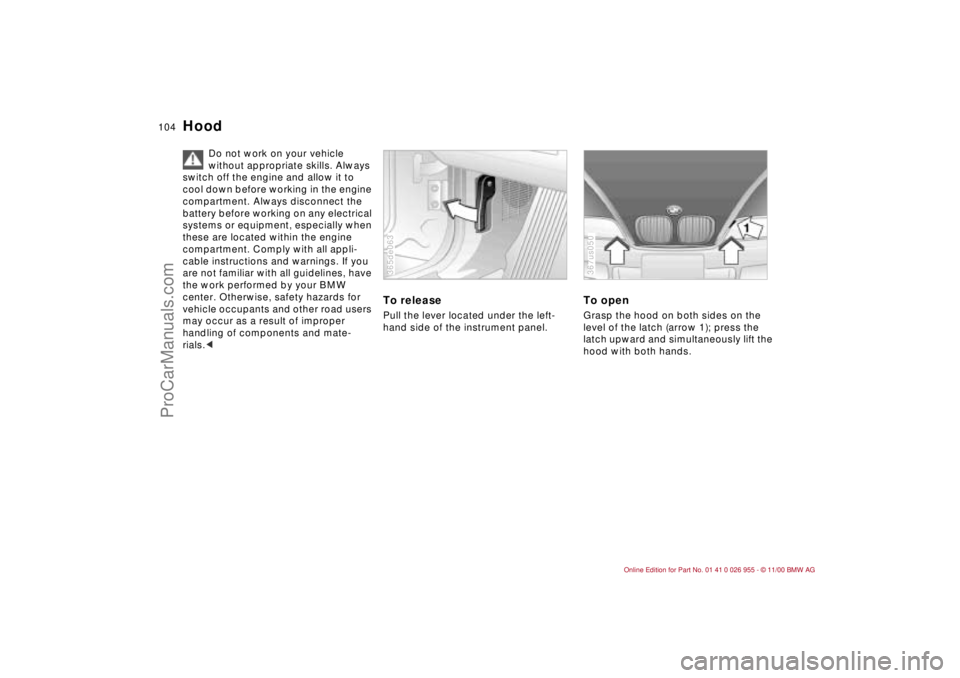
To release Pull the lever located under the left-
hand side of the instrument panel.365de063
To openGrasp the hood on both sides on the
level of the latch (arrow 1); press the
latch upward and simultaneously lift the
hood with both hands.367us050
Hood
ProCarManuals.com
Page 106 of 171
106n
Engine compartment
36mde775
ProCarManuals.com
Page 107 of 171

107n
IndexDataTechnologyRepairsCar careControlsOverview
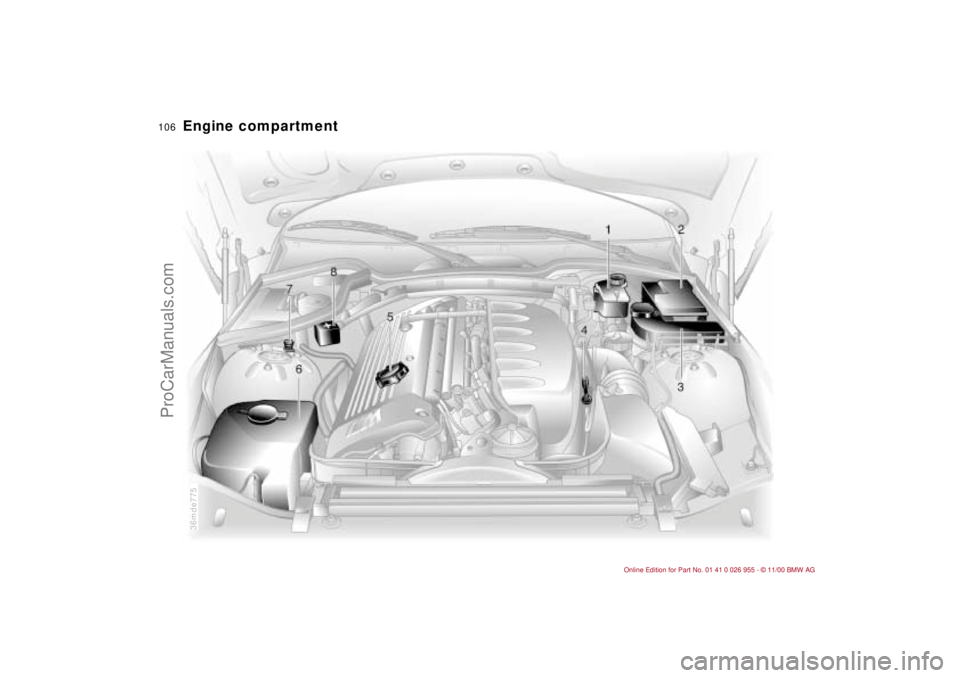
Engine compartment1 Brake fluid reservoir112
2 Fuse box142
3 Coolant expansion tank112
4 Engine oil dipstick109
5 Engine oil filler neck109
6 Reservoir for windshield and
headlamp
* washer system108
7 Auxiliary terminal for jump-starting –
negative terminal144
8 Auxiliary terminal for jump-starting –
positive terminal144
ProCarManuals.com
Page 109 of 171
109n
IndexDataTechnologyRepairsCar careControlsOverview
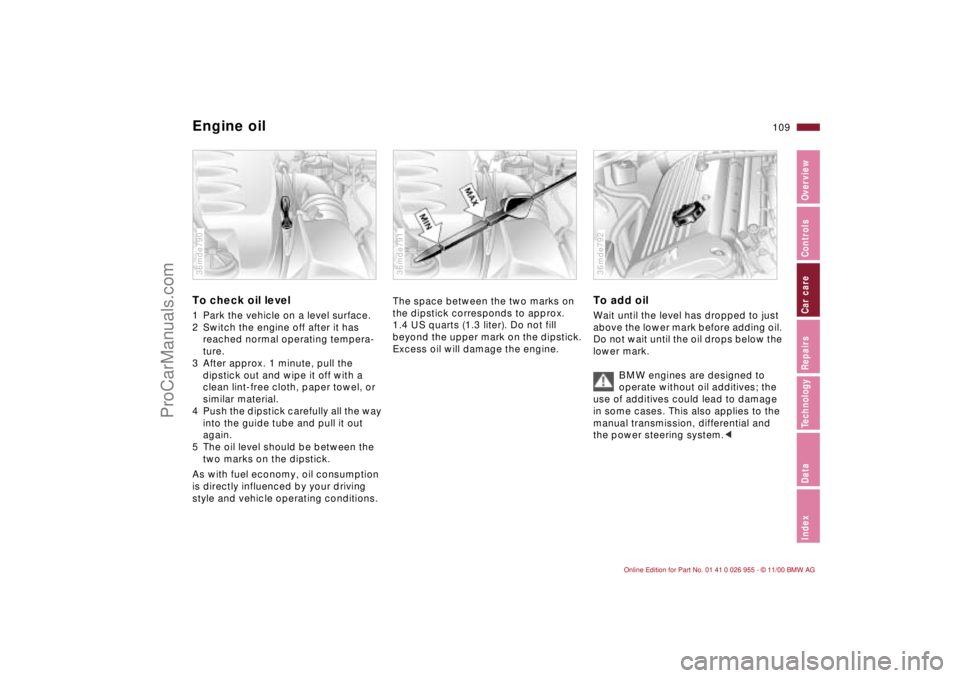
Engine oil To check oil level1 Park the vehicle on a level surface.
2 Switch the engine off after it has
reached normal operating tempera-
ture.
3 After approx. 1 minute, pull the
dipstick out and wipe it off with a
clean lint-free cloth, paper towel, or
similar material.
4 Push the dipstick carefully all the way
into the guide tube and pull it out
again.
5 The oil level should be between the
two marks on the dipstick.
As with fuel economy, oil consumption
is directly influenced by your driving
style and vehicle operating conditions.36mde790
The space between the two marks on
the dipstick corresponds to approx.
1.4 US quarts (1.3 liter). Do not fill
beyond the upper mark on the dipstick.
Excess oil will damage the engine.36mde791
To add oilWait until the level has dropped to just
above the lower mark before adding oil.
Do not wait until the oil drops below the
lower mark.
BMW engines are designed to
operate without oil additives; the
use of additives could lead to damage
in some cases. This also applies to the
manual transmission, differential and
the power steering system.< 36mde792
ProCarManuals.com