Page 35 of 109
INSTRUMENT AND CONTROL FUNCTIONS
3-21
3
EAU00324
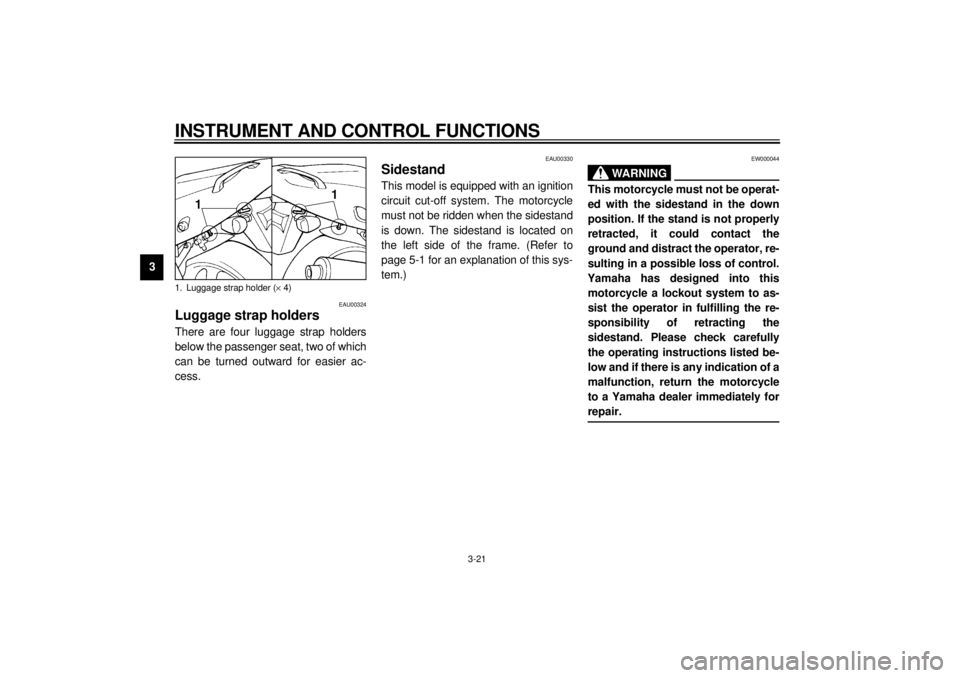
Luggage strap holdersThere are four luggage strap holders
below the passenger seat, two of which
can be turned outward for easier ac-
cess.
EAU00330
SidestandThis model is equipped with an ignition
circuit cut-off system. The motorcycle
must not be ridden when the sidestand
is down. The sidestand is located on
the left side of the frame. (Refer to
page 5-1 for an explanation of this sys-
tem.)
EW000044
WA R N I N G
@ This motorcycle must not be operat-
ed with the sidestand in the down
position. If the stand is not properly
retracted, it could contact the
ground and distract the operator, re-
sulting in a possible loss of control.
Yamaha has designed into this
motorcycle a lockout system to as-
sist the operator in fulfilling the re-
sponsibility of retracting the
sidestand. Please check carefully
the operating instructions listed be-
low and if there is any indication of a
malfunction, return the motorcycle
to a Yamaha dealer immediately for
repair. @
1. Luggage strap holder (´ 4)E_4tv_Functions.fm Page 21 Wednesday, September 1, 1999 11:10 AM
Page 67 of 109
PERIODIC MAINTENANCE AND MINOR REPAIR
6-17
6
EAU00626
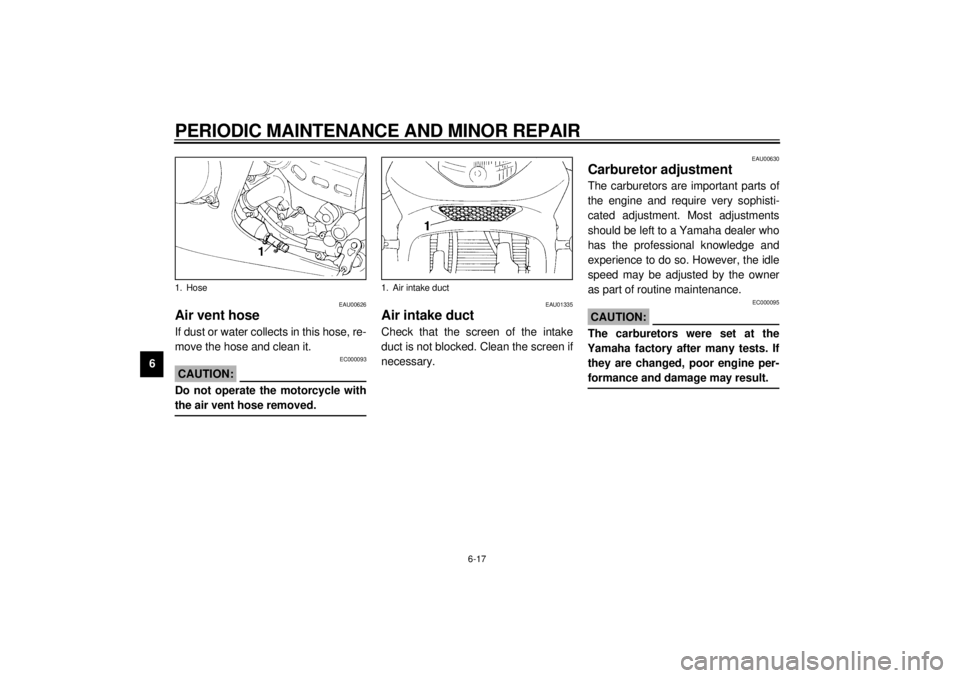
Air vent hoseIf dust or water collects in this hose, re-
move the hose and clean it.
EC000093
CAUTION:@ Do not operate the motorcycle with
the air vent hose removed. @
EAU01335
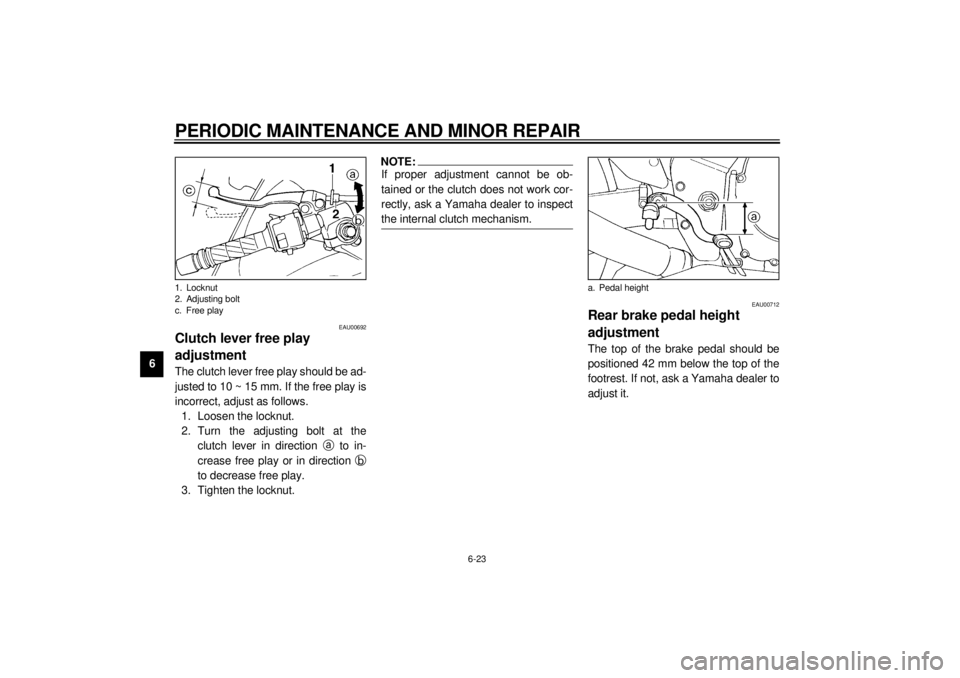
Air intake ductCheck that the screen of the intake
duct is not blocked. Clean the screen if
necessary.
EAU00630
Carburetor adjustmentThe carburetors are important parts of
the engine and require very sophisti-
cated adjustment. Most adjustments
should be left to a Yamaha dealer who
has the professional knowledge and
experience to do so. However, the idle
speed may be adjusted by the owner
as part of routine maintenance.
EC000095
CAUTION:@ The carburetors were set at the
Yamaha factory after many tests. If
they are changed, poor engine per-
formance and damage may result. @
1. Hose
1. Air intake duct
E_4tv_Periodic.fm Page 17 Wednesday, September 1, 1999 11:12 AM
Page 73 of 109
PERIODIC MAINTENANCE AND MINOR REPAIR
6-23
6
EAU00692
Clutch lever free play
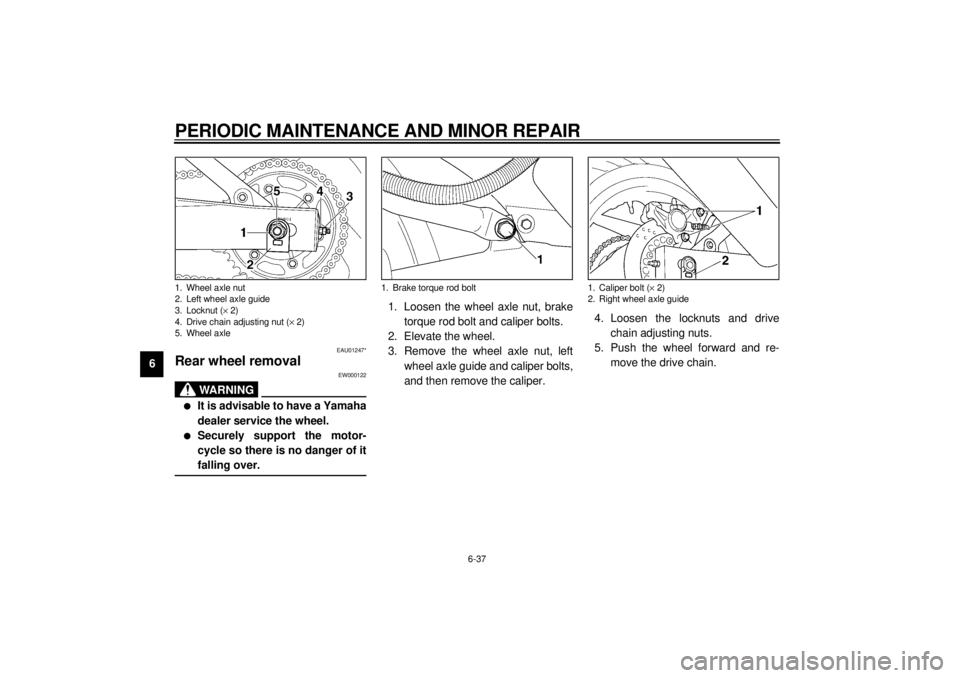
adjustmentThe clutch lever free play should be ad-
justed to 10 ~ 15 mm. If the free play is
incorrect, adjust as follows.
1. Loosen the locknut.
2. Turn the adjusting bolt at the
clutch lever in direction a
to in-
crease free play or in direction b
to decrease free play.
3. Tighten the locknut.
NOTE:@ If proper adjustment cannot be ob-
tained or the clutch does not work cor-
rectly, ask a Yamaha dealer to inspect
the internal clutch mechanism. @
EAU00712
Rear brake pedal height
adjustmentThe top of the brake pedal should be
positioned 42 mm below the top of the
footrest. If not, ask a Yamaha dealer to
adjust it.
1. Locknut
2. Adjusting bolt
c. Free play
a. Pedal height
E_4tv_Periodic.fm Page 23 Wednesday, September 1, 1999 11:12 AM
Page 76 of 109
PERIODIC MAINTENANCE AND MINOR REPAIR
6-26
6
l
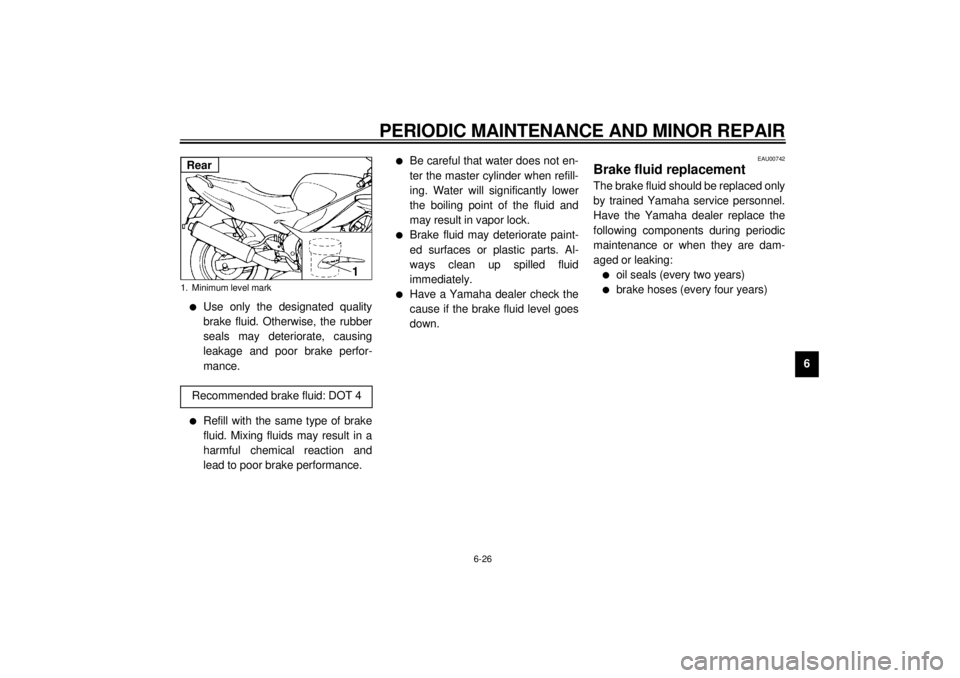
Use only the designated quality
brake fluid. Otherwise, the rubber
seals may deteriorate, causing
leakage and poor brake perfor-
mance.
l
Refill with the same type of brake
fluid. Mixing fluids may result in a
harmful chemical reaction and
lead to poor brake performance.
l
Be careful that water does not en-
ter the master cylinder when refill-
ing. Water will significantly lower
the boiling point of the fluid and
may result in vapor lock.
l
Brake fluid may deteriorate paint-
ed surfaces or plastic parts. Al-
ways clean up spilled fluid
immediately.
l
Have a Yamaha dealer check the
cause if the brake fluid level goes
down.
EAU00742
Brake fluid replacementThe brake fluid should be replaced only
by trained Yamaha service personnel.
Have the Yamaha dealer replace the
following components during periodic
maintenance or when they are dam-
aged or leaking:l
oil seals (every two years)
l
brake hoses (every four years)
1. Minimum level markRecommended brake fluid: DOT 4Rear
E_4tv_Periodic.fm Page 26 Wednesday, September 1, 1999 11:12 AM
Page 77 of 109
PERIODIC MAINTENANCE AND MINOR REPAIR
6-27
6
EAU00744
Drive chain slack checkNOTE:@ Spin the wheel several times and find
the tightest position of the chain. Check
and/or adjust the chain slack while it’s
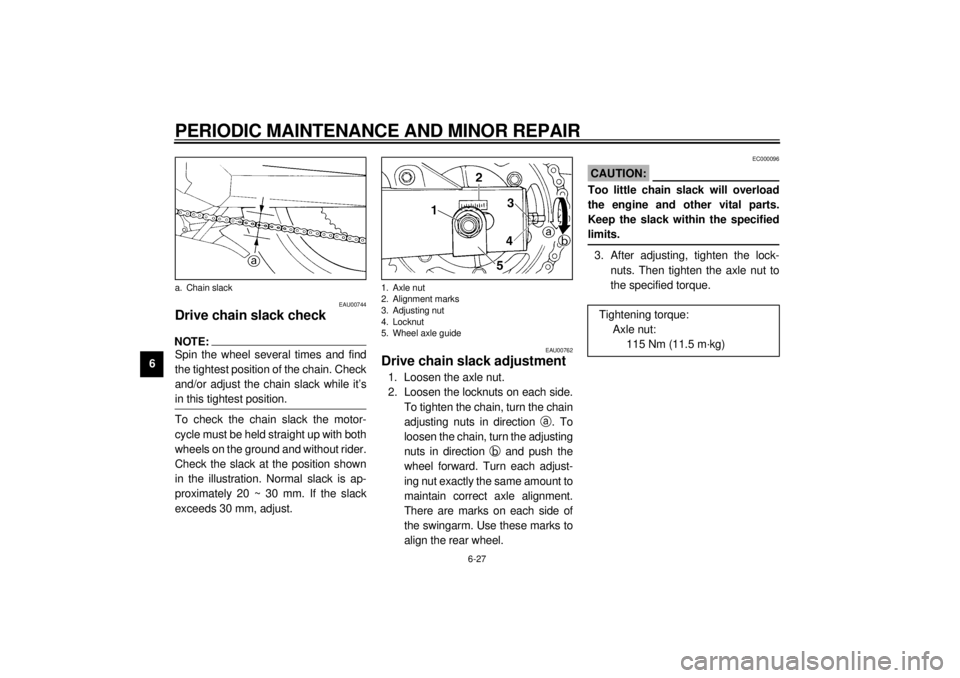
in this tightest position. @To check the chain slack the motor-
cycle must be held straight up with both
wheels on the ground and without rider.
Check the slack at the position shown
in the illustration. Normal slack is ap-
proximately 20 ~ 30 mm. If the slack
exceeds 30 mm, adjust.
EAU00762
Drive chain slack adjustment1. Loosen the axle nut.
2. Loosen the locknuts on each side.
To tighten the chain, turn the chain
adjusting nuts in direction a
. To
loosen the chain, turn the adjusting
nuts in direction b
and push the
wheel forward. Turn each adjust-
ing nut exactly the same amount to
maintain correct axle alignment.
There are marks on each side of
the swingarm. Use these marks to
align the rear wheel.
EC000096
CAUTION:@ Too little chain slack will overload
the engine and other vital parts.
Keep the slack within the specified
limits. @3. After adjusting, tighten the lock-
nuts. Then tighten the axle nut to
the specified torque.
a. Chain slack
1. Axle nut
2. Alignment marks
3. Adjusting nut
4. Locknut
5. Wheel axle guide
Tightening torque:
Axle nut:
115 Nm (11.5 m·kg)
E_4tv_Periodic.fm Page 27 Wednesday, September 1, 1999 11:12 AM
Page 85 of 109
PERIODIC MAINTENANCE AND MINOR REPAIR
6-35
6
EAU01623*
Tail/brake light bulb
replacement1. Remove the screws and the lens.
2. Remove the defective bulb by
pushing it inward and turning it
counterclockwise.
3. Install a new bulb by pushing it in-
ward and turning it clockwise.
4. Install the lens and tighten the
screws.
EC000108
CAUTION:@ Do not over-tighten the screws as
the lens may break. @
EAU01095
Turn signal light bulb
replacement1. Remove the screw and the lens.
2. Remove the defective bulb by
pushing it inward and turning it
counterclockwise.
3. Install a new bulb by pushing it in-
ward and turning it clockwise.
4. Install the lens and tighten the
screw.
EAU01252*
Front wheel removal
EW000122
WA R N I N G
@ l
It is advisable to have a Yamaha
dealer service the wheel.
l
Securely support the motor-
cycle so there is no danger of it
falling over.
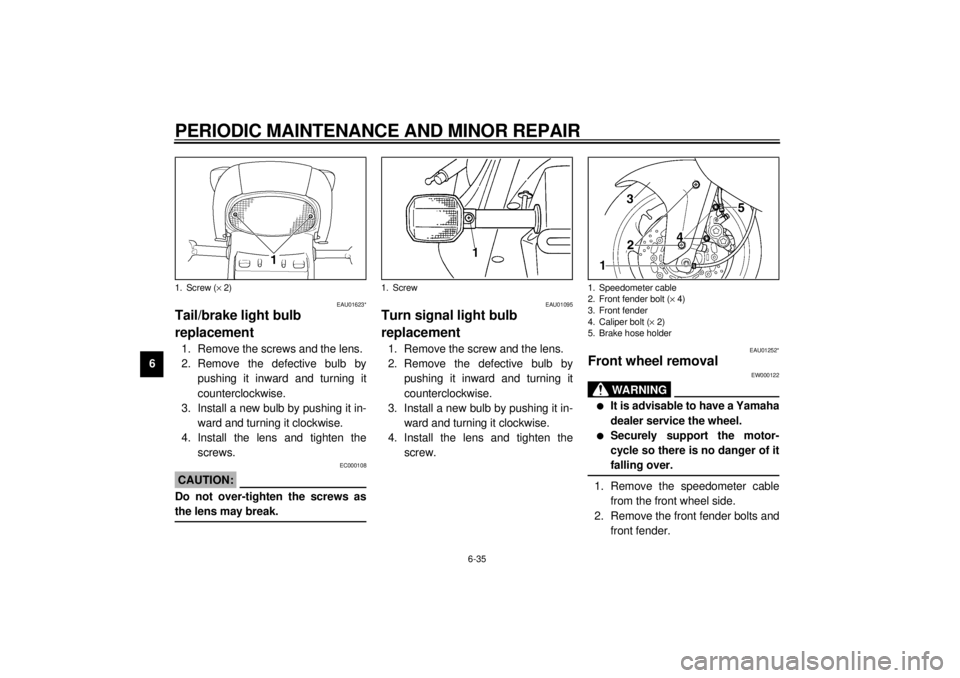
@1. Remove the speedometer cable
from the front wheel side.
2. Remove the front fender bolts and
front fender.
1. Screw (´ 2)
1. Screw
1. Speedometer cable
2. Front fender bolt (´ 4)
3. Front fender
4. Caliper bolt (´ 2)
5. Brake hose holder
E_4tv_Periodic.fm Page 35 Wednesday, September 1, 1999 11:12 AM
Page 87 of 109
PERIODIC MAINTENANCE AND MINOR REPAIR
6-37
6
EAU01247*
Rear wheel removal
EW000122
WARNING
@ l
It is advisable to have a Yamaha
dealer service the wheel.
l
Securely support the motor-
cycle so there is no danger of it
falling over.
@
1. Loosen the wheel axle nut, brake
torque rod bolt and caliper bolts.
2. Elevate the wheel.
3. Remove the wheel axle nut, left
wheel axle guide and caliper bolts,
and then remove the caliper.4. Loosen the locknuts and drive
chain adjusting nuts.
5. Push the wheel forward and re-
move the drive chain.
1. Wheel axle nut
2. Left wheel axle guide
3. Locknut (´ 2)
4. Drive chain adjusting nut (´ 2)
5. Wheel axle
1. Brake torque rod bolt
1. Caliper bolt (´ 2)
2. Right wheel axle guide
E_4tv_Periodic.fm Page 37 Wednesday, September 1, 1999 11:12 AM
Page 91 of 109
PERIODIC MAINTENANCE AND MINOR REPAIR
6-41
6
Engine overheating
EW000070
WARNING
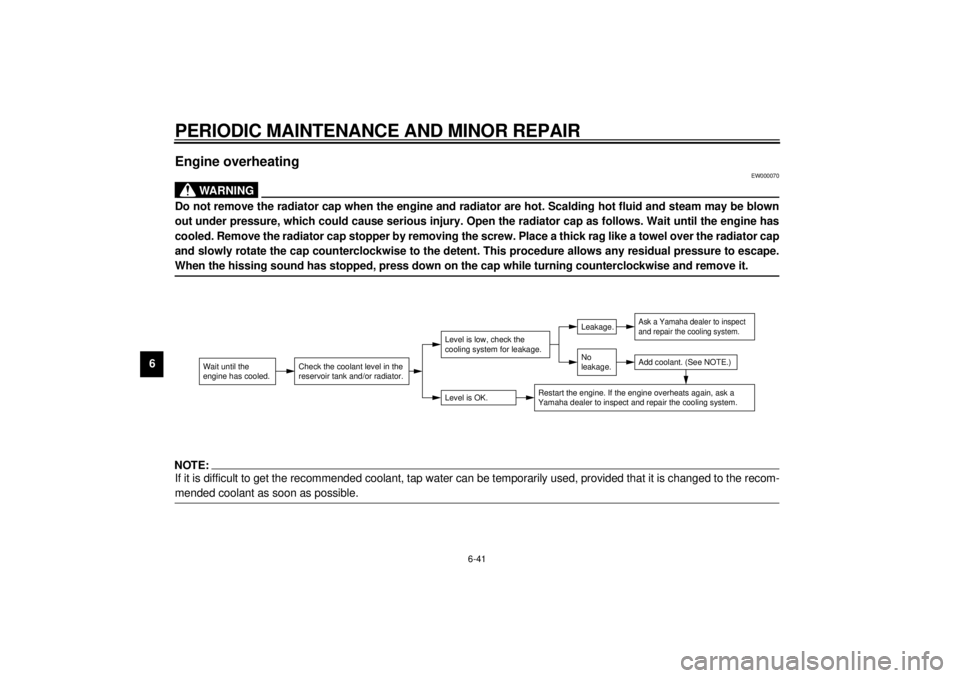
@ Do not remove the radiator cap when the engine and radiator are hot. Scalding hot fluid and steam may be blown
out under pressure, which could cause serious injury. Open the radiator cap as follows. Wait until the engine has
cooled. Remove the radiator cap stopper by removing the screw. Place a thick rag like a towel over the radiator cap
and slowly rotate the cap counterclockwise to the detent. This procedure allows any residual pressure to escape.
When the hissing sound has stopped, press down on the cap while turning counterclockwise and remove it. @NOTE:@ If it is difficult to get the recommended coolant, tap water can be temporarily used, provided that it is changed to the recom-
mended coolant as soon as possible. @
Wait until the
engine has cooled.
Check the coolant level in the
reservoir tank and/or radiator.
Level is OK.Level is low, check the
cooling system for leakage.
No
leakage.Leakage.
Ask a Yamaha dealer to inspect
and repair the cooling system.Add coolant. (See NOTE.)
Restart the engine. If the engine overheats again, ask a
Yamaha dealer to inspect and repair the cooling system.
E_4tv_Periodic.fm Page 41 Wednesday, September 1, 1999 11:12 AM