2000 TOYOTA CAMRY O2 sensor
[x] Cancel search: O2 sensorPage 1233 of 4770
ENGINE CONTROL (5S±FE)
EC EC I 2 II3 2II31 II2 12
C 21 B5A9A5A16
C 15 C26 C 13 C25 A9
A3 1
A42
A
A
A
A
A
B±YBR BR BR
BR BR
V±W
G± R
W
BR
G±W BR
BR
BR
BR
BR
BR
BR
BR
BR HT2 OX2 SPD W SIL
STP E03 E0 2 E01 E04
G± WBR BR
BR BR BR BR
BR
BR
BR
W G± R V±WB P±B
B P±B BR
BR
B±Y
(
SHIELDED)
(
*6)
HEATED OXYGEN
SENSOR
(
BANK 1 SENSOR 2) H 8
(
*6)
(
*5)
JUNCTION
CONNECTOR J2 3ENGINE CONTROL MODULEB E 7 E 8ACE 9
C 24E1
A
BR
A 7
B±O TACH
B±O
E1 +B
HT OX
C 15 C26 C 13 B16 A4 C 14A 8(
*1)
(
*2) , , DE10 , C 14 B13 A8A4A6(
*1)
(
*2)
D 2
BR EOM
A
Page 1234 of 4770
IGIH II3 6II2 2
IJ1 7IJ12 IG3 10C 2B15 C6C5 A A
B B
B CA A B A A CC 7B14 7. 5A
OBD FROM POWER SOURCE SYSTEM (
SEE PAGE 50)
1J 1015A
ST OP
1C 710A
GAUGE FROM POWER SOURCE SYSTEM (
SEE PAGE 50)
1D 2
MALFUNCTION
INDICATOR LAMP
SPEEDOMETER
1J 1
IG33
1J 71R51R 4 1J 81 2
54
AD
12 3 A 16 7
ABD
B
CG SG W G±R V±W
BR
G± WV±W R±L
BAT SIL
BR
W±B W±BBR
G± W BR
W±B
G±WWB
R±L R±L
V±W R±L R±L
G±R
L
P
BR PL G±RR±L
R±L
G±R
R±L
BR
COMBINATION METERC C 9 C10B
JUNCTION
CONNECTORJUNCTION
CONNECTOR JUNCTION
CONNECTOR
STOP LIGHT SWDATA LINK
CONNECTOR 3
J15J 4
J21
S 6D 5
JUNCTION
CONNECTORB J 7 J 8AJUNCTION CONNECTORB J 7 J 8A
JUNCTION
CONNECTORB J27 J28A
JUNCTION
CONNECTOR
VEHICLE SPEED SENSOR
(
COMBINATION METER) V 2
J11SI SE
IG+
* 6 : EXCEPT CALIFORNIA * 5 : CALIFORNIA (
SHIELDED)
I 3IG3 6C 8
TACHOMETER
B±O B±O
B±O
B±O
BF
BF
A F JUNCTION
CONNECTORJ28 B
,
J27
JUNCTION
CONNECTORA
A F ,
,
A C CC
I 5 JUNCTION CONNECTOR J 3
BR(
SHIELDED)
(
SHIELDED) W
* 1 : W/ ENGINE IMMOBILISER SYSTEM
* 2 : W/O ENGINE IMMOBILISER SYSTEM
,
Page 1235 of 4770

ENGINE CONTROL (5S±FE)
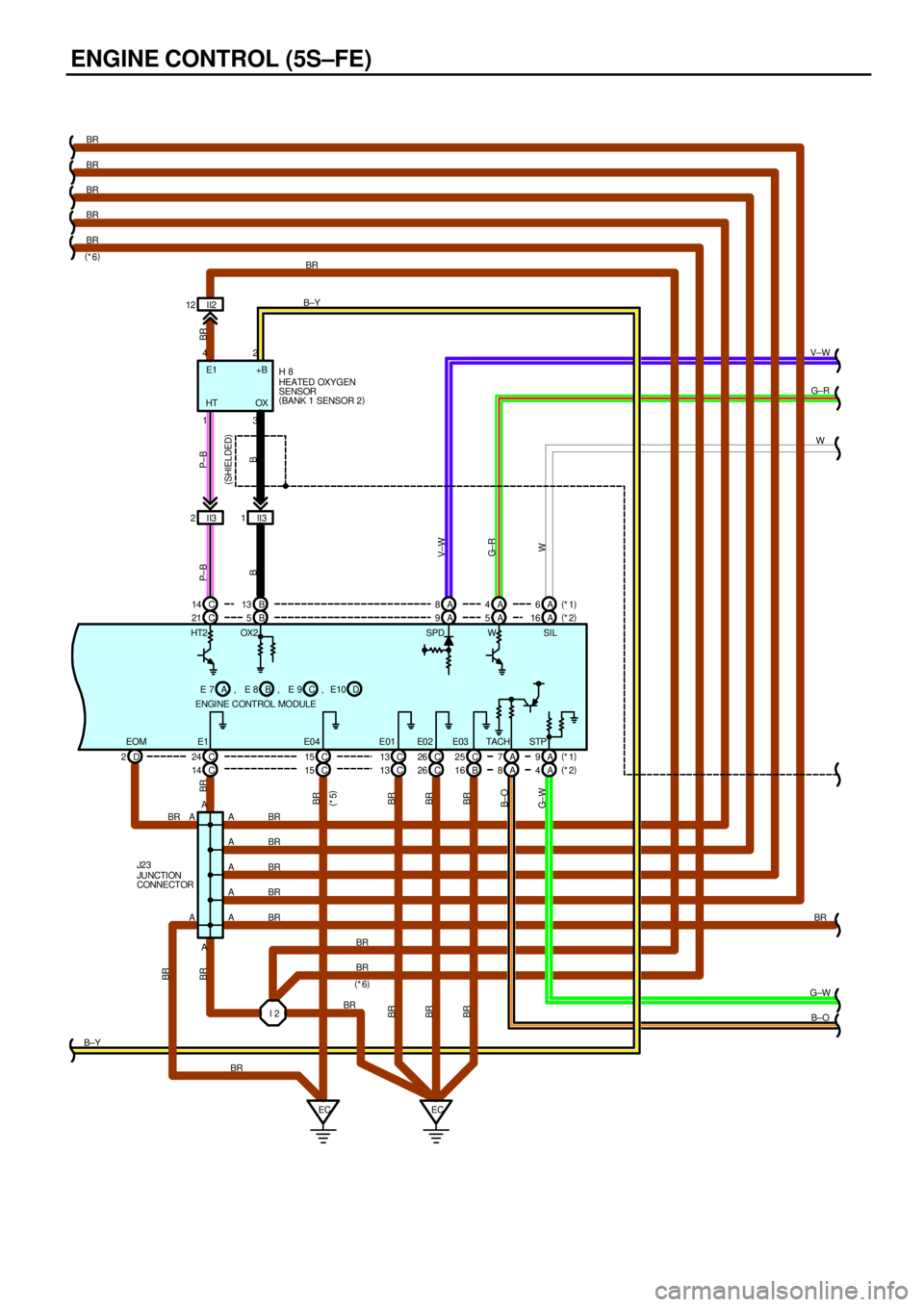
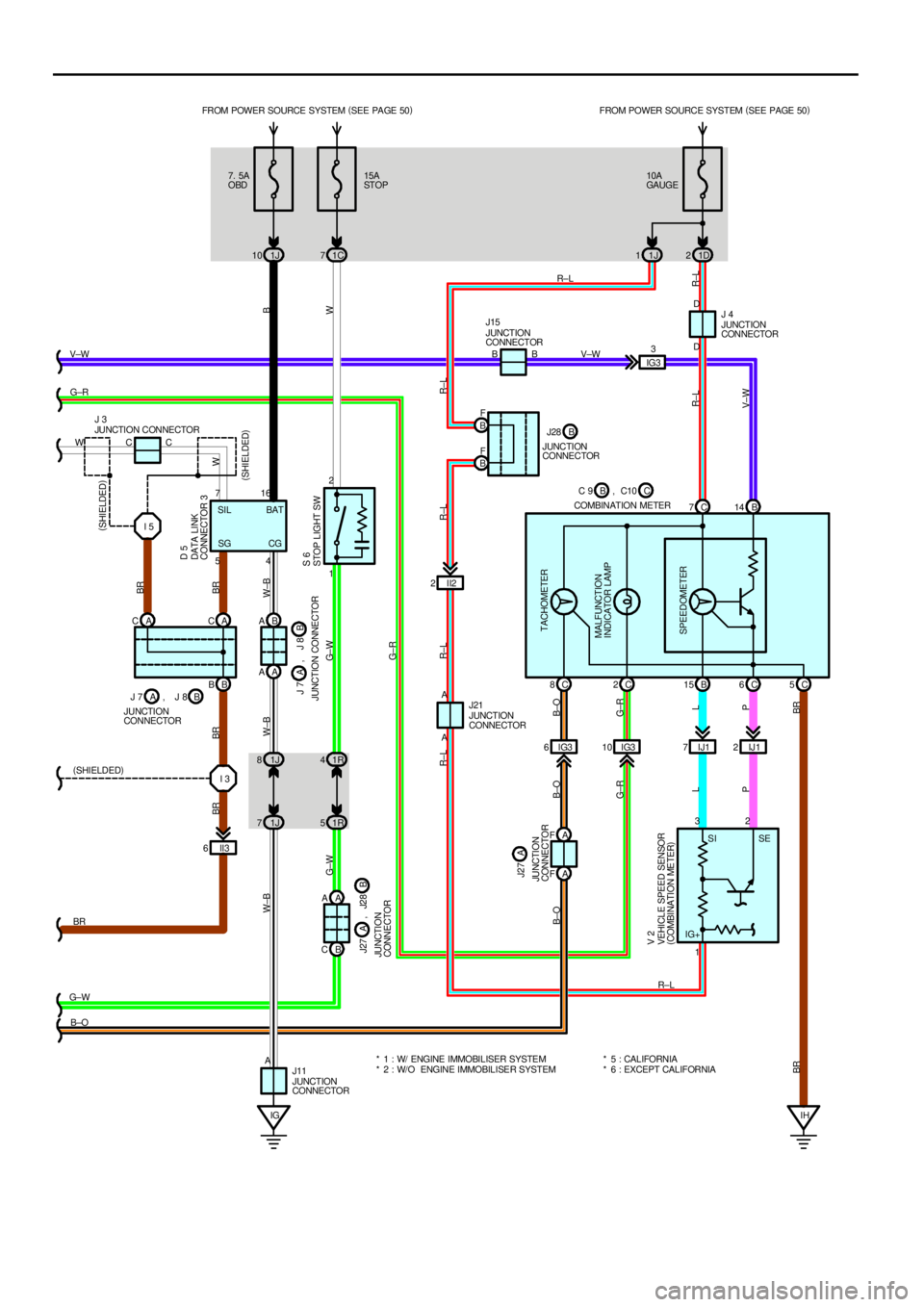
This system utilizes an engine control module and maintains overall control of the engine, transmission and so on. An outline
of the engine control is explained here.
1. INPUT SIGNALS
(1) Engine coolant temp. signal circuit
The engine coolant temp. sensor detects the engine coolant temp. and has a built±in thermistor with a resistance which
varies according to the engine coolant temp. thus the engine coolant temp. is input in the form of a control signal into
TERMINAL THW of the engine control module.
(2) Intake air temp. signal circuit
The intake air temp. sensor detects the intake air temp., which is input as a control signal into TERMINAL THA of the
engine control module.
(3) Oxygen sensor signal circuit
The oxygen density in the exhaust gases is detected and input as a control signal into TERMINAL OX1 (except
California) and OX2 of the engine control module.
(4) RPM signal circuit
Camshaft position and crankshaft position are detected by the camshaft position sensor and crankshaft position sensor.
Camshaft position is input as a control signal to TERMINAL G+ of the engine control module, and engine RPM is input
into TERMINAL NE+.
(5) Throttle signal circuit
The throttle position sensor detects the throttle valve opening angle, which is input as a control signal into TERMINAL
VTA of the engine control module.
(6) Vehicle speed signal circuit
The vehicle speed sensor, installed inside the transmission, detects the vehicle speed and inputs a control signal into
TERMINAL SPD of the engine control module.
(7) Park/Neutral position SW signal circuit (A/T)
The Park/Neutral position SW detects whether the shift position are in neutral, parking or not, and inputs a control signal
into TERMINAL STA of the engine control module.
(8) A/C SW signal circuit
The A/C amplifier function is built in the engine control module. The A/C SW signal inputs into the TERMINAL A/C SW of
the engine control module.
(9) Battery signal circuit
Voltage is constantly applied to TERMINAL BATT of the engine control module. When the ignition SW is turned on, the
voltage for engine control module start±up power supply is applied to TERMINAL +B of engine control module via EFI
relay.
(10) Intake air volume signal circuit
Intake air volume is detected by the manifold absolute pressure sensor (for manifold pressure) and is input as a control
signal into TERMINAL PIN of the engine control module.
(11) Starter signal circuit
To confirm whether the engine is cranking, the voltage applied to the starter motor during cranking is detected and the
signal is input into TERMINAL NSW of the engine control module as a control signal.
(12) Engine knock signal circuit
Engine knocking is detected by knock sensor 1 and the signal is input into TERMINAL KNK as a control signal.
(13) Electrical load signal circuit
The signal when systems such as the rear window defogger, headlights, etc. Which cause a high electrical burden are
on is input to TERMINAL ELS as a control signal.
(14) Air fuel ratio signal circuit (California)
The air fuel ratio is detected and input as a control signal into TERMINAL AF+ of the engine control module.
SYSTEM OUTLINE
Page 1236 of 4770
2. CONTROL SYSTEM
*SFI system
The SFI system monitors the engine condition through the signals, which are input from each sensor (Input signals from
(1) to (14) etc.) to the engine control module. The best fuel injection volume is decided based on this data and the
program memorized by the engine control module, and the control signal is output to TERMINALS #10, #20, #30 and
#40 of the engine control module to operate the injector. (Inject the fuel). The SFI system produces control of fuel
injection operation by the engine control module in response to the driving conditions.
*ESA system
The ESA system monitors the engine condition through the signals, which are input to the engine control module from
each sensor (Input signals from (1), (2), (4) to (12) etc.) the best ignition timing is detected according to this data and the
memorized data in the engine control module, and the control signal is output to TERMINALS IGT1 and IGT2. This
signal controls the igniter to provide the best ignition timing for the driving conditions.
*Idle Air Control system
The IAC system (Step motor type) increases the RPM and provides idling stability for fast idle±up when the engine is
cold and when the idle speed has dropped due to electrical load, etc. The engine control module evaluates the signals
from each sensor (Input signals (1), (4) to (8), (13) etc.), outputs current to TERMINALS ISCO and ISCC, and controls
the idle air control valve.
*Fuel pump control system
The engine control module operation outputs to TERMINAL FC and controls the CIR OPN relay. Thus controls the fuel
pump drive speed in response to conditions.
*EGR control system
The EGR cut control system controls the VSV (EGR) by evaluating the signals from each sensor which are input to the
engine control module (Input signals (1), (5), (6), (9) etc.) and by sending output to TERMINAL EGR of the engine
control module.
*A/C conditioning operation system
In addition to the conventional A/C cut control, the engine control module performs the air conditioning operation as well
since the A/C amplifier function is built in it.
3. DIAGNOSIS SYSTEM
With the diagnosis system, when there is a malfunctioning in the engine control module signal system, the malfunction
system is recorded in the memory. The malfunctioning system can then be found by reading the display (Code) of the
malfunction indicator lamp.
4. FAIL±SAFE SYSTEM
When a malfunction occurs in any system, if there is a possibility of engine trouble being caused by continued control based
on the signals from that system, the fail±safe system either controls the system by using data (Standard values) recorded in
the engine control module memory or else stops the engine.
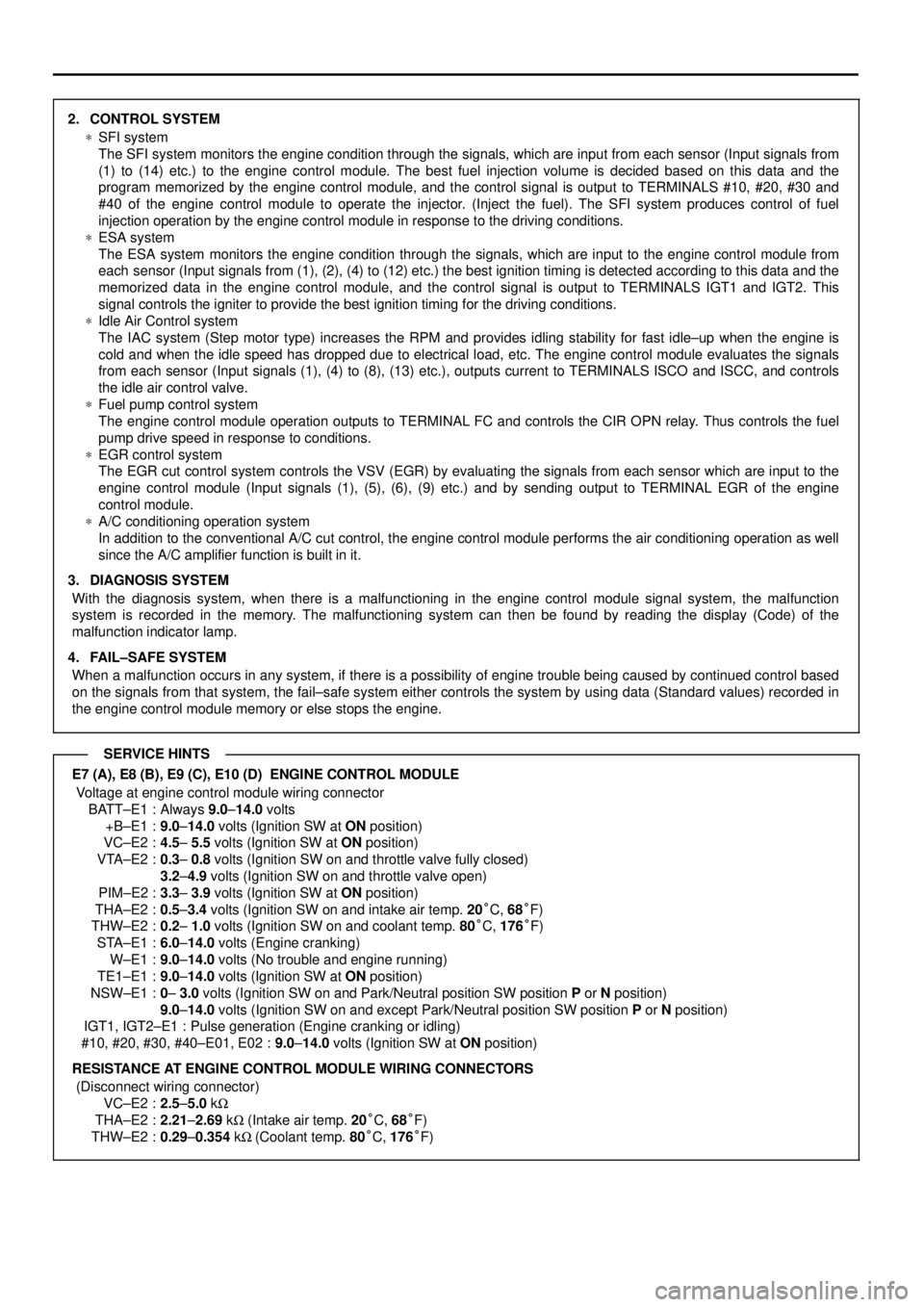
E7 (A), E8 (B), E9 (C), E10 (D) ENGINE CONTROL MODULE
Voltage at engine control module wiring connector
BATT±E1 : Always 9.0±14.0 volts
+B±E1 :9.0±14.0 volts (Ignition SW at ON position)
VC±E2 :4.5± 5.5 volts (Ignition SW at ON position)
VTA±E2 :0.3± 0.8 volts (Ignition SW on and throttle valve fully closed)
3.2±4.9 volts (Ignition SW on and throttle valve open)
PIM±E2 :3.3± 3.9 volts (Ignition SW at ON position)
THA±E2 :0.5±3.4 volts (Ignition SW on and intake air temp. 20°C, 68°F)
THW±E2 :0.2± 1.0 volts (Ignition SW on and coolant temp. 80°C, 176°F)
STA±E1 :6.0±14.0 volts (Engine cranking)
W±E1 :9.0±14.0 volts (No trouble and engine running)
TE1±E1 :9.0±14.0 volts (Ignition SW at ON position)
NSW±E1 :0± 3.0 volts (Ignition SW on and Park/Neutral position SW position P or N position)
9.0±14.0 volts (Ignition SW on and except Park/Neutral position SW position P or N position)
IGT1, IGT2±E1 : Pulse generation (Engine cranking or idling)
#10, #20, #30, #40±E01, E02 :9.0±14.0 volts (Ignition SW at ON position)
RESISTANCE AT ENGINE CONTROL MODULE WIRING CONNECTORS
(Disconnect wiring connector)
VC±E2 :2.5±5.0 kW
THA±E2 :2.21±2.69 kW (Intake air temp. 20°C, 68°F)
THW±E2 :0.29±0.354 kW (Coolant temp. 80°C, 176°F)
SERVICE HINTS
Page 1248 of 4770
10A
H±LP RH
(
LWR) 10A
H±LP LH
(
LWR)
22 2
2 3 1
B
R R±Y R±GR R±B
R±B
R±BR R±YR±B
B 1
JUNCTION
CONNECTOR J 1DIM H±LPH D 6
DAYTIME RUNNING LIGHT RELAY (
MAIN)
IG1 4IG19IG18
143
V±Y
P±L
GR±R GR±RP±L V±YRR±B
RAUTOMATIC LIGHT
CONTROL SENSOR A40 G±R
R±B A
AJUNCTION
CONNECTOR J 2
G±R G± R
TAIL
CLTB CLTS CLTE CSB CSO CSE H±ON
5 15 6 18 2 19 2016
B
Page 1252 of 4770
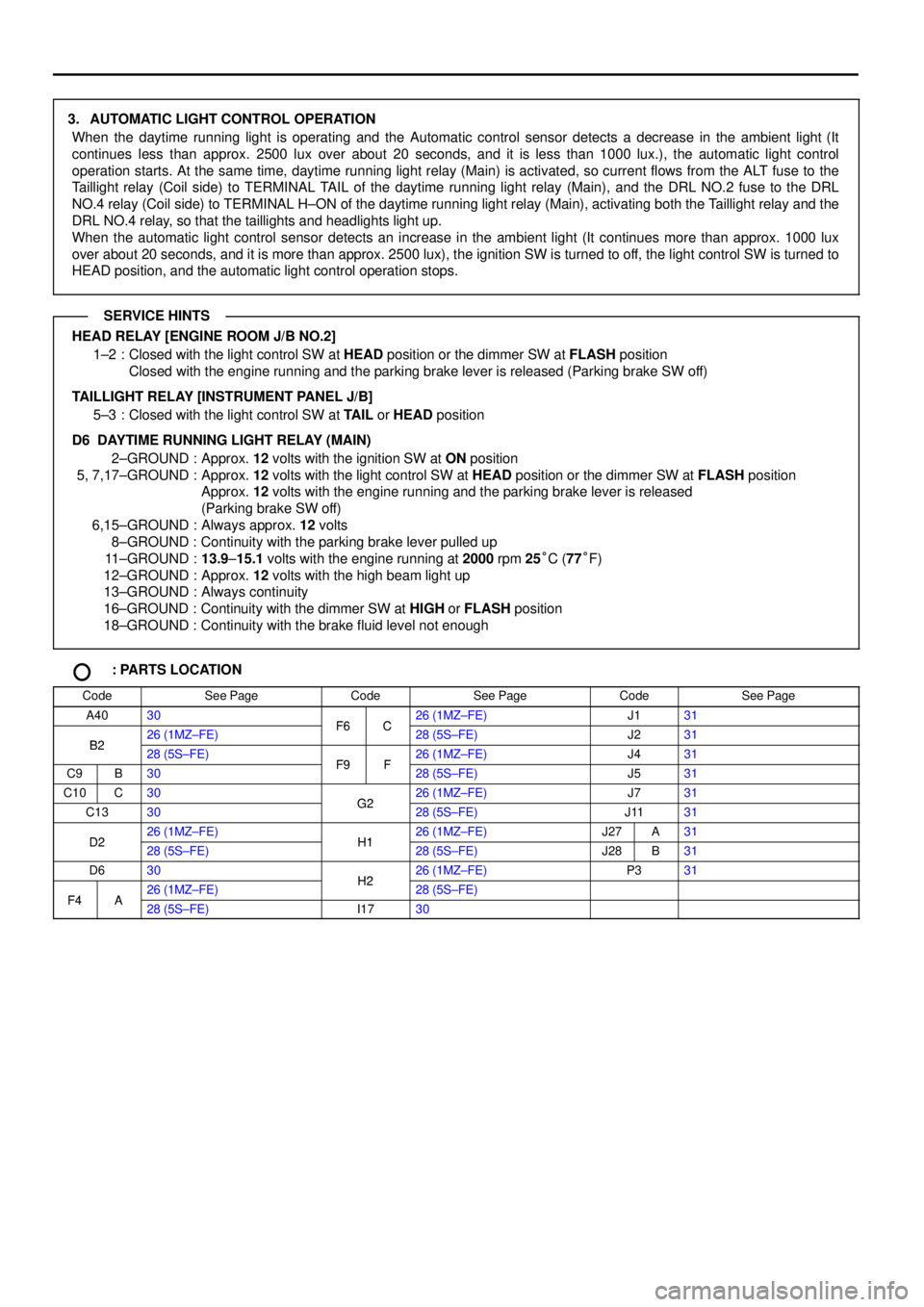
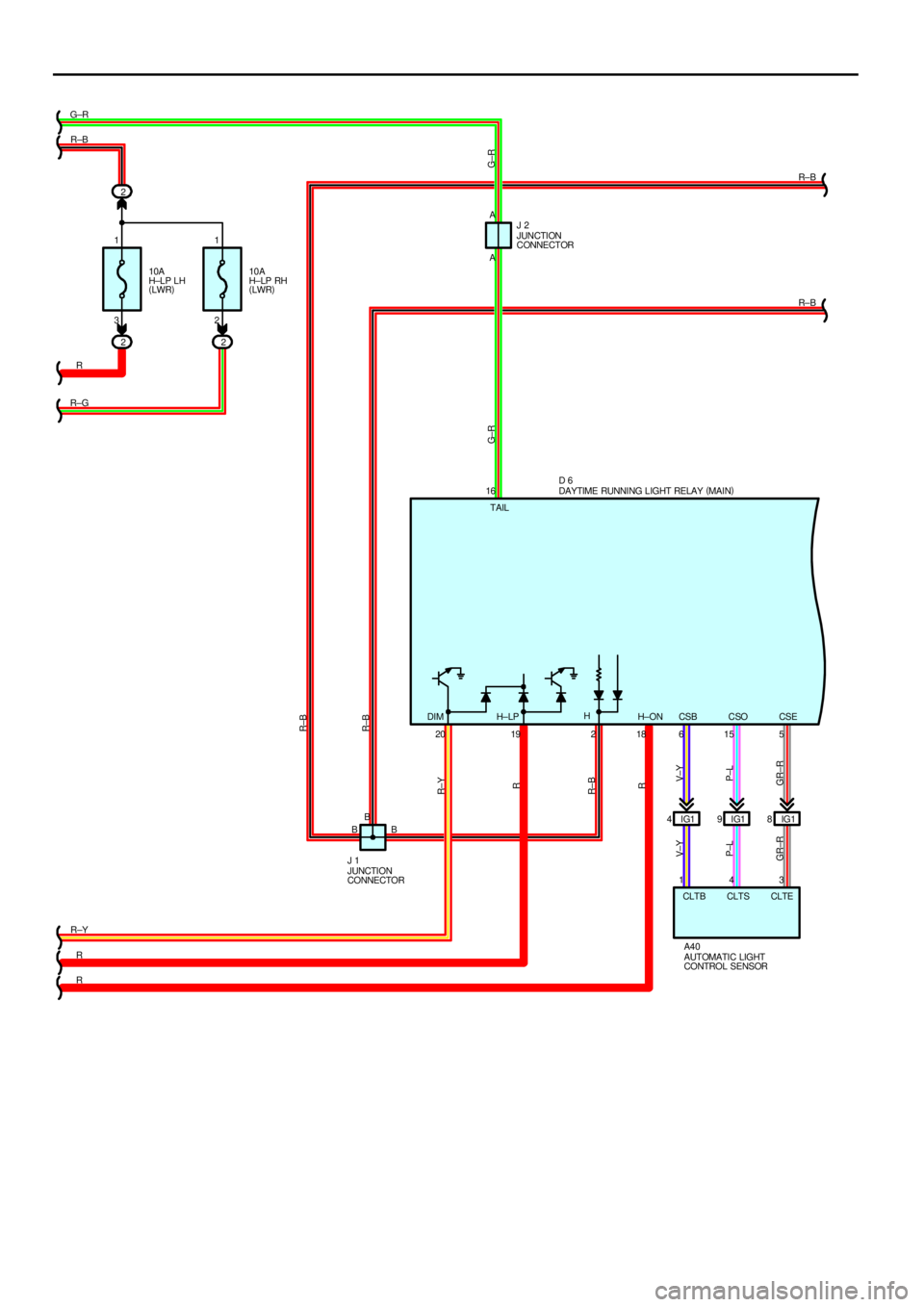
3. AUTOMATIC LIGHT CONTROL OPERATION
When the daytime running light is operating and the Automatic control sensor detects a decrease in the ambient light (It
continues less than approx. 2500 lux over about 20 seconds, and it is less than 1000 lux.), the automatic light control
operation starts. At the same time, daytime running light relay (Main) is activated, so current flows from the ALT fuse to the
Taillight relay (Coil side) to TERMINAL TAIL of the daytime running light relay (Main), and the DRL NO.2 fuse to the DRL
NO.4 relay (Coil side) to TERMINAL H±ON of the daytime running light relay (Main), activating both the Taillight relay and the
DRL NO.4 relay, so that the taillights and headlights light up.
When the automatic light control sensor detects an increase in the ambient light (It continues more than approx. 1000 lux
over about 20 seconds, and it is more than approx. 2500 lux), the ignition SW is turned to off, the light control SW is turned to
HEAD position, and the automatic light control operation stops.
HEAD RELAY [ENGINE ROOM J/B NO.2]
1±2 : Closed with the light control SW at HEAD position or the dimmer SW at FLASH position
Closed with the engine running and the parking brake lever is released (Parking brake SW off)
TAILLIGHT RELAY [INSTRUMENT PANEL J/B]
5±3 : Closed with the light control SW at TAIL or HEAD position
D6 DAYTIME RUNNING LIGHT RELAY (MAIN)
2±GROUND : Approx. 12 volts with the ignition SW at ON position
5, 7,17±GROUND : Approx. 12 volts with the light control SW at HEAD position or the dimmer SW at FLASH position
Approx. 12 volts with the engine running and the parking brake lever is released
(Parking brake SW off)
6,15±GROUND : Always approx. 12 volts
8±GROUND : Continuity with the parking brake lever pulled up
11±GROUND :13.9±15.1 volts with the engine running at 2000 rpm 25°C (77°F)
12±GROUND : Approx. 12 volts with the high beam light up
13±GROUND : Always continuity
16±GROUND : Continuity with the dimmer SW at HIGH or FLASH position
18±GROUND : Continuity with the brake fluid level not enough
: PARTS LOCATION
CodeSee PageCodeSee PageCodeSee Page
A4030F6C26 (1MZ±FE)J131
B226 (1MZ±FE)F6C28 (5S±FE)J231B228 (5S±FE)F9F26 (1MZ±FE)J431
C9B30F9F28 (5S±FE)J531
C10C30G226 (1MZ±FE)J731
C1330G228 (5S±FE)J1131
D226 (1MZ±FE)H126 (1MZ±FE)J27A31D228 (5S±FE)H128 (5S±FE)J28B31
D630H226 (1MZ±FE)P331
F4A26 (1MZ±FE)H228 (5S±FE)F4A28 (5S±FE)I1730
SERVICE HINTS
Page 1265 of 4770
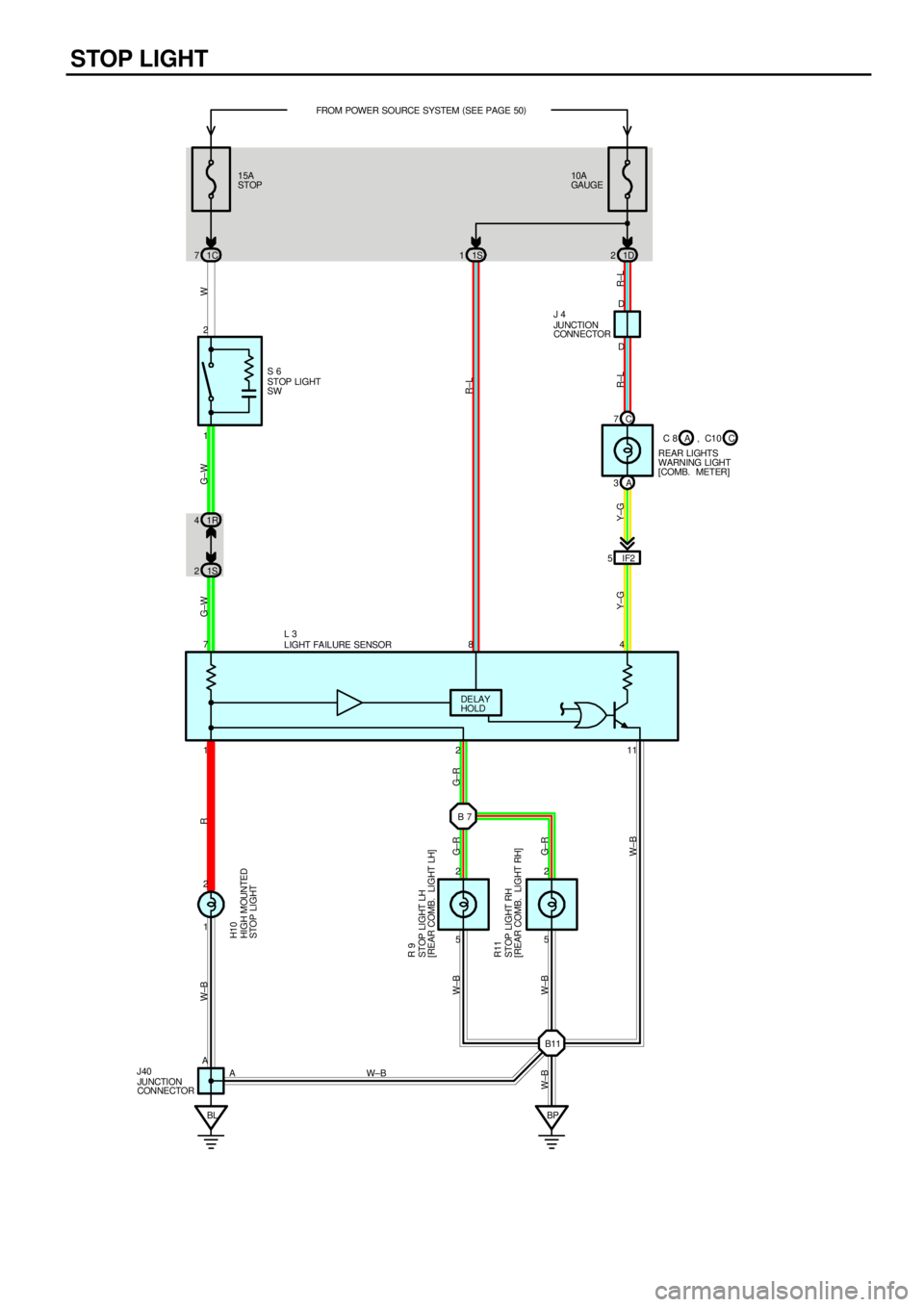
STOP LIGHT
1D 2 1C 7
BL5 2
5 2 B 7
B11D
78D
2
1IF2 5 1S 1 FROM POWER SOURCE SYSTEM (
SEE PAGE 50)
10A
GAUGE 15A
STOP
R W±B
Y±G R±L R±LR±L
LIGHT FAILURE SENSORJUNCTION
CONNECTOR
G± R W±B
W±BSTOP LIGHT RH
[REAR COMB. LIGHT RH] STOP LIGHT LH
[REAR COMB. LIGHT LH]HIGH MOUNTED
STOP LIGHT
J 4
R11 R 9H10
L 3 1R 4
1S 2
G±W
STOP LIGHT
SW
1 2
S 6
W
A
BP
W±BJUNCTION
CONNECTOR J40REAR LIGHTS
WARNING LIGHT
[COMB. METER] C 7
A 3
G±W
4
Y±G
11 2
G± R
W±BG± R
AW±B 1DE LAY
HOLDC C 8 A , C10
Page 1266 of 4770
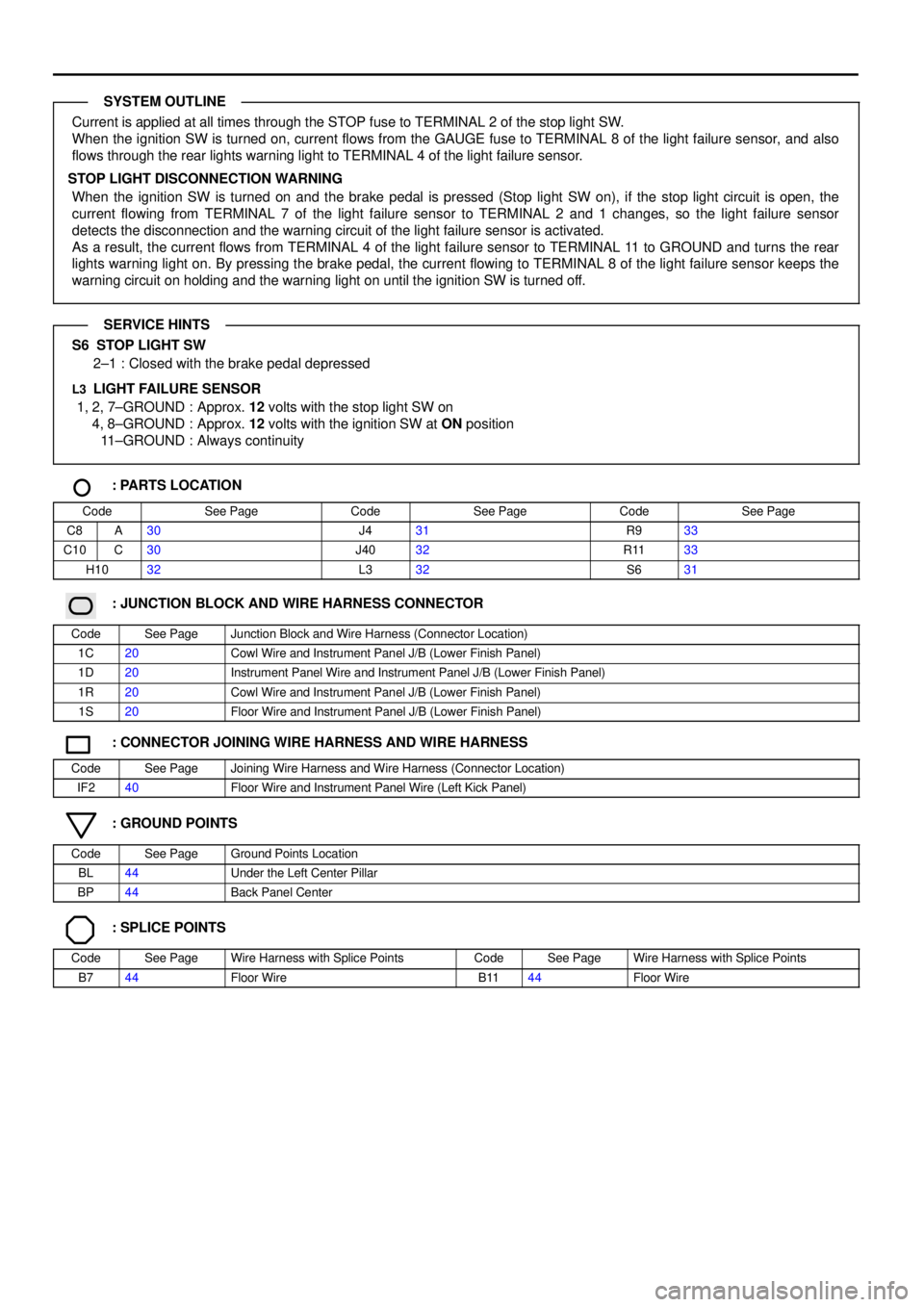
Current is applied at all times through the STOP fuse to TERMINAL 2 of the stop light SW.
When the ignition SW is turned on, current flows from the GAUGE fuse to TERMINAL 8 of the light failure sensor, and also
flows through the rear lights warning light to TERMINAL 4 of the light failure sensor.
STOP LIGHT DISCONNECTION WARNING
When the ignition SW is turned on and the brake pedal is pressed (Stop light SW on), if the stop light circuit is open, the
current flowing from TERMINAL 7 of the light failure sensor to TERMINAL 2 and 1 changes, so the light failure sensor
detects the disconnection and the warning circuit of the light failure sensor is activated.
As a result, the current flows from TERMINAL 4 of the light failure sensor to TERMINAL 11 to GROUND and turns the rear
lights warning light on. By pressing the brake pedal, the current flowing to TERMINAL 8 of the light failure sensor keeps the
warning circuit on holding and the warning light on until the ignition SW is turned off.
S6 STOP LIGHT SW
2±1 : Closed with the brake pedal depressed
L3 LIGHT FAILURE SENSOR
1, 2, 7±GROUND : Approx. 12 volts with the stop light SW on
4, 8±GROUND : Approx. 12 volts with the ignition SW at ON position
11±GROUND : Always continuity
: PARTS LOCATION
CodeSee PageCodeSee PageCodeSee Page
C8A30J431R933
C10C30J4032R1133
H1032L332S631
: JUNCTION BLOCK AND WIRE HARNESS CONNECTOR
CodeSee PageJunction Block and Wire Harness (Connector Location)
1C20Cowl Wire and Instrument Panel J/B (Lower Finish Panel)
1D20Instrument Panel Wire and Instrument Panel J/B (Lower Finish Panel)
1R20Cowl Wire and Instrument Panel J/B (Lower Finish Panel)
1S20Floor Wire and Instrument Panel J/B (Lower Finish Panel)
: CONNECTOR JOINING WIRE HARNESS AND WIRE HARNESS
CodeSee PageJoining Wire Harness and Wire Harness (Connector Location)
IF240Floor Wire and Instrument Panel Wire (Left Kick Panel)
: GROUND POINTS
CodeSee PageGround Points Location
BL44Under the Left Center Pillar
BP44Back Panel Center
: SPLICE POINTS
CodeSee PageWire Harness with Splice PointsCodeSee PageWire Harness with Splice Points
B744Floor WireB1144Floor Wire
SYSTEM OUTLINE
SERVICE HINTS