Page 1063 of 4770

W 1998 TOYOTA MOTOR CORPORATIONAll rights reserved. This book may not be repro-
duced or copied, in whole or in part, without the
written permission of Toyota Motor Corporation.
First Printing: Dec. 9, 1998 01-981209-00
FOREWORD
To assist you in your service activities, this manual explains the main characteristics of the 1999 CAMRY
CNG, in particular providing a technical explanation of the construction and operation of new mechanisms
and new technology used.
Applicable models: SXV23 Series
This manual is divided into 3 sections.
1. Introduction Ð Vehicle Outline and model line-up.
2. Technical Description Ð Technical explanation of the construction and operation of each new
system and component.
3. Appendix Ð Major technical specifications of the vehicle.
CAUTION, NOTICE, REFERENCE and NOTE are used in the following ways:
CAUTION
A potentially hazardous situation which could result in injury to people may occur
if instructions on what to do or not do are ignored.
NOTICEDamage to the vehicle or components may occur if instructions on what to do or not
do are ignored.
REFERENCEExplains the theory behind mechanisms and techniques.
NOTENotes or comments not included under the above 3 titles.
For detailed service specifications and repair procedures, refer to the following Repair Manuals:
Manual Name
Pub. No.
�1999 CAMRY Repair Manual Vol. 1
Vol. 2
�1999 CAMRY CNG Repair Manual Supplement
�1999 CAMRY CNG Electrical Wiring Diagram
ManualRM654U1
RM654U2
RM683U
EWD371U
All information contained herein is the most up-to-date at the time of publication. We reserve the right to
make changes without prior notice.
Page 1091 of 4770

APPENDIX
Curb to Curb m (ft.)
Rear
Model Code
Front mm (in.)
Rear mm (in.)4-Door Sedan
ItemArea
Body Type
Vehicle Grade
OverallLength mm (in.)
Width mm (in.)
Height* mm (in.)
Wheel Base mm (in.)
Tread
Rear mm (in.)
Effective Head Room
Front mm (in.)
Overhang
Min. Running Ground Clearance mm (in.)
Angle of Approach degrees
Angle of Departure degrees
Curb Weight
Gross Vehicle WeightFront kg (lb)
Rear kg (lb)
Total kg (lb)
Front kg (lb)
Rear kg (lb)
Total kg (lb)
Fuel Tank Capacity (US.gal., Imp. gal)
Max. Speed km / h (mph)
Max. Cruising Speed km / h (mph)
Acceleration
Wall to Wall m (ft.) 0 to 100 km/h sec.
Valve Mechanism
Brake Type
Parking Brake Type
Brake Booster Type and Size in.
Proportioning Valve Type
Suspension Type
Stabilizer Bar
Steering Gear Type
Steering Gear Ratio (Overall)
Power Steering TypeFront
Front
Rear Front
Rear
5
10
15
20
25
30
35
40
45
50
55
60
65
70
Major Dimensions & Vehicle Weights Performance Chassis
U.S.A.
Shoulder Room
Front mm (in.)
Rear mm (in.)
Front mm (in.)
Rear mm (in.)
Front mm (in.)
Rear mm (in.) Effective Leg Room
Turning Diameter
(Outside Front)0 to 400 m sec.
Engine
Electrical
Engine Type
Bore � Stroke mm (in.)
Differential Gear Ratio (Final) Counter Gear RatioIn Fifth
In Reverse Transmission Gear
RatioIn Third
In Fourth In First
In Second
Clutch Type
Transaxle TypeStarter Output kW Generator Output Watts Battery Capacity (5HR) Voltage & Amp. hr. Carburetor Type Compression Ratio Displacement cm
3 (cu.in.)
Max. Torque (SAE-NET) N´m/rpm (lb-ft@rpm) Research Octane No. RON
Max. Output (SAE-NET) kW/rpm (HP@rpm)
Engine
3rd Gear km/h (mph)
4th Gear km/h (mph) 1st Gear km/h (mph)
2nd Gear km/h (mph)
Max. Permissible
Speed
Luggage Compartment Capacity
28
MAJOR TECHNICAL SPECIFICATIONS
LE
SXV23L-AEPNCA
4785 (188.4)
1780 (70.1)
1420 (55.9)
2670 (105.1)
1545 (60.8)
1520 (59.8)
980 (38.6)
940 (37.0)
1102 (43.4)
901 (35.5)
1427 (56.2)
1425 (56.1)
970 (38.2)
1140 (44.9)
130 (5.1)
165
165
860 (1896)
595 (1312)
1455 (3208)
970 (2140)
950 (2095)
1920 (4235)
135 (35.7, 29.2)*1, 43 (11.4. 9.5)*2
0.332 m3 *3, 8.921 ft3
*4
180 (112)
Ð
Ð
Ð
66 (41)
119 (74)
Ð
Ð
11.9 (39.0)
11.4 (37.4)
5S-FNE
16-Valve, DOHC
87.0 � 91.0 (3.43 � 3.58)
2164 (132.0)
11.0 : 1
SFI
130
88/5200 (118/5200)
178/2400 (131/2400)
12 ± 55
960
1.4
Ð
A140E
2.810
1.549
1.000
0.706
Ð
2.296
0.945
4.176
Ventilated Disc
L.T. Drum
Drum
Tandem 8º + 9º
Dual-P Valve
MacPherson Strut
MacPherson Strut
STD
STD
Rack and Pinion
17.4 : 1
Integral Type
*: Unladed Vehicle
*
1: Water Volume
*2: Equivalent Gasoline Capacity
*3: VDA
*4: SAE Suitcase
Page 4583 of 4770
Toyota Supports ASE CertificationPage 1 of 2
EL002±98Title:
CIGARETTE LIGHTER SERVICE
Models:
All Models
Technical Service
BULLETIN
Apirl 10, 1998
When receiving customer complaints to repair the lighter or lighter socket, please
carefully investigate the cause of the failure to prevent further occurrences. If the
customer uses the wrong size lighter element or power accessory plug, damage may
occur to the lighter socket. When applicable, instruct the customer to replace the lighter
element with original equipment components or to use an appropriate sized accessory
plug. Dimensional information included within this document will instruct you on
component specifications.
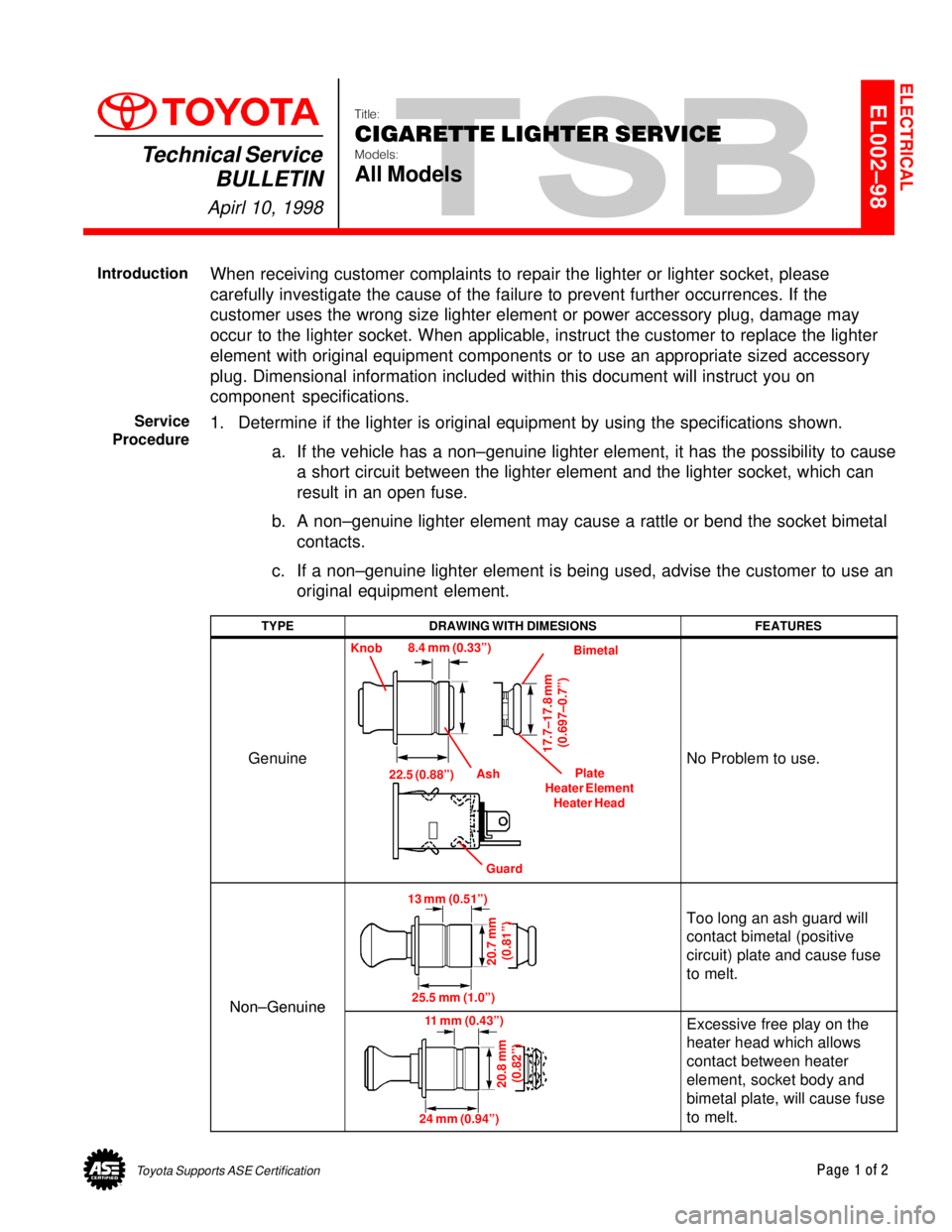
1. Determine if the lighter is original equipment by using the specifications shown.
a. If the vehicle has a non±genuine lighter element, it has the possibility to cause
a short circuit between the lighter element and the lighter socket, which can
result in an open fuse.
b. A non±genuine lighter element may cause a rattle or bend the socket bimetal
contacts.
c. If a non±genuine lighter element is being used, advise the customer to use an
original equipment element.
TYPEDRAWING WITH DIMESIONSFEATURES
Genuine
Knob
Bimetal
Plate
Heater Element
Heater Head
Guard Ash 8.4 mm (0.33º)
17.7±17.8 mm
(0.697±0.7º)
22.5 (0.88º)No Problem to use.
Non±Genuine
13 mm (0.51º)
20.7 mm
(0.81º)
25.5 mm (1.0º)
Too long an ash guard will
contact bimetal (positive
circuit) plate and cause fuse
to melt.
Non±Genuine11 mm (0.43º)
20.8 mm
(0.82º)
24 mm (0.94º)
Excessive free play on the
heater head which allows
contact between heater
element, socket body and
bimetal plate, will cause fuse
to melt.
ELECTRICAL
Introduction
Service
Procedure