Page 166 of 402

3-6
Automatic Operation
When the system is set for AUTO, your climate control
system will control the air delivery mode, fan speed,
A/C and RECIRC operations. Air will come from
the floor, panel or windshield outlets. The fan speed
will vary as the system maintains the selected
temperature setting.
When AUTO is selected, the A/C operation and air inlet
will be automatically controlled. The air conditioning
compressor will run at outside temperatures over
approximately 40�F (4�C). The air inlet will normally
be set to outside air. If it's hot outside, the air inlet will
automatically switch to recirculated inside air to help
quickly cool down your vehicle.
To find your comfort zone, start with 75� F (24�C)
temperature setting and allow about 20 minutes for the
system to regulate. Turn the TEMP knob up or down to
adjust the temperature setting if necessary. If you choose
the temperature setting of 60�F (15�C), the system will
remain at the maximum cooling setting and fan speed.
If you choose the temperature setting of 90�F (33�C),
the system will remain at the maximum heat setting and
fan speed. Choosing either maximum setting will not
cause the system to heat or cool any faster.Be careful not to cover the sensor located on the top of
the instrument panel near the windshield. This sensor
regulates temperature based on sun load.
The EXT (exterior) temperature sensor is located in the
front of the vehicle behind the grille. The displayed
temperature is most accurate after the vehicle has been
moving for a few minutes. If the vehicle is stopped and
then restarted within 2 1/2 hours, the sensor will be hot
from the engine heat. In this case, the temperature first
displayed will continue to be the previous temperature.
The display will update after the vehicle has been
moving for a few minutes and the sensor has a chance
to cool down to the actual temperature.
To avoid blowing cold air in cold weather, the system
will delay turning on the fan until warm air is available.
The length of delay depends on engine coolant
temperature. Pushing the fan button will override this
delay and change the fan to a selected speed.
Page 207 of 402

4-3
Drunken Driving
Death and injury associated with drinking and driving is
a national tragedy. It's the number one contributor to
the highway death toll, claiming thousands of victims
every year.
Alcohol affects four things that anyone needs to drive
a vehicle:
�Judgment
�Muscular Coordination
�Vision
�Attentiveness.
Police records show that almost half of all motor
vehicle
-related deaths involve alcohol. In most cases,
these deaths are the result of someone who was drinking
and driving. In recent years, over 17,000 annual motor
vehicle
-related deaths have been associated with the use
of alcohol, with more than 300,000 people injured.
Many adults
-- by some estimates, nearly half the adult
population
-- choose never to drink alcohol, so they
never drive after drinking. For persons under 21, it's
against the law in every U.S. state to drink alcohol.
There are good medical, psychological and
developmental reasons for these laws.The obvious way to solve the leading highway safety
problem is for people never to drink alcohol and then
drive. But what if people do? How much is ªtoo muchº
if the driver plans to drive? It's a lot less than many
might think. Although it depends on each person
and situation, here is some general information on
the problem.
The Blood Alcohol Concentration (BAC) of someone
who is drinking depends upon four things:
�The amount of alcohol consumed
�The drinker's body weight
�The amount of food that is consumed before and
during drinking
�The length of time it has taken the drinker to
consume the alcohol.
According to the American Medical Association, a
180
-lb. (82 kg) person who drinks three 12-ounce
(355 ml) bottles of beer in an hour will end up with a
BAC of about 0.06 percent. The person would reach the
same BAC by drinking three 4
-ounce (120 ml) glasses
of wine or three mixed drinks if each had 1
-1/2 ounces
(45 ml) of a liquor like whiskey, gin or vodka.
Page 316 of 402
6-41
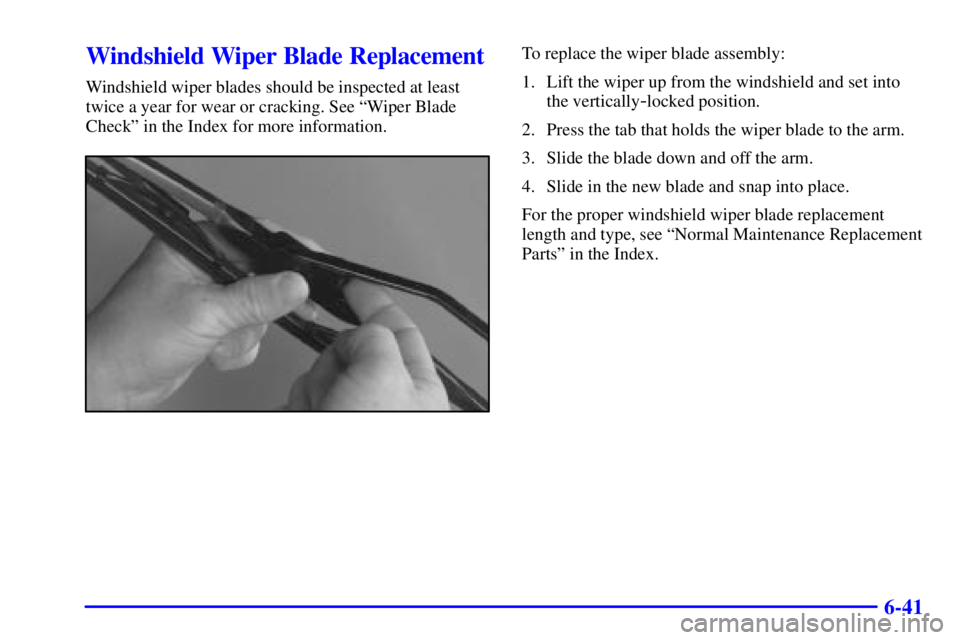
Windshield Wiper Blade Replacement
Windshield wiper blades should be inspected at least
twice a year for wear or cracking. See ªWiper Blade
Checkº in the Index for more information.
To replace the wiper blade assembly:
1. Lift the wiper up from the windshield and set into
the vertically
-locked position.
2. Press the tab that holds the wiper blade to the arm.
3. Slide the blade down and off the arm.
4. Slide in the new blade and snap into place.
For the proper windshield wiper blade replacement
length and type, see ªNormal Maintenance Replacement
Partsº in the Index.
Page 345 of 402

6-70 Wheel Nut Torque
100 lb-ft (140 N´m)
Capacities
Automatic Transaxle (Overdrive)
Pan Removal and
Replacement7.4 quarts (7.0 L) . . . . . . . . . . . . .
Complete Overhaul 10.0 quarts (9.5 L). . . . . . . .
When draining or replacing torque converter, more
fluid may be needed.
Cooling System10.0 quarts (9.5 L) . . . . . . . . . . . . .
Engine Crankcase4.5 quarts (4.3L) . . . . . . . . . . .
Oil change with filter change
Fuel Tank18.5 gallons (70.0 L) . . . . . . . . . . . . . . .
Air Conditioning RefrigerantSee refrigerant . . . .
charge label under the hood.
All capacities are approximate. When adding, be sure
to fill to the appropriate level, as recommended in
this manual.
Normal Maintenance
Replacement Parts
Air Cleaner Filter AC Type A-1096C . . . . . . . . . . . . .
Passenger Compartment Air Filter
(HVAC Air Filter) GM Part No. 25654414. . . . . . . .
Engine Oil Filter AC Type PF
-47 . . . . . . . . . . . . . . . .
Fuel Filter AC Type GF
-627 . . . . . . . . . . . . . . . . . . . .
Transaxle Filter GM Part No. 8651909. . . . . . . . . . . .
Spark Plugs AC Type 41
-921* . . . . . . . . . . . . . . . . .
Gap: 0.060 inch (1.52 mm)
Windshield Wiper Blades
Type Shepard's Hook. . . . . . . . . . . . . . . . . . . . . . . . .
Length 22 inches (56 cm). . . . . . . . . . . . . . . . . . . . .
*On 3800 V6 Supercharged Engine (Code 1) only, this
replaces original spark plug NGK Type PTR4B
-15.
Page 346 of 402
6-71 Vehicle Dimensions
Wheelbase 112.2 inches (285.0 cm). . . . . . . . . . . . . .
Tread Width
Front 62.4 inches (158.5 cm). . . . . . . . . . . . . . . . . .
Rear 62.3 inches (158.2 cm). . . . . . . . . . . . . . . . . . .
Length 202.6 inches (514.6 cm). . . . . . . . . . . . . . . . .
Width 73.8 inches (187.5 cm). . . . . . . . . . . . . . . . . . .
Height 56.0 inches (142.2 cm). . . . . . . . . . . . . . . . . . .
L36 Engine Accessory Belt
The 3800 V6 (L36) engine uses an engine accessory
belt. This diagram shows the features connected and the
routing. See ªMaintenance Scheduleº in the Index for
when to check the belt.
A. Power Steering
B. Generator
C. Air ConditioningD. Crank
E. Coolant Pump
F. Idler