Page 84 of 402
2-20
Ignition Positions
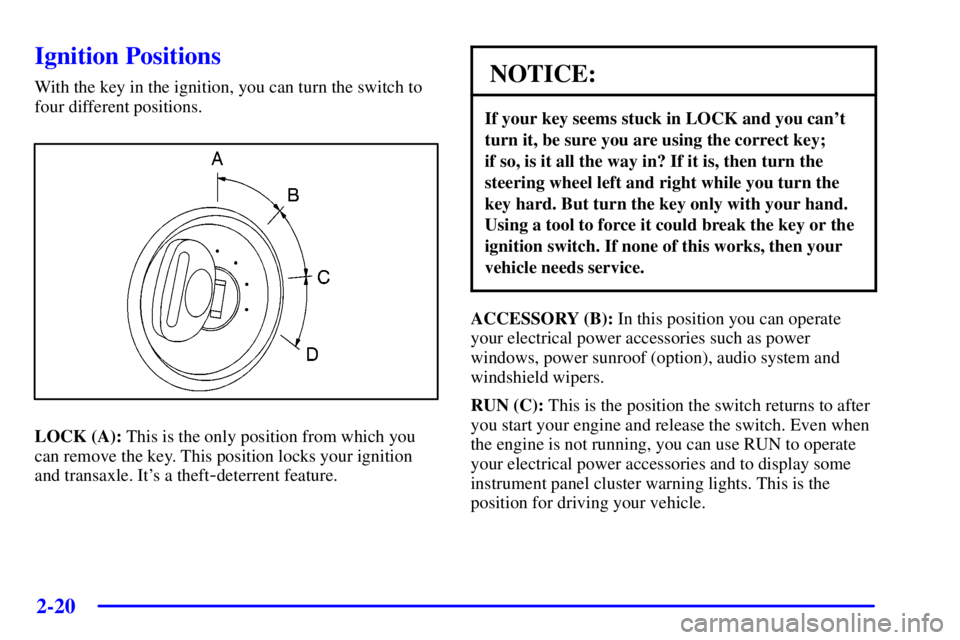
With the key in the ignition, you can turn the switch to
four different positions.
LOCK (A): This is the only position from which you
can remove the key. This position locks your ignition
and transaxle. It's a theft
-deterrent feature.
NOTICE:
If your key seems stuck in LOCK and you can't
turn it, be sure you are using the correct key;
if so, is it all the way in? If it is, then turn the
steering wheel left and right while you turn the
key hard. But turn the key only with your hand.
Using a tool to force it could break the key or the
ignition switch. If none of this works, then your
vehicle needs service.
ACCESSORY (B): In this position you can operate
your electrical power accessories such as power
windows, power sunroof (option), audio system and
windshield wipers.
RUN (C): This is the position the switch returns to after
you start your engine and release the switch. Even when
the engine is not running, you can use RUN to operate
your electrical power accessories and to display some
instrument panel cluster warning lights. This is the
position for driving your vehicle.
Page 97 of 402
2-33
Windows
Power Windows
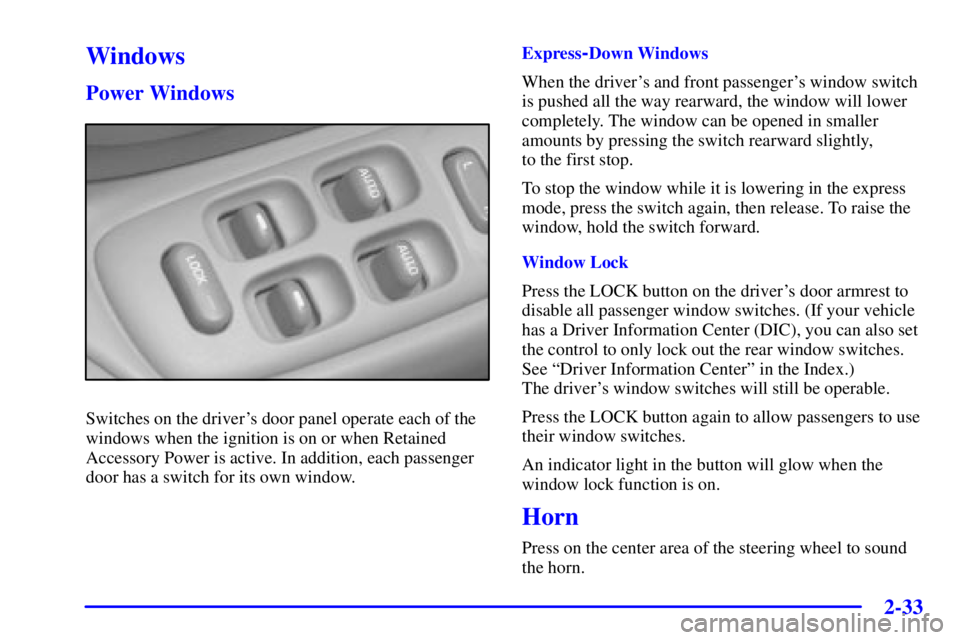
Switches on the driver's door panel operate each of the
windows when the ignition is on or when Retained
Accessory Power is active. In addition, each passenger
door has a switch for its own window.Express
-Down Windows
When the driver's and front passenger's window switch
is pushed all the way rearward, the window will lower
completely. The window can be opened in smaller
amounts by pressing the switch rearward slightly,
to the first stop.
To stop the window while it is lowering in the express
mode, press the switch again, then release. To raise the
window, hold the switch forward.
Window Lock
Press the LOCK button on the driver's door armrest to
disable all passenger window switches. (If your vehicle
has a Driver Information Center (DIC), you can also set
the control to only lock out the rear window switches.
See ªDriver Information Centerº in the Index.)
The driver's window switches will still be operable.
Press the LOCK button again to allow passengers to use
their window switches.
An indicator light in the button will glow when the
window lock function is on.
Horn
Press on the center area of the steering wheel to sound
the horn.
Page 213 of 402

4-9
Remember: Anti-lock doesn't change the time you need
to get your foot up to the brake pedal or always decrease
stopping distance. If you get too close to the vehicle in
front of you, you won't have time to apply your brakes
if that vehicle suddenly slows or stops. Always leave
enough room up ahead to stop, even though you have
anti
-lock brakes.
Using Anti
-Lock
Don't pump the brakes. Just hold the brake pedal down
firmly and let anti
-lock work for you. You may feel a
slight brake pedal pulsation or notice some noise, but
this is normal.
Braking in Emergencies
With anti-lock, you can steer and brake at the same
time. In many emergencies, steering can help you more
than even the very best braking.
Traction Control System
(If Equipped)
Your vehicle may have a traction control system that
limits wheel spin. This is especially useful in slippery
road conditions. The system operates only if it senses
that one or both of the front wheels are spinning or
beginning to lose traction. When this happens, the
system works the front brakes and reduces engine power
to limit wheel spin.
You may feel or hear the system working, but this
is normal.
If your vehicle is in cruise control when the traction
control system begins to limit wheel spin, the cruise
control will automatically disengage. When road
conditions allow you to safely use it again, you may
reengage the cruise control. (See ªCruise Controlº
in the Index.)
This light should come on
briefly when you start the
engine. If it stays on or
comes on while you are
driving, there's a problem
with your traction
control system.
Page 214 of 402
4-10
See ªTraction Control System Warning Lightº in the
Index. When this warning light is on, the system will not
limit wheel spin. Adjust your driving accordingly.
The traction control system automatically comes on
whenever you start your vehicle. To limit wheel spin,
especially in slippery road conditions, you should
always leave the system on. But you can turn the
traction control system off if you ever need to.
(You should turn the system off if your vehicle ever gets
stuck in sand, mud, ice or snow. See ªRocking Your
Vehicleº in the Index.)
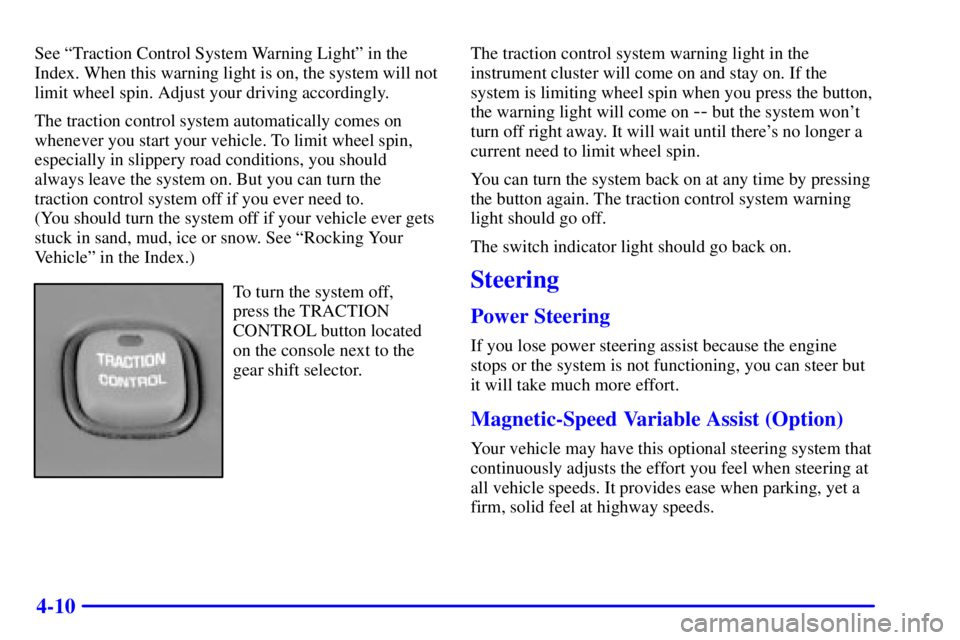
To turn the system off,
press the TRACTION
CONTROL button located
on the console next to the
gear shift selector.The traction control system warning light in the
instrument cluster will come on and stay on. If the
system is limiting wheel spin when you press the button,
the warning light will come on
-- but the system won't
turn off right away. It will wait until there's no longer a
current need to limit wheel spin.
You can turn the system back on at any time by pressing
the button again. The traction control system warning
light should go off.
The switch indicator light should go back on.
Steering
Power Steering
If you lose power steering assist because the engine
stops or the system is not functioning, you can steer but
it will take much more effort.
Magnetic-Speed Variable Assist (Option)
Your vehicle may have this optional steering system that
continuously adjusts the effort you feel when steering at
all vehicle speeds. It provides ease when parking, yet a
firm, solid feel at highway speeds.
Page 276 of 402

6-
6-1
Section 6 Service and Appearance Care
Here you will find information about the care of your vehicle. This section begins with service and fuel information,
and then it shows how to check important fluid and lubricant levels. There is also technical information about your
vehicle, and a part devoted to its appearance care.
6
-2 Service
6
-3 Fuel
6
-5 Fuels in Foreign Countries
6
-5 Filling Your Tank
6
-8 Filling a Portable Fuel Container
6
-8 Checking Things Under the Hood
6
-11 Supercharged Engine (If Equipped)
6
-11 Engine Oil
6
-16 Engine Air Cleaner/Filter
6
-18 Supercharger Oil
6
-19 Automatic Transaxle Fluid
6
-22 Engine Coolant
6
-24 Radiator Pressure Cap
6
-25 Power Steering Fluid
6
-25 Windshield Washer Fluid
6
-27 Brakes
6
-30 Battery6
-32 Bulb Replacement
6
-41 Windshield Wiper Blade Replacement
6
-42 Tires
6
-51 Appearance Care
6
-52 Cleaning the Inside of Your Vehicle
6
-54 Care of Safety Belts
6
-55 Cleaning the Outside of Your Vehicle
6
-57 Cleaning Aluminum or Chrome-Plated
Wheels (If Equipped)
6
-57 Sheet Metal Damage
6
-59 GM Vehicle Care/Appearance Materials
6
-60 Vehicle Identification Number (VIN)
6
-60 Electrical System
6
-64 Removing the Rear Seat Cushion
6
-69 Replacement Bulbs
6
-69 Capacities and Specifications
6
-70 Normal Maintenance Replacement Parts
Page 285 of 402
6-10 3800 V6 Series II Engine (L36)
When you open the hood on the 3800 (L36) engine, here's what you will see (3800 Supercharged (L67) engine similar):
A. Engine Coolant Recovery Tank
B. Power Steering Fluid
C. Automatic Transaxle Fluid Dipstick
D. Brake Master Cylinder
E. Windshield Washer Fluid ReservoirF. Radiator Pressure Cap
G. Engine Oil Dipstick
H. Engine Oil Fill Cap
I. Engine Air Cleaner/Filter
Page 300 of 402

6-25
Power Steering Fluid
The power steering fluid reservoir is located on the rear
passenger side of the engine compartment.
When to Check Power Steering Fluid
It is not necessary to regularly check power steering
fluid unless you suspect there is a leak in the system or
you hear an unusual noise. A fluid loss in this system
could indicate a problem. Have the system inspected
and repaired.
How to Check Power Steering Fluid
Turn the key off, let the engine compartment cool down,
wipe the cap and the top of the reservoir clean, then
unscrew the cap and wipe the dipstick with a clean rag.
Replace the cap and completely tighten it. Then remove
the cap again and look at the fluid level on the dipstick.
The level should be at the FULL COLD mark. If
necessary, add only enough fluid to bring the level up to
the mark.
What to Use
To determine what kind of fluid to use, see
ªRecommended Fluids and Lubricantsº in the Index.
Always use the proper fluid. Failure to use the proper
fluid can cause leaks and damage hoses and seals.
Windshield Washer Fluid
What to Use
When you need windshield washer fluid, be sure to read
the manufacturer's instructions before use. If you will be
operating your vehicle in an area where the temperature
may fall below freezing, use a fluid that has sufficient
protection against freezing.
Page 346 of 402
6-71 Vehicle Dimensions
Wheelbase 112.2 inches (285.0 cm). . . . . . . . . . . . . .
Tread Width
Front 62.4 inches (158.5 cm). . . . . . . . . . . . . . . . . .
Rear 62.3 inches (158.2 cm). . . . . . . . . . . . . . . . . . .
Length 202.6 inches (514.6 cm). . . . . . . . . . . . . . . . .
Width 73.8 inches (187.5 cm). . . . . . . . . . . . . . . . . . .
Height 56.0 inches (142.2 cm). . . . . . . . . . . . . . . . . . .
L36 Engine Accessory Belt
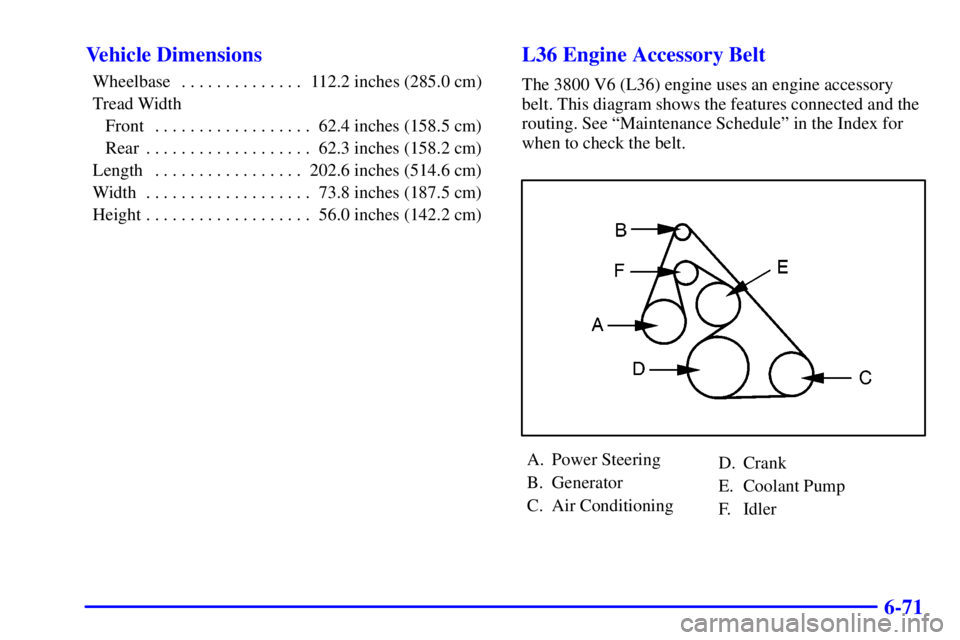
The 3800 V6 (L36) engine uses an engine accessory
belt. This diagram shows the features connected and the
routing. See ªMaintenance Scheduleº in the Index for
when to check the belt.
A. Power Steering
B. Generator
C. Air ConditioningD. Crank
E. Coolant Pump
F. Idler