2000 NISSAN PATHFINDER brake
[x] Cancel search: brakePage 228 of 265
![NISSAN PATHFINDER 2000 R50 / 2.G Owners Manual Schedule 1Abbreviations: R = Replace I = Inspect. Correct or replace if necessary. L = Lubricate [ ]: At the mileage intervals onlyMAINTENANCE OPERATIONMAINTENANCE INTERVAL
Perform at number of miles,](/manual-img/5/640/w960_640-227.png "NISSAN PATHFINDER 2000 R50 / 2.G Owners Manual Schedule 1Abbreviations: R = Replace I = Inspect. Correct or replace if necessary. L = Lubricate [ ]: At the mileage intervals onlyMAINTENANCE OPERATIONMAINTENANCE INTERVAL
Perform at number of miles,")
Schedule 1Abbreviations: R = Replace I = Inspect. Correct or replace if necessary. L = Lubricate [ ]: At the mileage intervals onlyMAINTENANCE OPERATIONMAINTENANCE INTERVAL
Perform at number of miles, kilometers
or months, whichever comes first.Miles´1,000 3.75 7.5 11.25 15 18.75 22.5 26.25 30 33.75 37.5 41.25 45 48.75 52.5 56.25 60
(km´1,000) (6) (12) (18) (24) (30) (36) (42) (48) (54) (60) (66) (72) (78) (84) (90) (96)
Months 3 6 9 12 15 18 21 24 27 30 33 36 39 42 45 48
Chassis and body maintenance
Brake lines & cablesIIII
Brake pads, rotors, drums & liningsIIIIIIII
Automatic transmission & transfer fluid,
manual transmission & differential gear oil
(exc. LSD)See NOTE (1)IIII
Limited-slip differential (LSD) gear oil See NOTE (1)IRIR
Steering gear, linkage & transfer gear, axle & suspension partsIIIIIIII
Tire rotation See NOTE (2)
Drive shaft boots (
) IIIIIIII
Propeller shaft See NOTE (3)LLLLLLLL
Front wheel bearing grease (4x2)II
Front wheel bearing grease (
) See NOTE (4)IRIR
Exhaust systemIIIIIIII
Supplemental air bag system and supple-
mental side air bag systems (if so
equipped)See NOTE (5)
Automatic Speed Control Device (ASCD) vacuum hosesIIII
NOTE: (1) If towing a trailer, using a camper or a car-top carrier, or driving on rough or muddy roads, change (not just inspect) oil at every 30,000 miles(48,000 km)
or 24 months except for LSD. Change LSD gear oil every 15,000 miles (24,000 km) or 12 months.
(2) Refer to ªTire rotationº under the ªGeneral maintenanceº heading earlier in this section.
(3) The propeller shaft should be re-greased after being immersed in water.
(4) If operating frequently in water, replace grease every 3,750 miles (6,000 km) or 3 months.
(5) Inspect the supplemental air bag system 10 years after the date of manufacture noted on the F.M.V.S.S. certification label.
Maintenance
9-7
Z
00.1.17/R50-D/V5
X
Page 230 of 265
![NISSAN PATHFINDER 2000 R50 / 2.G Owners Manual Schedule 2Abbreviations: R = Replace I = Inspect. Correct or replace if necessary. L = Lubricate [ ]: At the mileage intervals onlyMAINTENANCE OPERATIONMAINTENANCE INTERVAL
Perform at number of miles,](/manual-img/5/640/w960_640-229.png "NISSAN PATHFINDER 2000 R50 / 2.G Owners Manual Schedule 2Abbreviations: R = Replace I = Inspect. Correct or replace if necessary. L = Lubricate [ ]: At the mileage intervals onlyMAINTENANCE OPERATIONMAINTENANCE INTERVAL
Perform at number of miles,")
Schedule 2Abbreviations: R = Replace I = Inspect. Correct or replace if necessary. L = Lubricate [ ]: At the mileage intervals onlyMAINTENANCE OPERATIONMAINTENANCE INTERVAL
Perform at number of miles, kilometers or
months, whichever comes first.Miles´1,000 7.5 15 22.5 30 37.5 45 52.5 60
(km´1,000) (12) (24) (36) (48) (60) (72) (84) (96)
Months 6 12 18 24 30 36 42 48
Chassis and body maintenance
Brake lines & cablesIIII
Brake pads, rotors, discs, drums & liningsIIII
Automatic transmission & transfer fluid, manual transmission & dif-
ferential gear oil (exc. LSD)IIII
Limited-slip differential (LSD) gear oilIRIR
Steering gear, linkage & transfer gear, axle & suspension parts I I
Tire rotation See NOTE (1)
Drive shaft boots (
) IIII
Propeller shaft See NOTE (2)LLLL
Front wheel bearing grease (4x2)II
Front wheel bearing grease (
) IRIR
Exhaust systemII
Supplemental air bag system and supplemental
side air bag systems (if so equipped)See NOTE (3)
Automatic Speed Control Device (ASCD) vacuum hosesIIII
NOTE: (1) Refer to ªTire rotationº under the ªGeneral maintenanceº heading earlier in this section.
(2) The propeller shaft should be re-greased after being immersed in water.
(3) Inspect the supplemental air bag system 10 years after the date of manufacture noted on the F.M.V.S.S. certification label.
Maintenance
9-9
Z
00.1.17/R50-D/V5
X
Page 231 of 265

Maintenance for offroad driving
(
only)
Whenever you drive offroad through sand,
mud or water as deep as the wheel hub, more
frequent maintenance may be required of the
following items:G
Brake pads and discs
G
Brake lining and drums
G
Brake lines and hoses
G
Wheel bearing grease
G
Differential, transmission and transfer oil
G
Steering linkage
G
Propeller shafts and front drive shafts
G
Air cleaner filter
G
Clutch housing (See ªClutch housing drainº
in the ª8. Do-it-yourselfº section for check-
ing water entry.)
These items should be checked frequently to
assure safe and proper operation of your ve-
hicle.
EXPLANATION OF MAINTENANCE
ITEMS
Emission control system
maintenanceAdditional information on the following
items with * is found in the ª8. Do-it-
yourselfº section.
Drive belts*:
Check drive belts for wear, fraying or cracking
and also for proper tension. Replace the drive
belts if found damaged.
Air filter:
Under normal driving conditions, the air
cleaner filter should be replaced in accordance
with the maintenance schedule. However,
driving the vehicle in dusty areas may cause
more rapid clogging of the element. Conse-
quently, the element may have to be replaced
more frequently.
EVAP vapor lines:
Check vapor lines and connections for failure
or looseness. If leaks are found, replace the
lines.
Fuel lines:
Check the fuel hoses, piping and connectionsfor leaks, looseness or deterioration. Replace
any parts if they are damaged.
Fuel filter:
If the vehicle is operated under extremely
adverse weather conditions or in areas where
ambient temperatures are either extremely low
or extremely high, the filter might become
clogged. In such an event, replace the filter
immediately.
Engine coolant*:
Flush and refill the cooling system.
Engine oil & oil filter*:
Under normal driving conditions, the engine oil
and oil filter should be replaced in accordance
with the maintenance schedule. However, un-
der severe driving conditions, they may have
to be replaced more frequently.
Spark plugs*:
Replace with new plugs having the correct
heat range.
Timing belt:
Replace the timing belt for driving the cam-
shafts.
9-10
Maintenance
Z
00.1.17/R50-D/V5
X
Page 232 of 265

Chassis and body maintenanceBrake lines & cables:
Check the brake lines and hoses (including
brake booster vacuum hoses, connections &
check valve) and parking brake cables for
proper attachment, leaks, cracks, chafing,
abrasion, deterioration, etc.
Brake pads, rotors, drums & linings:
Check these and the other neighboring brake
components for wear, deterioration and leaks.
Under severe driving conditions, they may
have to be inspected more frequently.
Manual and automatic transmission,
transfer & differential gear fluid:
Visually inspect for signs of leakage and re-
place oil for limited-slip differential. Under se-
vere driving conditions, the oil should be re-
placed at the specified interval.
Steering gear, linkage & transfer gear,
axle & suspension parts & drive axle
shaft boots:
Check for damage, looseness and leakage of
oil or grease. Under severe driving conditions,
more frequent inspection should be per-
formed.Propeller shaft(s):
Check the propeller shaft(s) for damage,
looseness and grease leakage under severe
driving condition (
only).
Propeller shaft:
Apply specified grease to the greasing points
of propeller shafts in accordance with the
maintenance schedule. In the case of driving
in water, greasing should be performed imme-
diately afterwards.
Front wheel bearing grease:
Check the wheel bearing for grease leakage
around grease seals, axial end play and
smooth turning (4x2).
Check the wheel bearing grease condition or
repack these in accordance with the mainte-
nance schedule. In case of frequent driving in
muddy water, the bearing grease inspection
should be performed more frequently (
).
Exhaust system:
Visually check the exhaust pipes, muffler, and
hangers for proper attachment, leaks, cracks,
chafing, abrasion, deterioration, etc. Under
severe driving conditions, inspection should be
performed more frequently.Supplemental air bag, and supplemental
side air bag (if so equipped) systems:
Maintenance for the supplemental air bags or
supplemental side air bags should be done by
an authorized NISSAN dealer.
Automatic Speed Control Device (ASCD)
vacuum hoses:
Check vacuum hose (between ASCD actuator
and ASCD pump) for breakage, cracks or
fracture.
Maintenance
9-11
Z
00.1.17/R50-D/V5
X
Page 236 of 265

Capacity (Approximate)
Recommended specifications
US
measureImp
measureLiter
Manual transmissionÐ Ð Ð API GL-4 Viscosity SAE 75W-90 only
Differential gear oil (exc. LSD)Ð Ð Ð API GL-5*1
Limited-slip differential (LSD) gear oil Ð Ð ÐOnly LSD gear oil:
API GL-5 and SAE 80W-90*2 approved for Nissan
LSD*3
Automatic transmission fluid
Refill to the proper oil level according to the instructions in
the ª8. Do-it-yourselfº section.Nissan Matic ªDº (Continental US and Alaska) or
Canada Nissan Automatic Transmission Fluid.*6
Power steering fluidGenuine Nissan PSF II or equivalent*7
Transfer fluidNissan Matic ªDº (Continental U.S. and Alaska) or
Canada Nissan Automatic Transmission Fluid*6 or API
GL-4*1
Brake and clutch fluidGenuine Nissan Brake Fluid*4 or equivalent
DOT 3 (US F.M.V.S.S. No. 116)
Propeller shaft grease Ð Ð ÐNLGI No. 2 (Molybdenum disulphide lithium soap
base)
Multi-purpose greaseÐ Ð Ð NLGI No. 2 (Lithium soap base)
Air conditioning system refrigerantÐ Ð Ð HFC-134a (R-134a)*5
Air conditioning system lubricantsÐ Ð Ð Nissan A/C System Oil Type S or exact equivalent*5
*1: For further details, see recommended SAE viscosity number chart.
*2: SAE 90 is acceptable in temperatures above 0ÉF (þ18ÉC).
*3: Contact your NISSAN dealer for a list of approved oils.
*4: Available in mainland USA through your NISSAN dealer.
*5: See ªVehicle identificationº later in this section for air conditioner specification label.
*6: Dexron
TM
III/Mercon
TM
or equivalent may also be used. Outside the continental United States and Alaska contact a NISSAN dealer for more information regarding
suitable fluids, including recommended brand(s) of Dexron
TM
III/Mercon
TM
Automatic Transmission Fluid.
*7: Genuine Nissan PSF, Canada Nissan Automatic Transmission Fluid, DexronTM
III/Mercon
TM
or equivalent ATF may also be used.
Technical and consumer information
10-3
Z
00.1.17/R50-D/V5
X
Page 248 of 265
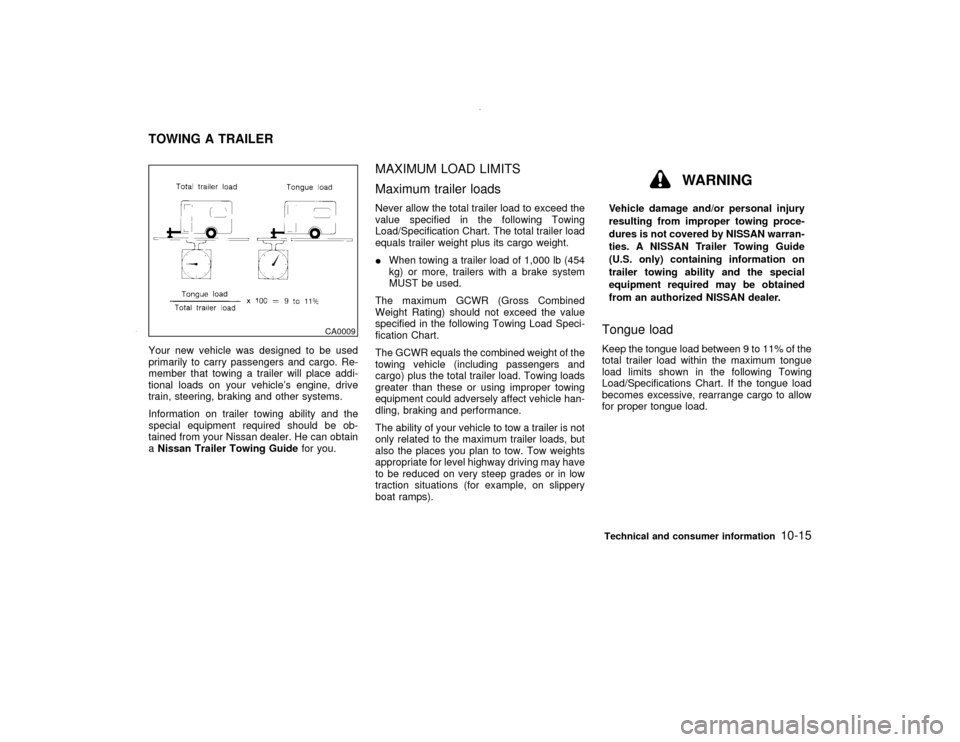
Your new vehicle was designed to be used
primarily to carry passengers and cargo. Re-
member that towing a trailer will place addi-
tional loads on your vehicle's engine, drive
train, steering, braking and other systems.
Information on trailer towing ability and the
special equipment required should be ob-
tained from your Nissan dealer. He can obtain
aNissan Trailer Towing Guidefor you.
MAXIMUM LOAD LIMITS
Maximum trailer loadsNever allow the total trailer load to exceed the
value specified in the following Towing
Load/Specification Chart. The total trailer load
equals trailer weight plus its cargo weight.
IWhen towing a trailer load of 1,000 lb (454
kg) or more, trailers with a brake system
MUST be used.
The maximum GCWR (Gross Combined
Weight Rating) should not exceed the value
specified in the following Towing Load Speci-
fication Chart.
The GCWR equals the combined weight of the
towing vehicle (including passengers and
cargo) plus the total trailer load. Towing loads
greater than these or using improper towing
equipment could adversely affect vehicle han-
dling, braking and performance.
The ability of your vehicle to tow a trailer is not
only related to the maximum trailer loads, but
also the places you plan to tow. Tow weights
appropriate for level highway driving may have
to be reduced on very steep grades or in low
traction situations (for example, on slippery
boat ramps).
WARNING
Vehicle damage and/or personal injury
resulting from improper towing proce-
dures is not covered by NISSAN warran-
ties. A NISSAN Trailer Towing Guide
(U.S. only) containing information on
trailer towing ability and the special
equipment required may be obtained
from an authorized NISSAN dealer.Tongue loadKeep the tongue load between 9 to 11% of the
total trailer load within the maximum tongue
load limits shown in the following Towing
Load/Specifications Chart. If the tongue load
becomes excessive, rearrange cargo to allow
for proper tongue load.
CA0009
TOWING A TRAILER
Technical and consumer information
10-15
Z
00.1.17/R50-D/V5
X
Page 249 of 265
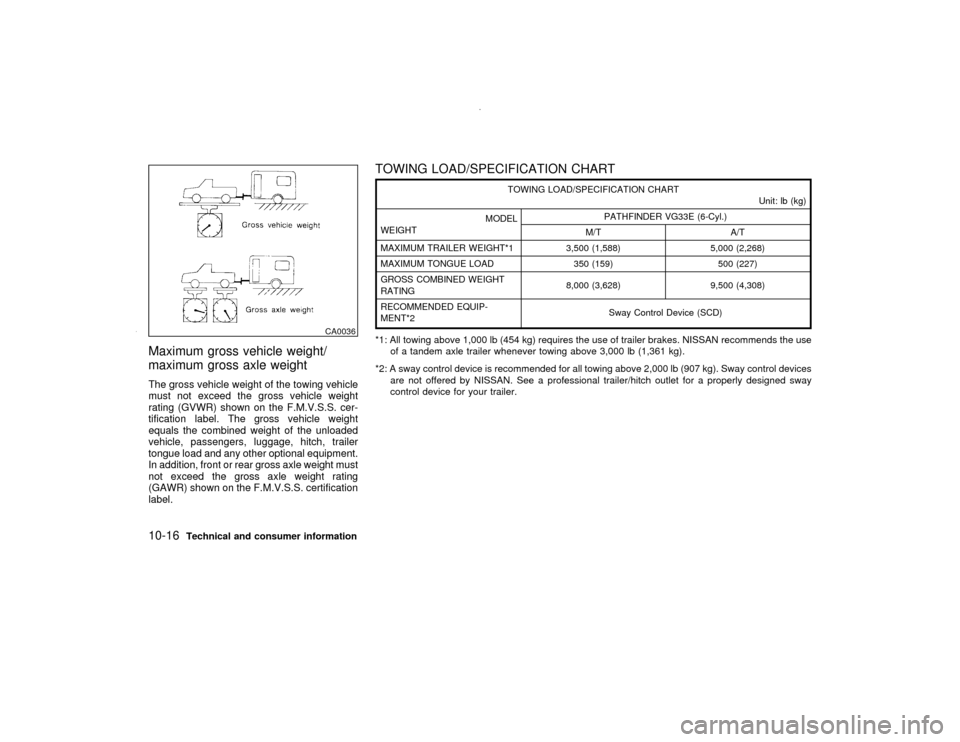
Maximum gross vehicle weight/
maximum gross axle weightThe gross vehicle weight of the towing vehicle
must not exceed the gross vehicle weight
rating (GVWR) shown on the F.M.V.S.S. cer-
tification label. The gross vehicle weight
equals the combined weight of the unloaded
vehicle, passengers, luggage, hitch, trailer
tongue load and any other optional equipment.
In addition, front or rear gross axle weight must
not exceed the gross axle weight rating
(GAWR) shown on the F.M.V.S.S. certification
label.
TOWING LOAD/SPECIFICATION CHART
TOWING LOAD/SPECIFICATION CHART
Unit: lb (kg)
MODEL
WEIGHTPATHFINDER VG33E (6-Cyl.)
M/T A/T
MAXIMUM TRAILER WEIGHT*1 3,500 (1,588) 5,000 (2,268)
MAXIMUM TONGUE LOAD 350 (159) 500 (227)
GROSS COMBINED WEIGHT
RATING8,000 (3,628) 9,500 (4,308)
RECOMMENDED EQUIP-
MENT*2Sway Control Device (SCD)
*1: All towing above 1,000 lb (454 kg) requires the use of trailer brakes. NISSAN recommends the use
of a tandem axle trailer whenever towing above 3,000 lb (1,361 kg).
*2: A sway control device is recommended for all towing above 2,000 lb (907 kg). Sway control devices
are not offered by NISSAN. See a professional trailer/hitch outlet for a properly designed sway
control device for your trailer.
CA0036
10-16
Technical and consumer information
Z
00.1.17/R50-D/V5
X
Page 250 of 265

TOWING SAFETY
Trailer hitchCheck the towing capacity of your receiver
type frame mounted hitch. Choose a proper
hitch for your vehicle and trailer. A genuine
NISSAN trailer hitch is available from your
NISSAN dealer (Canada only). Make sure the
trailer hitch is securely attached to the vehicle,
to help avoid personal injury or property dam-
age due to sway caused by crosswinds, rough
road surfaces or passing trucks.
CAUTION
ISpecial hitches which include frame
reinforcements are required for tow-
ing above 2,000 lb (907 kg). Suitable
Genuine NISSAN hitches for pickup
truck and sport utility vehicles are
available at an authorized NISSAN
dealer.
IDo not use axle-mounted hitches.
IDo not modify the vehicle exhaust
system, brake system, etc. to install a
trailer hitch.IAfter the hitch is removed, seal the
bolt holes to prevent exhaust fumes,
water or dust from entering the pas-
senger compartment.
IRegularly check all hitch mounting
bolts are securely mounted.
ITo reduce the possibility of additional
damage if your vehicle is struck from
the rear, where practical, remove the
hitch and/or receiver when not in use.
INever connect a trailer brake system
directly to the vehicle brake system.
Tire pressuresIWhen towing a trailer, inflate the vehicle
tires to the recommended cold tire pressure
indicated on the tire placard (affixed to the
glove box lid).
ITrailer tire condition, size, load rating and
proper inflation pressure should be in ac-
cordance with the trailer and tire manufac-
turers' specifications.Safety chainsAlways use a suitable chain between yourvehicle and the trailer. The chain should be
crossed and should be attached to the hitch,
not to the vehicle bumper or axle. Be sure to
leave enough slack in the chain to permit
turning corners.
Trailer lightsTrailer lights should comply with Federal
and/or local regulations.
When wiring vehicle for towing connection,
connect stop and tail light pickup into the
vehicle electrical circuit at point between
the sensor and stop light switch or light
switch.Trailer brakesIf your trailer is equipped with a braking sys-
tem, make sure it conforms to Federal and/or
local regulations and that it is properly in-
stalled.
WARNING
Never connect a trailer brake system
directly to the vehicle brake system.Trailer towing tipsIn order to gain skill and an understanding ofTechnical and consumer information
10-17
Z
00.1.17/R50-D/V5
X