2000 MITSUBISHI MONTERO Indicator
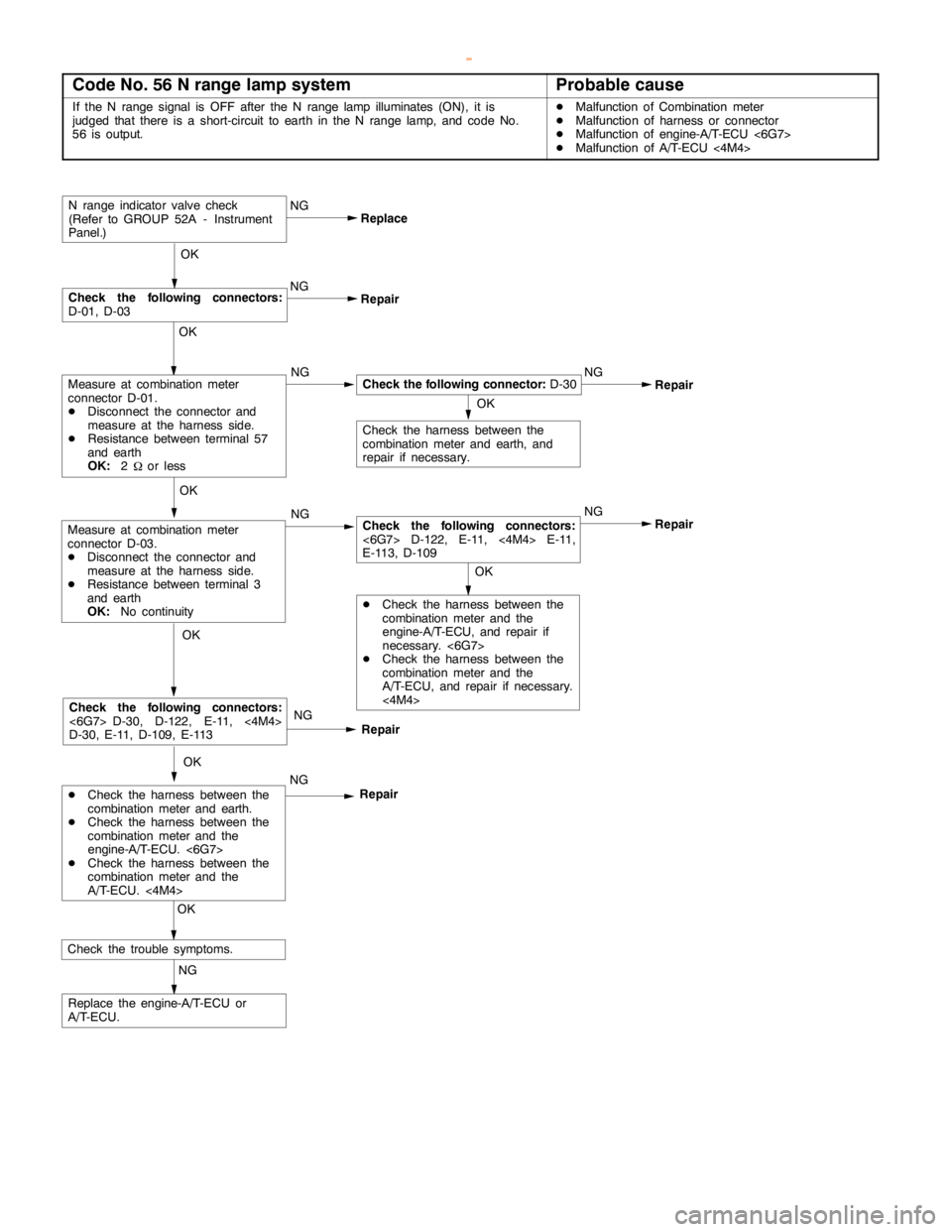
[x] Cancel search: IndicatorPage 947 of 1839
Page 964 of 1839

Page 966 of 1839

AUTOMATIC TRANSMISSION -Troubleshooting AUTOMATIC TRANSMISSION -Troubleshooting 23-65
Ter-
minal
No.Standard value Inspection conditions Check item
1062nd solenoid valveEngine: Idling
Shift range: 2ndSystem voltage
Engine: Idling
Shift range: Park7–9 V
107DCC solenoid valveEngine: Idling
Shift range: 1stSystem voltage
108Inhibitor switch REngine: Idling
Selector lever position: RSystem voltage
Engine: Idling
Shift range: Other than the above0V
109Select switchIgnition switch: ON
Selector lever operation: Sports modeSystem voltage
Ignition switch: ON
Selector lever operation: Other than the above0V
11 0Downshift switchIgnition switch: ON
Selector lever operation: Downshifted in Sports mode
and lever heldSystem voltage
Ignition switch: ON
Selector lever operation: Other than the above0V
11 24LLc switchIgnition switch: ON
Transfer lever position: 4LLcSystem voltage
Ignition switch: ON
Transfer lever position: Other than the above0V
11 5Wide open throttle switchAccelerator pedal: ReleasedSystem voltage
Accelerator pedal: Depressed0V
11 73rd shift indicator lampShift range: 3rdSystem voltage
Shift range: Other than the above0V
11 82nd shift indicator lampShift range: 2ndSystem voltage
Shift range: Other than the above0V
11 9RED solenoid valveEngine: Idling
Shift range: 5thSystem voltage
Engine: Idling
Shift range: Park7-9V
120UD solenoid valveEngine: Idling
Shift range: 1stSystem voltage
Engine: Idling
Shift range: Park7-9V
121Inhibitor switch NIgnition switch: ON
Selector lever position: NSystem voltage
Ignition switch: ON
Selector lever position: Other than the above0V
122Upshift switchIgnition switch: ON
Selector lever operation: Upshifted in Sports mode and
lever heldSystem voltage
Ignition switch: ON
Selector lever operation: Other than the above0V
123Stop lamp switchIgnition switch: ON
Brake pedal DepressedSystem voltage
Ignition switch: ON
Brake pedal Released0V
www.WorkshopManuals.co.uk
Purchased from www.WorkshopManuals.co.uk
Page 968 of 1839

Page 991 of 1839

AUTOMATIC TRANSMISSION -Troubleshooting
Ter-
minal
No.Check itemInspection conditionsStandard value
1Shift actuatorTransfer shift lever position: 2H®4H5.6 V®11.0 V®
5.6 V
3Shift actuatorTransfer shift lever position: 4H®2H5.6 V®11.0 V®
5.6 V
5Accelerator pedal positionAccelerator pedal: Fully closed (engine stopped)0.985 - 1.085 V
sensor (APS)Accelerator pedal: Fully open (engine stopped)4.0 V or higher
7Front propeller shaft speed
sensorMeasure the voltage between terminals 7 and 18 using
an oscilloscope.
Engine: 2 000 r/min
Shift range: 4thOscilloscope check
procedure (Refer to
P. 23-69
9Rear propeller shaft speed
sensorMeasure the voltage between terminals 9 and 18 using
an oscilloscope.
Engine: 2 000 r/min
Shift range: 4thOscilloscope check
procedure (Refer to
P. 23-69
11Diagnosis outputWhen normal (no diagnosis codes are output)0 V and 5 V alterna-
tes
13Power supplyIgnition switch: OFF0V
Ignition switch: ONSystem voltage
18Sensor earthAt all times0.5 V or less
20Transfer lever switch 2HTransfer shift lever position: 2HSystem voltage
Transfer shift lever position: Other than the above0V
21Transfer lever switch 4HTransfer shift lever position: 4HSystem voltage
Transfer shift lever position: Other than the above0V
22Transfer lever switch 4HLcTransfer shift lever position: 4HLcSystem voltage
Transfer shift lever position: Other than the above0V
23Transfer lever switch 4LLcTransfer shift lever position: 4LLcSystem voltage
Transfer shift lever position: Other than the above0V
24Diagnosis control––
25EarthAt all times0V
26EarthAt all times0V
31Backup power supplyAt all timesSystem voltage
32Inhibitor switch NSelector lever position: NSystem voltage
Selector lever position: Other than the above0V
33Inhibitor switch PSelector lever position: PSystem voltage
Selector lever position: Other than the above0V
34Stop lamp switchBrake pedal: DepressedSystem voltage
Brake pedal: Released0V
35EarthAt all times0V
37Rear wheel indicator lampOther than during transfer selectionSystem voltage
38Front wheel indicator lampDuring 4WDSystem voltage
39Earth <6G7>At all times0V
www.WorkshopManuals.co.uk
Purchased from www.WorkshopManuals.co.uk
Page 1275 of 1839
ABS <4WD>-Troubleshooting35B-12
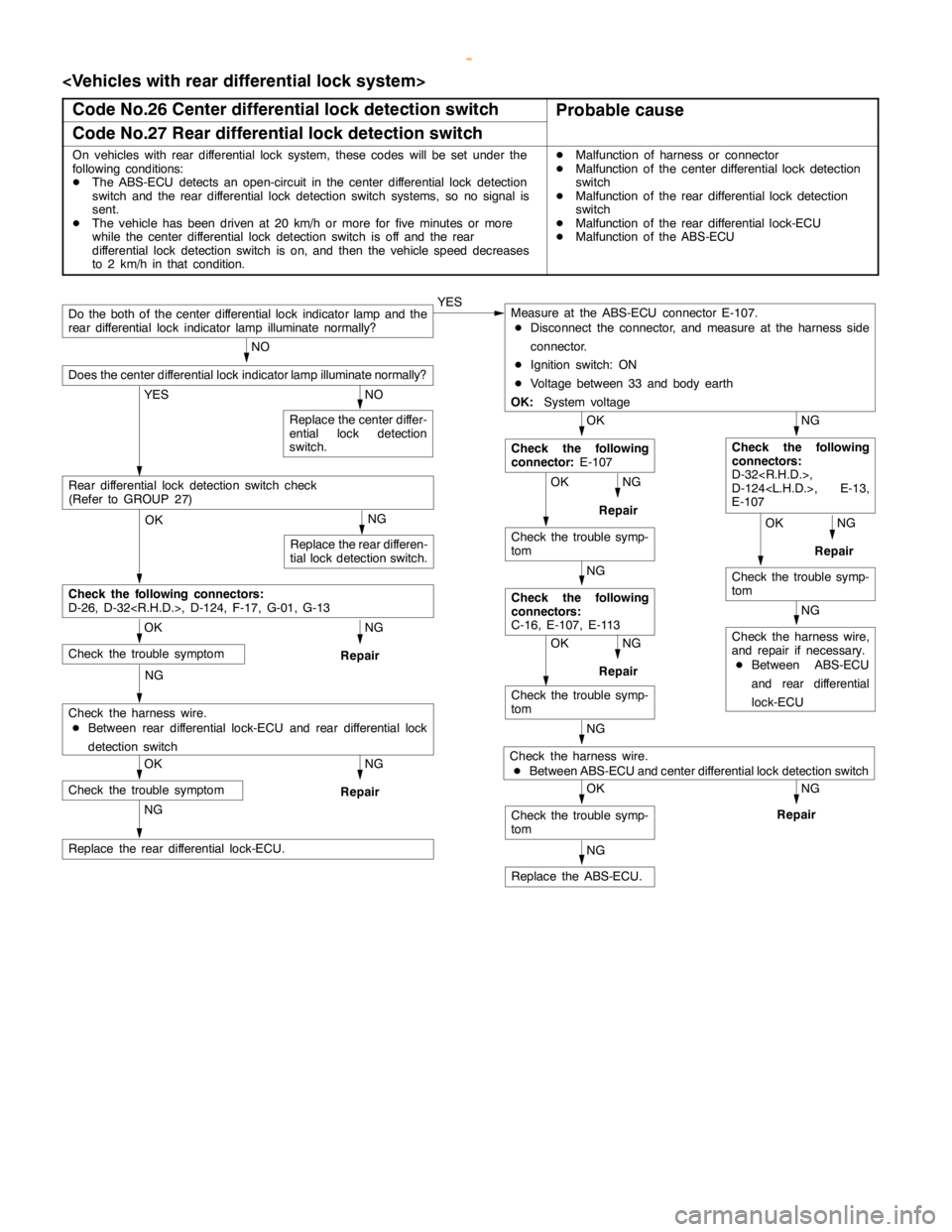
Code No.26 Center differential lock detection switch
Probable cause
Code No.27 Rear differential lock detection switch
On vehicles with rear differential lock system, these codes will be set under the
following conditions:
DThe ABS-ECU detects an open-circuit in the center differential lock detection
switch and the rear differential lock detection switch systems, so no signal is
sent.
DThe vehicle hasbeendriven at 20 km/h or more for five minutes or more
while the center differential lock detection switch is off and the rear
differential lock detection switch is on, and then the vehicle speed decreases
to 2 km/h in that condition.DMalfunction of harness or connector
DMalfunction of the
center differential lock detection
switch
DMalfunction of the
rear differential lock detection
switch
DMalfunction of the
rear differential lock-ECU
DMalfunction of the
ABS-ECU
YES
NG OK
Do the both of the center differential lock indicatorlamp and the
rear differential lock indicatorlamp illuminate normally?YESMeasure at the ABS-ECU connector E-107.
DDisconnect the connector, and measure at the harness side
connector.
DIgnition switch: ON
DVoltage between 33 and body earth
OK:System voltage
NG OK
NO
Does the center differential lock indicatorlamp illuminate normally?
NO
Replace the center differ-
ential lock detection
switch.
Check the following
connector:E-107Check the following
connectors:
D-32
D-124
E-107
NG
Repair
Repair
Check the trouble symp-
tom
Check the trouble symp-
tomOKNG
NG
Check the harness wire,
and repair if necessary.
DBetween ABS-ECU
and rear differential
lock-ECU
Check the following
connectors:
C-16, E-107, E-113
NG OK
Repair
Check the trouble symp-
tom
NG
Check the harness wire.
DBetween ABS-ECU and center differential lock detection switch
NG
Repair
OK
Check the trouble symp-
tom
Replace the ABS-ECU.
Rear differential lock detection switch check
(Refer to GROUP 27)
NG
OK
Check the following connectors:
D-26, D-32
NG
Repair
OK
Check the trouble symptom
NG
Check the harness wire.
DBetween rear differential lock-ECU and rear differential lock
detection switch
NG
Repair
OK
Check the trouble symptom
NG
Replace the rear differential lock-ECU.
NG
Replace the rear differen-
tial lock detection switch.
www.WorkshopManuals.co.uk
Purchased from www.WorkshopManuals.co.uk
Page 1599 of 1839
CHASSIS ELECTRICAL-Combination Meter54A-29
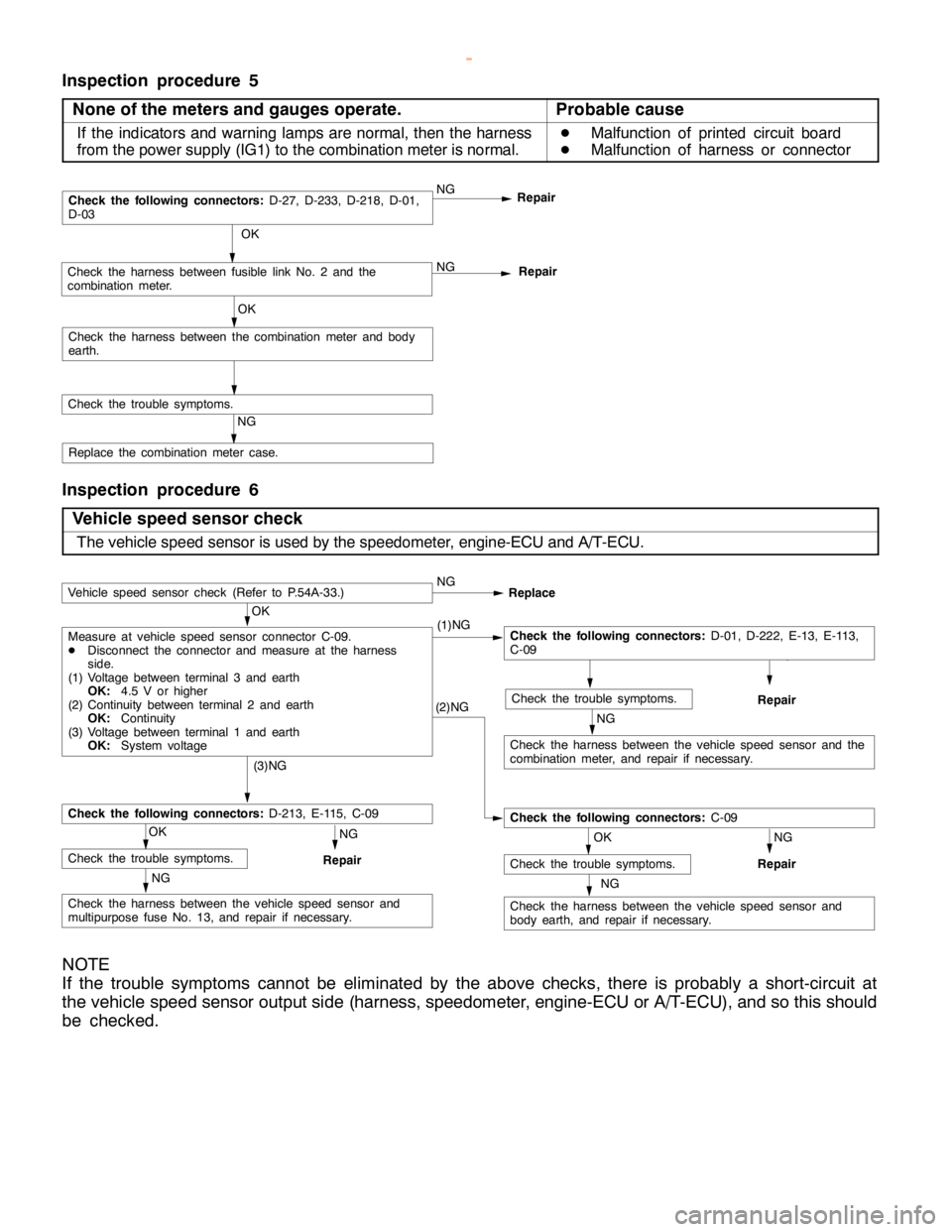
Inspection procedure 5
None of the meters and gauges operate.
Probable cause
If the indicators and warning lamps are normal, then the harness
from the power supply (IG1) to the combination meter is normal.D
Malfunction of printed circuit board
D
Malfunction of harness or connector
NGRepair NG
OK
Check the trouble symptoms.Repair
OK
Check the harness between the combination meter and body
earth.
Check the following connectors:D-27, D-233, D-218, D-01,
D-03
NG
Check the harness between fusible link No. 2 and the
combination meter.
Replace the combination meter case.
Inspection procedure 6
Vehicle speed sensor check
The vehicle speed sensor is used by the speedometer, engine-ECU and A/T-ECU.
NG
Check the harness between the vehicle speed sensor and
body earth, and repair if necessary.
RepairNG
OK
Check the trouble symptoms.NG
Check the harness between the vehicle speed sensor and
multipurpose fuse No. 13, and repair if necessary.
RepairNG
OK
Check the trouble symptoms.
Check the following connectors:D-213, E-115, C-09
(3)NG
(2)NG
Check the following connectors:C-09
NG
Check the harness between the vehicle speed sensor and the
combination meter, and repair if necessary.
RepairNG
OK
Check the trouble symptoms.
OK
Measure at vehicle speed sensor connector C-09.
DDisconnect the connector and measure at the harness
side.
(1) Voltage between terminal 3 and earth
OK:4.5 V or higher
(2) Continuity between terminal 2 and earth
OK:Continuity
(3) Voltage between terminal 1 and earth
OK:System voltage(1)NGCheck the following connectors:D-01, D-222, E-13, E-113,
C-09
Vehicle speed sensor check (Refer to P.54A-33.)NG
Replace
NOTE
If the trouble symptoms cannot be eliminated by the above checks, there is probably a short-circuit at
the vehicle speed sensor output side (harness, speedometer, engine-ECU or A/T-ECU), and so this should
be checked.
www.WorkshopManuals.co.uk
Purchased from www.WorkshopManuals.co.uk
Page 1691 of 1839

SWS -General InformationSWS -General Information54B-5
HEADLAMP WASHER
If the headlamp washer switch at the steering
column is placed in the ON position when the ignition
switch is in the ACC or ON position and theheadlamp switch is in the ON position, the headlamp
washer drive signal is turned ON for 0.5 second.
IGNITION KEY HOLE ILLUMINATION LAMP
When the ignition switch is turned to LOCK (OFF) or
ACC position with the driver’s door opened, the
ignition key hole illumination lamp is illuminated.
If the door is closed in that state, the lamp goes out
after 30 seconds. Vehicles with keyless entrysystem, it illuminates for 30 seconds after the
ignition key is removed. In either case the lamp goes
out when the ignition switch is turned to ON position.
HEADLAMP
Headlamp Automatic Shutdown Function
If the ignition switch is turned to LOCK (OFF) or
ACC position, when the headlamps are on, the
headlamps will be switched off in three minutes.
If the driver’s door is opened within that three-minute
period, the headlamps will be switched off
automatically. This prevents the battery from
discharged.
In addition, if the headlamps are turned on when
the ignition switch is at LOCK (OFF) or ACC position,
the headlamps will not be switched off.Headlamp Dimmer Switch Automatic Reset
Function
This function allows the dimmer switch to be reset
to the low-beam position whenever the headlamp
switch is turned ON.
Daytime Running Lamp (DRL) Function
If the ignition switch is turned to ON when the
headlamps and tail lamps are off, the headlamps
(low-beam) and tail lamps turn on.
FLASHER TIMER
Turn-signal Lamp
When the ignition switch is turned to ON position
and turn-signal lamp switch is placed in the ON
position for right or left turn signaling, the system
generates turn-signal lamp drive signals (flashing
signals).
The system also notifies of a blown turn-signal lamp
bulb by shortening the flashing intervals of the
corresponding indicator lamp.Hazard Warning Lamp
The system detects a change from ON to OFF
of the hazard lamp input signal and activates the
hazard lamps if they are not in operation or
deactivates the lamps if they are operating (reversal
of state between activation and deactivation).
FRONT FOG LAMP
If the front fog lamp switch is turned ON at the
condition that the headlamp or the tail lamp is turned
ON (including the illumination by the automatic
lighting function), the front fog lamp is turned ON.Whenever the tail lamps are turned on at the next
time, the front fog lamps will always be off regardless
of the switch positions. In addition, if the tail lamp
is switched off by the automatic lighting system,
the front fog lamp will also be switched off. However,
the front fog lamp will be illuminated when the tail
lamp is switched on.
www.WorkshopManuals.co.uk
Purchased from www.WorkshopManuals.co.uk