Page 2 of 280

overview–Instruments and Controls
EB21AMFf
1-Combination headlamps, dipper and turn signal
switch � p. 4–12
Headlamp washer switch* � p. 4–17
2-Supplemental restraint system (for driver’s seat)
�p. 3–22
Horn switch � p. 4–223-Meter and gauges � p. 4–2
4- Windscreen wiper and washer switch � p. 4–15
Rear window wiper and washer switch (Hatchback
only) � p. 4–16
5-Ventilators � p. 6–29
6-Multi centre display �p. 4–24
Digital clock � p. 4–26
7-Hazard warning flasher switch � p. 4–18
8-Supplemental restraint system (for passenger’s seat)
�p. 3–22
9-Front fog lamp switch* �p. 4–20
10 - Headlamp levelling switch � p. 4–13
11-Rheostat* (meter illumination control) � p. 4–21
12 - Rear fog lamp switch � p. 4–21
13 - Electric remote-controlled outside rear-view mirrors
switch* � p. 5–32
14 - Bonnet release lever � p. 2–8
15 - Auto-speed (cruise) control lever* � p. 5–36
16 - Ignition switch � p. 5–9
17 - Gearshift or selector lever � p. 5–14, 5–16
18 - A/T mode change over switch (vehicle with auto-
matic transmission INVECS-II 4A/T) � p. 5–21
19 - Ashtray � p. 6–46
20 - Cigarette lighter � p. 6–45
21 - Rear window demister switch � p. 4–19
22 -
Centre accessory box � p. 6–4723 - Heater/Air conditioning* � p. 6–30, 6–36
24 - Audio* � p. 6–2
EB21AMDf
LHD
B21A482t
Page 3 of 280

overview–Instruments and Controls
1-Supplemental restraint system (for passenger’s seat)
�p. 3–22
2-Hazard warning flasher switch � p. 4–18
3-Multi centre display �p. 4–24
Digital clock � p. 4–26
4-Ventilators � p. 6–29
5-Combination headlamps, dipper and turn signal
switch � p. 4–12
Headlamp washer switch* � p. 4–17
6-Meter and gauges � p. 4–2
7-Supplemental restraint system (for driver’s seat)
� p. 3–22
Horn switch � p. 4–22
8- Windscreen wiper and washer switch � p. 4–15
Rear window wiper and washer switch (Hatchback
only) � p. 4–16
9-Rheostat* (meter illumination control) � p. 4–21
10 -
Headlamp levelling switch � p. 4–1311-Front fog lamp switch* � p. 4–20
12 - Electric remote-controlled outside rear-view mirrors
switch* � p. 5–32
13 - Rear fog lamp switch � p. 4–21
14 - Audio* � p. 6–2
15 - Heater/Air conditioning* � p. 6–30, 6–36
16 - Rear window demister switch � p. 4–19
17 - Centre accessory box � p. 6–47
18 - Cigarette lighter � p. 6–45
19 - Ashtray � p. 6–46
20 - A/T mode change over switch (vehicles with auto-
matic transmission INVECS II 4A/T) � p. 5–21
21 - Gearshift or selector lever � p. 5–14, 5–16
22 - Ignitition switch � p. 5–9
23 - Bonnet release lever � p. 2–8
24 - Auto-speed (cruise) control lever* � p. 5–36
RHD
B21A483t
Page 54 of 280

SEATS AND SEATBELTS
3–26
When the impact sensors detect an impact
of sufficient frontal or side force, an auto-
mated circuit ignites materials in the inflator
to generate gas and inflate the air bags. The
air bags deployment produces a sudden,
loud noise, and releases some smoke and
powder, but these conditions are not injuri-
ous, and do not indicate a fire in the vehicle.
People with respiratory problems may feel
some temporary irritation from chemicals
used to produce the deployment; open the
windows after air bag deployment, if safe to
do so.
The air bags deflate very rapidly after de-
ployment, so there is little danger of ob-
scured vision.
The time required from the sensors detecting
an impact to deflation of the air bags after de-
ployment is shorter than a blink of an eye.
CAUTION
Air bags are inflated at an extremely
rapid speed. In certain situations,
contact with inflating air bags can re-
sult in light cuts, bruises, and the like.
G28G012a
Driver’s and passenger’s front air
bag system
EG29C-A
The driver’s air bag is located under the
padded cover in the middle of the steering
wheel. The front passenger air bag is con-
tained in the instrument panel above the
glove box.
The driver air bag and the front passenger air
bag are designed to inflate at the same time
even if the passenger seat is not occupied.
Page 55 of 280
SEATS AND SEATBELTS
3–27
G28L085d
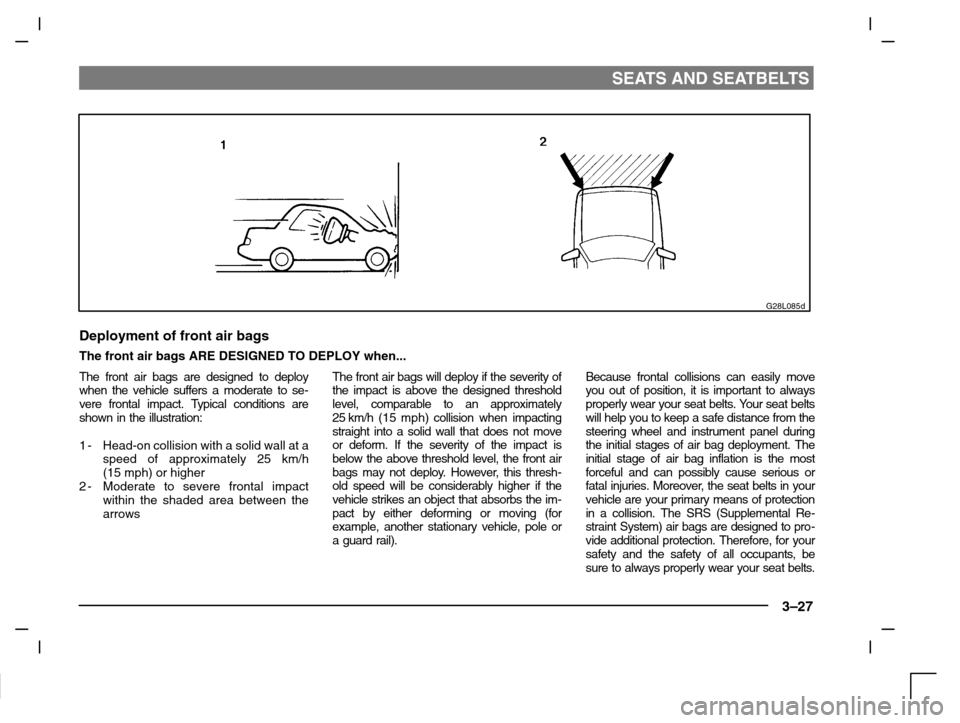
Deployment of front air bags
The front air bags ARE DESIGNED TO DEPLOY when...
The front air bags are designed to deploy
when the vehicle suffers a moderate to se-
vere frontal impact. Typical conditions are
shown in the illustration:
1-Head-on collision with a solid wall at a
speed of approximately 25 km/h
(15 mph) or higher
2-Moderate to severe frontal impact
within the shaded area between the
arrowsThe front air bags will deploy if the severity of
the impact is above the designed threshold
level, comparable to an approximately
25 km/h (15 mph) collision when impacting
straight into a solid wall that does not move
or deform. If the severity of the impact is
below the above threshold level, the front air
bags may not deploy. However, this thresh-
old speed will be considerably higher if the
vehicle strikes an object that absorbs the im-
pact by either deforming or moving (for
example, another stationary vehicle, pole or
a guard rail).Because frontal collisions can easily move
you out of position, it is important to always
properly wear your seat belts. Your seat belts
will help you to keep a safe distance from the
steering wheel and instrument panel during
the initial stages of air bag deployment. The
initial stage of air bag inflation is the most
forceful and can possibly cause serious or
fatal injuries. Moreover, the seat belts in your
vehicle are your primary means of protection
in a collision. The SRS (Supplemental Re-
straint System) air bags are designed to pro-
vide additional protection. Therefore, for your
safety and the safety of all occupants, be
sure to always properly wear your seat belts.
Page 56 of 280
SEATS AND SEATBELTS
3–28
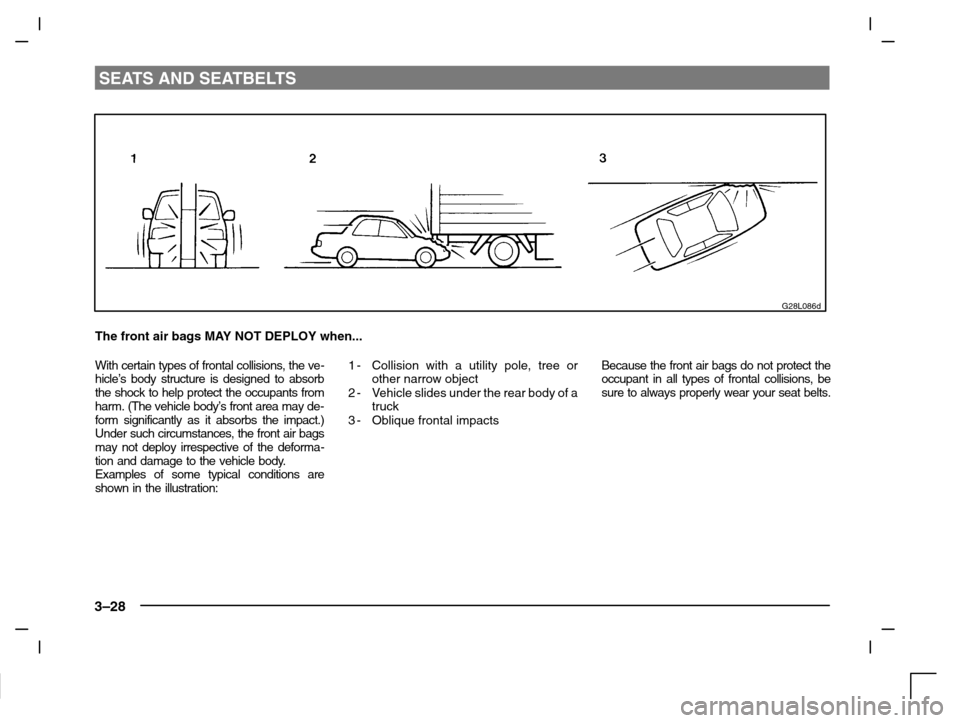
G28L086d
The front air bags MAY NOT DEPLOY when...
With certain types of frontal collisions, the ve-
hicle’s body structure is designed to absorb
the shock to help protect the occupants from
harm. (The vehicle body’s front area may de-
form significantly as it absorbs the impact.)
Under such circumstances, the front air bags
may not deploy irrespective of the deforma-
tion and damage to the vehicle body.
Examples of some typical conditions are
shown in the illustration:1-Collision with a utility pole, tree or
other narrow object
2-Vehicle slides under the rear body of a
truck
3-Oblique frontal impactsBecause the front air bags do not protect the
occupant in all types of frontal collisions, be
sure to always properly wear your seat belts.
Page 57 of 280
SEATS AND SEATBELTS
3–29
G28L087d
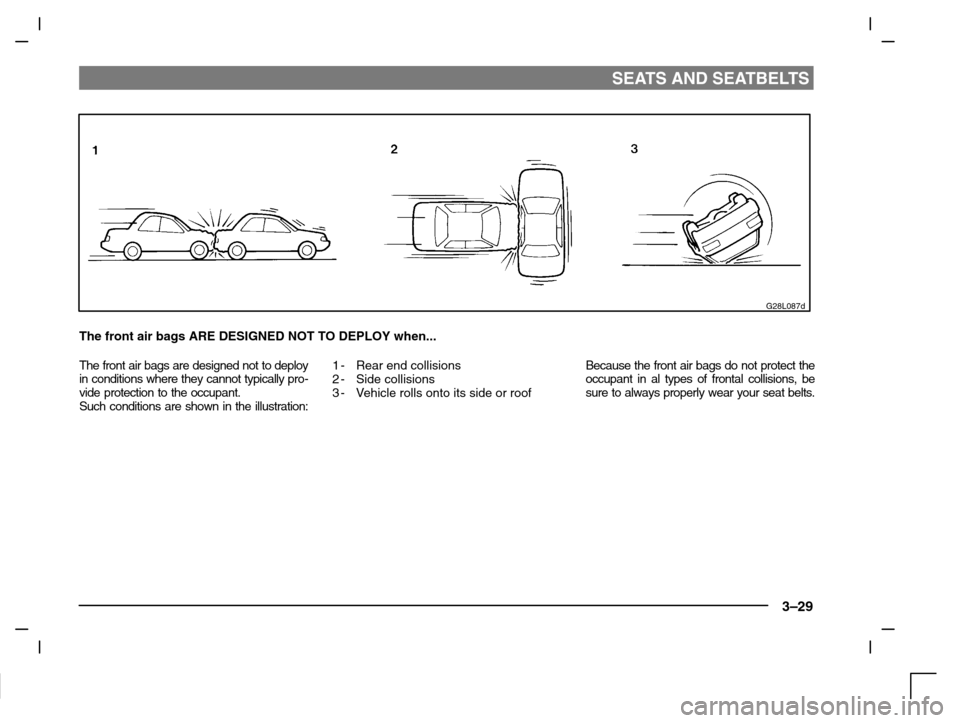
The front air bags ARE DESIGNED NOT TO DEPLOY when...
The front air bags are designed not to deploy
in conditions where they cannot typically pro-
vide protection to the occupant.
Such conditions are shown in the illustration:1-Rear end collisions
2-Side collisions
3-Vehicle rolls onto its side or roofBecause the front air bags do not protect the
occupant in al types of frontal collisions, be
sure to always properly wear your seat belts.
Page 58 of 280
SEATS AND SEATBELTS
3–30
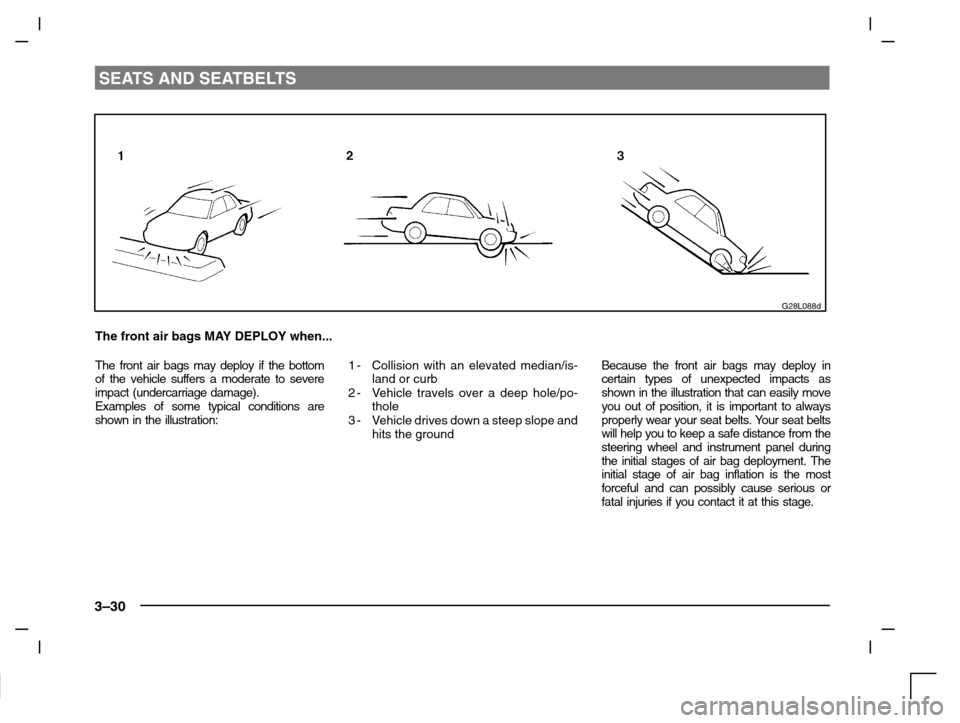
G28L088d
The front air bags MAY DEPLOY when...
The front air bags may deploy if the bottom
of the vehicle suffers a moderate to severe
impact (undercarriage damage).
Examples of some typical conditions are
shown in the illustration:1-Collision with an elevated median/is-
land or curb
2-Vehicle travels over a deep hole/po-
thole
3-Vehicle drives down a steep slope and
hits the groundBecause the front air bags may deploy in
certain types of unexpected impacts as
shown in the illustration that can easily move
you out of position, it is important to always
properly wear your seat belts. Your seat belts
will help you to keep a safe distance from the
steering wheel and instrument panel during
the initial stages of air bag deployment. The
initial stage of air bag inflation is the most
forceful and can possibly cause serious or
fatal injuries if you contact it at this stage.
Page 60 of 280
SEATS AND SEATBELTS
3–32
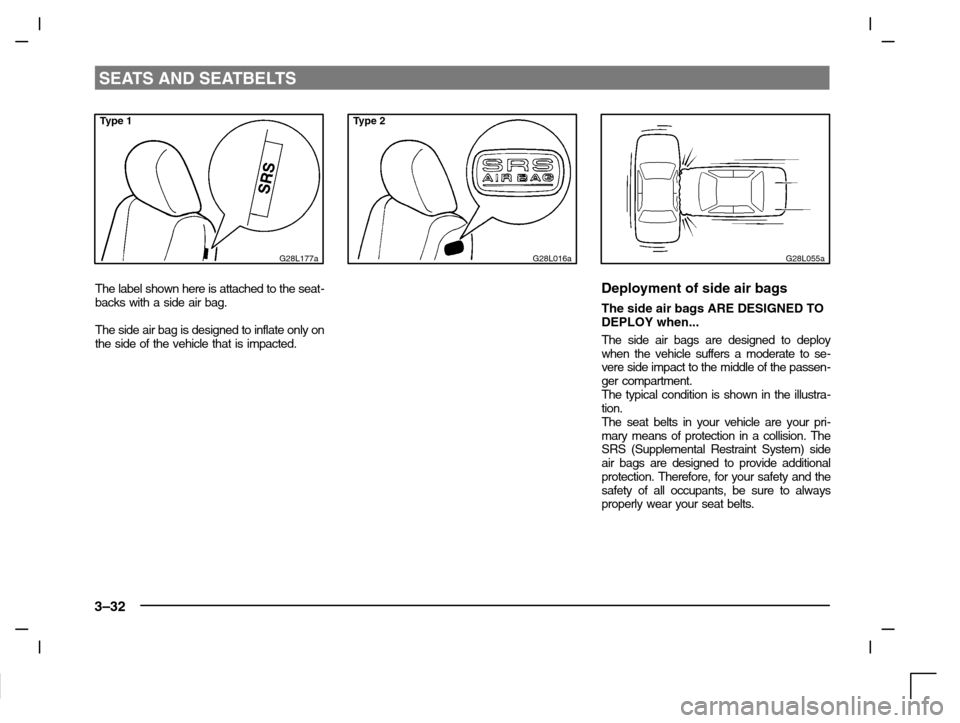
Type 1
G28L177a
The label shown here is attached to the seat-
backs with a side air bag.
The side air bag is designed to inflate only on
the side of the vehicle that is impacted.
Type 2
G28L016aG28L055a
Deployment of side air bags
The side air bags ARE DESIGNED TO
DEPLOY when...
The side air bags are designed to deploy
when the vehicle suffers a moderate to se-
vere side impact to the middle of the passen-
ger compartment.
The typical condition is shown in the illustra-
tion.
The seat belts in your vehicle are your pri-
mary means of protection in a collision. The
SRS (Supplemental Restraint System) side
air bags are designed to provide additional
protection. Therefore, for your safety and the
safety of all occupants, be sure to always
properly wear your seat belts.