Page 61 of 280
SEATS AND SEATBELTS
3–33
G28L089d
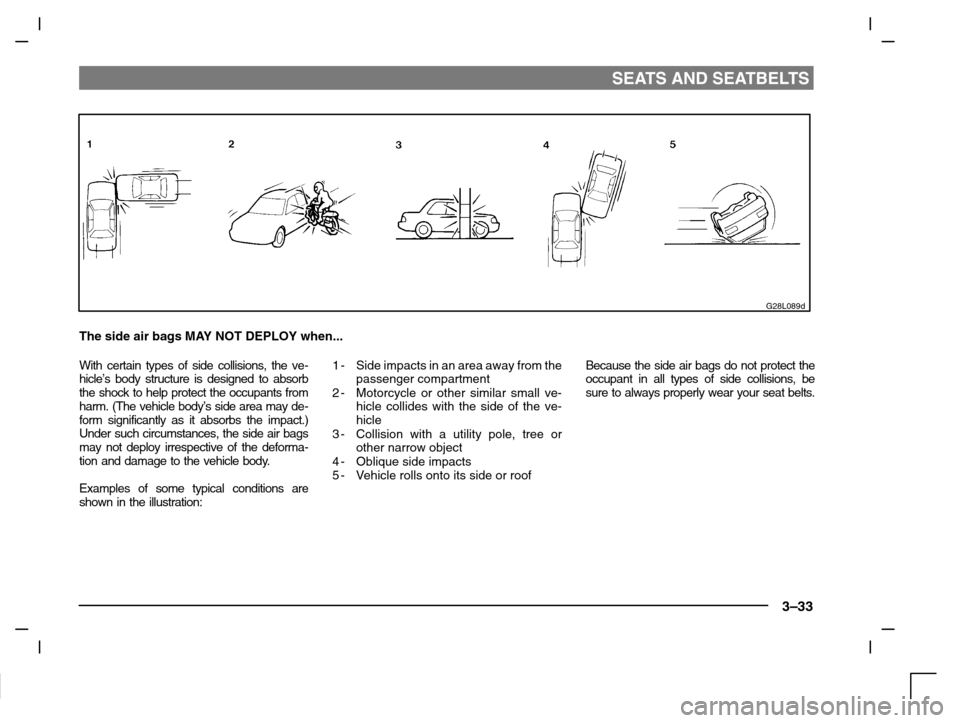
The side air bags MAY NOT DEPLOY when...
With certain types of side collisions, the ve-
hicle’s body structure is designed to absorb
the shock to help protect the occupants from
harm. (The vehicle body’s side area may de-
form significantly as it absorbs the impact.)
Under such circumstances, the side air bags
may not deploy irrespective of the deforma-
tion and damage to the vehicle body.
Examples of some typical conditions are
shown in the illustration:1-Side impacts in an area away from the
passenger compartment
2-Motorcycle or other similar small ve-
hicle collides with the side of the ve-
hicle
3-Collision with a utility pole, tree or
other narrow object
4-Oblique side impacts
5-Vehicle rolls onto its side or roofBecause the side air bags do not protect the
occupant in all types of side collisions, be
sure to always properly wear your seat belts.
Page 62 of 280
SEATS AND SEATBELTS
3–34
G28L090d
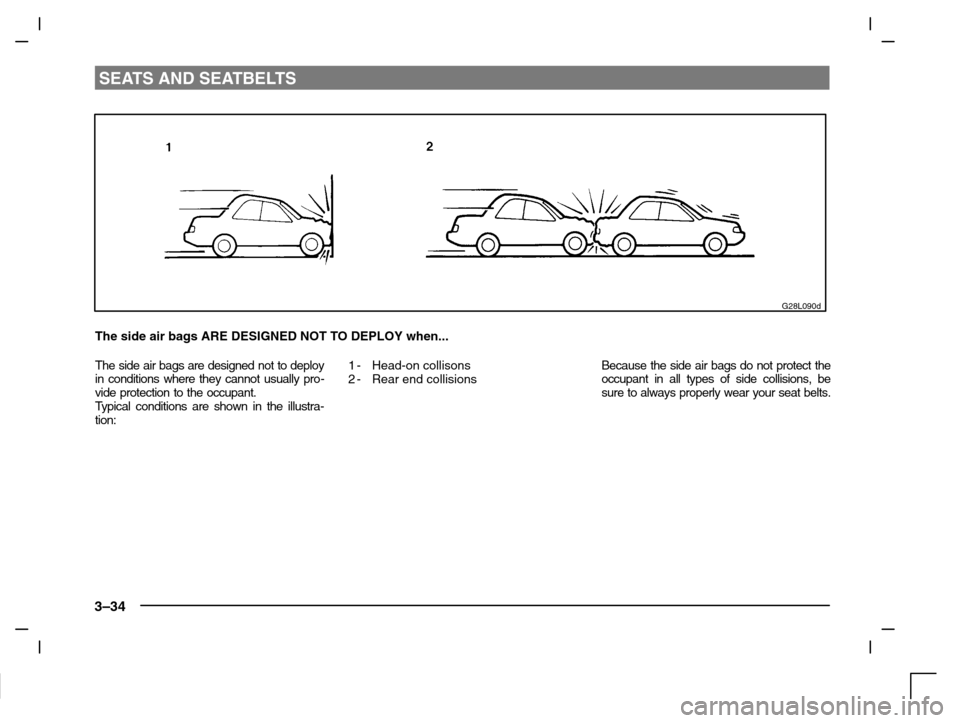
The side air bags ARE DESIGNED NOT TO DEPLOY when...
The side air bags are designed not to deploy
in conditions where they cannot usually pro-
vide protection to the occupant.
Typical conditions are shown in the illustra-
tion:1-Head-on collisons
2-Rear end collisionsBecause the side air bags do not protect the
occupant in all types of side collisions, be
sure to always properly wear your seat belts.
Page 65 of 280
SEATS AND SEATBELTS
3–37
WARNING
If any of the following conditions
occur, the SRS is not working proper-
ly and you should immediately have it
inspected by an authorized MITSUBI-
SHI dealer.
�The SRS warning lamp does not
illuminate when you start the ve-
hicle.
�The SRS warning lamp does not
go out after several seconds.
�The SRS warning lamp illumi-
nates while driving.
SRS servicingEG29G-A
The entire SRS including air bag and pre-
tensioner seat belt must be inspected by an
authorized MITSUBISHI dealer after
10 years.
WARNING
(1) Any maintenance performed on
or near the components of the
SRS must be performed only by
an authorized MITSUBISHI
dealer. Do not permit anyone else
to do service, inspection, main-
tenance or repair on any SRS
components or wiring; similarly,
no part of the SRS should ever be
handled or disposed of by any-
one except an authorized MITSU-
BISHI dealer.
Improper work on the SRS com-
ponents or wiring could result in
inadvertent deployment of the air
bags or could render the SRS in-
operative; either situation could
result in serious injury.
WARNING
(2) Do not modify your steering
wheel, seat belt retractor or any
other SRS components. For
example, replacement of the
steering wheel or modifications
to the front bumper or body struc-
ture can adversely affect SRS
performance and lead to possible
injury.
(3) If your vehicle has received any
front-end damage, you should
have the SRS inspected by an
authorized MITSUBISHI dealer to
ensure it is in proper working
order.
(4) On vehicles with the side air
bags, do not modify your front
seats, centre pillar and centre
console.
It can adversely affect SRS per-
formance and lead to possible in-
jury.
Also, if you have found any tear or
open seam in the seat fabric at the
portion near the side air bag, have
the seat inspected at an author-
ized MITSUBISHI dealer.
Page 90 of 280

INSTRUMENTS AND CONTROLS
4–24
D92A015d
Multi centre displayED92A-Q
When the ignition switch is in the ”ACC” position, the outside tempera-
ture and clock are displayed in the multi centre display. When the igni-
tion switch is in the ”ON” position, the average fuel consumption is dis-
played besides outside temperature and digital clock.
If your vehicle is equipped with an automatic air conditioning system,
set temperature, blower speed and air flow are displayed. (Refer to
”Automatic air conditioning” on page 6–36.)
A- Outside temperature / Set temperature
*1
B-Blower speed*1
C- Air flow*1
D- Average fuel consumption*2
E- Digital clock
F-DISP button (For vehicles with a MITSUBISHI genuine audio)
G- Display brightness / display unit selection button
*1:Option*2:Average fuel consumption:
For vehicles without MITSUBISHI genuine audio, only average
fuel consumption is displayed.
For vehicles with MITSUBISHI genuine audio, driving range and
average speed can be displayed besides average fuel con-
sumption by pushing the DISP button in the audio unit.
NOTE
(1) The display unit (ex. km or mile) and brightness can be changed
as desired. (Refer to ”Display brightness adjustment/Display unit
selection” on page 4–31.) When the system cannot provide a
definite value for average fuel consumption/driving range/aver-
age speed, it is displayed as ”– – –”.
(2) The figure of the display varies according to the conditions under
which a vehicle is travelling (road conditions, the manner in which
the vehicle is being driven, etc.).
Observe display for reference because the figure of the display
may differ from the actual figure.
Page 107 of 280

STARTING AND DRIVING
5–7
(3)City traffic
Frequent starting and stopping in-
creases the average fuel consumption.
Use roads with smooth traffic flow
whenever possible. When driving on
congested roads, avoid use of a low
gear at high engine speeds.
(4) Idling
The vehicle consumes fuel even during
idling. Avoid extended idling whenever
possible.
(5)Speed
The higher the vehicle speed, the more
fuel consumed. Avoid driving at full
speed. Even a slight release of the ac-
celerator pedal will save a significant
amount of fuel.
(6)Tyre inflation pressure
Check the tyre inflation pressures at
regular intervals. Low tyre inflation pres-
sure increases road resistance and fuel
consumption. In addition, low tyre pres-
sures adversely affect tyre wear and
driving stability.(7)Load
Do not drive with unnecessary articles in
the luggage compartment. Especially
during city driving where frequent start-
ing and stopping is necessary, the in-
creased weight of the vehicle will greatly
affect fuel consumption. Also avoid driv-
ing with unnecessary luggage, etc., on
the roof; the increased air resistance will
increase fuel consumption.
(8)Cold engine starting
Starting of a cold engine consumes
more fuel.
Unnecessary fuel consumption is also
caused by keeping a hot engine run-
ning. After the engine is started, com-
mence driving as soon as possible.
(9)Air conditioning*
The use of the air conditioning will in-
crease the fuel consumption.Trailer towingEC21AMFg
In order to tow a trailer with your vehicle, a
trailer towing device that meets all relevant
regulations in your area has to be mounted.
The regulations concerning the towing of a
trailer may differ from country to country. You
are advised to obey the regulations in each
area.
CAUTION
Danger of accident!
A towing bar should be fitted by an
authorized MITSUBISHI dealer.
Page 123 of 280
STARTING AND DRIVING
5–23
I04S037a
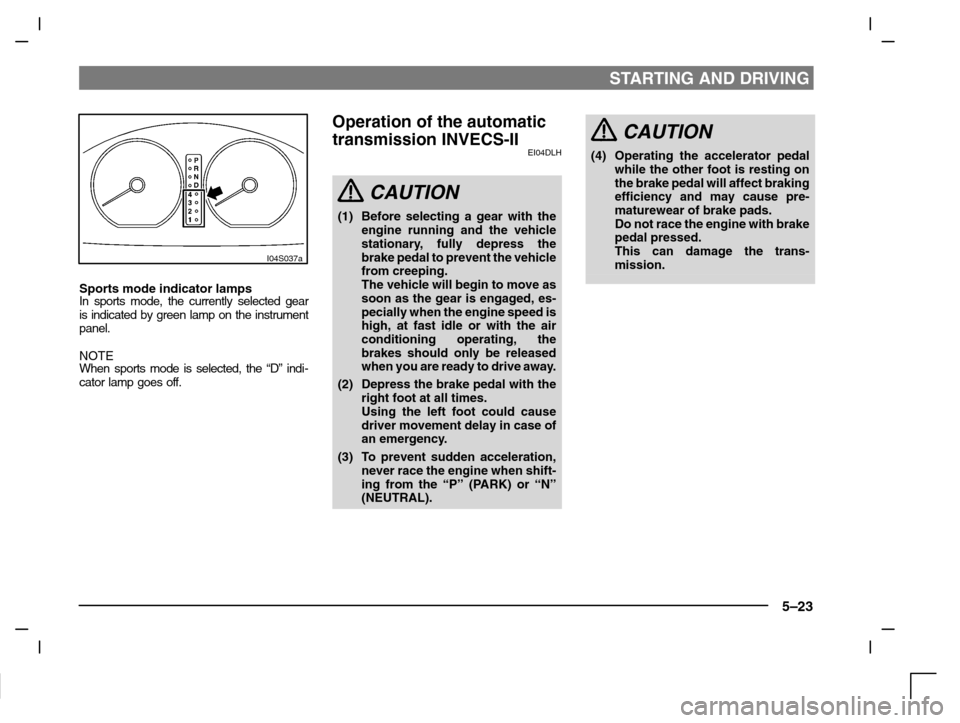
Sports mode indicator lampsIn sports mode, the currently selected gear
is indicated by green lamp on the instrument
panel.
NOTE
When sports mode is selected, the “D” indi-
cator lamp goes off.
Operation of the automatic
transmission INVECS-II
EI04DLH
CAUTION
(1) Before selecting a gear with the
engine running and the vehicle
stationary, fully depress the
brake pedal to prevent the vehicle
from creeping.
The vehicle will begin to move as
soon as the gear is engaged, es-
pecially when the engine speed is
high, at fast idle or with the air
conditioning operating, the
brakes should only be released
when you are ready to drive away.
(2) Depress the brake pedal with the
right foot at all times.
Using the left foot could cause
driver movement delay in case of
an emergency.
(3) To prevent sudden acceleration,
never race the engine when shift-
ing from the “P” (PARK) or “N”
(NEUTRAL).
CAUTION
(4) Operating the accelerator pedal
while the other foot is resting on
the brake pedal will affect braking
efficiency and may cause pre-
maturewear of brake pads.
Do not race the engine with brake
pedal pressed.
This can damage the trans-
mission.
Page 141 of 280
For pleasant driving
UKW/MW/LW electronic tuning radio with
tape player* 6–2. . . . . . . . . . . . . . . . . . . . . . . . . . . . . .
UKW/MW/LW electronic tuning radio with
CD player* 6–15. . . . . . . . . . . . . . . . . . . . . . . . . . . . . . .
Audio system anti-theft feature 6–26. . . . . . . . . . . .
Roof antenna 6–29. . . . . . . . . . . . . . . . . . . . . . . . . . . .
Ventilators 6–29. . . . . . . . . . . . . . . . . . . . . . . . . . . . . . .
Heater/Manual air conditioning* 6–30. . . . . . . . . . . .
Automatic air conditioning* 6–36. . . . . . . . . . . . . . .
Sun visors 6–44. . . . . . . . . . . . . . . . . . . . . . . . . . . . . .
Vanity mirror 6–45. . . . . . . . . . . . . . . . . . . . . . . . . . . . .
Cigarette lighter 6–45. . . . . . . . . . . . . . . . . . . . . . . . . .
Ashtray 6–46. . . . . . . . . . . . . . . . . . . . . . . . . . . . . . . . .
Accessory boxes 6–47. . . . . . . . . . . . . . . . . . . . . . . .
Sunglasses pocket 6–48. . . . . . . . . . . . . . . . . . . . . . .
Rear shelf panel (Hatchback) 6–49. . . . . . . . . . . . . .
Installation position for first–aid kit 6–50. . . . . . . . .
Cargo net* 6–51. . . . . . . . . . . . . . . . . . . . . . . . . . . . . . .
Page 170 of 280
FOR PLEASANT DRIVING
6–30
Side
H16A063a
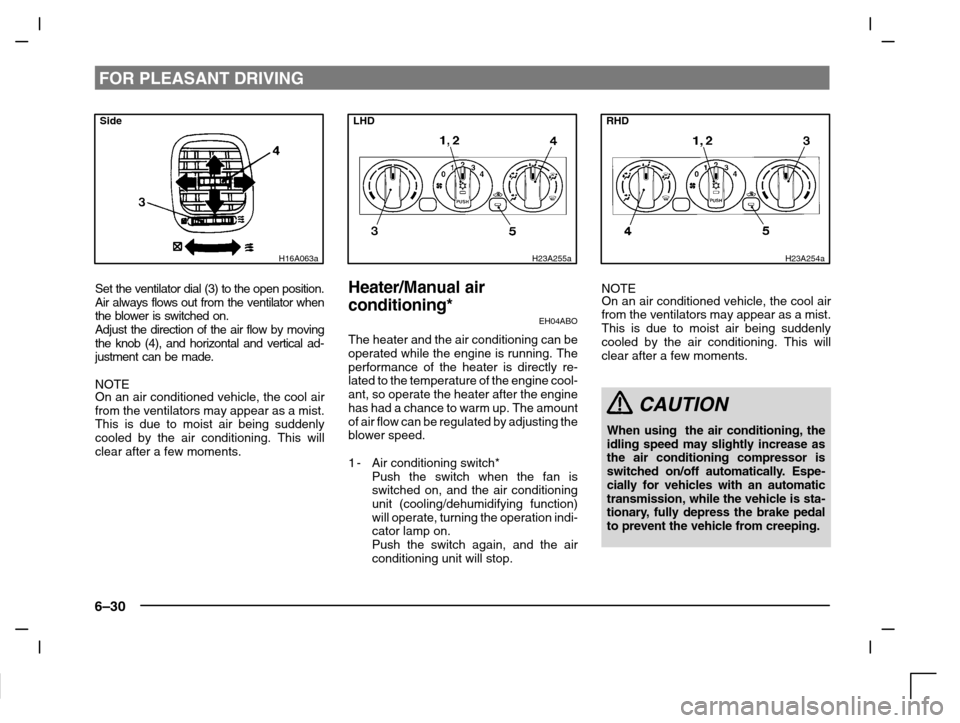
Set the ventilator dial (3) to the open position.
Air always flows out from the ventilator when
the blower is switched on.
Adjust the direction of the air flow by moving
the knob (4), and horizontal and vertical ad-
justment can be made.
NOTE
On an air conditioned vehicle, the cool air
from the ventilators may appear as a mist.
This is due to moist air being suddenly
cooled by the air conditioning. This will
clear after a few moments.
LHD
H23A255a
Heater/Manual air
conditioning*
EH04ABO
The heater and the air conditioning can be
operated while the engine is running. The
performance of the heater is directly re-
lated to the temperature of the engine cool-
ant, so operate the heater after the engine
has had a chance to warm up. The amount
of air flow can be regulated by adjusting the
blower speed.
1-Air conditioning switch*
Push the switch when the fan is
switched on, and the air conditioning
unit (cooling/dehumidifying function)
will operate, turning the operation indi-
cator lamp on.
Push the switch again, and the air
conditioning unit will stop.
RHD
H23A254a
NOTE
On an air conditioned vehicle, the cool air
from the ventilators may appear as a mist.
This is due to moist air being suddenly
cooled by the air conditioning. This will
clear after a few moments.
CAUTION
When using the air conditioning, the
idling speed may slightly increase as
the air conditioning compressor is
switched on/off automatically. Espe-
cially for vehicles with an automatic
transmission, while the vehicle is sta-
tionary, fully depress the brake pedal
to prevent the vehicle from creeping.