Page 206 of 280

FOR EMERGENCIES
8–6
N22A086a
7. Insert the bar (E) into the wheel nut
wrench (F). Then set the end of the bar
to the shaft’s jack end, as shown in the
illustration.
Slowly rotate the wheel nut wrench
until the tyre is slightly off the ground.
WARNING
(1) Raise the vehicle so the tyre just
clears the ground. It is dangerous
to raise the vehicle any higher.
(2) Never get under the vehicle while
using the jack. Avoid jarring the
raised vehicle or leaving it sup-
ported on the jack for any long
time. Both are very dangerous.
(3) Do not start or run the engine
while the vehicle is on the jack.
The vehicle might start moving
and the jack might get out of the
body.
(4) Do not turn the jacked up wheels.
The tyres remaining on the
ground may turn, causing the ve-
hicle body to fall down from the
jack.
(5) No one should stay in the vehicle
while the jack is used.
CAUTION
Use only the jack included with the
vehicle, and use it only for changing
wheels.
N03A064a
Spare wheelEN03ABBaCheck the air pressure in the spare tyre
weekly, making sure it is ready for emerg-
ency use. Maintaining the spare wheel at the
highest specified air pressure will ensure that
it can always be used under any conditions
(city/high–speed driving, varying load
weight, etc.).
WARNING
When used, set to the correct tyre
pressure.
Page 209 of 280
FOR EMERGENCIES
8–9
N23B083a
To install
Align the tyre valve with the valve opening
provided on the wheel cover.
Then tap around the outer edge of the
wheel cover with your hand to secure it in
place.
NOTE
Full wheel covers have a symbol mark pro-
vided on the reverse side to show the air
valve location.
Before installing the wheel cover to the
wheel, make sure that the opening with the
symbol mark is correctly aligned with the
air valve.
If a tyre is puncturedEN24AIDd
If a tyre must be changed due to a puncture,
do so only after first following every precau-
tion for safety: parking the vehicle in a place
where it is not a traffic hazard or dangerous
to you and your vehicle’s occupants, on a flat
surface.
1. Comply with local regulations con-
cerning the protection of broken-down
vehicle by switching on the hazard
warning flashers, setting up a warning
triangle, flashing signal lamp, etc., at
an adequate distance from the ve-
hicle. Have all passengers leave the
vehicle.
N22A220a
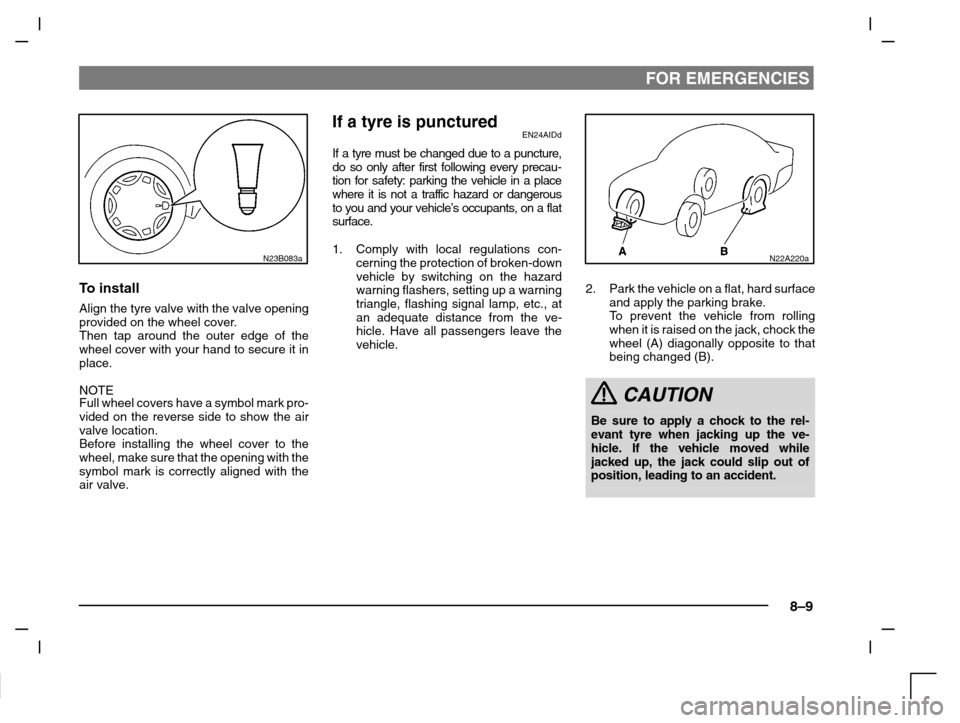
2. Park the vehicle on a flat, hard surface
and apply the parking brake.
To prevent the vehicle from rolling
when it is raised on the jack, chock the
wheel (A) diagonally opposite to that
being changed (B).
CAUTION
Be sure to apply a chock to the rel-
evant tyre when jacking up the ve-
hicle. If the vehicle moved while
jacked up, the jack could slip out of
position, leading to an accident.
Page 213 of 280

FOR EMERGENCIES
8–13
Front
N25A200a
Towing with a rope
1. For vehicles with automatic transmis-
sion check the automatic transmis-
sion fluid level. (Refer to “Automatic
transmission fluid” on page 9–4.)
If the fluid level is low, transport the ve-
hicle with all wheels off the ground.
CAUTION
If the vehicle is out of automatic trans-
mission fluid, the transmission could
be damaged.
2. The towing hooks (A) are located as
shown in the illustrations. Attach the
tow rope to the towing hooks.
Rear
N25A057a
NOTE
(1) Using any part other than the desig-
nated towing hooks (A) could result in
damage to vehicle body.
(2) Use care that the towing rope is kept as
horizontal as possible.
An angled towing rope can damage the
vehicle body.
(3) Never attempt to tow out a ditched ve-
hicle because the towing rope cannot
be kept horizontal.
3. Turn the ignition switch to the “ACC” or
“ON” position to unlock the steering
wheel.
CAUTION
(1) As the engine is not running, the
brake booster and power steer-
ing pump do not operate. This
means higher brake depression
force and higher steering effort
are required. Therefore vehicle
operation is more difficult than
usual.
(2) Do not leave the key in the
“LOCK” position. If the key is re-
moved while driving, the steering
will be locked causing loss of
control.
4. Turn on the hazard warning lamps.
5. Move the gearshift lever (manual
transmission) or the selector lever (au-
tomatic transmission) to Neutral or the
“N” position.
6. During towing make sure that close
contact is maintained between the
drivers of both vehicles, and that the
vehicles travel at low speed. Avoid
abrupt starting or stopping which
might subject the vehicles to shock.
Page 214 of 280
FOR EMERGENCIES
8–14
WARNING
Avoid sudden braking, sudden accel-
eration and sharp turning; such op-
eration could cause damage to the
towing hooks or the tow rope.
People in the vicinity could be injured
as a result.
CAUTION
When going down a long slope, the
brakes may overheat, reducting ef-
fectiveness. Have your vehicle towed
on a trailer.
NOTE
(1) Be sure the towing speed is within the
legal limit. In addition, if the vehicle is
equipped with an automatic transmis-
sion, make sure that the towing speed
and distance given below are never
exceeded.
Towing speed: 50 km/h
To w i n g d i s tance: 30 km
(2) When the front tow hook is used, be
very careful so that the rope does not
cause damage to the body.
(3) To prevent entry of exhaust gas from the
towing vehicle, set the air selection lever
to the recirculation position.
(4) Your vehicle should only be used to tow
another vehicle if the weight of the other
vehicle is less than your vehicle.
N25A261g
Page 216 of 280
FOR EMERGENCIES
8–16
Petrol-powered vehicles
N26A032a
2. With the engine still running, raise the
bonnet to ventilate the engine com-
partment.
A- Radiator fan
B- Radiator cap
C- Reserve tank
NOTE
Confirm that the radiator fan is turning. If the
fan is not turning, stop the engine immediate-
ly and contact an authorized MITSUBISHI
dealer for assistance.
Diesel-powered vehicles
N26A174a
WARNING
(1) Remember under the bonnet,
there can be boiling water gush-
ing out or support bar could be
burning hot. If the bonnet is
opened suddenly, you could get
burnt.
(2) Be careful of hot steam which
could be blowing off the reserve
tank cap.
(3) Do not attempt to remove the radi-
ator cap while the engine is hot.
N26A033a
3. After the engine coolant temperature
has dropped to the normal tempera-
ture, stop the engine.
Page 217 of 280

FOR EMERGENCIES
8–17
Petrol-powered vehicles
N26A034a
4. Check the coolant level in the reserve
tank. If there is none, make sure that
the engine has cooled down before re-
moving the radiator cap, because hot
steam or boiling water otherwise will
gush from the filler port and may scald
you.
5. Add coolant to the radiator and/or re-
serve tank if necessary (refer to the
“Maintenance” section).
CAUTION
Adding cold water rapidly when the
engine is hot could cause the cylinder
head and/or block to crack, add the
water a little at a time while running
the engine.
Diesel-powered vehicles
N26A160a
6. Examine the radiator hoses for cool-
ant leakage and the fan belts for
looseness or damage.
If there is anything wrong with the
cooling system or fan belt, have the
problem corrected at an authorized
MITSUBISHI dealer.
Emergency startingEN38A-Fe
If the engine cannot be started because the
battery is weak or dead, the battery from
another vehicle can be used with jumper
cables to start the engine.
WARNING
To start the engine by use of jumper
cables from another vehicle, perform
the correct procedures according to
the instruction manual. Incorrect pro-
cedures could result in a fire or ex-
plosion or damage to the vehicles.
1. Get the vehicles close enough so the
jumper cables can reach, but be sure
the vehicles are not touching each
other. If they are, it could cause a
ground connection you do not want.
The vehicle will not start, and the bad
grounding could damage the electri-
cal systems.
Page 218 of 280

FOR EMERGENCIES
8–18
CAUTION
Check the other vehicle. It must have
a 12-volt battery.
If the other system isn’t 12-volt, short-
ing can damage both vehicles.
2. You could be injured if the vehicles roll.
Set the parking brake firmly on each
vehicle. Put an automatic trans-
mission in “P” (PARK) or a manual
transmission in “N” (Neutral). Turn off
the ignition switch.
WARNING
Tu r n o f f t h e ignition on both vehicles
beforehand. Use care to make sure
that the cables or your clothes do not
get caught by the fan or drive belt.
Personal injury could result.
NOTE
Turn off all lamps, heater and other electrical
loads. This will avoid sparks and help save
both batteries.
3. Make sure battery electrolyte is at the
proper level.
Refer to “Battery” on page 9–7.
WARNING
If electrolyte fluid is not visible, or ap-
pears to be frozen, do not attempt
jump starting!
A battery might rupture or explode if
the temperature is below the freezing
point or if it is not filled to the proper
level.
Petrol-powered vehicles (1300 models)
N28A195a
4. Connect one end of one jumper cable
to the positive (+) terminal of the dis-
charged battery, and the other end to
the positive (+) terminal of the booster
battery.
5. Connect one end of the other jumper
cable to the negative (-) terminal of the
booster battery, and the other end to
the engine block of the vehicle with the
discharged battery at the point farthest
from the battery.
NOTE
Remove the cover before connecting the
jumper cable to the positive terminal of the
battery.
Page 219 of 280

FOR EMERGENCIES
8–19
Petrol-powered vehicles (1600 models)
N28A196a
WARNING
(1) Be sure to observe the connect-
ing sequence of 1 � 2 � 3 � 4.
(2) Make sure that the connection 4
is made to the appointed position
(shown in the illustration). If the
connection is made directly to the
negative side of the battery, the
flammable gases generated from
the battery might catch fire and
explode.
(3) When connecting the jumper
cable, do not connect the positive
(+) cable to the negative (-) ter-
minal. Otherwise sparks may
cause explosion of the battery.
Petrol-powered vehicles (1800 models)
N28A197a
WARNING
(4) When connecting the jumper
cable to the (-) terminal especially
in the 1800 models, do not touch
other parts with your hands, as
the engine compartment is hot
and burns could result.
Diesel-powered vehicles
N28A198a
CAUTION
(1) Use care not to get the jumper
cable caught in the cooling fan or
other rotating part in the engine
compartment.
(2) Use the proper cables suitable for
the battery size.
Otherwise heat damage to the
cables could result.
(3) Check the jumper cables for dam-
age and corrosion before use.
6. Start the engine in the vehicle which
has the booster battery, let the engine
idle a few minutes, then start the en-
gine in the vehicle with the discharged
battery.