Page 63 of 280
SEATS AND SEATBELTS
3–35
WARNING
(1) The side air bags are designed to
supplement the driver and front
passenger seat belts in certain
side impacts. Seat belts should
always be worn properly, and the
driver and front passenger
should sit well back and upright
without leaning against the win-
dow or door.
G28L029a
WARNING
(2) The side air bag inflates with
great force. The driver and front
passenger should not put their
arms out the window and should
not lean against the door, in order
to reduce risk of serious or poss-
ible fatal injury from a deploying
side air bag.
(3) Do not allow any rear seat occu-
pant to hold onto the seatback of
either front seat, in order to re-
duce risk of injury from a deploy-
ing side air bag. Special care
should be taken with children.
WARNING
(4) Do not place any objects near or
in front of the seatback of either
front seat. They could interfere
with proper side air bag inflation
and also could cause injury if
thrown free by side air bag de-
ployment.
(5) Do not place stickers, labels or
additional trim on the seatback of
either front seat. They could inter-
fere with proper side air bag infla-
tion.
(6) Do not install seat covers on
seats with side air bags. Do not
re-cover the seats with side air
bags. They could interfere with
proper side air bag inflation.
Page 64 of 280

SEATS AND SEATBELTS
3–36
WARNING
(7) Never install a rear-facing child
restraint in the front passenger
seat. A forward-facing child re-
straint should be used in the rear
seat only, whenever possible. If a
forward-facing child restraint
must be used in the front passen-
ger seat, adjust the seat to the
fully backward position and take
care to ensure that the child stays
in the child restraint and away
from the door.
Do not allow the child to lean
against or close to the front door
even if the child is seated in a
child restraint system.
The child’s head should also not
be leaned against or be close to
the area of the seat where the side
air bag is located. It is dangerous
if the side air bag inflates.
Failure to follow all of these in-
structions could lead to serious
or fatal injury to the child.
WARNING
(8) Work around and on the side air
bag system components should
only be done by an authorized
MITSUBISHI dealer. Improper
work could result in inadvertent
deployment of a side air bag or
could render a side air bag inop-
erative; either situation could re-
sult in serious injury.
G28G153a
SRS warning lampEG29F-Ac
There is a supplemental restraint system
(“SRS”) warning lamp on the instrument
panel. The system checks itself and the
lamp tells you if there is a problem. When the
ignition key is turned to the “ON” or “START”
position, the warning lamp should illuminate
for several seconds and then should go out.
This means the system is ready.
The SRS warning lamp is shared by the fol-
lowing:
�Driver’s front air bag
�Front passenger’s front air bag
�Side air bags
�Seat belt pre-tensioners
Page 65 of 280
SEATS AND SEATBELTS
3–37
WARNING
If any of the following conditions
occur, the SRS is not working proper-
ly and you should immediately have it
inspected by an authorized MITSUBI-
SHI dealer.
�The SRS warning lamp does not
illuminate when you start the ve-
hicle.
�The SRS warning lamp does not
go out after several seconds.
�The SRS warning lamp illumi-
nates while driving.
SRS servicingEG29G-A
The entire SRS including air bag and pre-
tensioner seat belt must be inspected by an
authorized MITSUBISHI dealer after
10 years.
WARNING
(1) Any maintenance performed on
or near the components of the
SRS must be performed only by
an authorized MITSUBISHI
dealer. Do not permit anyone else
to do service, inspection, main-
tenance or repair on any SRS
components or wiring; similarly,
no part of the SRS should ever be
handled or disposed of by any-
one except an authorized MITSU-
BISHI dealer.
Improper work on the SRS com-
ponents or wiring could result in
inadvertent deployment of the air
bags or could render the SRS in-
operative; either situation could
result in serious injury.
WARNING
(2) Do not modify your steering
wheel, seat belt retractor or any
other SRS components. For
example, replacement of the
steering wheel or modifications
to the front bumper or body struc-
ture can adversely affect SRS
performance and lead to possible
injury.
(3) If your vehicle has received any
front-end damage, you should
have the SRS inspected by an
authorized MITSUBISHI dealer to
ensure it is in proper working
order.
(4) On vehicles with the side air
bags, do not modify your front
seats, centre pillar and centre
console.
It can adversely affect SRS per-
formance and lead to possible in-
jury.
Also, if you have found any tear or
open seam in the seat fabric at the
portion near the side air bag, have
the seat inspected at an author-
ized MITSUBISHI dealer.
Page 66 of 280
SEATS AND SEATBELTS
3–38
WARNING
(5) On vehicles with side air bags, if
your vehicle has received any
damage to either side, you should
have the SRS inspected by an
authorized MITSUBISHI dealer to
ensure it is in proper working
order.
NOTE
(1) When you transfer ownership of the ve-
hicle to some other person, we urge you
to alert the new owner that it is equipped
with the SRS and refer that owner to the
applicable section in this owner’s man-
ual.
(2) If you junk or scrap the vehicle, we urge
you to first take the vehicle to an author-
ized MITSUBISHI dealer so that the
SRS can be rendered safe.
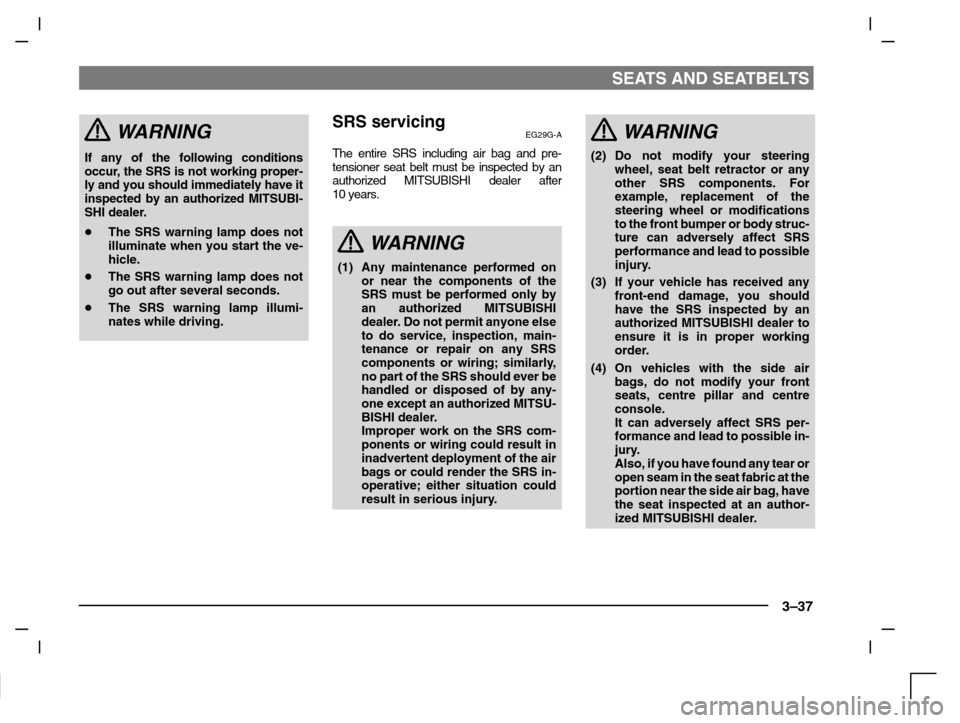
G28G062a
Caution labelEG29H-Aa
Passenger restraint warning/caution labels
are attached as shown in the illustration.
Page 67 of 280

Instruments and controls
Instruments 4–2. . . . . . . . . . . . . . . . . . . . . . . . . . . . . .
Speedometer 4–2. . . . . . . . . . . . . . . . . . . . . . . . . . . . .
Odometer/Tripmeter 4–3. . . . . . . . . . . . . . . . . . . . . . .
Tachometer 4–4. . . . . . . . . . . . . . . . . . . . . . . . . . . . . . .
Fuel gauge 4–4. . . . . . . . . . . . . . . . . . . . . . . . . . . . . . .
Water temperature gauge 4–5. . . . . . . . . . . . . . . . . .
Indication and warning lamps 4–6. . . . . . . . . . . . . .
Combination headlamps, dipper and turn
signal switch 4–12. . . . . . . . . . . . . . . . . . . . . . . . . . . .
Headlamp levelling switch 4–13. . . . . . . . . . . . . . . . .
Windscreen wiper and washer switch 4–15. . . . . .
Rear window wiper and washer switch
(Hatchback) 4–16. . . . . . . . . . . . . . . . . . . . . . . . . . . . .
Headlamp washer switch* 4–17. . . . . . . . . . . . . . . . .
Hazard warning flasher switch 4–18. . . . . . . . . . . . .
Rear window demister switch 4–19. . . . . . . . . . . . .
Front fog lamp switch* 4–20. . . . . . . . . . . . . . . . . . . .
Rear fog lamp switch 4–21. . . . . . . . . . . . . . . . . . . . .
Rheostat
(meter illumination control) 4–21. . . . . . . . . . . . . . . .
Horn switch 4–22. . . . . . . . . . . . . . . . . . . . . . . . . . . . .
Room lamps 4–22. . . . . . . . . . . . . . . . . . . . . . . . . . . . .
Multi centre display 4–24. . . . . . . . . . . . . . . . . . . . . .
Digital clock 4–26. . . . . . . . . . . . . . . . . . . . . . . . . . . . .
Page 72 of 280

INSTRUMENTS AND CONTROLS
4–6
D50A532d
A: Petrol-powered vehicle
B: Diesel-powered vehicle
Indication and warning lampsED50AMFe1-Turn - signal indication lamps/Hazard warning lamps
2-Automatic transmission indication lamp
(vehicles with A/T only, “N” indicator lamp is used also as A/T
warning lamp.) � Page 5–18
3-High - beam indication lamp
4-Low fuel warning lamp
5-Front fog lamp indication lamp*
6-Rear fog lamp indication lamp
7-Door ajar warning lamp
8-ABS warning lamp*� Page 5–28
9-Brake warning lamp
10 -HOLD indication lamp (vehicle with automatic transmission IN-
VECS-II 4A/T only)� Page 5–20
11-Supplemental restraint (SRS) warning lamp � Page 3–36
12 -Oil pressure warning lamp13 -Charge warning lamp
14 -TCL indication lamp* � Page 5–34
15 -Check engine indication lamp
16 -Cruise control indication lamp*� Page 5–35
17 -Diesel preheat indication lamp
(diesel-powered vehicles only)
18 -Overheating warning lamp
(diesel-powered vehicles only)
NOTE
To find information concerning the indication or warning lamps
marked by the symbol “�Page xx”, refer to the specified pages. For
the other indication and warning lamps, refer to the subsequent
pages.
Page 73 of 280

INSTRUMENTS AND CONTROLS
4–7
Turn-signal indication lamps - greenED52A-Bb
These indication lamps blink on and off when a turn-
signal lamp is operating.
NOTE
If the blinking is too fast, the cause may be a faulty
turn-signal connection or a blown lamp bulb.
Hazard warning indication lamps - greenED30A-A
When the hazard warning lamp switch is pressed, all
turn-signal lamps will flash on and off continuously.
High-beam indication lamp - blueED51A-Aa
This indication lamp illuminates when the high beam
is used.
Low fuel indication lamp - amberED63AMEa
The indication lamp comes on when the fuel tank is
getting low. Refuel as soon as possible.
CAUTION
Do not drive with an extremely low fuel level,
running out of fuel could cause damage to the
catalytic converter.
NOTE
(1) On inclines or curves, due to the movement of
fuel in the tank, the low fuel indication lamp may
come on earlier than usual.
(2)When the engine on diesel–powered vehicles
fails to operate owing to running out of fuel, it
may sometimes be difficult to start after refuel-
ing. This is due to air entering the fuel system.
Therefore, air must be bled from the system.
(Refer to the page 8–21.)
Front fog lamp indication lamp* - greenED74B-A
This lamp illuminates while the front fog lamps are on.
Page 74 of 280

INSTRUMENTS AND CONTROLS
4–8
Rear fog lamp indication lamp - amber
ED74A-B
This lamp illuminates while the rear fog lamp is on.
Door-ajar warning lamp - redED56A-Ca
This lamp illuminates when a door or the tailgate is
either open or incompletely closed.
CAUTION
Before moving your vehicle, check that the
warning lamp is OFF.
Brake warning lamp - redED23AAKb
With the ignition switch “ON”, the brake warning lamp
illuminates under the following conditions:
(1) When the parking brake lever has been en-
gaged.
(2) When the brake fluid level in the reservoir falls to
a low level.
CAUTION
(1) In the situations listed below, brake per-
formance may be compromised, if brakes
are applied suddenly; consequently,
avoid driving at high speeds or applying
the brakes suddenly. Furthermore, the ve-
hicle should be brought to a stop in a safe
location and your nearest authorized MIT-
SUBISHI dealer should be contacted.
�The brake warning lamp does not il-
luminate when the parking brake is ap-
plied or does not turn off when the
parking brake is released.
�The brake warning lamp remains il-
luminated during driving.
(2) The vehicle should be brought to a halt in
the following manner when brake per-
formance has deteriorated.
�Depress the brake pedal harder than
usual.
�Should the brakes fail, use engine
braking to reduce your speed and
slowly pull the parking brake lever to
park your vehicle.
Depress the brake pedal to operate the
stop lamp (brake lamp) to alert the ve-
hicles behind you.