Page 31 of 280
SEATS AND SEATBELTS
3–3
CAUTION
(1) Make sure that the seat is ad-
justed by an adult.
If it is adjusted by a child, an unex-
pected accident might occur.
(2) Do not place a cushion or the like
between your back and the seat-
back while driving. The effective-
ness of the head restraints will be
reduced in the event of an acci-
dent.
(3) When sliding or reclining the seat
rearward, pay careful attention to
the rear seat passengers.
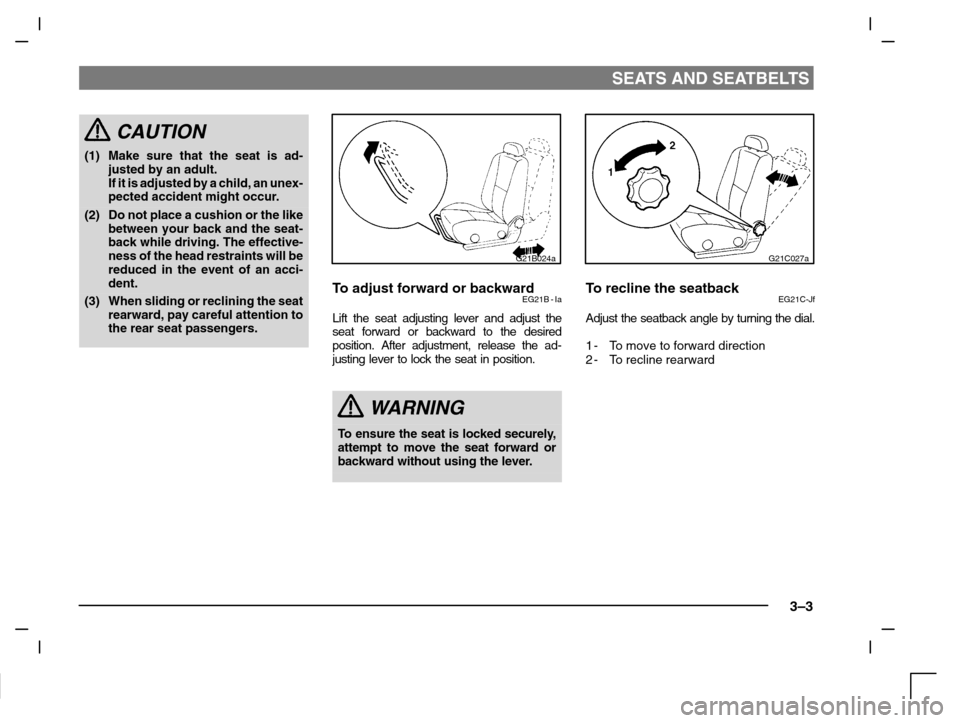
G21B024a
To adjust forward or backwardEG21B - Ia
Lift the seat adjusting lever and adjust the
seat forward or backward to the desired
position. After adjustment, release the ad-
justing lever to lock the seat in position.
WARNING
To e n s u r e the seat is locked securely,
attempt to move the seat forward or
backward without using the lever.
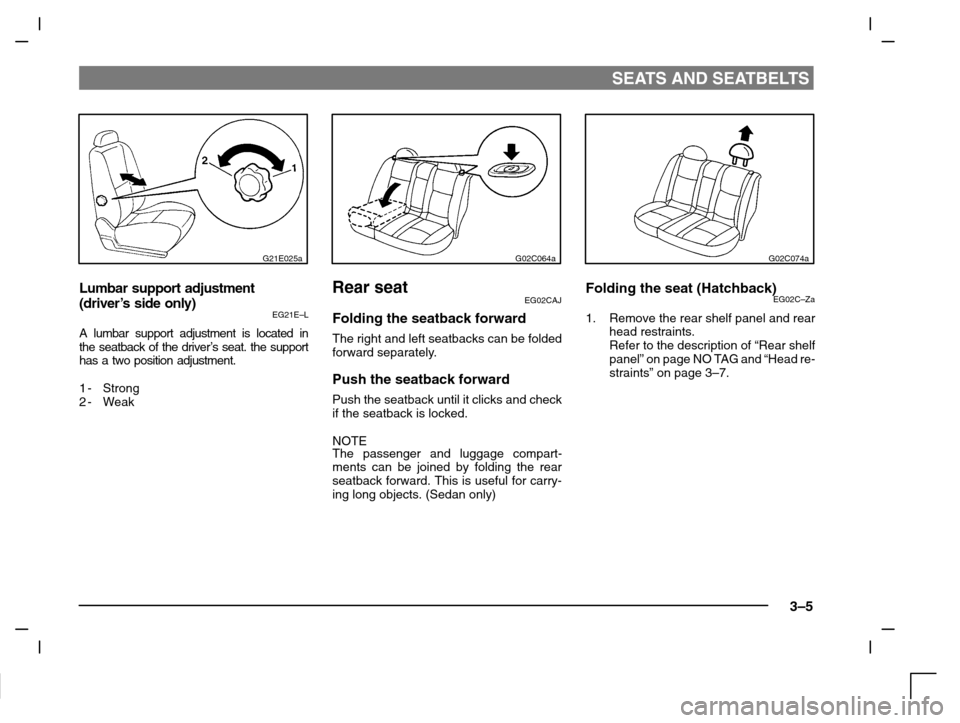
G21C027a
To recline the seatbackEG21C-Jf
Adjust the seatback angle by turning the dial.
1-To move to forward direction
2-To recline rearward
Page 33 of 280
SEATS AND SEATBELTS
3–5
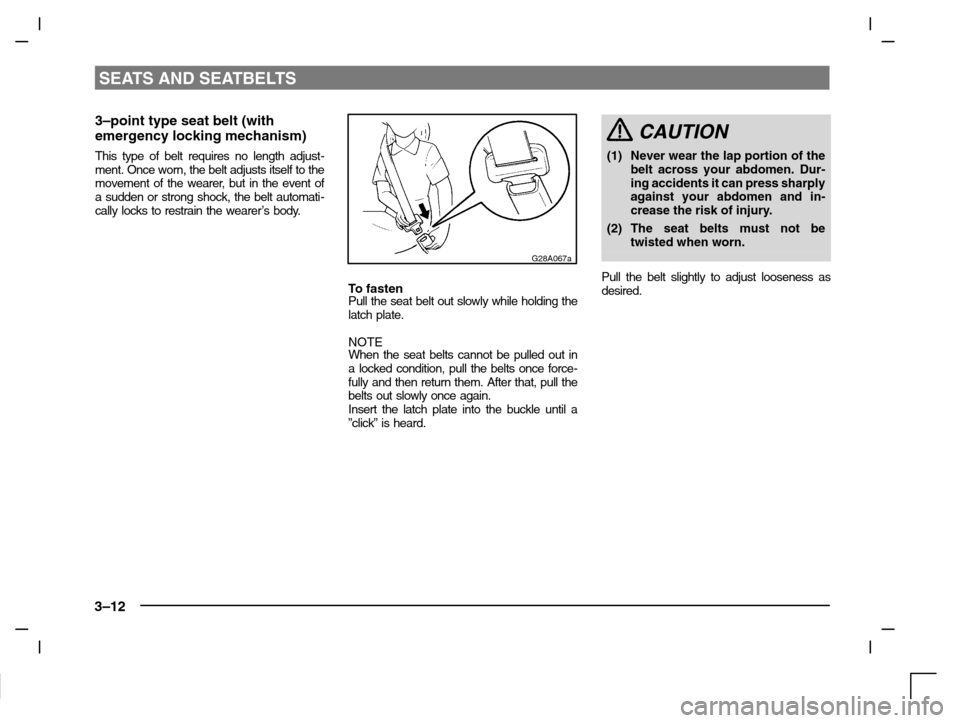
G21E025a
Lumbar support adjustment
(driver’s side only)
EG21E–L
A lumbar support adjustment is located in
the seatback of the driver’s seat. the support
has a two position adjustment.
1-Strong
2- Weak
G02C064a
Rear seatEG02CAJ
Folding the seatback forward
The right and left seatbacks can be folded
forward separately.
Push the seatback forward
Push the seatback until it clicks and check
if the seatback is locked.
NOTE
The passenger and luggage compart-
ments can be joined by folding the rear
seatback forward. This is useful for carry-
ing long objects. (Sedan only)
G02C074a
Folding the seat (Hatchback)EG02C–Za
1. Remove the rear shelf panel and rear
head restraints.
Refer to the description of “Rear shelf
panel” on page NO TAG and “Head re-
straints” on page 3–7.
Page 35 of 280

SEATS AND SEATBELTS
3–7
G02C066a
Anti-theft lockEG02D–Aa
The anti-theft lock is located on the top of the
rear seatback. The cylinder is operated with
the master key (A).
When the lock is in the “LOCK” position, the
seatback cannot be folded down by using
the seatback release button.
This feature is useful to help prevent theft
when the vehicle is parked in an exposed
area, because the “trunk through” feature
does not then apply.
The seatback can be folded down when the
lock is turned to the “FREE” position.
1-Lock
2-Free
At other times, leave the lock at the “FREE”
position.
Head restraintsEG26AAP
WARNING
(1) The head restraints can only pro-
tect you if they are correctly ad-
justed.
(2) A cushion or similar device
should not be placed on the seat-
back as it may increase the dis-
tance between your head and the
head restraint and reduce the ef-
fectiveness of the restraint.
G26A075a
Height adjustment
Adjust the head restraint height so that the
centre of the restraint is as close as possible
to eye level to reduce the chances of injury
in the event of collision. Any person too tall
for the restraint to reach their seated eye
level, should adjust the restraint as high as
possible.
To raise the head restraint, move it upward.
To l o w e r the restraint, move it downward
while pushing the height adjusting knob (A)
in the direction of the arrow. After adjustment,
push the head restraint downward and make
sure that it is locked.
Page 40 of 280
SEATS AND SEATBELTS
3–12
3–point type seat belt (with
emergency locking mechanism)
This type of belt requires no length adjust-
ment. Once worn, the belt adjusts itself to the
movement of the wearer, but in the event of
a sudden or strong shock, the belt automati-
cally locks to restrain the wearer’s body.
G28A067a
To fastenPull the seat belt out slowly while holding the
latch plate.
NOTE
When the seat belts cannot be pulled out in
a locked condition, pull the belts once force-
fully and then return them. After that, pull the
belts out slowly once again.
Insert the latch plate into the buckle until a
”click” is heard.
CAUTION
(1) Never wear the lap portion of the
belt across your abdomen. Dur-
ing accidents it can press sharply
against your abdomen and in-
crease the risk of injury.
(2) The seat belts must not be
twisted when worn.
Pull the belt slightly to adjust looseness as
desired.
Page 42 of 280
SEATS AND SEATBELTS
3–14
G28A112a
When the rear–centre three–point seat belt
is not being used, stow the tongues as
shown in the illustration.
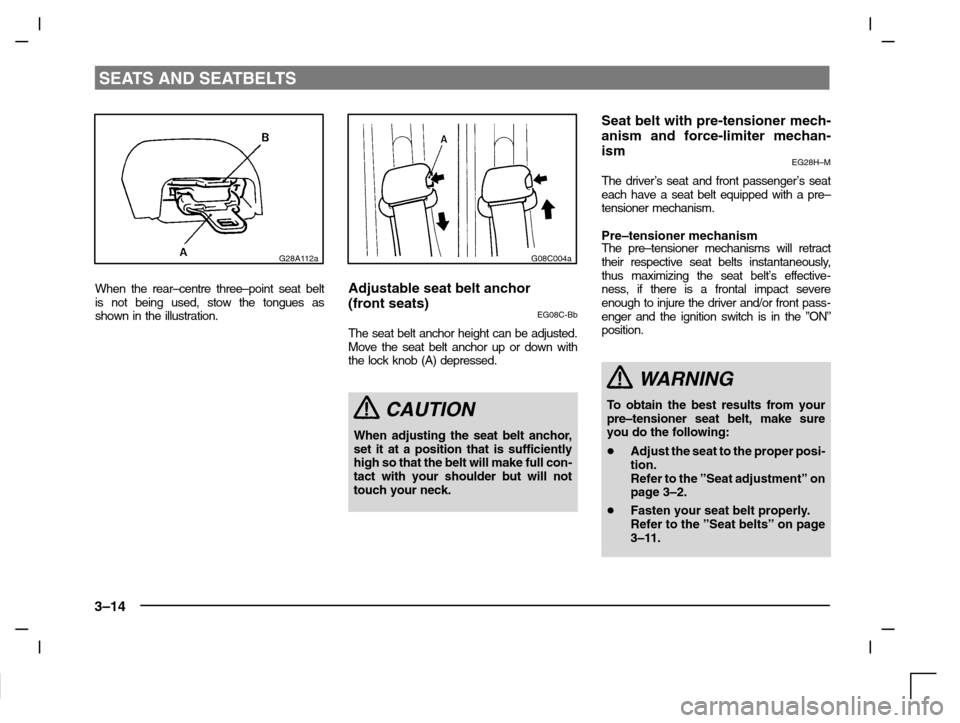
G08C004a
Adjustable seat belt anchor
(front seats)
EG08C-Bb
The seat belt anchor height can be adjusted.
Move the seat belt anchor up or down with
the lock knob (A) depressed.
CAUTION
When adjusting the seat belt anchor,
set it at a position that is sufficiently
high so that the belt will make full con-
tact with your shoulder but will not
touch your neck.
Seat belt with pre-tensioner mech-
anism and force-limiter mechan-
ism
EG28H–M
The driver’s seat and front passenger’s seat
each have a seat belt equipped with a pre–
tensioner mechanism.
Pre–tensioner mechanismThe pre–tensioner mechanisms will retract
their respective seat belts instantaneously,
thus maximizing the seat belt’s effective-
ness, if there is a frontal impact severe
enough to injure the driver and/or front pass-
enger and the ignition switch is in the ”ON”
position.
WARNING
To o btain the best results from your
pre–tensioner seat belt, make sure
you do the following:
�Adjust the seat to the proper posi-
tion.
Refer to the ”Seat adjustment” on
page 3–2.
�Fasten your seat belt properly.
Refer to the ”Seat belts” on page
3–11.
Page 47 of 280
SEATS AND SEATBELTS
3–19
G18C021a
Installing a child restraint system
to a 3-point type seat belt
(with emergency/automatic lock-
ing mechanism)
EG20D-A
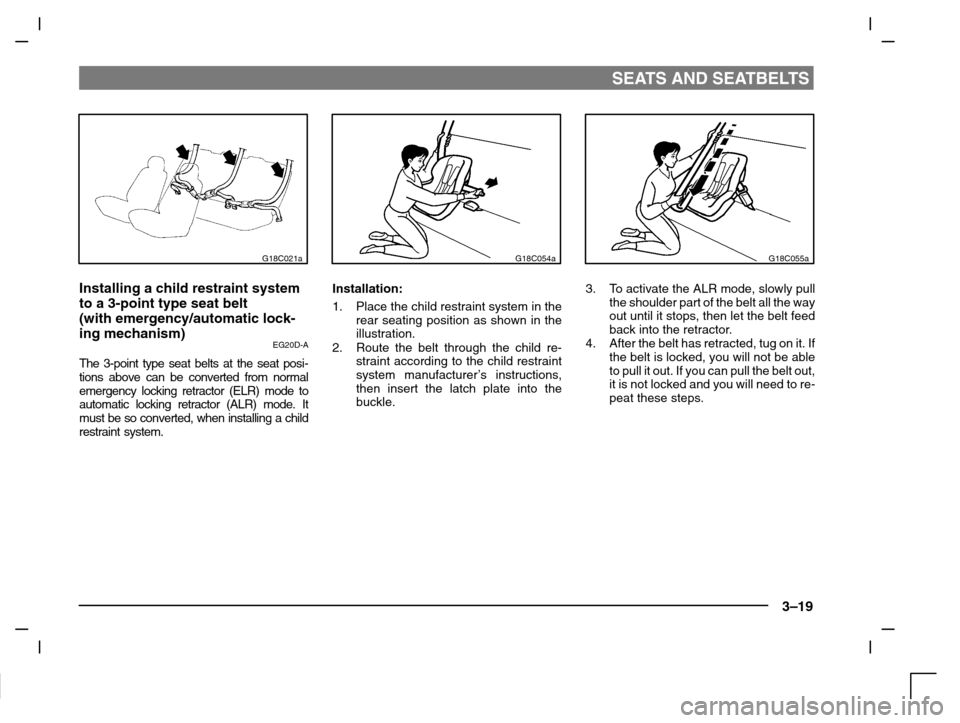
The 3-point type seat belts at the seat posi-
tions above can be converted from normal
emergency locking retractor (ELR) mode to
automatic locking retractor (ALR) mode. It
must be so converted, when installing a child
restraint system.
G18C054a
Installation:
1. Place the child restraint system in the
rear seating position as shown in the
illustration.
2. Route the belt through the child re-
straint according to the child restraint
system manufacturer’s instructions,
then insert the latch plate into the
buckle.
G18C055a
3. To activate the ALR mode, slowly pull
the shoulder part of the belt all the way
out until it stops, then let the belt feed
back into the retractor.
4. After the belt has retracted, tug on it. If
the belt is locked, you will not be able
to pull it out. If you can pull the belt out,
it is not locked and you will need to re-
peat these steps.
Page 48 of 280
SEATS AND SEATBELTS
3–20
G18C056a
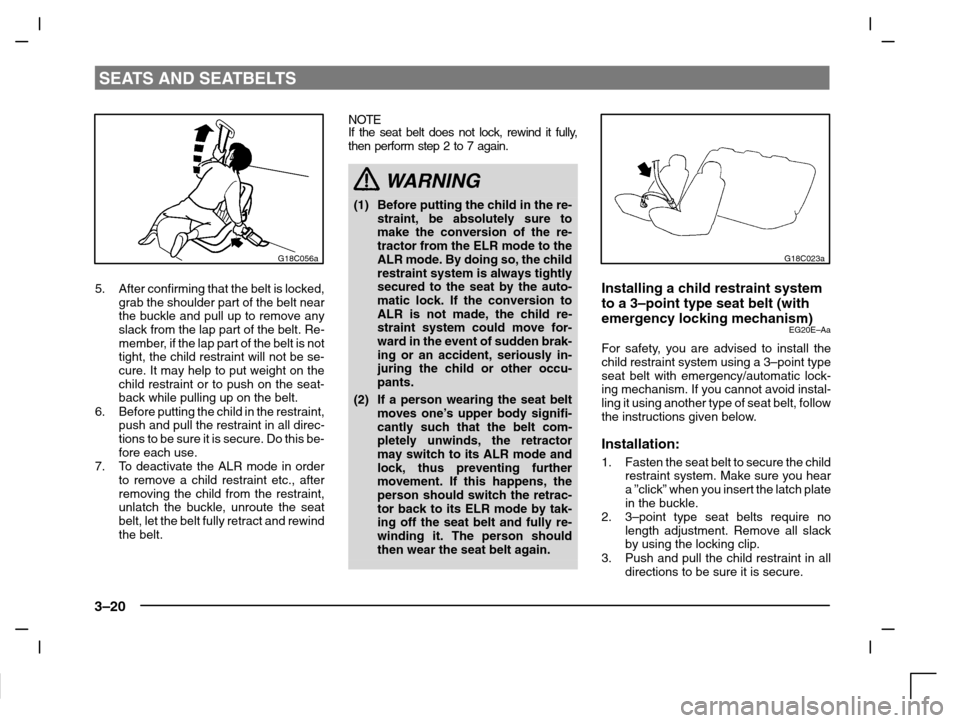
5. After confirming that the belt is locked,
grab the shoulder part of the belt near
the buckle and pull up to remove any
slack from the lap part of the belt. Re-
member, if the lap part of the belt is not
tight, the child restraint will not be se-
cure. It may help to put weight on the
child restraint or to push on the seat-
back while pulling up on the belt.
6. Before putting the child in the restraint,
push and pull the restraint in all direc-
tions to be sure it is secure. Do this be-
fore each use.
7. To deactivate the ALR mode in order
to remove a child restraint etc., after
removing the child from the restraint,
unlatch the buckle, unroute the seat
belt, let the belt fully retract and rewind
the belt.NOTE
If the seat belt does not lock, rewind it fully,
then perform step 2 to 7 again.
WARNING
(1) Before putting the child in the re-
straint, be absolutely sure to
make the conversion of the re-
tractor from the ELR mode to the
ALR mode. By doing so, the child
restraint system is always tightly
secured to the seat by the auto-
matic lock. If the conversion to
ALR is not made, the child re-
straint system could move for-
ward in the event of sudden brak-
ing or an accident, seriously in-
juring the child or other occu-
pants.
(2) If a person wearing the seat belt
moves one’s upper body signifi-
cantly such that the belt com-
pletely unwinds, the retractor
may switch to its ALR mode and
lock, thus preventing further
movement. If this happens, the
person should switch the retrac-
tor back to its ELR mode by tak-
ing off the seat belt and fully re-
winding it. The person should
then wear the seat belt again.
G18C023a
Installing a child restraint system
to a 3–point type seat belt (with
emergency locking mechanism)
EG20E–Aa
For safety, you are advised to install the
child restraint system using a 3–point type
seat belt with emergency/automatic lock-
ing mechanism. If you cannot avoid instal-
ling it using another type of seat belt, follow
the instructions given below.
Installation:
1. Fasten the seat belt to secure the child
restraint system. Make sure you hear
a ”click” when you insert the latch plate
in the buckle.
2. 3–point type seat belts require no
length adjustment. Remove all slack
by using the locking clip.
3. Push and pull the child restraint in all
directions to be sure it is secure.
Page 49 of 280
SEATS AND SEATBELTS
3–21
G28B059a
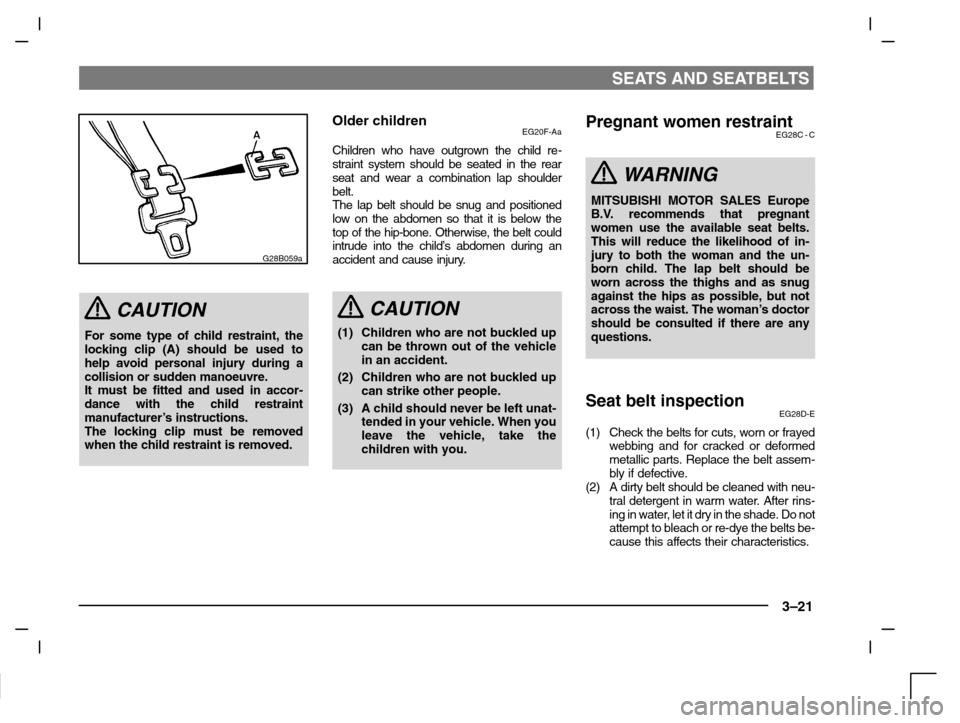
CAUTION
For some type of child restraint, the
locking clip (A) should be used to
help avoid personal injury during a
collision or sudden manoeuvre.
It must be fitted and used in accor-
dance with the child restraint
manufacturer’s instructions.
The locking clip must be removed
when the child restraint is removed.
Older childrenEG20F-Aa
Children who have outgrown the child re-
straint system should be seated in the rear
seat and wear a combination lap shoulder
belt.
The lap belt should be snug and positioned
low on the abdomen so that it is below the
top of the hip-bone. Otherwise, the belt could
intrude into the child’s abdomen during an
accident and cause injury.
CAUTION
(1) Children who are not buckled up
can be thrown out of the vehicle
in an accident.
(2) Children who are not buckled up
can strike other people.
(3) A child should never be left unat-
tended in your vehicle. When you
leave the vehicle, take the
children with you.
Pregnant women restraintEG28C - C
WARNING
MITSUBISHI MOTOR SALES Europe
B.V. recommends that pregnant
women use the available seat belts.
This will reduce the likelihood of in-
jury to both the woman and the un-
born child. The lap belt should be
worn across the thighs and as snug
against the hips as possible, but not
across the waist. The woman’s doctor
should be consulted if there are any
questions.
Seat belt inspectionEG28D-E
(1) Check the belts for cuts, worn or frayed
webbing and for cracked or deformed
metallic parts. Replace the belt assem-
bly if defective.
(2) A dirty belt should be cleaned with neu-
tral detergent in warm water. After rins-
ing in water, let it dry in the shade. Do not
attempt to bleach or re-dye the belts be-
cause this affects their characteristics.