Page 12 of 267
Doo
r Lock s
Keeping your doors locked
reduces the chance of being thrown out of the vehicle during
a crash. It also helps prevent
occupants from accidentally
opening a door and falling out, and outsiders from unexpectedly
opening your doors.
Pre-Driv e Safet y Checklis t
To make sure you and your
passengers get the maximum
protection from your vehicle's safety features, check the
following each time before you
drive away. All adults, and children who
have outgrown child safety seats, are wearing their seat
belts and wearing them
properly (see page 13). Any infant or small child is
properly restrained in a child seat in the back seat (see page
18).
Front seat occupants are sitting
upright and as far back as
possible from the steering wheel and dashboard (see page
10).
Seat-backs are upright (see
page 11).
Head restraints are properly
adjusted (see page 12).
All doors and the tailgate are closed and locked (see page
10).
All cargo is properly stored or secured (see page 171). The rest of this section gives more
detailed information about how
you can maximize your safety.
Remember, however, that no
safety system can prevent all
injuries or deaths that can occur in severe crashes, even when seat
belts are properly worn and the
airbags deploy.
Drive r an d Passenge r Safet y
Page 13 of 267
Protectin
g Adult s
Introductio n
The following pages provide instructions on how to properly
protect the driver and other adult
occupants.
These instructions also apply to children who have outgrown child
seats and are large enough to wear
lap/shoulder belts. (See page 33
for important additional
guidelines on how to properly
protect larger children.)
1 . Clos e an d Loc k th e Door s
After everyone has entered the
vehicle, be sure the doors and tailgate are closed and locked.
For safety, locking the doors
reduces the chance that a
passenger, especially a child, will open a door while the vehicle is
moving and accidentally fall out. It also reduces the chance of
someone being thrown out of the
vehicle during a crash.
For security, locked doors can
prevent an outsider from unexpectedly opening a door
when you come to a stop.
See page 100 for how to lock the
doors.
2
. Adjus t th e Fron t Seat s
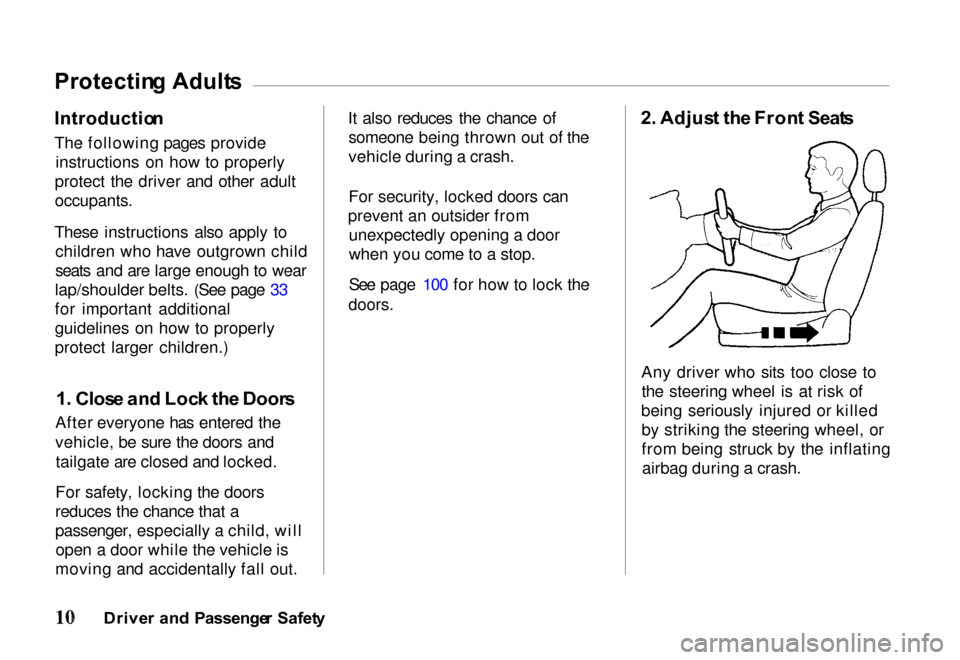
Any driver who sits too close to the steering wheel is at risk of
being seriously injured or killed by striking the steering wheel, or
from being struck by the inflatingairbag during a crash.
Drive r an d Passenge r Safet y
Page 47 of 267
Carbo
n Monoxid e Hazar d
Your vehicle's exhaust contains
carbon monoxide gas. You should
have no problem with carbon monoxide entering the vehicle in
normal driving if you maintain your vehicle properly. Have theexhaust system inspected for leaks
whenever:
The vehicle is raised for an oil
change.
You notice a change in the
sound of the exhaust.
The vehicle was in an accident that may have damaged the
underside. High levels of carbon monoxide
can collect rapidly in enclosed areas, such as a garage. Do not
run the engine with the garage door closed. Even with the door
open, run the engine only longenough to move the vehicle out of
the garage.
With the tailgate glass open, air
flow can pull exhaust gas into theinterior. This can create a
hazardous condition. If you must drive with the tailgate glass open,
open all the windows and set the
heating and cooling system asshown below.
If you must sit in your parked
vehicle, even in an unconfined
area, with the engine running, adjust the heating and cooling
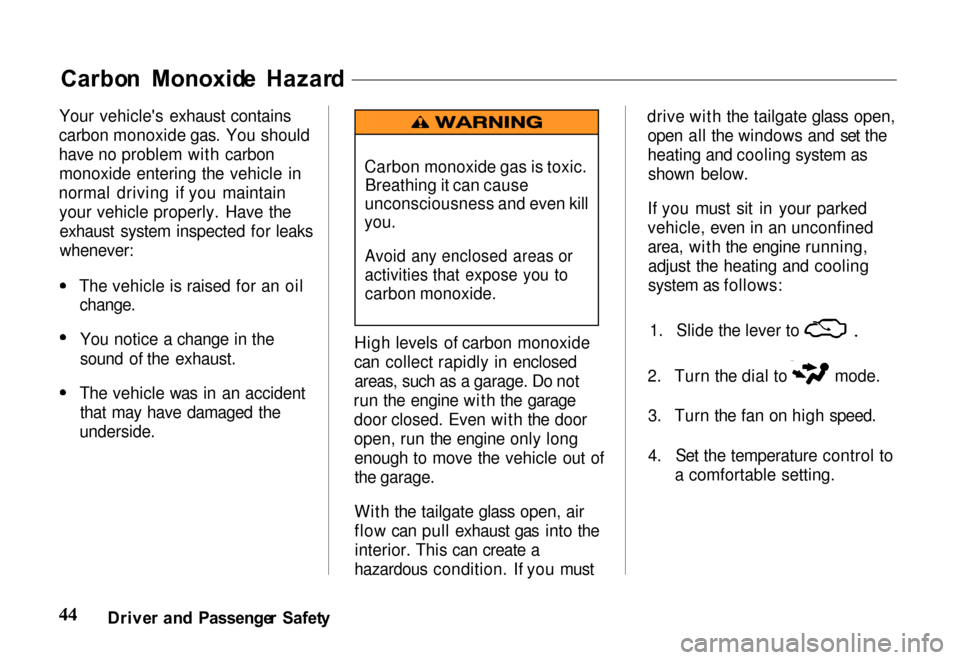
system as follows: 1. Slide the lever to
2. Turn the dial to mode.
3. Turn the fan on high speed.
4. Set the temperature control to a comfortable setting.
Driver an d Passenge r Safet y
Carbon monoxid
e gas is toxic.
Breathing it can cause
unconsciousness and even kill
you.
Avoid any enclosed areas or
activities that expose you to
carbon monoxide.
Page 98 of 267
Interio
r Feature s
Keys and Ignition .......... 97
Steering Column Lock/
Ignition Switch ........ 97 LOCK .............. 97
ACC ................ 97
ON ................. 97START .............. 97
Key Removal ........... 98
Key Reminder .......... 98
Guard Against Theft ..... 98
Locks ................... 99 Power Door Locks ...... 100
Child-Safe Door Locks .. 101
Mirrors ................. 101 Interior Mirror ......... 101Power Mirrors ......... 101Vanity Mirror .......... 102 Power Windows .......... 103
Checking the CircuitBreaker ............. 104
Tailgate ................ 104 Operation ............. 104
Hood Release ............ 105
Interior Lights ........... 107 Luggage Light ......... 107Dome Light ........... 107
Courtesy Lights ........ 108
Map Lights............ 108
Moonroof ............... 108 Conveniences ............ 109
Beverage Holder ....... 109
Sun Visor ............. 110Glove Box ............ 110
Assist Grip ............ 111
Horn Button ........... 11
Tilt Steering Wheel ..... 1
11
1
Cigarette Lighte
r ....... 112
Ashtrays .............. 112
Accessory Power Outlets . 113
Interio r Feature s
Page 103 of 267
Powe
r Doo r Lock s
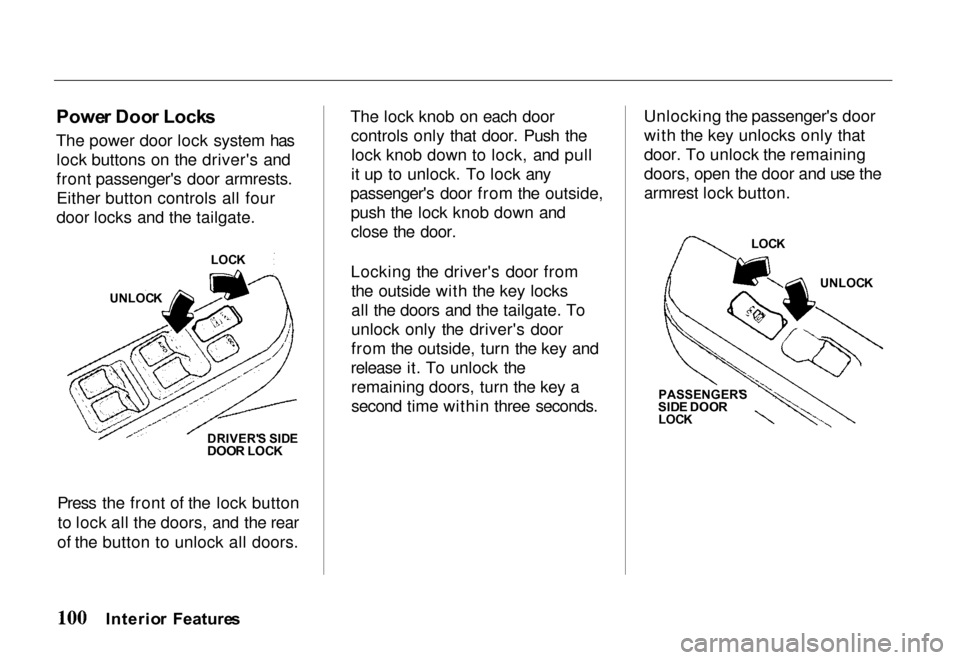
The power door lock system has lock buttons on the driver's and
front passenger's door armrests.
Either button controls all four
door locks and the tailgate.
Press the front of the lock buttonto lock all the doors, and the rear
of the button to unlock all doors. The lock knob on each door
controls only that door. Push thelock knob down to lock, and pull
it up to unlock. To lock any
passenger's door from the outside, push the lock knob down and
close the door.
Locking the driver's door fromthe outside with the key locks
all the doors and the tailgate. To
unlock only the driver's door
from the outside, turn the key and
release it. To unlock the remaining doors, turn the key a
second time within three seconds. Unlocking the passenger's door
with the key unlocks only that
door. To unlock the remaining
doors, open the door and use the
armrest lock button.
Interio r Feature s
UNLOC
K LOC
K
DRIVER' S SID E
DOO R LOC K
LOC
K
UNLOC K
PASSENGER' S
SID E DOO R
LOC K
Page 107 of 267
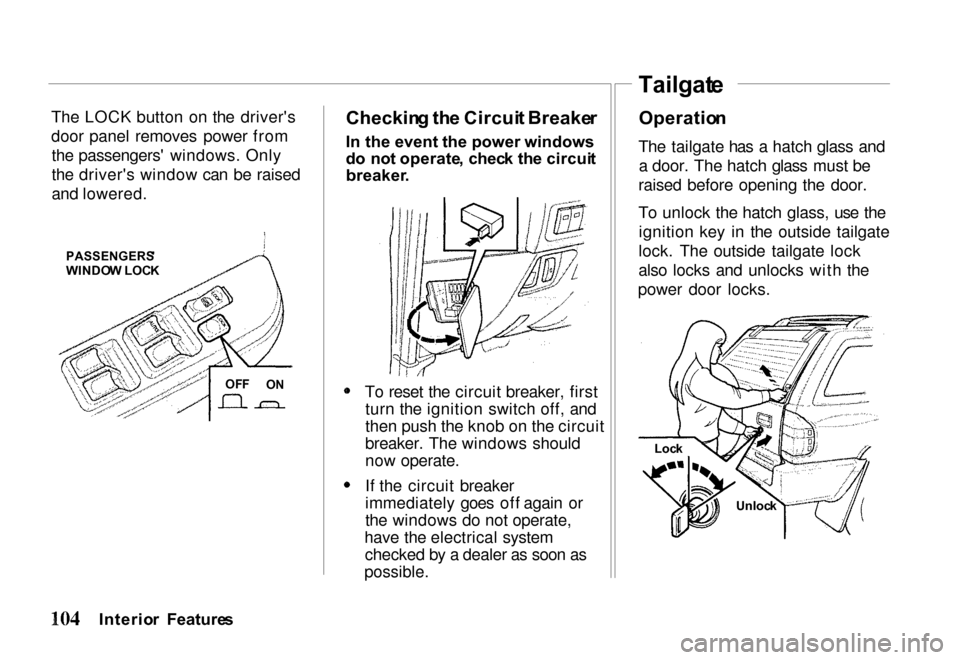
The LOCK button on the driver's
door panel removes power from
the passengers' windows. Only
the driver's window can be raised
and lowered. Checkin
g th e Circui t Breake r
In the event the power windows
d o no t
operate
, chec k th e circui t
breaker .
To reset the circuit breaker, first turn the ignition switch off, and
then push the knob on the circuit
breaker. The windows should
now operate.
If the circuit breaker
immediately goes off again or
the windows do not operate,
have the electrical system checked by a dealer as soon as
possible.
Operatio
n
The tailgate has a hatch glass and a door. The hatch glass must be
raised before opening the door.
To unlock the hatch glass, use the ignition key in the outside tailgate
lock. The outside tailgate lock
also locks and unlocks with the
power door locks.
Interio r Feature s
Tailgat
e
PASSENGERS '
WINDO W LOC K
Lock
Unlock
OF
F
ON
Page 109 of 267
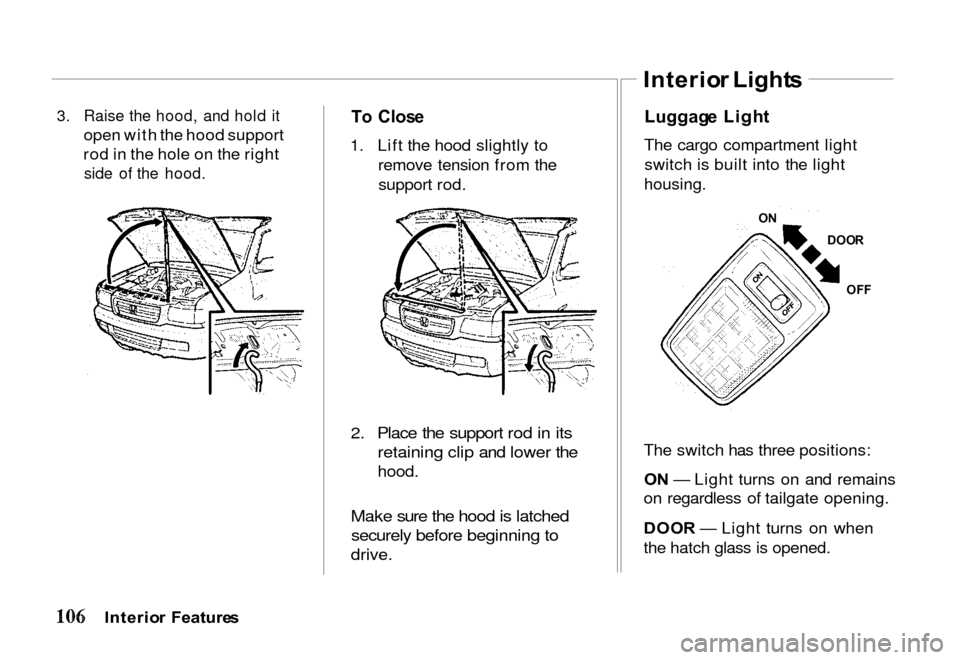
3. Raise the hood, and hold it
open with the hood support
rod in the hole on the right
side of the hood.
T
o Clos e
1. Lift the hood slightly to remove tension from thesupport rod.
2. Place the support rod in its retaining clip and lower the
hood.
Make sure the hood is latched securely before beginning to
drive.
Luggag
e Ligh t
The cargo compartment light switch is built into the light
housing.
The switch has three positions: O N — Light turns on and remains
on regardless of tailgate opening.
DOO R — Light turns on when
the hatch glass is opened.
Interio r Feature s Interio
r Light s
O N
DOOR
OF F
Page 110 of 267
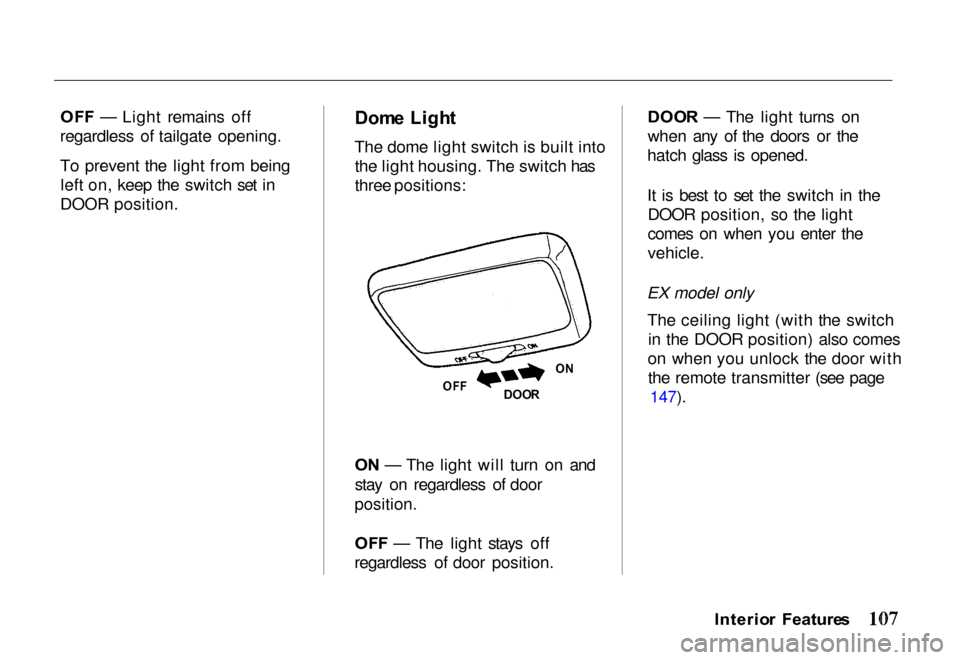
OF
F — Light remains off
regardless of tailgate opening.
To prevent the light from being left on, keep the switch set in
DOOR position.
Dom
e Ligh t
The dome light switch is built into the light housing. The switch has
three positions:
O N — The light will turn on and
stay on regardless of door
position.
OF F — The light stays off
regardless of door position. DOO
R — The light turns on
when any of the doors or the
hatch glass is opened.
It is best to set the switch in the DOOR position, so the light
comes on when you enter the
vehicle.
EX model only The ceiling light (with the switch in the DOOR position) also comes
on when you unlock the door with the remote transmitter (see page
147).
Interio r Feature s
OF F
DOOR
O
N