Page 190 of 267

find a leak, it must be repaired
before you can continue
driving. (See
Towing on page
187.)
If you don't find an obvious leak, check the coolant level inthe radiator reserve tank. If the
level is below the MIN mark, add
coolant to halfway between the
MIN and MAX marks.
If there was no coolant in the
reserve tank, you may also
have to add coolant to the
radiator.
Let the engine cool down until
the pointer reaches the middle
of the temperature gauge, orlower, before checking the
radiator. If needed, add coolant to the
radiator to bring the level up to the filler neck, and to the
reservoir up to the level indicated on the reservoir tank. Proper equipment must be used to
prevent damage to vehicles during
any towing. State and local laws
that apply to vehicles in tow must
be followed. Get detailed towing
instructions from your Honda
dealer.
Should it become necessary to
tow your vehicle, follow these
directions.
Precaution s
Before towing, make sure that
the power train, axle,
transmission, wheels and steering system are in good
condition.
If any of these items are
damaged, a flatbed trailer must
be used.
In Cas e o f Emergenc y
Towin
g
Removing the radiator cap
while the engine is hot can
cause the coolant to spray out, seriously scalding you.
Always let the engine andradiator cool down before
removing the radiator cap.
Page 203 of 267
Maintenanc
e Schedul e
Check oil and coolant level, at each fuel stop. Under severe driving conditions, service these items more often.
* 1 Using SAE 10W-40 oil, or any viscosity other than those recommended, may reduce engine life and affect the warranty.
* 2 This service is recommended only.
Inspec
t monthly :
— These fluids: brake, clutch, PIS, battery, ATF, windshield washer
— Tire pressure
Car e an d Maintenanc e
R — Replace L — Lube I — Inspect After inspection, clean, adjust, repair or replace if necessary.
Page 204 of 267
R — Replace L — Lube I — Inspect After inspection, clean, adjust, repair or replace if necessary.
Check oi
l and coolant level at each fuel stop.
Under severe driving conditions, service these items more often. These conditions are: Service for severe driving conditions
Repeated short trips in cold weather Frequent idling and/or frequent low-speed operation Change engine oil and filter - Every 3,750 miles (6,000 km) Driving in dusty areas Towing a trailer or 3 months
Change rear axle oil - Every 15,000 miles (24,000 km)
Care an d Maintenanc e
Page 216 of 267

The engine cooling system is
designed to maintain the engine at
the proper operating temperatures.
The cooling system was filled at the factory with a quality engine
coolant. The engine cooling system is designed to use coolant (a
mixture of water and ethylene glycol antifreeze) rather than plain
water. The engine coolant solutionshould be used year-round. It has
many advantages such as: provides freezing protection as
lowas — 33°F( — 36°C)
provides boiling protection up
to262°F(128°C)
protects against rust and
corrosion in the cooling system maintains the proper engine
temperature for efficient
operation and emission control
allows proper operation of the
engine coolant temperature gaugeSee the Maintenance Schedule in
this section to find out when the
engine coolant must be replaced.
Checkin g th e Coolan t Leve l
Check the engine coolant level at the interval shown in the
Maintenance Schedule unless there
is evidence of leaking or
overheating. The engine coolant
level should be between the
maximum and the minimum level
marks on the radiator reserve tank.
Car e an d Maintenanc e
Recommende
d Lubrican t
Engin
e Coolin g Syste m
Page 217 of 267

You usually do not need to remove
the radiator cap to check the engine
coolant level.
Addin g Engin e Coolan t
To add engine coolant, remove the cap on the radiator reserve tank
and fill the tank up to the
maximum level mark. Add a
50/50 mixture of water and a good
quality ethylene glycol antifreeze. If you need to add engine coolant
frequently, see your Honda dealer
for a cooling system check.
If the proper quality antifreezeis used, there is no need to add
extra inhibitors or additives. They may be harmful to the proper
operation of the system.
Coolin g Syste m Servic e
The cooling system should be serviced at the intervals specified in the Maintenance Schedule as
follows:
Wash the radiator cap and filler
neck with clean water.
Check the engine coolant level
in the radiator and have it tested
for freeze protection. Add
ethylene glycol antifreeze, if
needed, to maintain freeze
protection at —33°F (—36°C).
Have the cooling system and
radiator cap tested for a pressure capacity of 15 psi (105
kPa). If a replacement cap is
needed, use a cap specified for
your model. Tighten all radiator and heater
hose clamps and inspect all
hoses. Replace the hoses if they
are swollen, "checked," or
otherwise worn. Carefully tighten the hose clamps at the
radiator. Overtightening could bend or collapse the radiator
fittings. Clean the front of the radiator
core and air conditioning
condenser.
It is the owner's responsibility to: Maintain the cooling system
freeze protection at —33°F
Car e an d Maintenanc e
Removing the radiator cap
while the engine is hot can
cause the coolant to spray out, seriously scalding you.
Always let the engine andradiator cool down beforeremoving the radiator cap.
Page 218 of 267
(—36°C) to ensure protection
against corrosion and loss of
engine coolant from boiling.
This should be done even if freezing temperatures are not
expected.
Add ethylene glycol-basedantifreeze when antifreeze has
to be added because of engine
coolant loss or if more
protection against freezing at
temperatures lower than —33 °F
(—36°C) is needed. Do not use
an alcohol-based or
methanol-based antifreeze, or
plain water. They boil at a
lower point, and do not provide corrosion protection.
Thermosta
t
The engine coolant temperature is
controlled by a thermostat, which stops engine coolant flow through
the radiator until a preset
temperature is reached. This
thermostat is installed in the
engine coolant inlet on the front of the engine block. The same
thermostat is used in both winter
and summer. Othe
r Require d
Maintenanc e
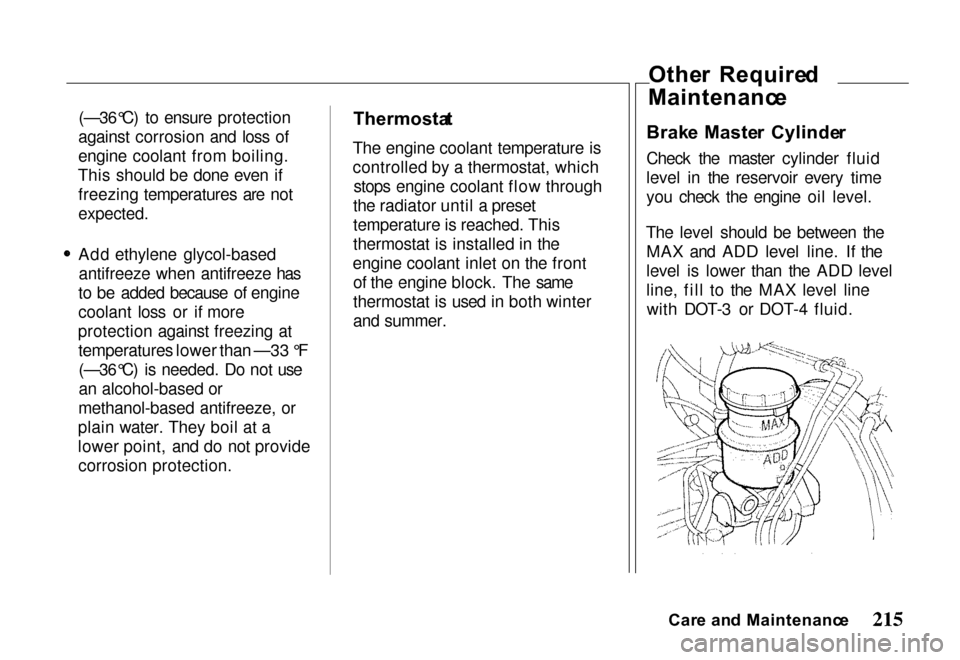
Brak e Maste r Cylinde r
Check the master cylinder fluid
level in the reservoir every time
you check the engine oil level.
The level should be between the MAX and ADD level line. If the
level is lower than the ADD level
line, fill to the MAX level linewith DOT-3 or DOT-4 fluid.
Car e an d Maintenanc e
Page 222 of 267

Spar
k Plug s
Replace the spark plugs with the
type specified in the "Technical
Data" section.
Clutc h
Check the clutch play at the pedal.
Lubricate the clutch pedal bushing and clevis pin, at the intervalsshown in the Maintenance
Schedule, with water-resistant
chassis lubricant. If you hear a squeaking noise coming from the
area of the bushing or clevis pin at
the clutch pedal arm when the
clutch pedal is depressed,
lubricate it with water-resistant EP
chassis grease.
Check the fluid level in the clutch
reservoir at the interval shown in
the Maintenance Schedule. If the fluid is low in the reservoir, it
should be filled to the
maximum
level lin
e with DOT-3 or DOT-4
fluid.
Flui d o r Lubrican t Level s
Check the fluid or lubricant level in the brake master cylinder,
clutch master cylinder, power steering reservoir, rear axle,
engine and transmission, windshield washer reservoir and
engine coolant at specified
intervals.
Powe
r Steerin g
Check the fluid level in the power steering fluid reservoir as
recommended in the Maintenance Schedule. The fluid level should
be between the "MIN" and "MAX" marks on the reservoir.
Use only automatic transmission
fluid labeled DEXRON III.
Car e an d Maintenanc e
Page 258 of 267

Emergency, In Case of ...... 179
Charging System Indicator . 60Check Engine Light ....... 61
Checking the Fuses ...... 189
Engine Overheating ...... 186 Jump Starting ........... 180
Malfunction Indicator Lamp 61Oil Pressure Indicator ..... 62
Emissions Controls ........ 245
Engine
Belts .................. 218
Break-in ............... 154
Check Light ............. 61Coolant Temperature Gauge 58
Identification Number .... 228
Malfunction Indicator Lamp 61 Oil
Capacity ............. 231
Recommendation ...... 194
Oil Pressure Indicator ..... 62 Overheating ............ 186
Specifications .......... 231
Starting ............... 153
Ethanol in Gasoline ........ 197
Evaporative
Emission Controls ........ 246
Exhaust Fumes ............ 44
Expectant Mothers,
Use of Seat Belts by ...... 16
Exterior, Cleaning the ...... 220
Fabric, Cleaning.
See Interior Cleaning
Fan Control Lever ......... 117
Features,
Comfort and Convenience . . 115
Filling the Fuel Tank ....... 193 Filters
Air .................. 210
Oil .................. 208
5-Speed Manual Transmission Checking Fluid Level ... 211Shifting ................ 81
Flashers, Hazard Warning ....
74
Flat Tire
, Changing a ....... 182
Fluids Automatic Transmission . .
212
Capacity ............
. 233
Brake ................. 215
Clutch ................ 219
5-Speed Manual Transmission .......... 211
Capacity ............. 233
Power Steering .......... 219
Windshield Washer ...... 69
FM Stereo
Radio Reception ........ 132

