2000 HONDA PASSPORT light
[x] Cancel search: lightPage 199 of 267

To Close
1. Lift the hood slightly to remove tension from the support rod.
2. Place the support rod in its retaining clip and lower the
hood.
Always make sure the hood is securely latched before you begin
driving.
Engin
e Oi l Dipstic k
Check the oil level when the
engine is off and the oil is warm, such as during a fuel stop. See
page 209. Your Honda operates most
effectively on unleaded gasoline with a pump octane number of 86
or higher. Use of a lower octane
gasoline can cause a persistent, heavy metallic rapping noise in
the engine that can lead to
mechanical damage.
We recommend gasolines containing
detergent additives that help prevent
fuel system and engine deposits.
Using gasoline containing lead will
damage your vehicle's emission
controls. This contributes to air
pollution and can void certain parts
of your warranty.
Oxygenate d Fuel s
Some conventional gasolines are
being blended with alcohol or an
ether compound. These gasolines are collectively referred to as
oxygenated fuels. To meet clean air
Car e an d Maintenanc e
Fue
l Requirement s
Page 207 of 267

Owne
r Safet y Check s
Promptly take any safety
problems to your Honda dealer for service advice.
Parkin g brak e — Park on a fairly
steep hill and hold the vehicle
with the parking brake only. This
checks its holding ability.
Starte r safet y switc h (automati c
transmission ) — Check the safety
switch by trying to start the
engine in each gear. The starter should work only with the shift
lever in the "P" (Park) or "N" (Neutral) position.
Starte r safet y switc h (manua l
transmission ) — To check the
safety switch, place the shift lever
in "Neutral," push the clutch
pedal halfway and try to start the engine. The starter should not
work. The starter should work only when the clutch pedal is fully
depressed.
Transmissio n shif t indicato r
(automati c transmission ) —
Check that the indicator points to
the gear chosen.
Steerin g — Be alert for any
changes in steering action. An inspection or service is needed
when the steering wheel is harder
to turn or has too much free play,
or if there are unusual sounds when turning or parking.
Whee l alignment , balanc e an d
tire s — Uneven or abnormal tire
wear, or pulling to the right or left
on a straight and level road may show the need for a wheel
alignment. A vibration of the
steering wheel or seat at normal
highway speeds means wheel balancing is needed. Check tire
pressures (including the spare) at
least monthly and whenever the
vehicle is serviced (see page 159).
Brake s — Watch for the
"BRAKE" light coming on. Other signs of possible brake trouble are
such things as repeated pulling to
one side when braking, unusual sounds when braking or between
brake applications, or increased
brake pedal travel. If you note one
of these conditions, have the system checked at once and
repaired if needed.
Car e an d Maintenanc e
Page 209 of 267
Seat-bac
k latche s — Seat-back
latches are designed to prevent
forward motion of the seat-back when the vehicle stops suddenly.
Check to see that the seat-backlatches are holding by pulling
forward on the top of the folding
seat-back.
Also check to see that the
reclining seats are operating properly.
Light s an d beepers — Check
panel lighting, warning lights, and
the seat belt reminder light and
beeper. Also check the key beeper and interior lights. On the outside,
check the license plate light, sidemarker lights, headlights, parking
lights, taillights, brake lights, turnsignals, backup lights and hazard
warning flashers. Have the
headlight aim checked promptly if the beams seem to be aimed
improperly.
Glas
s — Check for broken,
scratched or damaged glass that
could reduce visibility or cause injury.
Doo r latches — Check that the
doors close, latch and lock
securely.
Hoo d latc h — Check that the
hood closes firmly. Check for
broken, damaged, or missing parts that might prevent secure
latching. Make sure the secondarylatch keeps the hood from
opening all the way when first
released.
Flui
d leaks — Check for fuel,
water, oil or other fluid leaks by
looking at the surface beneath the
vehicle after it has been parked
for awhile. Water dripping from
the air conditioning system after use is normal. If you notice
gasoline fumes or fluid at any
time, locate the source and have it
corrected at once.
Spar e tir e an d jac k — Check that
the spare tire and all jack gear are securely stowed at all times.
Tailgat e latc h — Check that the
tailgate closes, latches and locks
securely.
Car e an d Maintenanc e
Page 211 of 267
Change the oil and oil filter every
3,750 miles (6,000 kilometers) or
every three months if you drive under one or more of these
"severe driving" conditions: Driving in dusty areas
Towing a trailer
Frequent idling or idling for
long periods Frequent short trips (4 miles [6
kilometers] or less) in cold or
freezing weather, where the
engine does not thoroughly
warm up. Change the oil and oil filter as
soon as possible after driving in
a dust storm.
Oi
l Chang e
Changing the oil and filter requires
special tools and access from underneath the vehicle. The vehicle
should be raised on a service station-type hydraulic lift for this
service. Unless you have the
knowledge and proper equipment,
you should have this maintenance
done by a skilled mechanic.
1. Warm up the engine. This makes the oil drain faster and
more thoroughly.
2. Remove the oil filler cap.
3. Remove the drain plug and drain oil fully.
4. Install the drain plug, with a new gasket, and tighten it.
5. Fill the engine with the proper amount of new oil (see
"Specifications"). Oil Filter Installation
1. Remove the old oil filter with the filter wrench.
2. Apply a light coat of engine oil to the oil filter gasket.
3. Hand-tighten the filter until the gasket contacts the sealing
face.
4. Using the filter wrench, tighten the filter one full turn.
5. Run the engine and inspect for
leaks.
6. Shut off the engine. After a couple of minutes, check the
oil level. If necessary, add oilto bring it to the FULL mark.
An improperly installed oil filter can result in severe engine
damage.
Car e an d Maintenanc e
NOTIC
E
Page 219 of 267
If the diaphragm inside the
reservoir cap is deformed, return
it to the original (collapsed)
condition, then tighten the cap.
It is normal for the brake fluid
level to go down slightly as the
front brake pads wear. So be sure
to keep the reservoir fluid at the
proper level.
If the reservoir needs frequent
refilling, it may indicate a serious mechanical problem.
Brake fluid absorbs water from
the air. Never use brake fluid that
has been open to the air for an
extended period. Throw it away and use new brake fluid from a
sealed container.
Brake fluid can damage your vehicle's paint. Thoroughly clean
up any brake fluid spills.
Shift-on-the-Fl
y Syste m
The fluid level in the system should
be checked at the intervals shown in the Maintenance Schedule.
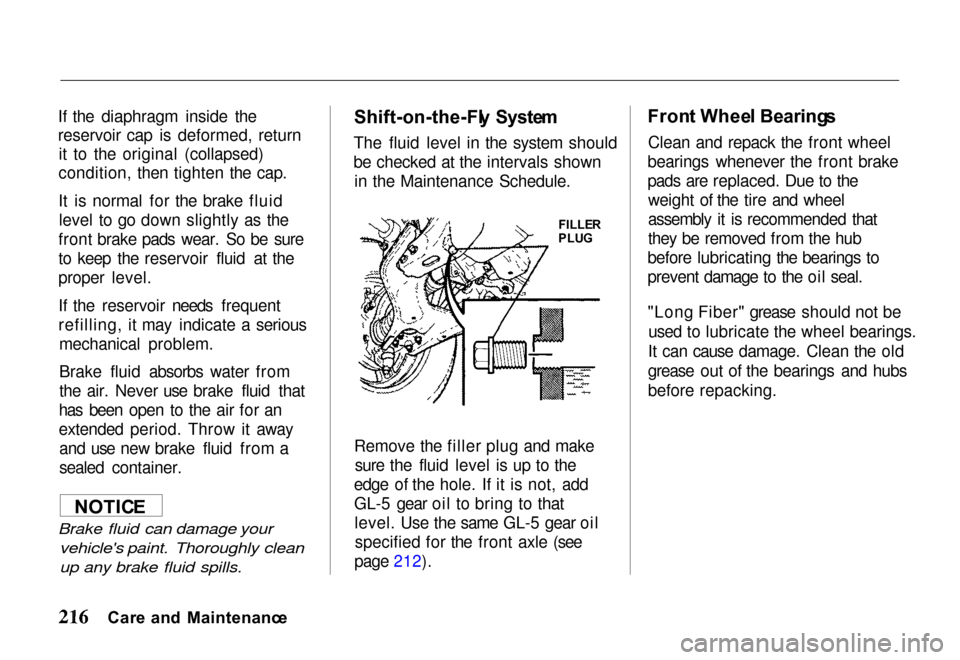
Remove the filler plug and make sure the fluid level is up to the
edge of the hole. If it is not, add
GL-5 gear oil to bring to that level. Use the same GL-5 gear oilspecified for the front axle (see
page 212). Fron
t Whee l Bearing s
Clean and repack the front wheel
bearings whenever the front brake
pads are replaced. Due to the weight of the tire and wheel
assembly it is recommended that
they be removed from the hub
before lubricating the bearings to
prevent damage to the oil seal.
"Long Fiber" grease should not be
used to lubricate the wheel bearings.
It can cause damage. Clean the old
grease out of the bearings and hubs
before repacking.
Car e an d Maintenanc e
NOTIC
E
FILLE
R
PLU G
Page 220 of 267

Hoo
d Latc h an d Hinge s
Lubricate the hood latch assembly
and hood hinge assembly as
follows:
1. Wipe off any accumulatio n of
dirt o
r contamination on the
latch parts.
2. Apply multipurpose-type grease (NLGI No. 1 or 2) to
the hood latch pin cam.
3. Apply light engine oil to all pivot points in the release
mechanism.
4. Lubricate hood hinges with multipurpose-type grease
(NLGI No. 1 or 2).
5. Check the hood hinges and
latch mechanism to assure
they are working correctly.
Ai
r Conditionin g
Periodically have your Honda dealer check your air conditioning
system to be sure there has been
no loss in cooling output. See
your Honda dealer if you suspect
that the system is not performing
as it should.
Bod y Lubricatio n
Normal use of a vehicle causes
metal-to-metal movement at certain
points in the body. Noise, wear and improper operation at these points
will result when a protective film of lubricant is not provided.
For exposed surfaces such as door
checks, door lock bolts, lock striker plates, etc., apply a thin
film of light engine oil.
Any lubricant should be used
sparingly. After application, all excess lubricant should be
carefully wiped off.
The seat adjusters and seat track should be lubricated with water-
resistant EP chassis lubricant.
There are other points on the
vehicle body which may occasionally require lubrication.
Window regulators and controls are confined in the space between
the upholstery and the outside
door panel. Easy access to the
working parts may be made by
removing the trim. Door weatherstrips and rubber hood
bumpers should be lightly coatedwith a rubber lubricant.
Car e an d Maintenanc e
Page 223 of 267

Accelerato
r Peda l Linkag e
Lubricate the accelerator pedal
fulcrum pin with multipurpose
Whee l Alignmen t
Proper wheel alignment improves tire mileage. Your vehicle's
suspension parts should be
inspected often and aligned when
needed (see the "Technical Data" section). Improper alignment will
cause the front tires to roll at an angle that will result in faster tire
wear.
Proper tire balancing provides the
best riding comfort and helps
reduce tire tread wear. Out-of-balance tires can cause
annoying vibration and uneven
tire wear such as cupping and flat
spots.
Exterio
r
Washin g You r Vehicl e
The best way to preserve your vehicle's finish is to keep it clean by
frequent washings. Wash the vehicle
with lukewarm or cold water.
Do not use hot water or wash in direct sunlight. Do not use strong
soap or chemical detergents. All
cleaning agents should be promptly
flushed from the surface and not
allowed to dry on the finish.
Polishin g an d Waxin g
You r Vehicl e
Polishing is recommended to
remove accumulated residue and eliminate any "weathered"
appearance.
Your Honda dealer offers several
polishes and cleaners that have
proven to maintain the original finish appearance and durability. Protectio
n o f Exterio r
Brigh t Meta l Part s
Bright metal parts should be cleaned
regularly to keep their luster.
Washing with water is all that is
usually needed. However, chrome
polish may be used on chrome or stainless steel trim, if necessary. A
coating of wax, rubbed to a high
polish, is recommended for all bright metal parts.
Car e o f Aluminu m Wheel s
Aluminum wheels have a clear-coat finish similar to paint.
Use a chamois skin, sponge or
other soft material when washing
the wheels.
Foreig n Materia l Deposit s
Calcium chloride and other salts, ice melting agents, road oil and
tar, tree sap, bird droppings,
Car e an d Maintenanc e
Page 226 of 267
Cleanin
g Fabri c
Cleaning General Soilage or
Water Spots From Fabric Trim
Multipurpose powdered cleaner is
excellent for this type of cleaning and for cleaning panel sections
where small cleaning rings may
be left from spot cleaning. Vacuum the area thoroughly to
remove loose dirt.
ALWAYS clean a full trim
assembly or complete trim
section. Mask surrounding trim
along stitch or welt-lines.
Mix the multipurpose
powdered cleaner in strict accordance with the directions
on the label of its container.
Mix in proportion for smaller
quantities. USE SUDS ONLY ON A
CLEAN SPONGE OR SOFT
BRISTLE BRUSH. DO NOT
SATURATE FABRIC OR RUB
HARSHLY WITH THE
BRUSH.
IMMEDIATELY AFTER
CLEANING, WIPE OFF
EXCESS CLEANER WITH A
SLIGHTLY DAMP ABSORBENT
TOWEL OR CLOTH. IMMEDIATELY AFTER
WIPING, FORCE-DRY THE
FABRIC WITH AN AIR HOSE, HEAT DRYER, OR HEAT
LAMP. Use caution if you are using a heat dryer or heat lamp
so you do not damage the
fabric.
When trim materials that have a
sheen or lustrous finish are dry,
wipe them with a soft, clean
cloth to restore the sheen.
Spot Cleaning Fabric
With Solvent Cleaner
Before trying to remove a spot or
stain from fabric, determine as
accurately as you can what kind of
spot or stain it is and how long it
has been there. Some spots or stains can be removed with water
or mild soap solution (see
"Removal of Specific Stains"). Spots or stains should always be
removed as soon as possible.
Some types of stains or soilage,
such as lipstick, inks and grease,
are very difficult (sometimes
impossible) to completely remove.
When cleaning this type of stain or soilage be sure not to enlarge the
soiled area. Fabric cleaner (solvent
type) is excellent for spot-cleaning
grease, oil or fat stains.
Car e an d Maintenanc e