Page 169 of 267
Drivin
g fo r Bes t Fue l
Econom y
How, where, and when you drive all affect how many miles/
kilometers you can get from a
gallon/liter of fuel. The careful attention you give your vehicle as
far as maintenance and repairs will also help fuel economy.
Fuel Selection Use only unleaded gasolinemeeting federal government
regulations. The federal
government specifies the
minimum octane rating number of
unleaded gasoline. Unleaded
gasoline must be used for proper
emissions control system
operation. It will also minimize spark plug fouling. The use of
leaded gasoline can damage the
emissions control system and could result in loss of warranty
coverage.
"Jackrabbit" Starts
You can save fuel (and prolong
engine and tire life) by avoiding fast starts away from lights andstop signs.
Stop-and-Go Driving Frequent stop-and-go driving
during a trip will cut down on
your miles per gallon (kilometers
per liter). Plan even your short shopping trips to take advantage
of through streets to avoid traffic
lights. Pace your driving to avoid
unplanned stops.
Excessive Idling
An idling engine uses fuel, too. If
you're faced with more than a few
minutes wait and you're not in traffic, it is better to turn off the
key and start the engine again
later.
Repetitive Harsh Stopping Harsh stops can also waste fuel;instead of moving the vehicle, the
energy is wasted as heat in
braking. Energy in the form of
fuel is also needed to accelerate
back to driving speed.
Lubricants A well-lubricated vehicle meansless friction between moving
parts. This manual lists the proper
lubrication intervals in the "Care
and Maintenance" section.
Air Cleaner Your vehicle gets its power from a
mixture of fuel and air. The air is
taken into the engine through the
Drivin g Tip s
Fue
l Econom y
Page 173 of 267

systems, such as the SRS and
anti-lock brake system.
However, if electronic accessories
are improperly installed, or
exceed your vehicle's electrical
system capacity, they can interfere with the operation of your vehicle,
or even cause the airbags to
deploy.
Before installing any accessory: Make sure the accessory does
not obscure any lights, or interfere with proper vehicle
operation or performance. Be sure electronic accessories
do not overload electrical
circuits (see page 236). Have the installer contact your
Honda dealer for assistance
before installing any electronic
accessory.
If possible, have your dealer
inspect the final installation.
Modification s
Do not remove any original
equipment or modify your vehicle in any way that would alter its
design or operation. This could
make your vehicle unsafe and illegal to drive.
For example, do not make any modifications that would change
the ride height of your vehicle, or
install wheels and tires with a
different overall diameter.
Such modifications can adversely
affect handling, and interfere with
the operation of the vehicle's
anti-lock brakes and other
systems.
In addition, any modifications that
decrease ground clearance increase the chance of
undercarriage parts striking a
curb, speed bump, or other raised object, which could cause your
airbags to deploy.
Do not modify your steering wheel or any other part of your
Supplemental Restraint System.Modifications could make the
system ineffective.
Additiona l Safet y Precautio n
Do not attach or place objects on
the airbag covers. Any object
attached to, or placed on, the
covers marked "SRS," in the
center of the steering wheel and on top of the dashboard, could
interfere with the proper operation
of the airbags. Or, if the airbags
inflate, the objects could be
propelled inside the vehicle and hurt someone.
Drivin g Tip s
Page 174 of 267
Carryin
g Carg o
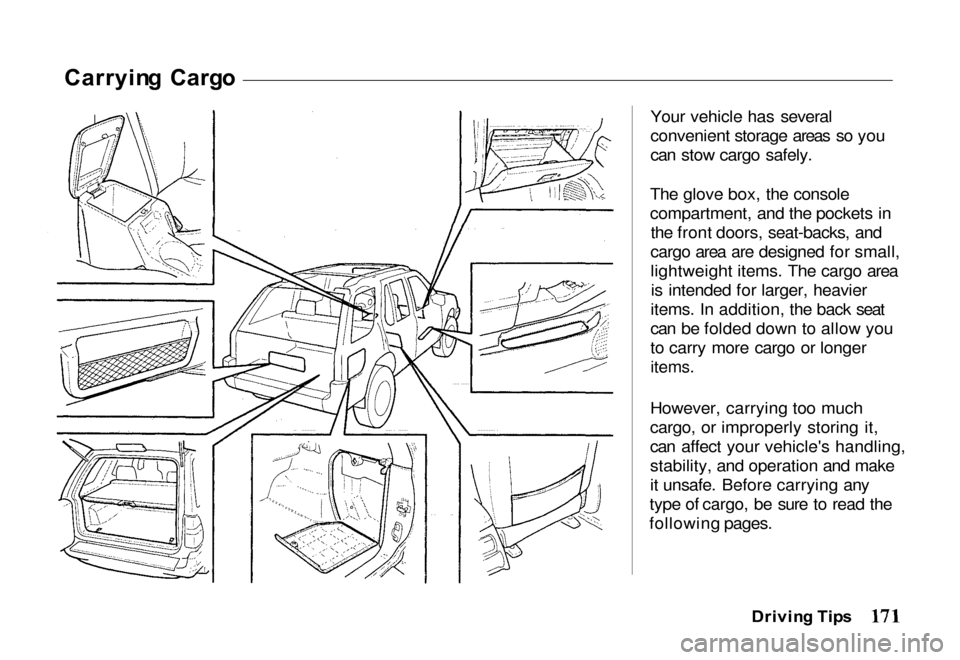
Your vehicle has several
convenient storage areas so you
can stow cargo safely.
The glove box, the console
compartment, and the pockets in the front doors, seat-backs, and
cargo area are designed for small,
lightweight items. The cargo area is intended for larger, heavier
items. In addition, the back seat
can be folded down to allow you
to carry more cargo or longer
items.
However, carrying too much
cargo, or improperly storing it,
can affect your vehicle's handling,
stability, and operation and make
it unsafe. Before carrying any
type of cargo, be sure to read the
following pages.
Drivin g Tip s
Page 180 of 267

Safet
y Chai n
Always use a suitable safety chain
between your vehicle and the
trailer.
Check with your trailer
manufacturer for the required
equipment. Cross the safety
chains under the hitch and attach
them to the trailer hitch hardware.
This will prevent the trailer from
dropping to the ground in the
event the hitch disengages. For
proper use and installation,
consult your trailer manufacturer.
Traile r Light s
Trailer lights and equipment must
comply with federal, state and local regulations. Check with your
local recreational vehicle dealer
for the requirements in your area. Use only equipment designed for
your vehicle.
Improper equipment or installation can cause damage to
your vehicle's electrical system and affect your vehicle warranty.
Consult your Honda dealer for installation.
Tire s
Always check the condition of
your vehicle's tires and trailer's
tires before operation. Replace
worn or damaged tires before
operation.
Inflate tire pressure to the
recommended cold tire pressure indicated in the tire
manufacturer's warranty booklet in the glove box packet.
Check the tire manufacturer's
requirements when replacement
tires are installed on your vehicle.
Trailer tire condition, size, load
rating, and proper inflation
pressure should be in accordance
with the tire manufacturer's
specifications. Improper tire size
and inflation can cause tire
failure, possibly resulting in
vehicle damage and personal
injury.
Traile r Brake s
Trailers with a total weight of
1,000 pounds or more require trailer brakes. If your trailer is
equipped with a braking system,
make sure it conforms to federal,state, and local equipment
regulations.
Driving Tip s
Page 181 of 267
There are no provisions in your
vehicle to tap into its hydraulic
braking system. Any attempt toattach the trailer's brakes to your
vehicle's hydraulic braking system, no matter how successfulit may seem, will lower braking
effectiveness and create a
potential hazard.
Equipmen t Chec k
Before operating your vehicle,
check all safety equipment to
ensure safe operation. Be sure
your vehicle is properly serviced
to avoid mechanical failure.
Check that your vehicle remains
level when the loaded or unloadedtrailer is hitched. Do not drive if
the rear end of your vehicle is abnormally higher or lower.
Check for proper tongue weight,
overload, improper weight
distribution, worn suspension, or
other possible causes.
Make sure the trailer load is
properly positione
d and secured
so its does not shift around whil
e
driving.
Chec k
if your rearview mirrors
comply with federal, state and
local regulations. If not, confirm
the proper mirrors required for
towing and have them installed.
Perform an equipment check of
all braking, lighting and safety
equipment to ensure they are working properly.
Your safety depends on proper
operation and installation of
equipment. Never operate a
vehicle with faulty equipment.
Limite
d Sli p Differentia l
Standard on 4WD models
The limited slip differential is
designed to improve traction by limiting wheelspin. If one rear
wheel begins to spin on a slipperysurface, the limited slip
differential will automatically
transmit driving force to the other
rear wheel.
Drivin g Tip s
Page 183 of 267

Jum
p Startin g
Do not push or tow your vehicle to start it. Under some conditions
this may damage the three-way catalytic converter or other parts
of the vehicle.
If your vehicle has a discharged
battery, it can be started by using the battery in another vehicle; a
procedure called "jump starting." To jump start your vehicle:
1. Position the vehicle with the good (charged) battery so that
the jump-starting cables will
reach. Do not allow the vehiclesto touch. Check to see that the
bumpers do not touch.
2. Turn off all electric motors and accessories in both
vehicles. Turn off all lights
except hazard flashers and
lights needed to light up the
work area. Turn off theignition, apply the parking
brake firmly, and shift an automatic transmission to
"P" (Park) and a manual
transmission to "N" (Neutral)
in both vehicles.
3. Check fluid level of the battery before attempting to
charge or jump start. (Do not use an open flame to check,
and do not smoke.)CHARG ETEST
INDICATO R
BLUE
COLORLES S
If the battery is a sealed type
and if the fluid level is below
the lower level line on the side
of the battery, do not try to
jump start the vehicle or charge or test the battery. Do
not add fluid. Instead, install a new battery.
I n Cas e o f Emergenc y
A battery can explode if you
do not follow the correct
procedure, seriously injuring
anyone nearby.
Keep all sparks, open flames,
and smoking materials away
from the battery.
CHARGIN G
NECESSAR Y
LOWE
R
LEVE L
O K
UPPERLEVEL
Page 189 of 267

Reverse this procedure to store
the spare tire. Connect the spare
tire to the bracket with the outside
of the wheel facing up. Make sure
the tire does not catch on any part
of the underbody of the vehicle as
you are raising it, and that the spare tire is stored securely before
driving.
If the engine overheats:
The engine coolant temperaturegauge pointer will move up to
the "H" or higher. Engine "ping" will become
excessive.
Loss of engine power will be
noticed.
Either steam or boiling water
will squirt out of the radiator.
If you find that the engine is
overheating:
Stop the vehicle, and turn on
the hazard warning lights.
If you see or hear steam or
coolant coming from the
engine compartment, turn off the engine immediately. If you do not see or hear steam
or spray, turn off the A/C (if
on) and run the engine at a
speed slightly higher than idle
speed (about 1,500 rpm) for
several minutes. Watch the
coolant temperature gauge. If it
remains at the ''H" mark, turn
off the engine.
Open the hood only after all
signs of steam or hot coolant
spray have stopped. Look for
signs of an obvious leak, such
as a split radiator hose. If you
I n Cas e o f Emergenc y
Steam and spray from an
overheated engine can
seriously scald you.
Do not open the hood if steam
is coming out.
Engin
e Overheatin g
Page 198 of 267
Hoo
d Releas e
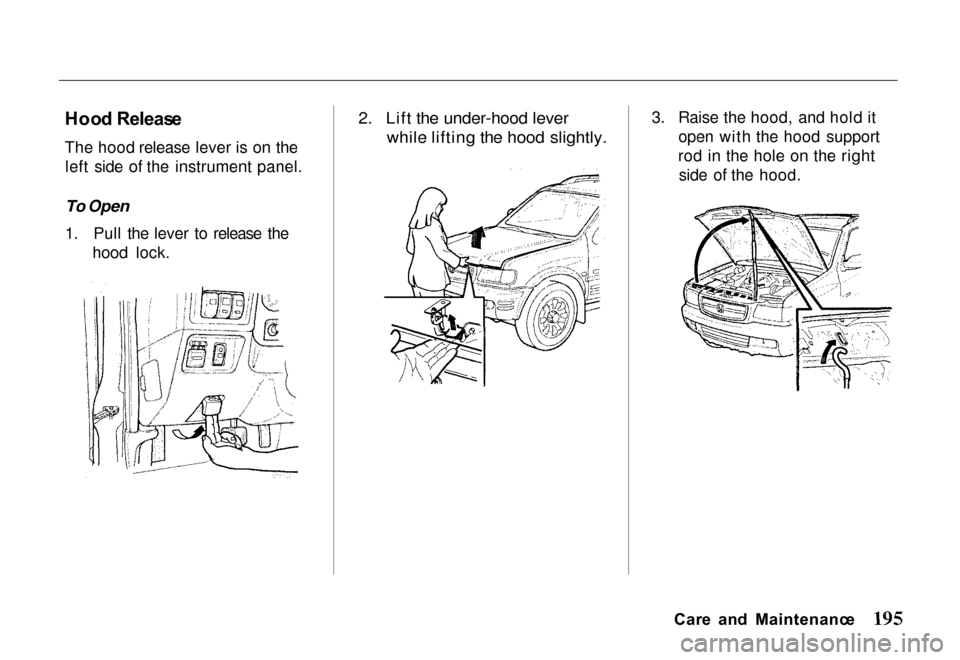
The hood release lever is on the left side of the instrument panel.
To Open
1. Pull the lever to release the hood lock.
2. Lift the under-hood lever
while lifting the hood slightly.
3. Raise the hood, and hold it
open with the hood support
rod in the hole on the right side of the hood.
Car e an d Maintenanc e