2000 HONDA ODYSSEY seats
[x] Cancel search: seatsPage 32 of 352
Protecting Childre n
Installing a Child Seat
After selecting a proper child seat,
and a good position to install the seat,
there are three main steps in installing the seat:
1. Secure the child seat to the vehicle
with a seat belt. All child seats
must be secured to the vehicle
with the lap part of a lap/shoulder belt. A child whose seat is not
properly secured to the vehiclecan be endangered in a crash. See
pages 31 and 36 for instructions on
how to secure child seats in this
vehicle.
2. Make sure the child seat is firmly
secured. After installing a child
seat, push and pull the seat
forward and from side to side to
verify that it is secure. To provide security during normal
driving maneuvers as well as during
a collision, we recommend that
parents secure a child seat as firmly as possible.
However, a child seat does not need
to be "rock solid." In some vehiclesor seating positions, it may be
difficult to install a child seat so that
it does not move at all. Some side-to-
side or back-and-forth movement can
be expected and should not reduce
the child seat's effectiveness.
If the child seat is not secure, try
installing it in a different seating
position, or use a different style ofchild seat that can be firmly secured
in the desired seating position.
3. Secure the child in the child seat.
Make sure the child is properly
strapped in the child seat
according to the child seat maker's
instructions. A child who is not
properly secured in a child seat can be thrown out of the seat in a
crash and seriously injured.
Storing a Child Seat
When you are not using a child seat, either remove it and store it in a safe
place, or make sure it is properlysecured. An unsecured child seat can
be thrown around the vehicle during a crash or sudden stop and injure
someone.
Drive r an d Passenge r Safet y
Page 33 of 352
Protectin
g Childre n
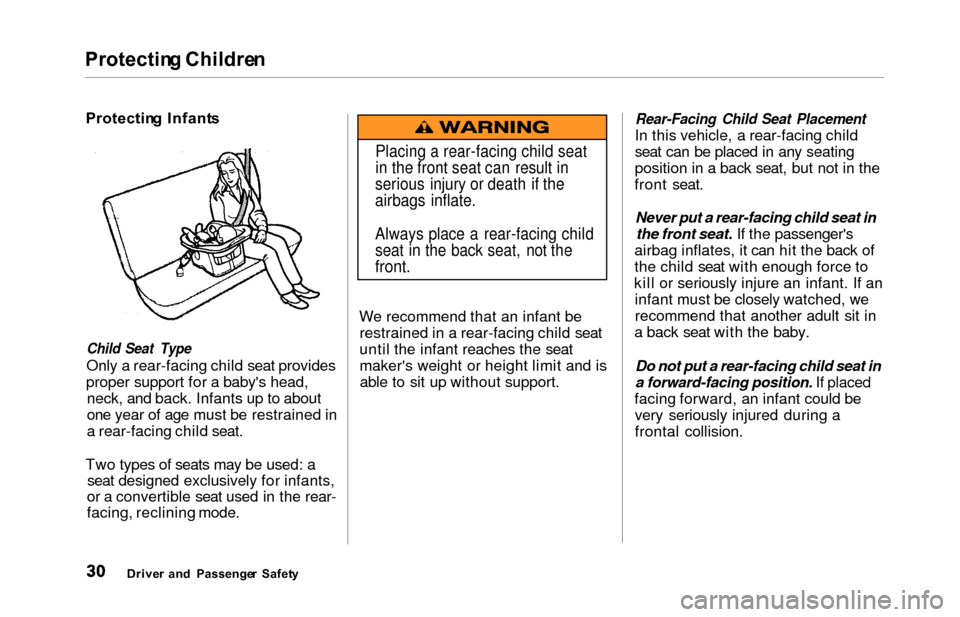
Protectin g Infant sChild Seat Type
Only a
rear-facing child seat provides
proper support for a baby's head, neck, and back. Infants up to about
one year of age must be restrained in
a rear-facing child seat.
Two types of seats may be used: a seat designed exclusively for infants,
or a convertible seat used in the rear-
facing, reclining mode. We recommend that an infant be
restrained in a rear-facing child seat
until the infant reaches the seat
maker's weight or height limit and isable to sit up without support.
Rear-Facing Child Seat Placement
In thi
s vehicle, a rear-facing child
seat can be placed in any seating
position in a back seat, but not in the
front seat.
Never put a rear-facing child seat in
the front seat. If the passenger's
airbag inflates, it can hit the back of
the child seat with enough force to
kill or seriously injure an infant. If an infant must be closely watched, we
recommend that another adult sit in
a back seat with the baby.
Do not put a rear-facing child seat in
a forward-facing position. If placed
facing forward, an infant could be very seriously injured during a
frontal collision.
Drive r an d Passenge r Safet y
Placing a rear-facing child seat
in the front seat can result in
serious injury or death if the
airbags inflate.
Always place a rear-facing child
seat in the back seat, not the
front.
Page 34 of 352
Protecting Childre n
Installing a Rear-Facing Child Seat
with a Lap/Shoulder Belt
The lap/shoulder belts in the outer
back seats have a lockingmechanism that must be activated tosecure a child seat.
The following pages provide instructions on how to secure a rear-
facing child seat with this type of seat belt.
See page 33 for how to secure a rear-
facing child seat in the center position on the third seat with the lap
part of the lap/shoulder belt.
For tips on installing a rear-facingchild seat with either type of seat
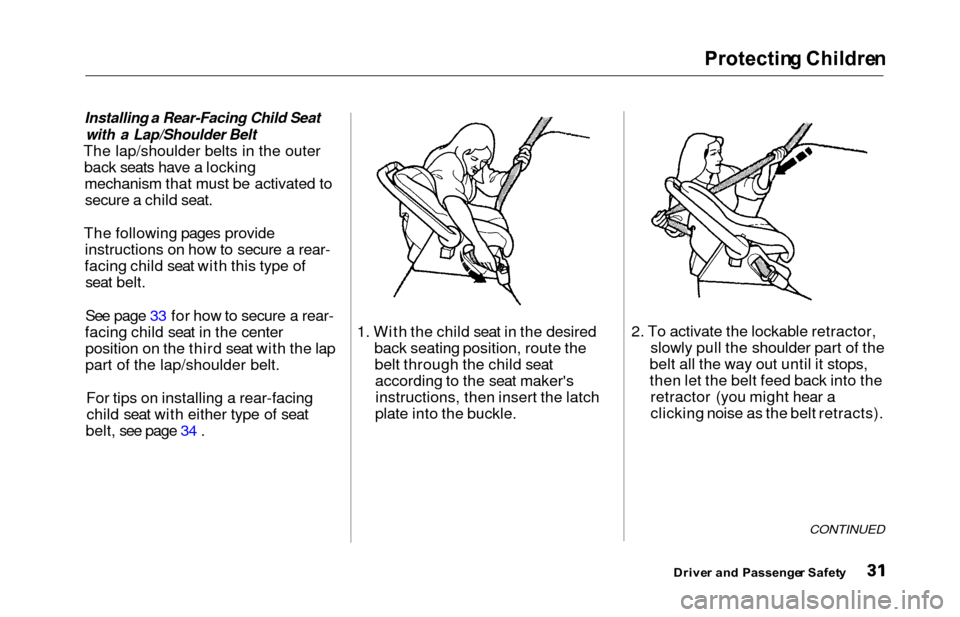
belt, see page 34 . 1. With the child seat in the desired
back seating position, route thebelt through the child seataccording to the seat maker'sinstructions, then insert the latch
plate into the buckle. 2. To activate the lockable retractor,
slowly pull the shoulder part of the
belt all the way out until it stops,
then let the belt feed back into the retractor (you might hear a
clicking noise as the belt retracts).
CONTINUED
Drive r an d Passenge r Safet y
Page 38 of 352
Protecting Childre n
Protectin g Smal l Childre n
Child Seat Type
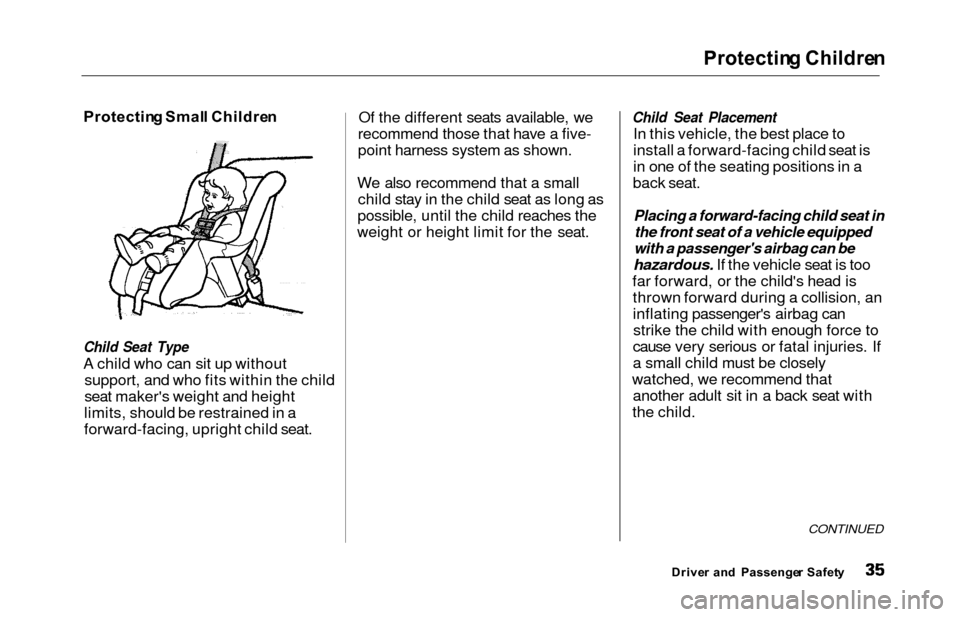
A child who can sit up without
support, and who fits within the child
seat maker's weight and height
limits, should be restrained in a
forward-facing, upright child seat. Of the different seats available, we
recommend those that have a five-
point harness system as shown.
We also recommend that a small child stay in the child seat as long as
possible, until the child reaches the
weight or height limit for the seat.
Child Seat Placement
In this vehicle, the best place to
install a forward-facing child seat is
in one of the seating positions in a
back seat.
Placing a forward-facing child seat in the front seat of a vehicle equipped
with a passenger's airbag can be
hazardous. If the vehicle seat is too
far forward, or the child's head is thrown forward during a collision, an
inflating passenger's airbag canstrike the child with enough force to
cause very serious or fatal injuries. If
a small child must be closely
watched, we recommend that another adult sit in a back seat with
the child.
CONTINUED
Drive r an d Passenge r Safet y
Page 49 of 352
Additional Informatio n Abou t You r Sea t Belt s
The seat belts in all positions except
the driver's and the center positionof the third seat have an additional
locking mechanism that must be activated to secure a child seat. (See
pages 31 and 36 for instructions on
how to secure child seats with this
type of seat belt.)
If the shoulder part of the belt is
pulled all the way out, the locking
mechanism will activate. The belt
will retract, but it will not allow thepassenger to move freely.
To deactivate the locking
mechanism, unlatch the buckle and
let the seat belt fully retract. To
refasten the belt, pull it out only as
far as needed.
See page 15 for instructions on how
to wear the lap/shoulder belt
properly.
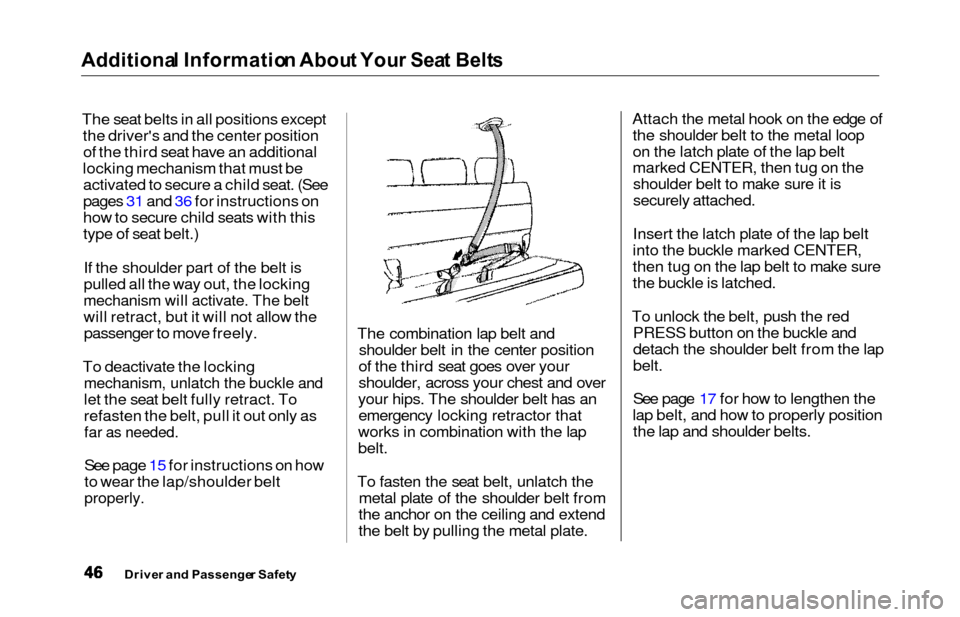
The combination lap belt and shoulder belt in the center position
of the third seat goes over your
shoulder, across your chest and over
your hips. The shoulder belt has an emergency locking retractor that
works in combination with the lap
belt.
To fasten the seat belt, unlatch the metal plate of the shoulder belt from
the anchor on the ceiling and extend
the belt by pulling the metal plate. Attach the metal hook on the edge of
the shoulder belt to the metal loop
on the latch plate of the lap belt
marked CENTER, then tug on theshoulder belt to make sure it is
securely attached.
Insert the latch plate of the lap belt
into the buckle marked CENTER,
then tug on the lap belt to make sure
the buckle is latched.
To unlock the belt, push the red PRESS button on the buckle and
detach the shoulder belt from the lap
belt.
See page 17 for how to lengthen the
lap belt, and how to properly position the lap and shoulder belts.
Drive r an d Passenge r Safet y
Page 58 of 352

Instrument
s an d Control s
This section gives information about
the controls and displays that
contribute to the daily operation of
your Honda. All the essential
controls are within easy reach.
Control Locations............................
56
Indicator Lights...............................
. 57
Gauges.............................................. 62
Controls Near the Steering
Wheel........................................ 65
Headlights.................................... 66
Automatic Lighting Off
Feature......................................
67
Daytime Runnin
g Lights.............
67
Instrument
Pane
l Brightness.....
67
Turn
Signals................................
.
68
Windshield
Wipers.....................
. 68
Windshield Washers................... 70
Rear Window Wiper and Washer...................................... 70
Hazard Warning........................ 70
Rear Windo
w Defogger.............. 71
Steering Wheel Adjustment....... 72
Steering Wheel Controls................ 73
Cruise Control.............................. 73
Remote Audio Controls .............. 76
Keys and Locks................................ 76
Keys............................................... 76
Immobilizer System..................... 77
Ignition Switch............................. 78
Power Door Locks....................... 79
Remote Transmitter.................... 81
Childproof Door Locks............... 85
Tailgate......................................... 85
Glove Box..................................... 87
Manual Sliding Doors...................... 88
Power Sliding Doors........................ 89
HomeLink Universal Transmitter.................................. 95
Seats.................................................. 99
Passenger Seating....................... 99
Seat Adjustments....................... 100
Driver's Seat Power
Adjustments........................... 102
Armrests..................................... 103
Head Restraints......................... 104
Third Seat Access...................... 105 Moving the Second Row Bucket Seat............................ 106
Removing the Bucket Seats in the Second Row................. 108
Folding the Third Seat.............. 109
Power Windows............................. 112
Mirrors............................................ 115
Parking Brake................................ 116
Digital Clock................................... 117 Center Table................................... 117
Beverage Holder............................ 118
Sunglasses Holder......................... 120
Sun Visor......................................... 121
Vanity Mirror................................. 121 Rear Compartment........................ 122
Center Pocket................................ 122Coin Holder.................................... 122
Storage Box.................................... 123
Coat Hook....................................... 123
Accessory Power Sockets............. 124 Interior Lights................................ 125
Instrument s an d Control s
Page 102 of 352
Seats
Passenge r Seatin g
Convertible Second Row Bucket
Seats
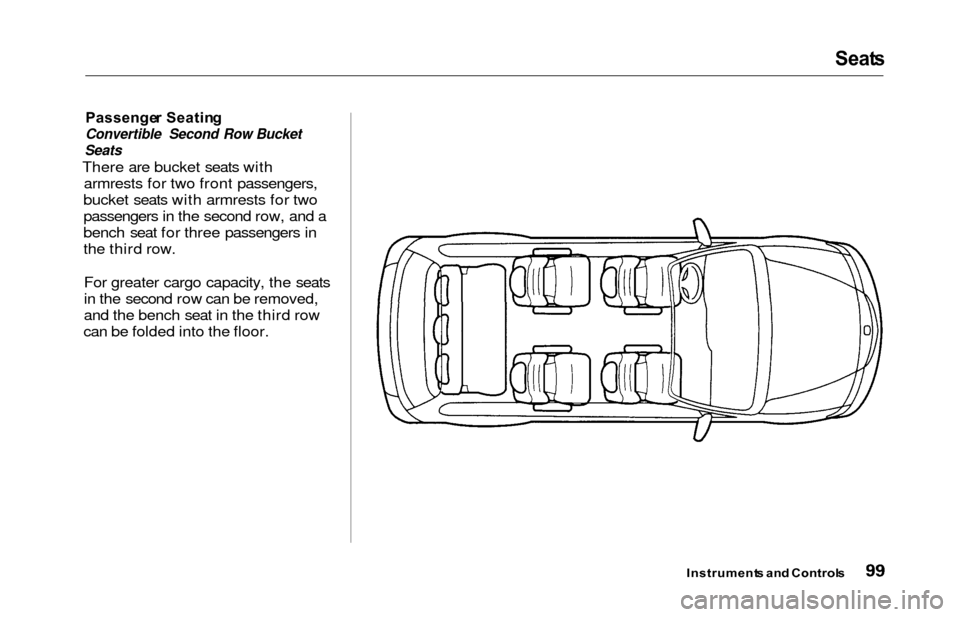
There are bucket seats with
armrests for two front passengers,
bucket seats with armrests for two
passengers in the second row, and a
bench seat for three passengers in
the third row.
For greater cargo capacity, the seats
in the second row can be removed,
and the bench seat in the third row
can be folded into the floor.
Instrument s an d Control s
Page 103 of 352
Seats
Seat Adjustment s
See pages 12 — 13 for important safety
information and warnings about how to
properly position seats and seat-backs.
The EX model has a power adjustable driver's seat. All other
models have manual driver's seat
adjustments.
The front passenger's seat, and the seats in the second and third rows
adjust manually.
Make all seat adjustments before
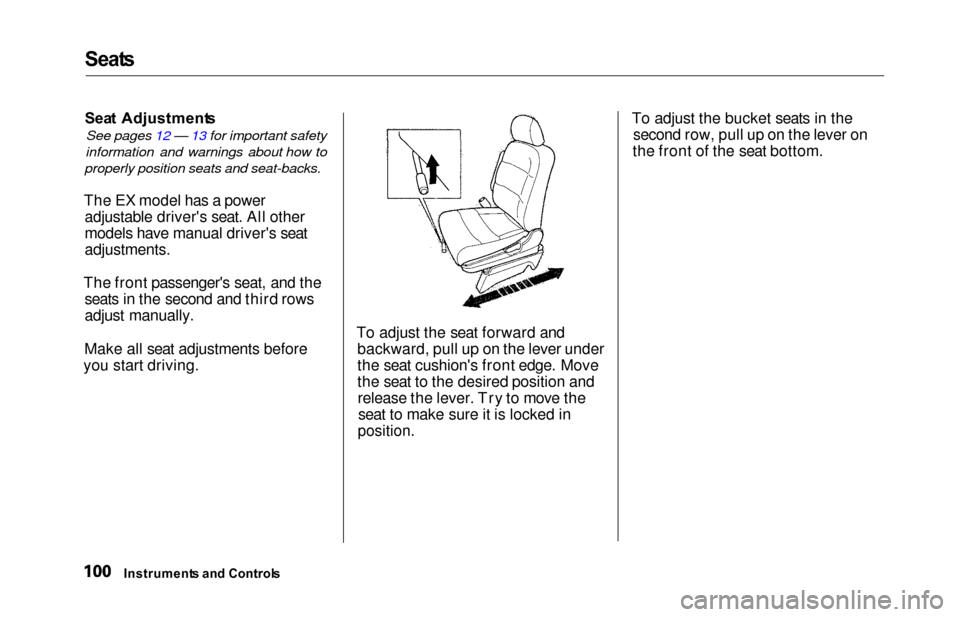
you start driving. To adjust the seat forward and
backward, pull up on the lever under
the seat cushion's front edge. Move
the seat to the desired position andrelease the lever. Try to move theseat to make sure it is locked in
position.
To adjust the bucket seats in the second row, pull up on the lever on
the front of the seat bottom.
Instrument s an d Control s