2000 HONDA ODYSSEY change time
[x] Cancel search: change timePage 193 of 352
Service Statio n Procedure s
3. Remove the fuel fill cap slowly.
You may hear a hissing sound aspressure inside the tank escapes.
Place the cap in the holder on the
fuel fill door.
4. Stop filling the tank after the fuel nozzle automatically clicks off. Do
not try to "top off" the tank, leavesome room for the fuel to expand
with temperature changes.
5. Screw the fuel fill cap back on, tighten it until it clicks several
times. If you do not properly
tighten the cap, the Malfunction
Indicator Lamp may come on (seepage 309 ).
6. Push the fuel fill door closed until it latches.Openin g th e Hoo d
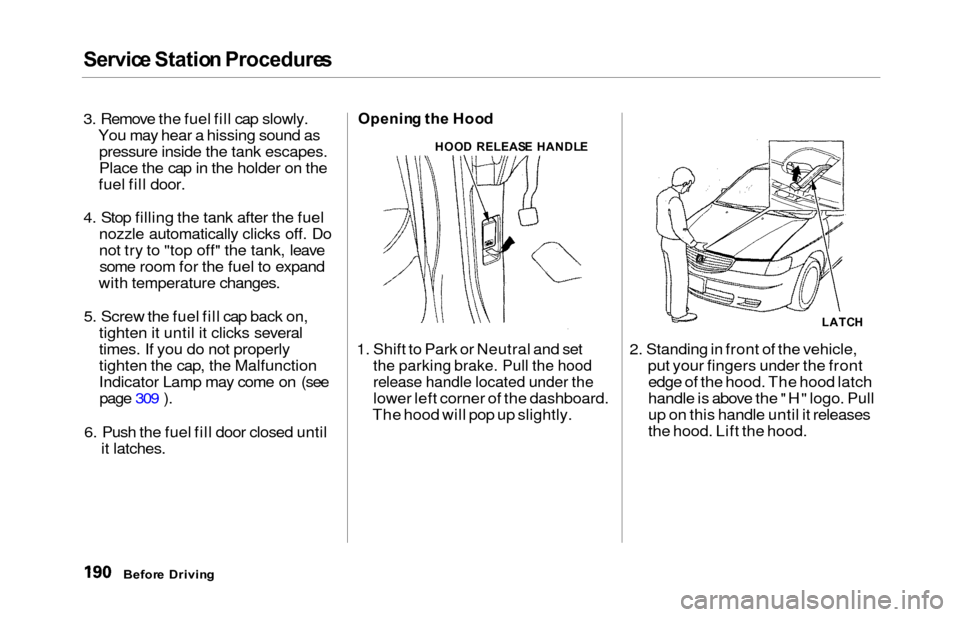
1. Shift to Park or Neutral and set
the parking brake. Pull the hood
release handle located under the
lower left corner of the dashboard.
The hood will pop up slightly. 2. Standing in front of the vehicle,
put your fingers under the frontedge of the hood. The hood latch
handle is above the "H" logo. Pull
up on this handle until it releases
the hood. Lift the hood.
Befor e Drivin g
HOOD RELEAS E HANDL E
LATCH
Page 222 of 352
Towin
g a Traile r
Gros s Vehicl e Weigh t Ratin g
(GVWR) :
The total weight of the vehicle, all occupants, all cargo, and the
tongue load must not exceed: 5,565 Ibs (2,525 kg)
Gros s Axl e Weigh t Ratin g
(GAWR) :
The total weight of the vehicle, all occupants, all cargo, and the
tongue load must not exceed:
2,775 Ibs (1,260 kg)
on the front axle
2,840 Ibs (1,290 kg)
on the rear axle
Gros
s Combine d Weigh t Ratin g
(GCWR) :
The total weight of the vehicle, all occupants and cargo, and the
trailer and everything in or on it,
must not exceed:
8,160 Ibs (3,700 kg)
with transmission fluid cooler
6,660 Ibs (3,025 kg)
without transmission fluid cooler
Checkin
g Load s
The best way to confirm that vehicle and trailer weights are within limits
is to have them checked at a public
scale.
Using a suitable scale or a special
tongue load gauge, check the tongue
load the first time you set up a
towing combination (a fully-loaded
vehicle and trailer), then recheck the tongue load whenever the conditions
change.
Driving
Exceeding load limits or
improperly loading your vehicle
and trailer can cause a crash in
which you can be seriously
injured or killed.
Check the loading of your
vehicle and trailer carefully before starting to drive.
Page 244 of 352
Engine Oi l
Additive s
Your Honda does not need any oil additives. Purchasing additives for
the engine or transmission will not increase your vehicle's performance
or longevity. It only increases the
cost of operating your vehicle. Changin
g th e Oi l an d Filte r
Always change the oil and filter according to the time and distance (miles/kilometers) recommenda-
tions in the maintenance schedule.
The oil and filter collect contami- nants that can damage your engine if
they are not removed regularly.
Changing the oil and filter requires
special tools and access from
underneath the vehicle. The vehicle should be raised on a service station-
type hydraulic lift for this service. Unless you have the knowledge and
proper equipment, you should have
this maintenance done by a skilled mechanic.
1. Run the engine until it reaches normal operating temperature,
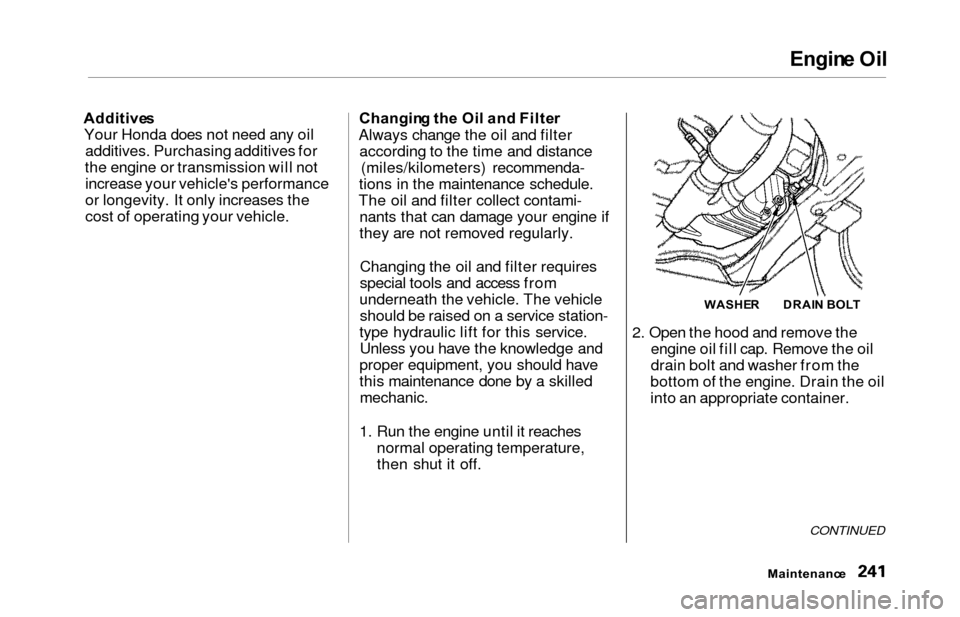
then shut it off. 2. Open the hood and remove the
engine oil fill cap. Remove the oil
drain bolt and washer from the
bottom of the engine. Drain the oil
into an appropriate container.
CONTINUED
Maintenanc e
WASHERDRAIN BOL T
Page 284 of 352
Storing You r Vehicl e
If you need to park your vehicle for
an extended period (more than one
month), there are several things you
should do to prepare it for storage.
Proper preparation helps prevent
deterioration and makes it easier to
get your vehicle back on the road. If
possible, store your vehicle indoors.
Fill the fuel tank.Change the engine oil and filter
(see page 241).
Wash and dry the exterior
completely.
Clean the interior. Make sure the
carpeting, floor mats, etc. are
completely dry.
Leave the parking brake off. Put
the transmission in Park.
Block the rear wheels.
If the vehicle is to be stored for a
longer period, it should be
supported on jackstands so the
tires are off the ground. Leave one window open slightly (if
the vehicle is being stored
indoors).
Disconnect the battery.
Support the front and rear wiper
blade arms with a folded towel or rag so they do not touch the
windshield.
To minimize sticking, apply a silicone spray lubricant to all door
and tailgate seals. Also, apply a
vehicle body wax to the painted surfaces that mate with the door
and tailgate seals.
Cover the vehicle with a
"breathable" cover, one made
from a porous material such as cotton. Nonporous materials, such
as plastic sheeting, trap moisture,
which can damage the paint.
If possible, run the engine for a
while periodically (preferably once a month).
If you store your vehicle for 12
months or longer, have your Honda
dealer perform the inspections called
for in the 24 months/30,000 miles (48,000 km) maintenance schedule
(Normal Conditions) as soon as you
take it out of storage (see page 230).
The replacements called for in the maintenance schedule are not
needed unless the vehicle hasactually reached that time or mileage.
Maintenanc e
Page 346 of 352
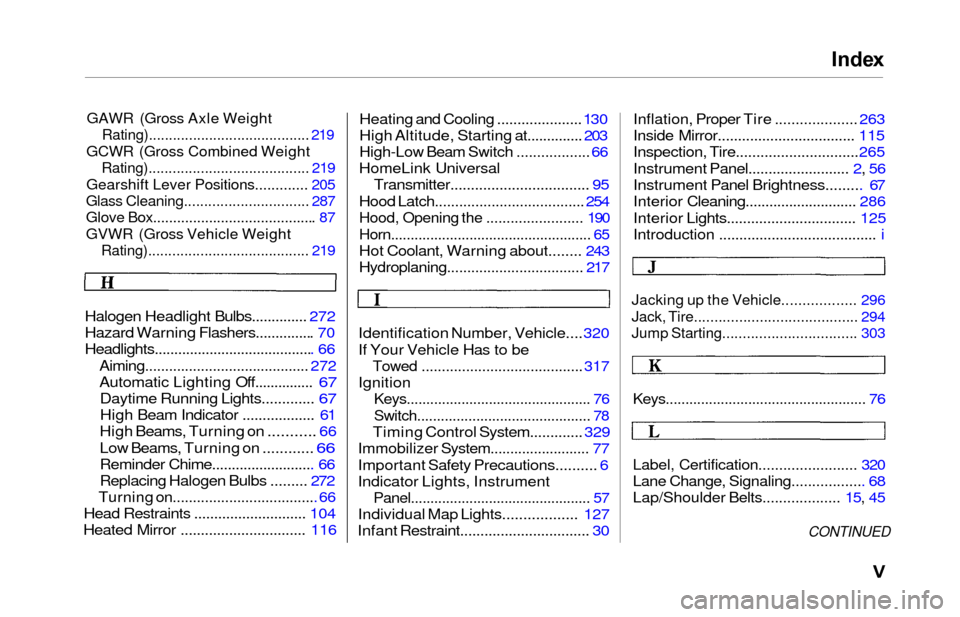
Index
GAWR (Gross Axle Weight
Rating)........................................ 219
GCWR (Gross Combined Weight
Rating)........................................ 219
Gearshift Lever Positions............. 205
Glass Cleaning............................... 287
Glove Box........................................ . 87
GVWR (Gross Vehicle Weight
Rating)........................................ 219
Halogen Headlight Bulbs.............. 272
Hazard Warning Flashers.............. . 70
Headlights........................................ . 66
Aiming......................................... 272
Automatic Lighting Off............... 67
Daytime Running Lights............. 67
High Beam Indicator .................. 6 1
High Beams, Turning on
........... 66
Low Beams, Turning on ............
66
Reminder Chime.......................... 66
Replacing Halogen Bulbs ......... 272
Turning on.................................... 66
Head Restraints ............................ 104
Heated Mirror ............................... 116Heating and Cooling .....................
130
High Altitude, Starting at.............. 203
High-Low Beam Switch .................. 66
HomeLink Universal
Transmitter.................................. 95
Hood Latch..................................... 254
Hood, Opening the ........................ 190
Horn.................................................. . 65
Hot Coolant, Warning about........ 243
Hydroplaning.................................. 217
Identification Number, Vehicle.... 320
If Your Vehicle Has to be
Towed ....................................... . 317
Ignition
Keys............................................... 76
Switch........................................... . 78
Timing Control System............. 329
Immobilizer System......................... 77
Important Safety Precautions.......... 6
Indicator Lights, Instrument
Panel............................................. . 57
Individual Map Lights.................. 127
Infant Restraint............................... . 30
Inflation, Proper Tire .................... 263
Inside Mirror.................................. 115
Inspection, Tire.............................. 265
Instrument Panel......................... 2, 56
Instrument Panel Brightness......... 67
Interior Cleaning............................ 286
Interior Lights................................ 125
Introduction ....................................... i
Jacking up the Vehicle.................. 296
Jack, Tire........................................ 294
Jump Starting................................. 303
Keys................................................... 76
Label, Certification........................ 320
Lane Change, Signaling.................. 68
Lap/Shoulder Belts................... 15, 45
CONTINUED
Page 350 of 352

Index
Tachometer...................................... 62
Tailgate............................................. 85
Opening the.................................. 85
Open Monitor Light.................... 60
Taillights, Changing Bulbs in....... 275
Taking Care of the Unexpected .. 291
Tape Player ........................... 160, 181
Technical Descriptions DOT Tire Quality Grading....... 324
Driving in Foreign Countries... 327
Emissions Control Systems...... 328Oxygenated Fuels...................... 326
Three Way Catalytic Converter................................ 330
Temperature Gauge........................ 63 Tensioners, Seat Belts.................... 50Tether Attachment Points.............. 43
Theft Protection............................ .
186
Three Way Catalytic Converter... 330
Time, Setting the........................... 117
Timing Belt..................................... 263
Tire Chains..................................... 269
Tire, How to Change a Flat.......... 293 Tires...............................................
. 263
Air Pressure.............................. . 263
Balancing.................................... 266
Checking Wear.......................... 265
Compact Spare........................... 292
DOT Tire Quality Grading....... 324
Inflation....................................... 263
Inspection................................... 265 Replacing.................................... 267
Rotating....................................... 266
Snow........................................... . 269
Specifications............................ . 323
Tire Chains................................. 269
Towing
A Trailer ................................. 218
Emergency Wrecker................. 317
Traction Control System (TCS)... 213
Transmission
Checking Fluid Level................ 249
Fluid Selection........................... . 249
Identification Number............... 321
Shifting the Automatic.............. 205
Treadwear...................................... 324
Trip Meter......................................... 63
Turn Signals..................................... 68
Tools, Tire Changing ................... 293
Underside, Cleaning...................... 288
Unexpected, Taking Care
of the .......................................... 29 1
Uniform Tire Quality Grading .... 324
Unleaded Gasoline......................... 188
Upholstery Cleaning...................... 286
Used Oil, How to Dispose of........ 242
Vanity Mirror................................. 121
Vehicle Capacity Load.......... 198, 218
Vehicle Dimensions....................... 322
Vehicle Identification Number..... 320
Vehicle Storage.............................. 281
Ventilation............................. 133, 138
VIN ................................................. 320
Vinyl Cleaning ............................... 286
Viscosity, Oil.................................. . 240
CONTINUED