Page 126 of 361
2-68
Raising the Convertible Top
1. Park on a level surface, set the parking brake firmly
and shift an automatic transmission into PARK (P).
Shift a manual transmission into REVERSE (R).
Lower both windows and sunshades and turn the
ignition key to OFF.
2. Tilt the driver's seat forward and press the storage
compartment release button, or use the manual
release cable if battery power has been lost. Lift the
storage compartment lid (C). (After pressing the
release button, the driver and passenger door glass
should retract to the full
-down position, if they have
not already been lowered.)
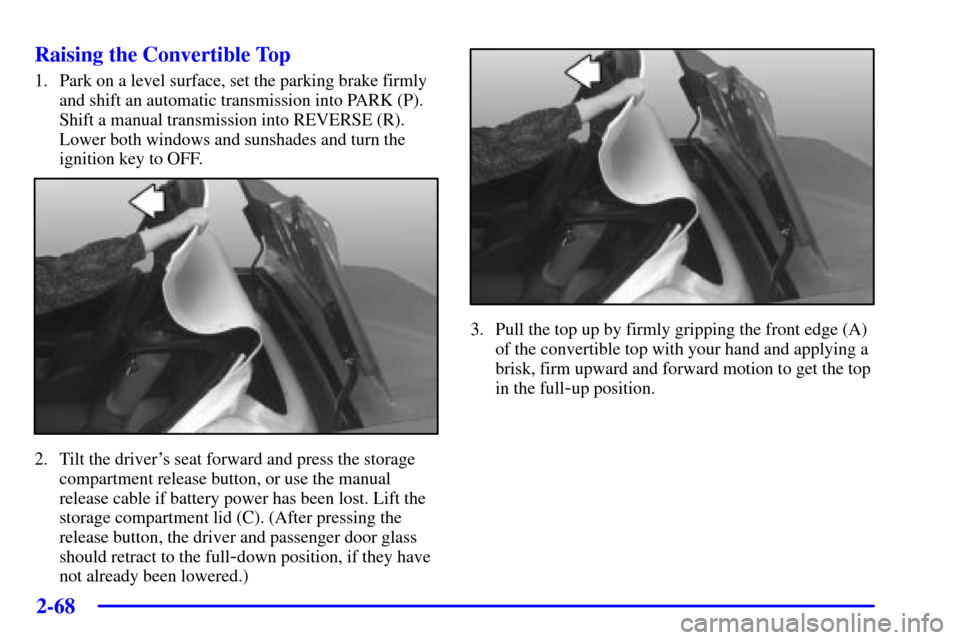
3. Pull the top up by firmly gripping the front edge (A)
of the convertible top with your hand and applying a
brisk, firm upward and forward motion to get the top
in the full
-up position.
Page 149 of 361
2-91
Press the GAGE button again to display the oil
temperature, such as:
�OIL TEMP 234 �F or
�OIL TEMP 112 �C
Press the GAGE button again to display the coolant
temperature, such as:
�COOLANT TEMP 123 �F or
�COOLANT TEMP 51 �C
Press the GAGE button again to display the transmission
fluid temperature (automatic transmission only),
such as:
�TRANS FLUID 123 �F or
�TRANS FLUID 51 �C
Press the GAGE button again to display the battery
voltage, such as:
�BATTERY VOLTS 13.5
Press the GAGE button again to display the tire pressure
for the front tires (left and right), such as:
�FRONT L34 R33 PSI or
�FRONT L234 R228 kPaPress the GAGE button again to display the tire pressure
for the rear tires (left and right), such as:
�REAR L34 R33 PSI or
�REAR L234 R228 kPa
Note that tire pressure is not available until the vehicle
has reached a speed of 15 mph (24 km/h) or more.
3 TRIP
The TRIP button allows you to scroll through the
functions listed below when you press it.
Page 154 of 361

2-96
If you choose AUTO LOCK ON, both doors will
automatically lock when the vehicle exceeds 10 mph
(16 km/h) in a manual transmission. In a vehicle with an
automatic transmission, both doors will automatically
lock when you move the shifter out of PARK (P).
Choose AUTO LOCK OFF to turn this option off.
Auto Unlock
The AUTO UNLOCK will be available only if AUTO
LOCK is set to ON which is described previously.
Press the OPTIONS button until AUTO UNLOCK
appears on the display, then use the RESET button to
page through the following choices:
�AUTO UNLOCK DRIVER
�AUTO UNLOCK BOTH
�AUTO UNLOCK OFF
If you choose AUTO UNLOCK DRIVER, the driver's
door will automatically unlock when you turn the
vehicle off and pull the key out of the ignition.
Choose AUTO UNLOCK BOTH, and both doors will
automatically unlock when you turn the vehicle off and
pull the key out of the ignition.
AUTO UNLOCK OFF turns off this option.Easy Entry
The easy entry feature will only be available if the
vehicle is equipped with the memory option.
Press the OPTIONS button until SEAT EASY ENTRY
appears on the display, then use the RESET button to
page through the following choices:
�SEAT EASY ENTRY ON
�SEAT EASY ENTRY OFF
If you choose SEAT EASY ENTRY ON, when you turn the
ignition off and remove the key, the seat will automatically
move back and the telescopic steering wheel (if equipped)
will return to its full
-forward position for an easy exit or an
easy entrance when returning to the vehicle.
SEAT EASY ENTRY OFF turns off this option.
Languages
You can select which language the DIC will display its
messages. Press the OPTIONS button until the word
LANGUAGES appears on the display, then use the
RESET button to page through the following choices:
�LANGUAGE ENGLISH
�LANGUAGE FRENCH
�LANGUAGE GERMAN
�LANGUAGE SPANISH
Page 161 of 361

2-103
REDUCE ENGINE RPM: You will hear four chimes
when this message is displayed. To acknowledge the
warning, press the RESET button. After you press the
RESET button, a message will be displayed and you
will hear a chime every minute until this condition
changes. If you do not press RESET, the message will
remain on the digital display until the condition changes.
If the engine oil temperature exceeds 320�F (160�C),
this message is displayed. You should check the engine
coolant temperature and engine oil level. If your engine
is too hot, see ªEngine Overheatingº in the Index.
Your vehicle may need service, so see your dealer.
You can monitor the oil temperature with the GAGES
button on the DIC.
HIGH TRANS TEMP (Automatic Transmission
Only): You will hear four chimes when this message is
displayed. To acknowledge this warning, press the
RESET button. After you press the RESET button,
the message will be displayed every 10 minutes until
the condition changes. If you do not press RESET,
the message remains on the display until the
condition changes.If the transmission fluid temperature rises above
270�F (132�C) or rises rapidly, this message is
displayed. The transmission may shift gears or apply the
torque converter clutch to reduce the fluid temperature.
Driving aggressively or driving on long hills can cause
the transmission fluid temperature to be higher than
normal. If this message appears, you may continue to
drive at a slower speed. You should also monitor the
transmission fluid temperature and allow it to cool to at
least 230�F (110�C). The transmission fluid temperature
can be monitored with the GAGES button on the DIC.
See ªAutomatic Transmission Fluidº in the Index.
You should also check the engine coolant temperature.
If it is also hot, see ªEngine Overheatingº in the Index.
If the HIGH TRANS TEMP message is displayed
during normal vehicle operation on flat roads, your
vehicle may need service. See your dealer for
an inspection.
SERVICE ACTIVE HANDLG: If the SERVICE
ACTIVE HNDLG message is displayed, there is a
problem with your Active Handling System and your
vehicle needs service. The instrument cluster light will
also be on and a chime will sound. When this message is
displayed, the system is not working. Adjust your
driving accordingly.
Page 165 of 361
2-107 Other Messages
Here are more messages that you can receive on your
Driver Information Center (DIC). To acknowledge a
message and read another message that may have come
on at the same time, press the RESET button.
�BRAKE BEFORE SHIFT (Automatic
Transmissions Only)
�CHANGE OIL NOW (See ªGM Oil Life System�º
in the Index.)
�CHANGE OIL SOON (See ªGM Oil Life System�º
in the Index.)
�CRUISE DISENGAGED (See ªCruise Controlº in
the Index.)
�CRUISE SET __ MPH (__ km/h) (See ªCruise
Controlº in the Index.)
�DOOR AJAR�ENGINE PROTECTION REDUCE ENGINE RPM
�HATCH AJAR (Coupe)
�TONNEAU AJAR
�HIGH VOLTAGE (See ªVoltmeterº in the Index.)
�LOW BRAKE FLUID (See ªBrake Fluidº in
the Index.)
�LOW FUEL (See ªFuel Gageº in the Index.)
�LOW VOLTAGE (See ªVoltmeterº in the Index.)
�LOW WASHER FLUID (See ªWindshield Washer
Fluidº in the Index.)
�RESERVE FUEL (See ªFuel Gageº in the Index.)
�TRUNK AJAR (Convertible/Hardtop)
�UPSHIFT NOW (See ªManual Transmissionº in
the Index.)
Page 235 of 361
5-4
2. Get the vehicles close enough so the jumper cables
can reach, but be sure the vehicles aren't touching
each other. If they are, it could cause a ground
connection you don't want. You wouldn't be able to
start your vehicle, and the bad grounding could
damage the electrical systems.
To avoid the possibility of the vehicles rolling, set
the parking brake firmly on both vehicles involved
in the jump start procedure. Put an automatic
transmission in PARK (P) or a manual transmission
in NEUTRAL before setting the parking brake.
3. Turn off the ignition on both vehicles. Unplug
unnecessary accessories plugged into the cigarette
lighter or accessory plug. Turn off all lamps that
aren't needed as well as radios. This will avoid
sparks and help save both batteries. In addition,
it could save your radio.
NOTICE:
If you leave your radio on, it could be badly
damaged. The repairs wouldn't be covered by
your warranty.
4. Open the hoods and locate the batteries. Find the
positive (+) and negative (
-) terminals on each.
CAUTION:
An electric fan can start up even when the engine
is not running and can injure you. Keep hands,
clothing and tools away from any underhood
electric fan.
Page 241 of 361
5-10
NOTICE:
If your engine catches fire because you keep
driving with no coolant, your vehicle can be
badly damaged. The costly repairs would not be
covered by your warranty. See ªOverheated
Engine Protection Operating Modeº in the Index.
If No Steam Is Coming From Your Engine
If you get an engine overheat warning but see or hear no
steam, the problem may not be too serious. Sometimes
the engine can get a little too hot when you:
�Climb a long hill on a hot day.
�Stop after high
-speed driving.
�Idle for long periods in traffic.If you get the overheat warning with no sign of steam,
try this for a minute or so:
1. If your air conditioner is on, turn it off.
2. Turn on your heater to full hot at the highest fan
speed and open the window as necessary.
3. If you're in a traffic jam, shift to NEUTRAL (N);
otherwise, shift to the highest gear while
driving
-- AUTOMATIC OVERDRIVE (�) or
THIRD (3) for automatic transmissions.
If you no longer have the overheat warning, you can
drive. Just to be safe, drive slower for about 10 minutes.
If the warning doesn't come back on, you can
drive normally.
If the warning continues, pull over, stop, and park your
vehicle right away.
If there's still no sign of steam, idle the engine for
three minutes while you're parked. If you still have the
warning, turn off the engine and get everyone out of
the vehicle until it cools down. Also, see ªOverheated
Engine Protection Operating Modeº listed previously in
this section.
You may decide not to lift the hood but to get service
help right away.
Page 250 of 361

6-
6-1
Section 6 Service and Appearance Care
Here you will find information about the care of your vehicle. This section begins with service and fuel information,
and then it shows how to check important fluid and lubricant levels. There is also technical information about your
vehicle, and a part devoted to its appearance care.
6
-2 Service
6
-3 Fuel
6
-5 Filling Your Tank
6
-9 Checking Things Under the Hood
6
-12 Engine Oil
6
-17 Engine Air Cleaner/Filter
6
-19 Automatic Transmission Fluid
6
-19 Manual Transmission Fluid
6
-21 Hydraulic Clutch
6
-22 Rear Axle
6
-23 Engine Coolant
6
-26 Surge Tank Pressure Cap
6
-26 Power Steering Fluid
6
-27 Windshield Washer Fluid
6
-29 Brakes
6
-32 Battery
6
-33 Bulb Replacement
6
-37 Windshield Wiper Blade Replacement6
-40 Tires
6
-52 Lifting Your Corvette
6
-56 Appearance Care
6
-56 Cleaning the Inside of Your Vehicle
6
-59 Cleaning a Removable Roof Panel
6
-60 Cleaning the Outside of Your Vehicle
6
-61 Cleaning Your Convertible Top
6
-62 Cleaning Aluminum Wheels
6
-62 Cleaning Tires
6
-62 Finish Damage
6
-63 Underbody Maintenance
6
-64 GM Vehicle Care/Appearance Materials
6
-65 Vehicle Identification Number (VIN)
6
-65 Service Parts Identification Label
6
-66 Electrical System
6
-73 Replacement Bulbs
6
-74 Capacities and Specifications
6
-75 Normal Maintenance Replacement Parts