Page 4 of 364
iii
Table of Contents (cont'd)
Braking/Anti-lock Brakes
Traction Control System
Steering
Driving Tips for Various Road ConditionsRecreational Vehicle Towing
Loading Your Vehicle
Towing a Trailer Heating and Air Conditioning
Setting the Radio ClockRadio/Cassette Player/CD Player
Radio Theft-Deterrent Feature
Hazard Warning Flashers
Jump Starting
Towing Your VehicleEngine Overheating
Changing a Flat Tire
If You're Stuck
Problems on the Road
Section
3
Section
4
Section
5
Comfort Controls and Audio Systems
Your Driving and the Road
Page 10 of 364
ix
For example,
these symbols
are used on an
original battery:
CAUTION
POSSIBLE
INJURY
PROTECT
EYES BY
SHIELDING
CAUSTIC
BATTERY
ACID COULD
CAUSE
BURNS
AVOID
SPARKS OR
FLAMES
SPARK OR
FLAME
COULD
EXPLODE
BATTERY
These symbols
are important
for you and
your passengers
whenever your
vehicle is
driven:
DOOR LOCK
UNLOCK
FASTEN
SEAT
BELTS
POWER
WINDOW
AIR BAG
These symbols
have to do with
your lamps:
MASTER
LIGHTING
SWITCH
TURN
SIGNALS
PARKING
LAMPS
HAZARD
WARNING
FLASHER
DAYTIME
RUNNING
LAMPS
FOG LAMPS
These symbols
are on some of
your controls:
WINDSHIELD
WIPER
WINDSHIELD
WASHER
WINDSHIELD
DEFROSTER
REAR
WINDOW
DEFOGGER
VENTILATING
FAN
These symbols
are used on
warning and
indicator lights:
ENGINE
COOLANT
TEMP
BATTERY
CHARGING
SYSTEM
BRAKE
COOLANT
ENGINE OIL
PRESSURE
ANTI-LOCK
BRAKES
Here are some
other symbols
you may see:
FUSE
LIGHTER
HORN
SPEAKER
FUEL
Vehicle Symbols
These are some of the symbols you may find on your vehicle.
Page 11 of 364
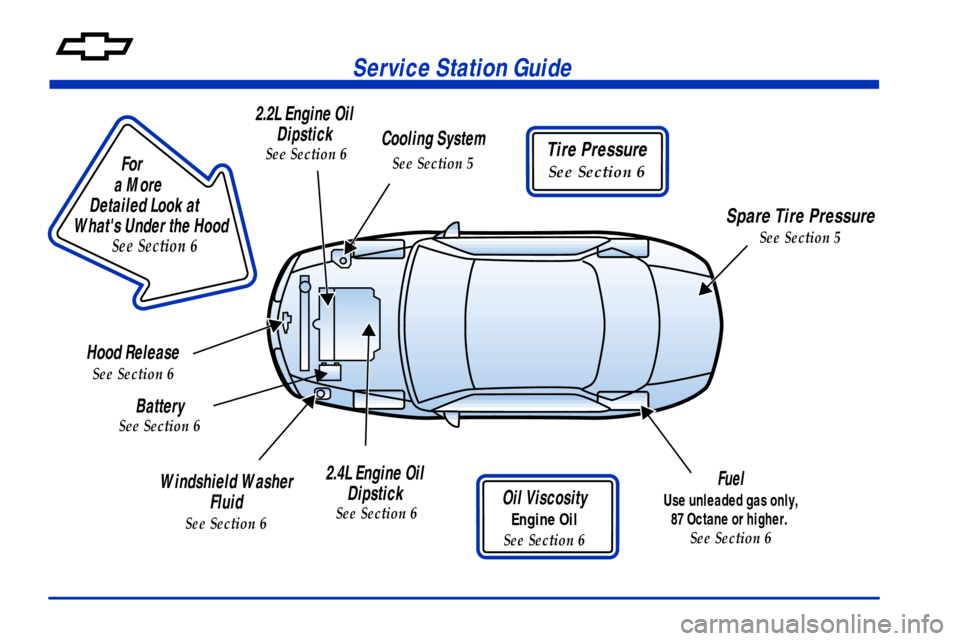
For
a More
Detailed Look at
What's Under the Hood
See Section 6
Service Station Guide
Oil Viscosity
Engine Oil
See Section 6
Fuel
Use unleaded gas only,
87 Octane or higher.
See Section 6
Cooling System
See Section 5
Hood Release
See Section 6
Windshield Washer
Fluid
See Section 6
Spare Tire Pressure
See Section 5
Battery
See Section 6
Tire Pressure
See Section 6
2.4L Engine Oil
Dipstick
See Section 6
2.2L Engine Oil
Dipstick
See Section 6
Page 65 of 364

2-
2-1
Section 2 Features and Controls
Here you can learn about the many standard and optional features on your vehicle, and information on starting,
shifting and braking. Also explained are the instrument panel and the warning systems that tell you if everything is
working properly
-- and what to do if you have a problem.
2
-2 Keys
2
-4 Door Locks
2
-7 Remote Keyless Entry (If Equipped)
2
-13 Theft
2
-14 Passlock�
2-14 New Vehicle ªBreak-Inº
2
-15 Ignition Positions
2
-17 Starting Your Engine
2
-19 Engine Coolant Heater (If Equipped)
2
-21 Automatic Transaxle Operation
2
-25 Manual Transaxle Operation
2
-27 Parking Brake
2
-28 Shifting Into PARK (P)
(Automatic Transaxle Only)
2
-29 Shifting Out of PARK (P)
(Automatic Transaxle Only)
2
-30 Parking Your Vehicle
(Manual Transaxle Models Only)
2
-30 Parking Over Things That Burn2
-31 Engine Exhaust
2
-31 Running Your Engine While You're Parked
(Automatic Transaxle)
2
-32 Windows
2
-33 Tilt Wheel (If Equipped)
2
-34 Turn Signal/Multifunction Lever
2
-40 Exterior Lamps
2
-42 Interior Lamps
2
-44 Mirrors
2
-46 Storage Compartments
2
-46 Ashtrays and Cigarette Lighter (If Equipped)
2
-47 Sun Visors
2
-47 Sunroof (If Equipped)
2
-48 Convertible Top (If Equipped)
2
-60 The Instrument Panel -- Your
Information System
2
-62 Instrument Panel Cluster
2
-64 Warning Lights, Gages and Indicators
Page 76 of 364

2-12
Trunk
To unlock the trunk from the outside, insert the key and
turn the trunk lock cylinder or use the remote keyless
entry transmitter (if equipped).
When closing the trunk, close from the center to ensure
it fully latches.
CAUTION:
It can be dangerous to drive with the trunk lid
open because carbon monoxide (CO) gas can
come into your vehicle. You can't see or smell
CO. It can cause unconsciousness and even death.
If you must drive with the trunk lid open or if
electrical wiring or other cable connections must
pass through the seal between the body and the
trunk lid:
�Make sure all other windows are shut.
CAUTION: (Continued)
CAUTION: (Continued)
�Turn the fan on your heating or cooling
system to its highest speed with the setting
on any airflow selection except MAX.
That will force outside air into your vehicle.
See ªComfort Controlsº in the Index.
�If you have air outlets on or under the
instrument panel, open them all the way.
See ªEngine Exhaustº in the Index.
Remote Trunk Release (If Equipped)
Pull upward on the remote
release handle, located on
the floor near the left side
of the driver's seat, to
release the trunk lid.
Page 78 of 364

2-14
Passlock�
Your vehicle is equipped with the Passlock
theft
-deterrent system.
Passlock is a passive theft
-deterrent system. Passlock
enables fuel if the ignition lock cylinder is turned with a
valid key. If a correct key is not used or the ignition lock
cylinder is tampered with, fuel is disabled.
During normal operation, the THEFT SYSTEM light
will go off approximately five seconds after the key is
turned to the ON ignition position.
If the engine stalls and the THEFT SYSTEM light
flashes, wait until the light stops flashing before trying
to restart the engine. Remember to release the key from
START as soon as the engine starts.
If the engine is running and the THEFT SYSTEM light
comes on, you will be able to restart the engine if you
turn the engine off. However, your Passlock system is not
working properly and must be serviced by your dealer.
Your vehicle is not protected by Passlock at this time.
You may also want to check the fuses (see ªFuses and
Circuit Breakersº in the Index). See your dealer for service.
In an emergency, call the Chevrolet Roadside Assistance
Center at 1
-800-ROADSIDE (1-800-762-3743).
In Canada call 1
-800-268-6800.
New Vehicle ªBreak-Inº
NOTICE:
Your vehicle doesn't need an elaborate
ªbreak
-in.º But it will perform better in the
long run if you follow these guidelines:
�Don't drive at any one speed -- fast or
slow
-- for the first 500 miles (805 km).
Don't make full
-throttle starts.
�Avoid making hard stops for the first
200 miles (322 km) or so. During this time
your new brake linings aren't yet broken
in. Hard stops with new linings can mean
premature wear and earlier replacement.
Follow this breaking
-in guideline every
time you get new brake linings.
�Don't tow a trailer during break
-in.
See ªTowing a Trailerº in the Index for
more information.
Page 79 of 364

2-15
Ignition Positions
With the ignition key in the ignition, you can turn the
switch to five positions.
ACCESSORY (A): In this position, you can operate
your electrical power accessories. Press in the ignition
switch as you turn it toward you.LOCK (B): This is the only position in which you can
remove the key. This locks your steering wheel, ignition,
shift lever and transaxle.
OFF (C): This position unlocks the steering wheel,
ignition and transaxle, but does not send electrical
power to any accessories. Use this position if your
vehicle must be pushed or towed, but never try to
push
-start your vehicle. A warning chime will sound
if you open the driver's door when the ignition is off
and the key is in the ignition.
RUN (D): This is the position the switch returns to,
after you start your engine and release the switch.
The switch stays in RUN when the engine is running.
But even when the engine is not running, you can use
RUN to operate your electrical power accessories, and
to display some instrument panel warning lights.
START (E): This position starts the engine. When
the engine starts, release the key. The ignition switch
will return to RUN for normal driving.
Even if the engine is not running, the positions
ACCESSORY and RUN allow you to operate
electrical accessories, such as the radio.
Page 80 of 364

2-16
CAUTION:
On manual transaxle vehicles, turning the key to
LOCK will lock the steering column and result
in a loss of ability to steer the vehicle. This could
cause a collision. If you need to turn the engine
off while the vehicle is moving, turn the key only
to OFF. Don't press the key release button while
the vehicle is moving.
NOTICE:
If your key seems stuck in LOCK and you can't
turn it, be sure you are using the correct key;
if so, is it all the way in? If it is, then turn the
steering wheel left and right while you turn the
key hard. But turn the key only with your hand.
Using a tool to force it could break the key or the
ignition switch. If none of this works, then your
vehicle needs service.
Key Release Button (Manual Transaxle)
The ignition key cannot
be removed from the
ignition unless the key
release button is used.
To remove the key, turn the key to OFF. While pressing
the key release button in, turn the key to LOCK. Pull the
key straight out.
Retained Accessory Power
Your vehicle is equipped with a Retained Accessory
Power (RAP) feature which will allow the radio to
continue to work up to 10 minutes after the ignition is
turned to OFF.
Your radio will work when the ignition key is in RUN or
ACCESSORY. Once the key is turned from RUN to OFF,
the radio will continue to work for up to 10 minutes or
until the driver's door is opened.