Page 89 of 364

2-25
Manual Transaxle Operation
5-Speed
This is your shift pattern.
Here's how to operate your transaxle:
FIRST (1): Press the clutch pedal and shift into
FIRST (1). Then, slowly let up on the clutch pedal
as you press the accelerator pedal.You can shift into FIRST (1) when you're going less
than 20 mph (32 km/h). If you've come to a complete
stop and it's hard to shift into FIRST (1), put the shift
lever in NEUTRAL (N) and let up on the clutch. Press
the clutch pedal back down. Then shift into FIRST (1).
SECOND (2): Press the clutch pedal as you let up
on the accelerator pedal and shift into SECOND (2).
Then, slowly let up on the clutch pedal as you press
the accelerator pedal.
THIRD (3), FOURTH (4) and FIFTH (5): Shift
into THIRD (3), FOURTH (4) and FIFTH (5), the
same way you do for SECOND (2). Slowly let up on
the clutch pedal as you press the accelerator pedal.
To stop, let up on the accelerator pedal and press the
brake pedal. Just before the vehicle stops, press the
clutch pedal and the brake pedal, and shift to
NEUTRAL (N).
NEUTRAL (N): Use this position when you start
or idle your engine.
Page 92 of 364
2-28
Shifting Into PARK (P)
(Automatic Transaxle Only)
CAUTION:
It can be dangerous to get out of your vehicle if
the shift lever is not fully in PARK (P) with the
parking brake firmly set. Your vehicle can roll.
If you have left the engine running, the vehicle
can move suddenly. You or others could be
injured. To be sure your vehicle won't move,
even when you're on fairly level ground, use
the steps that follow. If you're pulling a trailer,
see ªTowing a Trailerº in the Index.
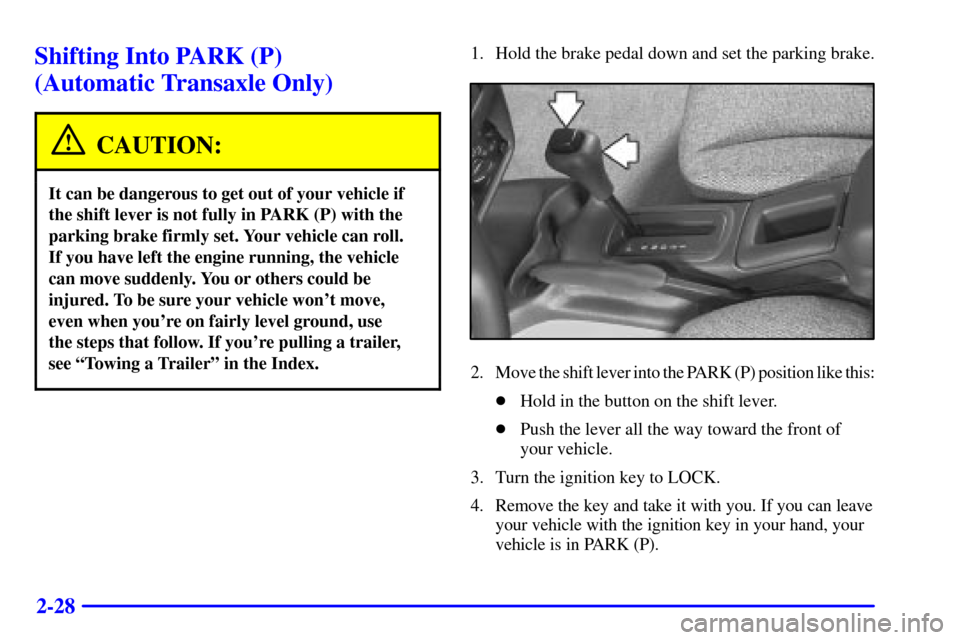
1. Hold the brake pedal down and set the parking brake.
2. Move the shift lever into the PARK (P) position like this:
�Hold in the button on the shift lever.
�Push the lever all the way toward the front of
your vehicle.
3. Turn the ignition key to LOCK.
4. Remove the key and take it with you. If you can leave
your vehicle with the ignition key in your hand, your
vehicle is in PARK (P).
Page 93 of 364

2-29 Leaving Your Vehicle With the Engine
Running (Automatic Transaxle Only)
CAUTION:
It can be dangerous to leave your vehicle with
the engine running. Your vehicle could move
suddenly if the shift lever is not fully in PARK (P)
with the parking brake firmly set. And, if you
leave the vehicle with the engine running, it could
overheat and even catch fire. You or others could
be injured. Don't leave your vehicle with the
engine running unless you have to.
If you have to leave your vehicle with the engine
running, be sure your vehicle is in PARK (P) and your
parking brake is firmly set before you leave it. After
you've moved the shift lever into PARK (P), hold the
regular brake pedal down. Then, see if you can move the
shift lever away from PARK (P) without first pushing
the button. If you can, it means that the shift lever
wasn't fully locked into PARK (P).
Torque Lock (Automatic Transaxle)
If you are parking on a hill and you don't shift your
transaxle into PARK (P) properly, the weight of the
vehicle may put too much force on the parking pawl in
the transaxle. You may find it difficult to pull the shift
lever out of PARK (P). This is called ªtorque lock.º
To prevent torque lock, set the parking brake and then
shift into PARK (P) properly before you leave the
driver's seat. To find out how, see ªShifting Into
PARK (P)º in the Index.
When you are ready to drive, move the shift lever out
of PARK (P) before you release the parking brake.
If torque lock does occur, you may need to have
another vehicle push yours a little uphill to take some
of the pressure from the parking pawl in the transaxle,
so you can pull the shift lever out of PARK (P).
Shifting Out of PARK (P)
(Automatic Transaxle Only)
Your vehicle has an automatic transaxle shift lock
control system. You have to fully apply your regular
brakes before you can shift from PARK (P) when
the ignition is in RUN. See ªAutomatic Transaxleº
in the Index.
Page 95 of 364

2-31
Engine Exhaust
CAUTION:
Engine exhaust can kill. It contains the gas
carbon monoxide (CO), which you can't see or
smell. It can cause unconsciousness and death.
You might have exhaust coming in if:
�Your exhaust system sounds strange
or different.
�Your vehicle gets rusty underneath.
�Your vehicle was damaged in a collision.
�Your vehicle was damaged when driving over
high points on the road or over road debris.
�Repairs weren't done correctly.
�Your vehicle or exhaust system had been
modified improperly.
If you ever suspect exhaust is coming into
your vehicle:
�Drive it only with all the windows down to
blow out any CO; and
�Have your vehicle fixed immediately.
Running Your Engine While You're
Parked (Automatic Transaxle)
It's better not to park with the engine running. But if you
ever have to, here are some things to know.
CAUTION:
Idling the engine with the climate control
system off could allow dangerous exhaust into
your vehicle (see the earlier Caution under
ªEngine Exhaustº).
Also, idling in a closed-in place can let deadly
carbon monoxide (CO) into your vehicle even if
the fan switch is at the highest setting. One place
this can happen is a garage. Exhaust
-- with
CO
-- can come in easily. NEVER park in a
garage with the engine running.
Another closed-in place can be a blizzard.
(See ªBlizzardº in the Index.)
Page 96 of 364

2-32
CAUTION:
It can be dangerous to get out of your vehicle if
the shift lever is not fully in PARK (P) with the
parking brake firmly set. Your vehicle can roll.
Don't leave your vehicle when the engine is
running unless you have to. If you've left the
engine running, the vehicle can move suddenly.
You or others could be injured. To be sure your
vehicle won't move, even when you're on fairly
level ground, always set your parking brake and
move the shift lever to PARK (P).
Follow the proper steps to be sure your vehicle won't
move. See ªShifting Into PARK (P)º in the Index.
If you are parking on a hill and if you're pulling a
trailer, also see ªTowing a Trailerº in the Index.
Windows
Manual Windows
On a vehicle with manual windows, use the window
crank to open and close each window.
Power Windows (If Equipped)
With power windows, switches on the center console
control each of the windows when the ignition is on.
In addition, on four
-door models, each rear passenger
door has a control switch for its own window.
Page 105 of 364

2-41 Daytime Running Lamps
Daytime Running Lamps (DRL) can make it easier
for others to see the front of your vehicle during the
day. DRL can be helpful in many different driving
conditions, but they can be especially helpful in the
short periods after dawn and before sunset.
The DRL system will make your high and low
-beam
headlamps come on at a reduced brightness in
daylight when:
�The ignition is on with the engine running,
�the headlamp switch is OFF,
�the parking brake is released, and
�the transaxle is not in PARK (P) on models with an
automatic transaxle only.
This indicator light on
your instrument panel
cluster will come on
when the DRL are on.A flashing DRL telltale indicates a possible burned out
headlamp, or that the vehicle may need service to repair
a stuck DRL relay.
When the DRL are on, your high and low
-beam
headlamps will be on at a reduced brightness. The
taillamps, sidemarker and other lamps won't be on.
Your instrument panel won't be lit up either.
When you turn on the headlamp switch, your high and
low
-beam headlamps will go out, and your low-beam
headlamps will come on. The other lamps that come
on with your headlamps will also come on.
When you turn off the headlamp switch, the regular
lamps will go off, and your high and low
-beam
headlamps will come on to the reduced brightness.
To idle your vehicle with the DRL off, set the parking
brake. The DRL will stay off until you release the
parking brake.
As with any vehicle, you should turn on the regular
headlamp system when you need it.
Page 122 of 364
2-58
1. Set the parking brake and shift your automatic
transaxle to PARK (P) or your manual transaxle to
NEUTRAL (N). Turn the engine off.
2. Push the button in the latch handle and rotate the
handle down.
3. Open the trunk.
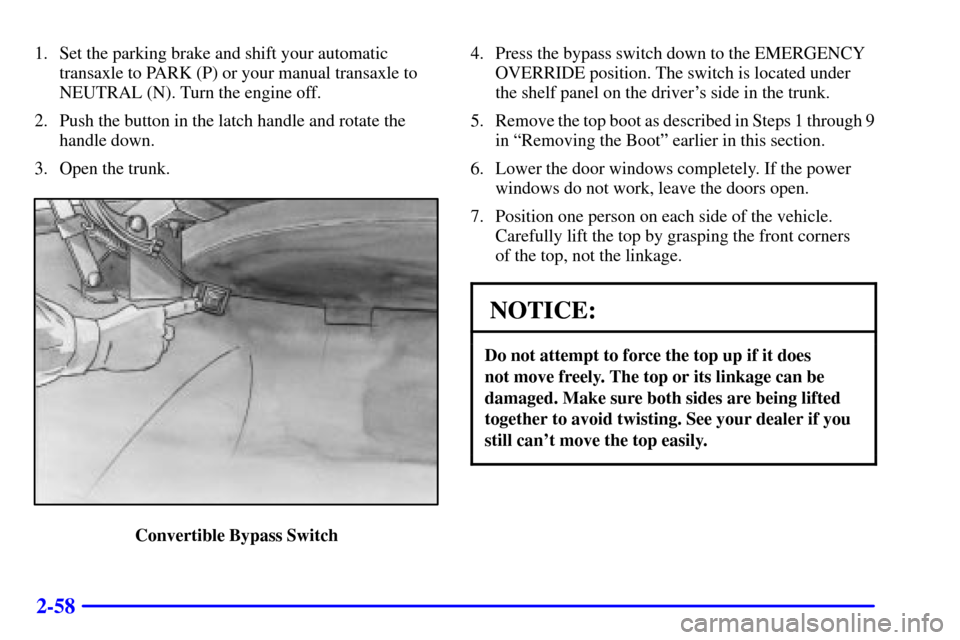
Convertible Bypass Switch4. Press the bypass switch down to the EMERGENCY
OVERRIDE position. The switch is located under
the shelf panel on the driver's side in the trunk.
5. Remove the top boot as described in Steps 1 through 9
in ªRemoving the Bootº earlier in this section.
6. Lower the door windows completely. If the power
windows do not work, leave the doors open.
7. Position one person on each side of the vehicle.
Carefully lift the top by grasping the front corners
of the top, not the linkage.
NOTICE:
Do not attempt to force the top up if it does
not move freely. The top or its linkage can be
damaged. Make sure both sides are being lifted
together to avoid twisting. See your dealer if you
still can't move the top easily.
Page 128 of 364
2-64 Tachometer (If Equipped)
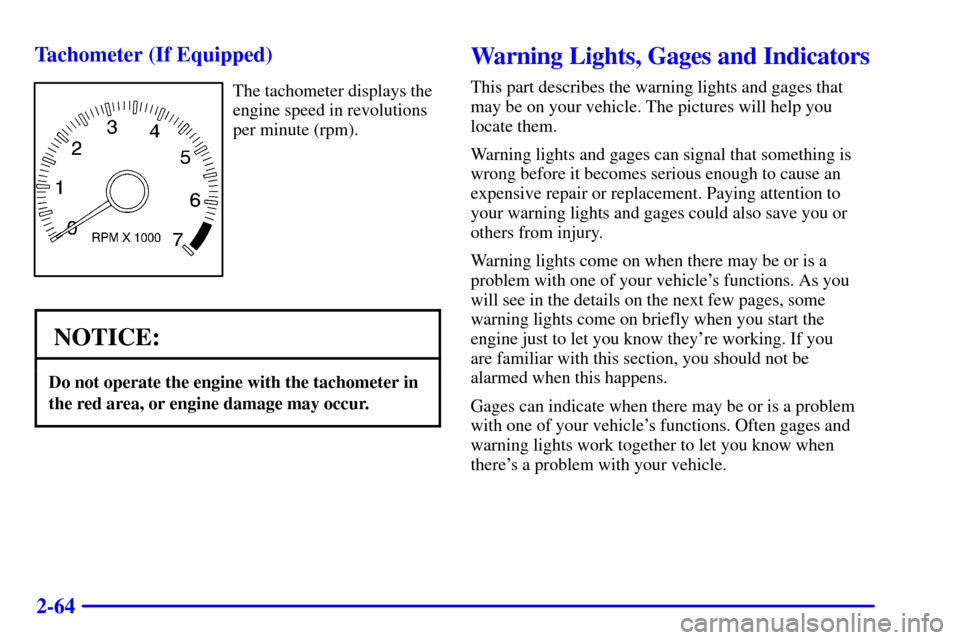
The tachometer displays the
engine speed in revolutions
per minute (rpm).
NOTICE:
Do not operate the engine with the tachometer in
the red area, or engine damage may occur.
Warning Lights, Gages and Indicators
This part describes the warning lights and gages that
may be on your vehicle. The pictures will help you
locate them.
Warning lights and gages can signal that something is
wrong before it becomes serious enough to cause an
expensive repair or replacement. Paying attention to
your warning lights and gages could also save you or
others from injury.
Warning lights come on when there may be or is a
problem with one of your vehicle's functions. As you
will see in the details on the next few pages, some
warning lights come on briefly when you start the
engine just to let you know they're working. If you
are familiar with this section, you should not be
alarmed when this happens.
Gages can indicate when there may be or is a problem
with one of your vehicle's functions. Often gages and
warning lights work together to let you know when
there's a problem with your vehicle.