Page 212 of 359

4-2
Defensive Driving
The best advice anyone can give about driving is:
Drive defensively.
Please start with a very important safety device in your
vehicle: Buckle up. (See ªSafety Beltsº in the Index.)Defensive driving really means ªbe ready for anything.º
On city streets, rural roads or freeways, it means
ªalways expect the unexpected.º
Assume that pedestrians or other drivers are going to
be careless and make mistakes. Anticipate what they
might do. Be ready for their mistakes.
Rear
-end collisions are about the most preventable
of accidents. Yet they are common. Allow enough
following distance. It's the best defensive driving
maneuver, in both city and rural driving. You never
know when the vehicle in front of you is going to brake
or turn suddenly.
Defensive driving requires that a driver concentrate on
the driving task. Anything that distracts from the
driving task
-- such as concentrating on a cellular
telephone call, reading, or reaching for something on
the floor
-- makes proper defensive driving more
difficult and can even cause a collision, with resulting
injury. Ask a passenger to help do things like this, or
pull off the road in a safe place to do them yourself.
These simple defensive driving techniques could save
your life.
Page 222 of 359
4-12
Try to adjust your speed so you can ªdriveº through
the curve. Maintain a reasonable, steady speed. Wait to
accelerate until you are out of the curve, and then
accelerate gently into the straightaway.
To help you steer in the direction you want to go, during
certain sharp or sudden cornering maneuvers, gear
selection is controlled. This will maximize the available
drive wheel torque and minimize the transaxle response
time and shift activity. During this kind of maneuver, the
transaxle shifts automatically as vehicle speed changes.
Steering in Emergencies
There are times when steering can be more effective than
braking. For example, you come over a hill and find a
truck stopped in your lane, or a car suddenly pulls out
from nowhere, or a child darts out from between parked
cars and stops right in front of you. You can avoid these
problems by braking
-- if you can stop in time. But
sometimes you can't; there isn't room. That's the time
for evasive action
-- steering around the problem.
Your vehicle can perform very well in emergencies like
these. First apply your brakes. (See ªBraking in
Emergenciesº earlier in this section.) It is better to
remove as much speed as you can from a possible
collision. Then steer around the problem, to the left
or right depending on the space available.
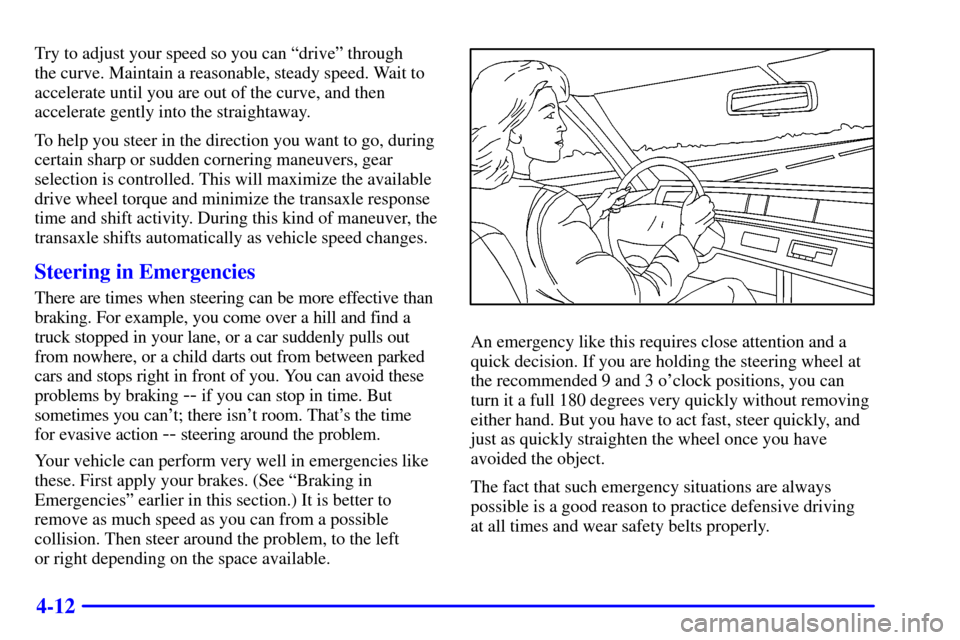
An emergency like this requires close attention and a
quick decision. If you are holding the steering wheel at
the recommended 9 and 3 o'clock positions, you can
turn it a full 180 degrees very quickly without removing
either hand. But you have to act fast, steer quickly, and
just as quickly straighten the wheel once you have
avoided the object.
The fact that such emergency situations are always
possible is a good reason to practice defensive driving
at all times and wear safety belts properly.
Page 248 of 359
4-38 When You Are Ready to Leave After
Parking on a Hill
1. Apply your regular brakes and hold the pedal down
while you:
�Start your engine;
�Shift into a gear; and
�Be sure the parking brake has released.
2. Let up on the brake pedal.
3. Drive slowly until the trailer is clear of the chocks.
4. Stop and have someone pick up and store the chocks.
Maintenance When Trailer Towing
Your vehicle will need service more often when you're
pulling a trailer. See the Maintenance Schedule booklet
for more on this. Things that are especially important
in trailer operation are automatic transaxle fluid (don't
overfill), engine oil, drive belt, cooling system and brake
system. If you're trailering, it's a good idea to review
this information before you start your trip.
Check periodically to see that all hitch nuts and bolts
are tight.
Engine Cooling When Trailer Towing
Your cooling system may temporarily overheat during
severe operating conditions. See ªEngine Overheatingº
in the Index.
Page 277 of 359

6-
6-1
Section 6 Service and Appearance Care
Here you will find information about the care of your vehicle. This section begins with service and fuel information,
and then it shows how to check important fluid and lubricant levels. There is also technical information about your
vehicle, and a part devoted to its appearance care.
6
- 2 Service
6
- 3 Fuel
6
- 5 Filling Your Tank
6
- 8 Filling a Portable Fuel Container
6
- 8 Checking Things Under the Hood
6
- 11 Engine Oil
6
- 16 Engine Air Cleaner/Filter
6
- 19 Automatic Transaxle Fluid
6
- 22 Engine Coolant
6
- 25 Surge Tank Pressure Cap
6
- 26 Power Steering Fluid
6
- 27 Windshield Washer Fluid
6
- 28 Brakes
6
- 32 Battery
6
- 34 Bulb Replacement6
- 43 Windshield Wiper Blade Replacement
6
- 44 Tires
6
- 52 Appearance Care
6
- 53 Cleaning the Inside of Your Vehicle
6
- 54 Care of Safety Belts
6
- 55 Cleaning the Outside of Your Vehicle
6
- 57 Cleaning Tires
6
- 59 GM Vehicle Care/Appearance Materials
6
- 60 Vehicle Identification Number (VIN)
6
- 60 Service Parts Identification Label
6
- 61 Electrical System
6
- 68 Removing the Rear Seat Cushion
6
- 69 Replacement Bulbs
6
- 69 Capacities and Specifications
6
- 70 Normal Maintenance Replacement Parts
Page 308 of 359

6-32 Replacing Brake System Parts
The braking system on a vehicle is complex. Its many
parts have to be of top quality and work well together
if the vehicle is to have really good braking. Your
vehicle was designed and tested with top
-quality GM
brake parts. When you replace parts of your braking
system
-- for example, when your brake linings wear
down and you have to have new ones put in
-- be
sure you get new approved GM replacement parts.
If you don't, your brakes may no longer work properly.
For example, if someone puts in brake linings that
are wrong for your vehicle, the balance between your
front and rear brakes can change
-- for the worse.
The braking performance you've come to expect can
change in many other ways if someone puts in the
wrong replacement brake parts.
Battery
Your new vehicle comes with a maintenance free
ACDelco� battery. When it's time for a new battery,
get one that has the replacement number shown on
the original battery's label. We recommend an
ACDelco battery.The battery is located under the rear seat cushion.
To access the battery, see ªRemoving the Rear Seat
Cushionº in the Index. You don't need to access the
battery to jump start your vehicle. See ªJump Startingº
in the Index.
CAUTION:
A battery that isn't properly vented can let
sulfuric acid fumes into the area under the rear
seat cushion. These fumes can damage your rear
seat safety belt systems. You may not be able
to see this damage, and the safety belts might
not provide the protection needed in a crash.
If a replacement battery is ever needed, it must be
vented in the same manner as the original battery.
Always make sure that the vent hose is properly
reattached before reinstalling the seat cushion.
Page 324 of 359

6-48 Buying New Tires
To find out what kind and size of tires you need, look at
the Tire
-Loading Information label.
The tires installed on your vehicle when it was new had
a Tire Performance Criteria Specification (TPC Spec)
number on each tire's sidewall. When you get new tires,
get ones with that same TPC Spec number. That way
your vehicle will continue to have tires that are designed
to give proper endurance, handling, speed rating,
traction, ride and other things during normal service
on your vehicle. If your tires have an all
-season tread
design, the TPC number will be followed by an ªMSº
(for mud and snow).
If you ever replace your tires with those not having
a TPC Spec number, make sure they are the same
size, load range, speed rating and construction type
(bias, bias
-belted or radial) as your original tires.
CAUTION:
Mixing tires could cause you to lose control
while driving. If you mix tires of different sizes
or types (radial and bias
-belted tires), the vehicle
may not handle properly, and you could have a
crash. Using tires of different sizes may also
cause damage to your vehicle. Be sure to use
the same size and type tires on all wheels.
It's all right to drive with your compact spare,
though. It was developed for use on your vehicle.
CAUTION:
If you use bias-ply tires on your vehicle, the
wheel rim flanges could develop cracks after
many miles of driving. A tire and/or wheel could
fail suddenly, causing a crash. Use only radial
-ply
tires with the wheels on your vehicle.
Page 330 of 359

6-54 Cleaning Leather
Use a soft cloth with lukewarm water and a mild soap or
saddle soap and wipe dry with a soft cloth. Then, let the
leather dry naturally. Do not use heat to dry.
�For stubborn stains, use a leather cleaner. See your
dealer for this product.
�Never use oils, varnishes, solvent
-based or abrasive
cleaners, furniture polish or shoe polish on leather.
�Soiled or stained leather should be cleaned
immediately. If dirt is allowed to work into the
finish, it can harm the leather.
Cleaning the Top of the Instrument Panel
Use only mild soap and water to clean the top surfaces
of the instrument panel. Sprays containing silicones or
waxes may cause annoying reflections in the windshield
and even make it difficult to see through the windshield
under certain conditions.
Cleaning Interior Plastic Components
Use only a mild soap and water solution on a soft
cloth or sponge. Commercial cleaners may affect the
surface finish.
Cleaning Wood Panels
Use a clean cloth moistened in warm, soapy water
(use mild dish washing soap). Dry the wood immediately
with a clean cloth.
Cleaning Speaker Covers
Vacuum around a speaker cover gently, so that the
speaker won't be damaged. Clean spots with just water
and mild soap.
Care of Safety Belts
Keep belts clean and dry.
CAUTION:
Do not bleach or dye safety belts. If you do, it
may severely weaken them. In a crash, they
might not be able to provide adequate protection.
Clean safety belts only with mild soap and
lukewarm water.
Page 344 of 359
6-68
Removing the Rear Seat Cushion
NOTICE:
The battery and main fuse boxes are located
under the rear seat cushion. The battery's ground
terminal and some relay wires are exposed. To help
avoid damage to the battery and wires, be careful
when removing or reinstalling the seat cushion.
Do not remove covers from covered parts. Do not
store anything under the seat, as objects could
touch exposed wires and cause a short.
To Remove the Rear Seat Cushion
1. Pull up on the front of the cushion to release the
front hooks.
2. Pull the cushion up and out toward the front of
the vehicle.To Reinstall the Rear Seat Cushion
CAUTION:
A safety belt that isn't properly routed through
the seat cushion or is twisted won't provide the
protection needed in a crash. If the safety belt
CAUTION: (Continued)
