Page 136 of 321
2-71 Engine Coolant Temperature Warning Light
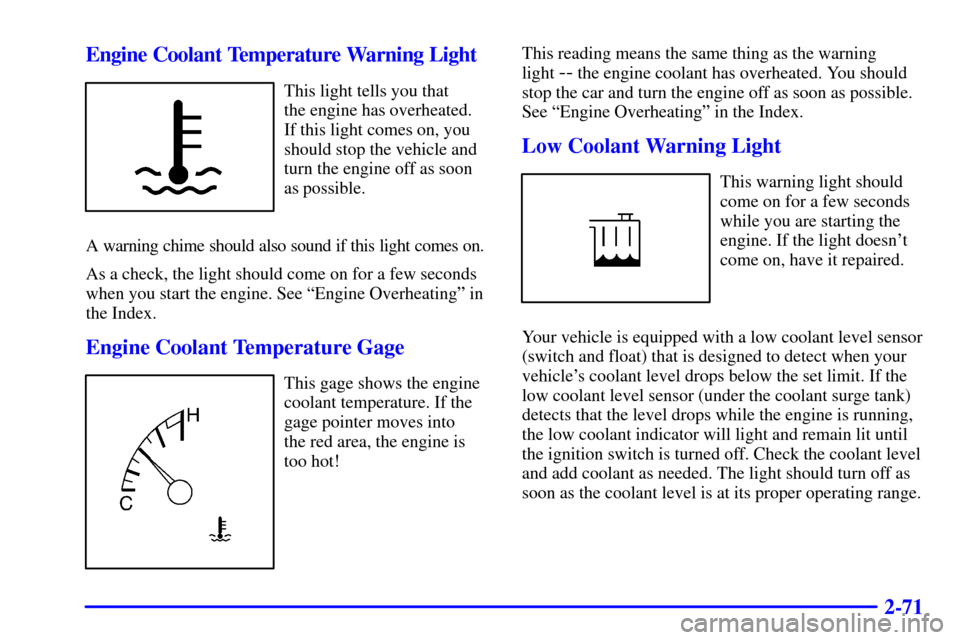
This light tells you that
the engine has overheated.
If this light comes on, you
should stop the vehicle and
turn the engine off as soon
as possible.
A warning chime should also sound if this light comes on.
As a check, the light should come on for a few seconds
when you start the engine. See ªEngine Overheatingº in
the Index.
Engine Coolant Temperature Gage
This gage shows the engine
coolant temperature. If the
gage pointer moves into
the red area, the engine is
too hot!This reading means the same thing as the warning
light
-- the engine coolant has overheated. You should
stop the car and turn the engine off as soon as possible.
See ªEngine Overheatingº in the Index.
Low Coolant Warning Light
This warning light should
come on for a few seconds
while you are starting the
engine. If the light doesn't
come on, have it repaired.
Your vehicle is equipped with a low coolant level sensor
(switch and float) that is designed to detect when your
vehicle's coolant level drops below the set limit. If the
low coolant level sensor (under the coolant surge tank)
detects that the level drops while the engine is running,
the low coolant indicator will light and remain lit until
the ignition switch is turned off. Check the coolant level
and add coolant as needed. The light should turn off as
soon as the coolant level is at its proper operating range.
Page 148 of 321

3-4
In cold weather, when the system senses the need for
heat, airflow will be directed out of the floor outlets.
As the interior temperature approaches a desired setting,
the blower speed will decrease. To maintain interior
comfort, the airflow may move to the instrument panel
air outlets and floor outlets (bi
-level mode). On bright
sunny days in cold weather, the airflow may come out
of the air conditioning outlets (AC mode) to maintain
comfort and prevent stuffiness.
If your vehicle is sitting out on a hot day and you have
the climate control system set for automatic operation,
the air will first flow out of the floor air outlets during
cool down. That is normal. This is to remove hot air
from the air outlets. As the air is cooled, the airflow
will move through the air conditioning outlets.
To avoid blowing cold air in cold weather, the system
will delay turning on the fan until warm air is available.
The length of delay depends on the outside air
temperature, engine coolant temperature or the time
since the engine was last started. As the coolant warms
up, the blower fan speed will gradually increase and
air will flow from the heater outlets, with some airflow
to the windshield to prevent fogging under most
normal conditions.If you leave your vehicle, the system will remember
the control setting the next time you start your engine,
except for recirculation and rear defrost (heated backlite).
Each ignition cycle cancels recirculation.
Manual Operation
You may manually adjust the air delivery mode or
fan speed.
HEATER/DEFROST: This setting directs air to
the floor outlets and toward the windshield.
AC: This setting directs airflow through the middle
instrument panel outlets.
BI-LEVEL: This setting directs air into your
vehicle in two ways. Cool air is directed to the upper
portion of your body through the middle instrument
panel outlets while warm air is directed to the floor.
HEATER: This setting directs warm air
through the floor outlets. Some warm air is sent to
the windshield to minimize fogging.
Page 226 of 321
5-13
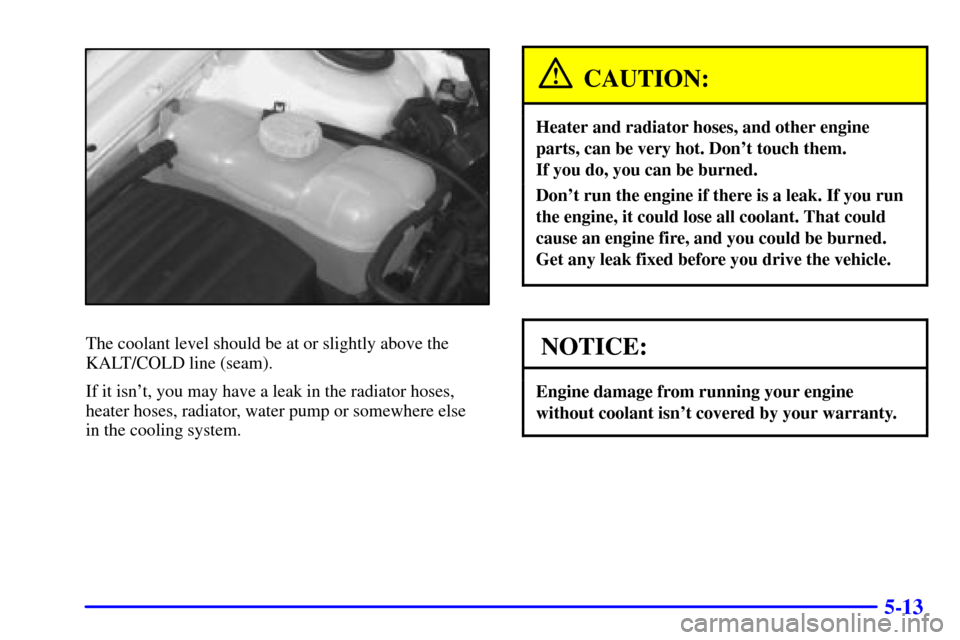
The coolant level should be at or slightly above the
KALT/COLD line (seam).
If it isn't, you may have a leak in the radiator hoses,
heater hoses, radiator, water pump or somewhere else
in the cooling system.
CAUTION:
Heater and radiator hoses, and other engine
parts, can be very hot. Don't touch them.
If you do, you can be burned.
Don't run the engine if there is a leak. If you run
the engine, it could lose all coolant. That could
cause an engine fire, and you could be burned.
Get any leak fixed before you drive the vehicle.
NOTICE:
Engine damage from running your engine
without coolant isn't covered by your warranty.
Page 227 of 321
5-14
NOTICE:
When adding coolant, it is important that
you use only DEX
-COOL� (silicate-free) coolant.
If coolant other than DEX-COOL is added
to the system, premature engine, heater core or
radiator corrosion may result. In addition, the
engine coolant will require change sooner
-- at
30,000 miles (50 000 km) or 24 months,
whichever occurs first. Damage caused by the
use of coolant other than DEX
-COOL� is not
covered by your new vehicle warranty.
If there seems to be no leak, with the engine on, check to
see if the electric engine cooling fans are running. If the
engine is overheating, both fans should be running.
If they aren't, your vehicle needs service.
How to Add Coolant to the Coolant
Surge Tank
If you haven't found a problem yet, but the coolant level
isn't at the KALT/COLD line (seam), add a 50/50
mixture of clean, drinkable water and DEX
-COOL�
coolant at the coolant surge tank, but be sure the cooling
system, including the coolant surge tank pressure cap, is
cool before you do it. (See ªEngine Coolantº in the
Index for more information.)
Page 231 of 321
5-18
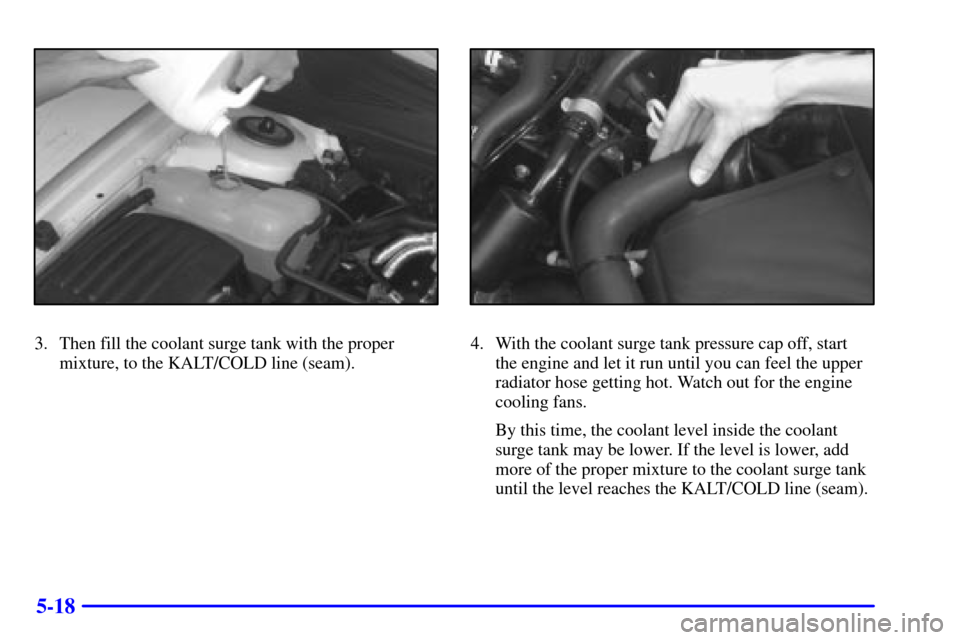
3. Then fill the coolant surge tank with the proper
mixture, to the KALT/COLD line (seam).4. With the coolant surge tank pressure cap off, start
the engine and let it run until you can feel the upper
radiator hose getting hot. Watch out for the engine
cooling fans.
By this time, the coolant level inside the coolant
surge tank may be lower. If the level is lower, add
more of the proper mixture to the coolant surge tank
until the level reaches the KALT/COLD line (seam).
Page 245 of 321

6-
6-1
Section 6 Service and Appearance Care
Here you will find information about the care of your vehicle. This section begins with service and fuel information,
and then it shows how to check important fluid and lubricant levels. There is also technical information about your
vehicle, and a part devoted to its appearance care.
6
- 2 Service
6
- 3 Fuel
6
- 5 Fuels in Foreign Countries
6
- 5 Filling Your Tank
6
- 9 Checking Things Under the Hood
6
- 11 Engine Oil
6
- 15 Engine Air Cleaner/Filter
6
- 19 Automatic Transmission Fluid
6
- 19 Rear Axle
6
- 20 Engine Coolant
6
- 24 Surge Tank Pressure Cap
6
- 24 Power Steering Fluid
6
- 25 Windshield Washer Fluid
6
- 26 Brakes
6
- 30 Battery
6
- 30 Bulb Replacement6
- 37 Wiper Blade Replacement
6
- 38 Tires
6
- 47 Appearance Care
6
- 47 Cleaning the Inside of Your Vehicle
6
- 49 Care of Safety Belts
6
- 51 Cleaning the Outside of Your Vehicle
6
- 52 Cleaning Aluminum or Chrome-Plated
Wheels (If Equipped)
6
- 53 Underbody Maintenance
6
- 54 GM Vehicle Care/Appearance Materials
6
- 55 Vehicle Identification Number (VIN)
6
- 55 Service Parts Identification Label
6
- 56 Electrical System
6
- 63 Replacement Bulbs
6
- 63 Capacities and Specifications
6
- 64 Normal Maintenance Replacement Parts
Page 264 of 321

6-20 How to Check Lubricant
If the level is below the bottom of the filler plug hole,
you'll need to add some lubricant. Add enough lubricant
to raise the level to the bottom of the filler plug hole.
What to Use
Refer to the Maintenance Schedule to determine what
kind of lubricant to use. See ªRecommended Fluids
and Lubricantsº in the Maintenance Schedule booklet.
Engine Coolant
The cooling system in your vehicle is filled with
DEX
-COOL� engine coolant. This coolant is
designed to remain in your vehicle for 5 years or
150,000 miles (240 000 km), whichever occurs first,
if you add only DEX
-COOL� extended life coolant.
The following explains your cooling system and how
to add coolant when it is low. If you have a problem
with engine overheating, see ªEngine Overheatingº
in the Index.
A 50/50 mixture of clean, drinkable water and
DEX
-COOL� coolant will:
�Give freezing protection down to
-34�F (-37�C).
�Give boiling protection up to 265�F (129�C).
�Protect against rust and corrosion.
�Help keep the proper engine temperature.
�Let the warning lights and gages work as
they should.
Page 267 of 321
6-23
CAUTION:
Turning the surge tank pressure cap when the
engine and radiator are hot can allow steam and
scalding liquids to blow out and burn you badly.
Never turn the surge tank pressure cap
-- even a
little
-- when the engine and radiator are hot.
The vehicle must be on a level surface. When your
engine is cold, the coolant level should be at the
KALT/COLD line (seam).
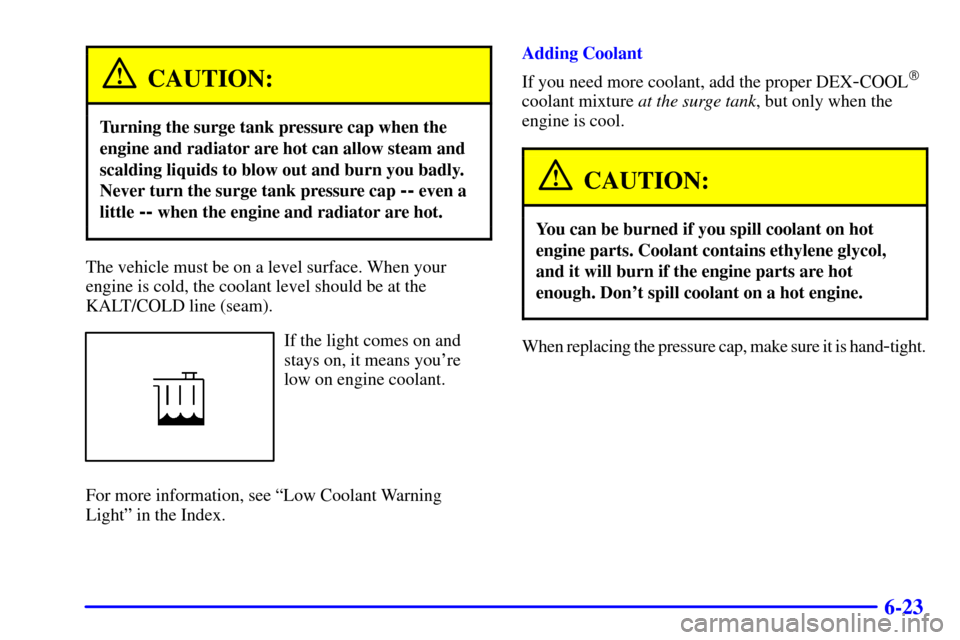
If the light comes on and
stays on, it means you're
low on engine coolant.
For more information, see ªLow Coolant Warning
Lightº in the Index.Adding Coolant
If you need more coolant, add the proper DEX
-COOL�
coolant mixture at the surge tank, but only when the
engine is cool.
CAUTION:
You can be burned if you spill coolant on hot
engine parts. Coolant contains ethylene glycol,
and it will burn if the engine parts are hot
enough. Don't spill coolant on a hot engine.
When replacing the pressure cap, make sure it is hand-tight.