Page 242 of 321
5-29
NOTICE:
Improperly tightened wheel bolts can lead to
brake pulsation and rotor damage. To avoid
expensive brake repairs, evenly tighten the wheel
bolts in the proper sequence and to the proper
torque specification.
Storing a Flat or Spare Tire and Tools
CAUTION:
Storing a jack, a tire or other equipment in the
passenger compartment of the vehicle could
cause injury. In a sudden stop or collision, loose
equipment could strike someone. Store all these
in the proper place.
After you've put the spare tire on your vehicle, you'll
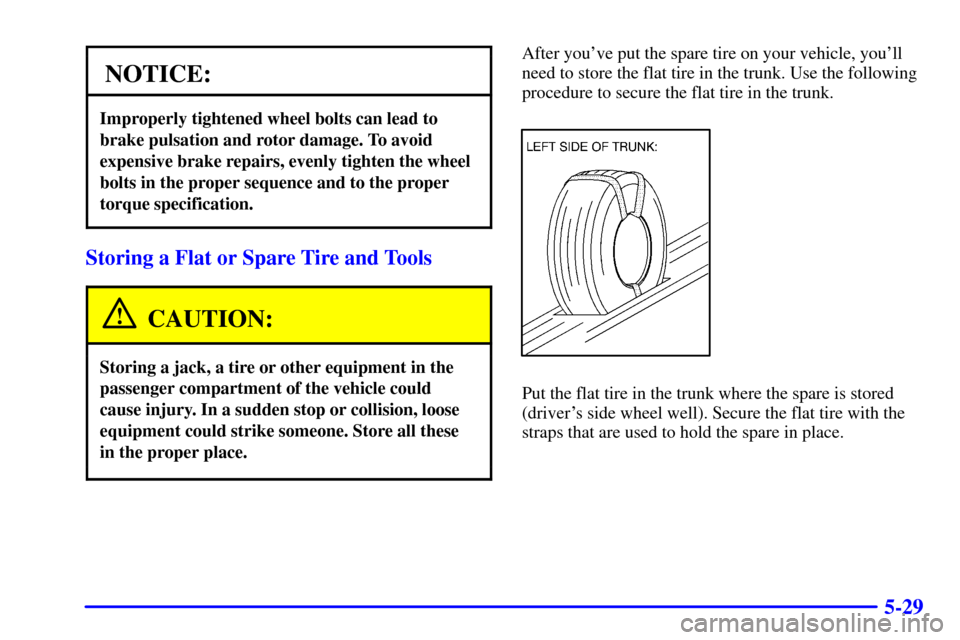
need to store the flat tire in the trunk. Use the following
procedure to secure the flat tire in the trunk.
Put the flat tire in the trunk where the spare is stored
(driver's side wheel well). Secure the flat tire with the
straps that are used to hold the spare in place.
Page 245 of 321

6-
6-1
Section 6 Service and Appearance Care
Here you will find information about the care of your vehicle. This section begins with service and fuel information,
and then it shows how to check important fluid and lubricant levels. There is also technical information about your
vehicle, and a part devoted to its appearance care.
6
- 2 Service
6
- 3 Fuel
6
- 5 Fuels in Foreign Countries
6
- 5 Filling Your Tank
6
- 9 Checking Things Under the Hood
6
- 11 Engine Oil
6
- 15 Engine Air Cleaner/Filter
6
- 19 Automatic Transmission Fluid
6
- 19 Rear Axle
6
- 20 Engine Coolant
6
- 24 Surge Tank Pressure Cap
6
- 24 Power Steering Fluid
6
- 25 Windshield Washer Fluid
6
- 26 Brakes
6
- 30 Battery
6
- 30 Bulb Replacement6
- 37 Wiper Blade Replacement
6
- 38 Tires
6
- 47 Appearance Care
6
- 47 Cleaning the Inside of Your Vehicle
6
- 49 Care of Safety Belts
6
- 51 Cleaning the Outside of Your Vehicle
6
- 52 Cleaning Aluminum or Chrome-Plated
Wheels (If Equipped)
6
- 53 Underbody Maintenance
6
- 54 GM Vehicle Care/Appearance Materials
6
- 55 Vehicle Identification Number (VIN)
6
- 55 Service Parts Identification Label
6
- 56 Electrical System
6
- 63 Replacement Bulbs
6
- 63 Capacities and Specifications
6
- 64 Normal Maintenance Replacement Parts
Page 253 of 321
6-9
Checking Things Under the Hood
CAUTION:
An electric fan under the hood can start up and
injure you even when the engine is not running.
Keep hands, clothing and tools away from any
underhood electric fan.
CAUTION:
Things that burn can get on hot engine parts and
start a fire. These include liquids like gasoline,
oil, coolant, brake fluid, windshield washer and
other fluids, and plastic or rubber. You or others
could be burned. Be careful not to drop or spill
things that will burn onto a hot engine.
Hood Release
Pull the lever inside the
vehicle to open the hood.
It is located on the
lower left side of the
instrument panel.
Then go to the front of the vehicle and find the
secondary hood release which is located above the front
grille. Lift up on the release lever as you raise the hood.
Page 254 of 321
6-10
When you open the hood, you'll see:
A. Coolant Fill Location
B. Engine Air Cleaner/Filter
C. Passenger Compartment
Air FilterD. Engine Oil Fill Location
E. Engine Oil Dipstick Location
F. Windshield Washer FluidG. Brake Master Cylinder
H. Power Steering Fluid
I. Battery
Before closing the hood, be sure all filler caps are on properly. Then pull the hood down and close it firmly.
Page 268 of 321
6-24
Surge Tank Pressure Cap
NOTICE:
The surge tank cap is a 14 psi (97 kPa)
pressure
-type cap and must be tightly installed
to prevent coolant loss and possible engine
damage from overheating.
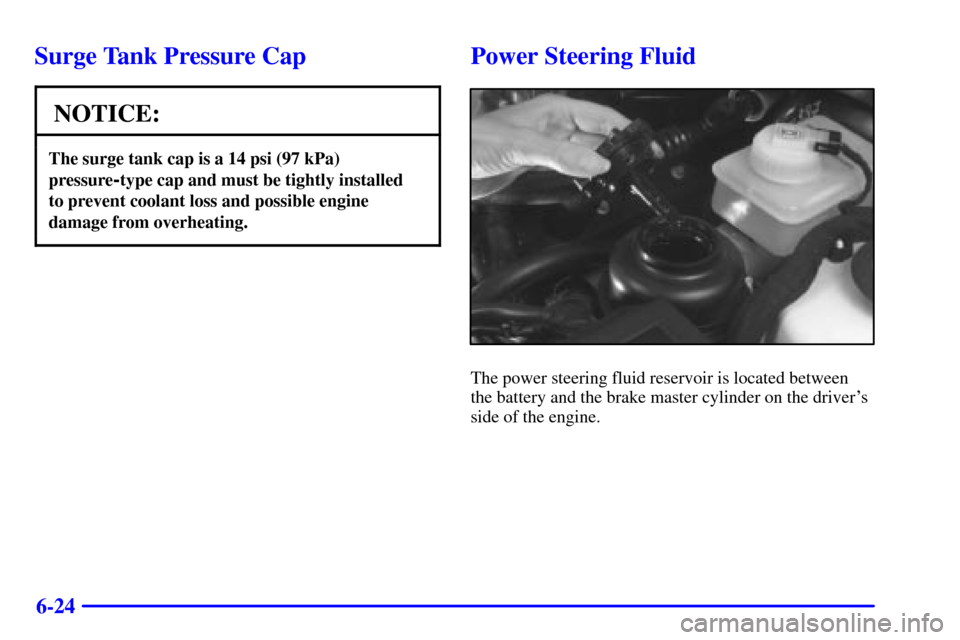
Power Steering Fluid
The power steering fluid reservoir is located between
the battery and the brake master cylinder on the driver's
side of the engine.
Page 270 of 321
6-26
NOTICE:
�When using concentrated washer fluid,
follow the manufacturer's instructions for
adding water.
�Don't mix water with ready
-to-use washer
fluid. Water can cause the solution to freeze
and damage your washer fluid tank and
other parts of the washer system. Also,
water doesn't clean as well as washer fluid.
�Fill your washer fluid tank only
three
-quarters full when it's very cold.
This allows for expansion if freezing occurs,
which could damage the tank if it is
completely full.
�Don't use engine coolant (antifreeze) in
your windshield washer. It can damage
your washer system and paint.
Brakes
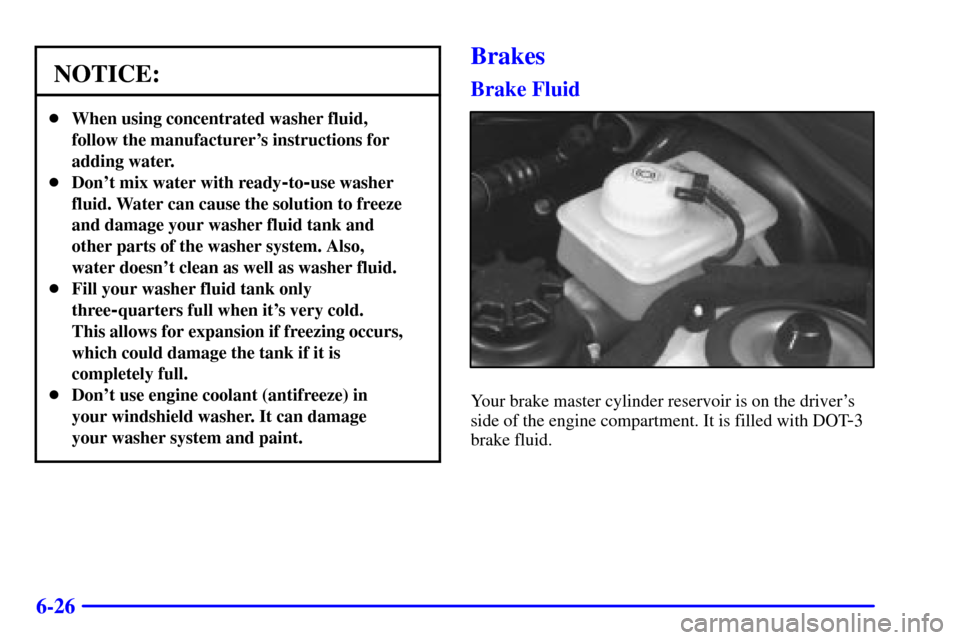
Brake Fluid
Your brake master cylinder reservoir is on the driver's
side of the engine compartment. It is filled with DOT
-3
brake fluid.
Page 271 of 321
6-27
There are only two reasons why the brake fluid level in
the reservoir might go down. The first is that the brake
fluid goes down to an acceptable level during normal
brake lining wear. When new linings are put in, the
fluid level goes back up. The other reason is that fluid
is leaking out of the brake system. If it is, you should
have your brake system fixed, since a leak means that
sooner or later your brakes won't work well, or won't
work at all.
So, it isn't a good idea to ªtop offº your brake fluid.
Adding brake fluid won't correct a leak. If you add fluid
when your linings are worn, then you'll have too much
fluid when you get new brake linings. You should add
(or remove) brake fluid, as necessary, only when work is
done on the brake hydraulic system.
CAUTION:
If you have too much brake fluid, it can spill on
the engine. The fluid will burn if the engine is hot
enough. You or others could be burned, and your
vehicle could be damaged. Add brake fluid only
when work is done on the brake hydraulic system.
When your brake fluid falls to a low level, your brake
warning light will come on. See ªBrake System Warning
Lightº in the Index.
What to Add
When you do need brake fluid, use only DOT
-3 brake
fluid. Use new brake fluid from a sealed container only.
Refer to ªRecommended Fluids and Lubricantsº in the
Maintenance Schedule booklet.
Always clean the brake fluid reservoir cap and the area
around the cap before removing it. This will help keep
dirt from entering the reservoir.
CAUTION:
With the wrong kind of fluid in your brake system,
your brakes may not work well, or they may
not even work at all. This could cause a crash.
Always use the proper brake fluid.
Page 272 of 321
6-28
NOTICE:
�Using the wrong fluid can badly damage
brake system parts. For example, just a few
drops of mineral
-based oil, such as engine
oil, in your brake system can damage brake
system parts so badly that they'll have to
be replaced. Don't let someone put in the
wrong kind of fluid.
�If you spill brake fluid on your vehicle's
painted surfaces, the paint finish can be
damaged. Be careful not to spill brake
fluid on your vehicle. If you do, wash it off
immediately. See ªAppearance Careº in
the Index.
Brake Wear
Your vehicle has four-wheel disc brakes.
Your vehicle has electronic wear sensors that let you
know when the front brake pads are significantly worn
and new pads are needed. The brake pad wear indicator
light will come on and stay on when the brake pads are
worn and need to be replaced. (See ªBrake Pad Wear
Indicator Lightº in the Index.)
CAUTION:
The brake pad wear indicator light means that
soon your brakes won't work well. That could
lead to an accident. When the brake pad wear
indicator light comes on and stays on, have your
vehicle serviced.