2000 BMW 540I SEDAN key
[x] Cancel search: keyPage 4 of 217
© 1999 BMW AG
Munich, Germany
Reprinting, including excerpts, only with the
written consent of BMW AG, Munich.
Order no. 01 41 0 155 012
US English VIII/99
Printed in Germany
Printed on environmentally friendly paper
(bleached without chlorine, suitable for recycling).
4n
Notes on the Owner's Manual
We have made every effort to ensure
that you are able to find what you need
in this Owner's Manual as quickly as
possible. The fastest way to find certain
topics is by using the detailed index at
the end. If you desire an initial overview
of your vehicle, this can be found in the
first chapter. The detailed list of con-
tents that directly follows the summary
of contents is intended to stimulate
your curiosity regarding your BMW and
to encourage you to read the manual.
Should you wish to sell your BMW at
some time in the future, please remem-
ber to hand over the Owner's Manual to
the new owner; it is part of the vehicle.
If you have any additional questions, an
authorized BMW center will be glad to
advise you.
Symbols used
These sections contain vital infor-
mation Ð please read the accom-
panying text passages carefully, both
for your own safety and to prevent dam-
age to your BMW.
<
These passages contain informa-
tion on special and unique fea-
tures of your vehicle.
<
Indicates special information on
recycling.
<
<
Indicates the end of a note.
*
Indicates special equipment, country-
specific equipment and optional extras.
Indicates that you should consult
the relevant section of this
Owner's Manual for information on a
particular part or assembly.
Alerts you to functions which can
be adjusted by your authorized
BMW center ("Car Memory" or "Key
Memory"). Refer to page 58.
<
The individual vehicle
On buying your BMW, you have de-
cided in favor of a model with individu-
alized equipment and features. This
Owner's Manual describes all models
and equipment that BMW offers within
the same group.
We hope you will understand that
equipment and features are included
which you might not have chosen for
your vehicle. Any differences can easily
be identified, since all optional acces-
sories and special equipment are
marked with an asterisk
*
.
If your BMW features equipment which
is not described in this Owner's Manual
(car radio or telephone, for instance),
Supplementary Owner's Manuals are
enclosed. We ask you to read these
manuals as well.
Page 10 of 217

Contents
Overview
Controls and features
Cockpit16
Instrument cluster18
Indicator and warning lamps22
Multifunction steering wheel
(MFL)25
Hazard warning flashers27
Warning triangle 27
First-aid kit 27
Refueling28
Fuel specifications29
Tire inflation pressure29
Locks and security systems:
Keys34
Electronic vehicle
immobilizer35
Central locking system36
Opening and closing Ð from the
outside36
With the key 36
Opening and closing Ð from the
inside40
Luggage compartment lid/
Tailgate41
Luggage compartment44
Alarm system45
Electric power windows47
Sliding/Tilt sunroof 48
Adjustments:
Seats 50
Steering wheel 54
Mirrors54
Seat, mirror and steering wheel
memory56
Car Memory, Key Memory58
Passenger safety systems:
Safety belts59
Airbags60
Child restraints 64
Child seat security66
Child-safety locks66
Driving:
Steering/Ignition lock67
Starting the engine68
Switching off the engine69
Parking brake69
Manual transmission70
Automatic transmission 71
Automatic transmission with
Steptronic 74
Indicator/Headlamp flasher77
Wiper/Washer system77
Rear window defroster79
Cruise control80
Everything under control:
Odometer, outside temperature
display82
Tachometer83
Energy control83
Fuel gauge83
Temperature gauge84
Service Interval Display84
Check Control85
Onboard computer88
Technology for safety and
convenience:
Park Distance Control (PDC) 90
Automatic Stability Control plus
Traction (ASC+T)/Dynamic
Stability Control (DSC) 91
Tire Pressure Control (RDC) 92
Page 22 of 217
22n
Indicator and warning lampsTechnology that monitors itselfMany of the systems of your BMW mon-
itor themselves automatically, both dur-
ing engine starts and while you are driv-
ing. Indicator and warning lamps that
are identified by "l" are tested for
proper functioning whenever the igni-
tion key is turned. They each light up
once for different periods of time.
If a fault should occur in one of these
systems, the corresponding lamp does
not go out after the engine is started or
it lights up while the vehicle is moving.
You will see how to react to this below.
Red: Stop immediately
Battery charge current l
The battery is no longer being
charged. There is a malfunction
of the alternator V-belt or in the charg-
ing circuit of the alternator. Please con-
tact the nearest BMW center.
If the ribbed V-belt is defective, do
not continue driving. The engine
could be damaged due to overheating.
If the ribbed V-belt is defective, in-
creased steering effort is also re-
quired.<
Engine oil pressure l
Comes on while the engine is
running and the "STOP! ENGINE
OILPRESS" message appears in the
Check Control: Stop vehicle and switch
off engine immediately. Check level of
oil in engine, top up as required. If oil
level is correct: Please contact the
nearest BMW center.
Do not continue driving. The en-
gine could be damaged because
of inadequate lubrication.<
Tire Pressure Control (RDC)
* l
In addition, there is an acousti-
cal warning signal: A tire failure
has occurred. Reduce vehicle speed
immediately and stop the vehicle. Avoid
hard brake applications. Do not over-
steer. For additional information: Refer
to page 92.
Parking brake
*, brake hydraulic
system l
Comes on when you engage the
parking brake. For additional informa-
tion: Refer to page 69.
Comes on although the parking brake is
released: Have the brake fluid level
checked. Before driving further, be
sure to read the notes on pages 130
and 152.
Also comes on with the message
"CHECK BRAKE PADS" in the Check
Control.
Parking brake warning lamp
*/
Brake hydraulic system for
Canadian models.
Page 25 of 217
25n
RepairsIndexOverview Controls Car care Technology Data
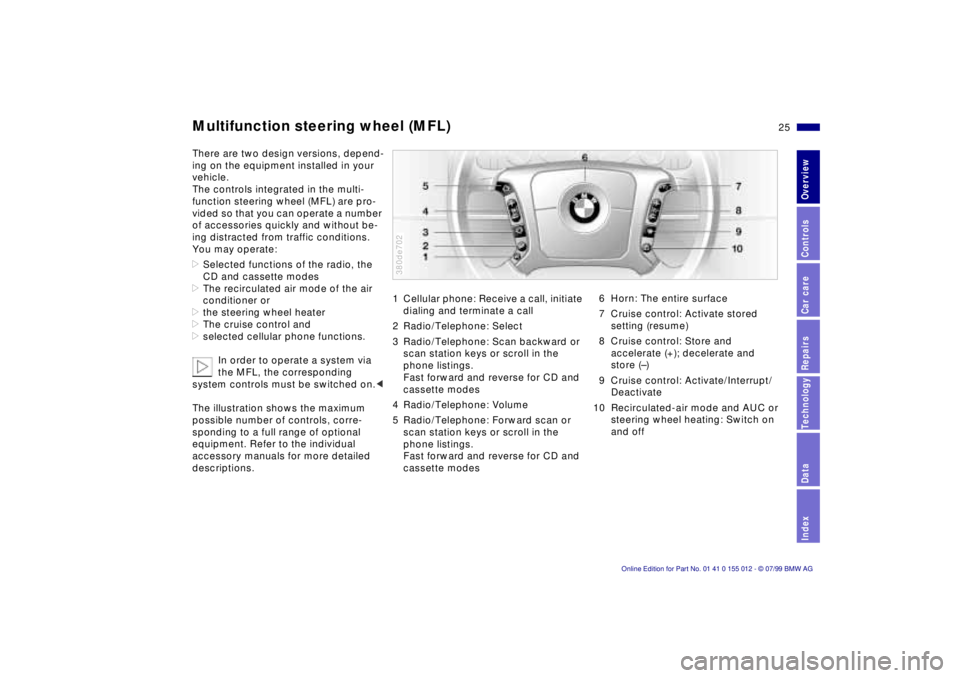
Multifunction steering wheel (MFL)There are two design versions, depend-
ing on the equipment installed in your
vehicle.
The controls integrated in the multi-
function steering wheel (MFL) are pro-
vided so that you can operate a number
of accessories quickly and without be-
ing distracted from traffic conditions.
You may operate:
>Selected functions of the radio, the
CD and cassette modes
>The recirculated air mode of the air
conditioner or
>the steering wheel heater
>The cruise control and
>selected cellular phone functions.
In order to operate a system via
the MFL, the corresponding
system controls must be switched on.<
The illustration shows the maximum
possible number of controls, corre-
sponding to a full range of optional
equipment. Refer to the individual
accessory manuals for more detailed
descriptions.
1 Cellular phone: Receive a call, initiate
dialing and terminate a call
2 Radio/Telephone: Select
3 Radio/Telephone: Scan backward or
scan station keys or scroll in the
phone listings.
Fast forward and reverse for CD and
cassette modes
4 Radio/Telephone: Volume
5 Radio/Telephone: Forward scan or
scan station keys or scroll in the
phone listings.
Fast forward and reverse for CD and
cassette modes380de702
6 Horn: The entire surface
7 Cruise control: Activate stored
setting (resume)
8 Cruise control: Store and
accelerate (+); decelerate and
store (Ð)
9 Cruise control: Activate/Interrupt/
Deactivate
10 Recirculated-air mode and AUC or
steering wheel heating: Switch on
and off
Page 26 of 217
26n
M Multifunction steering wheel (MFL)
*
There are two design versions, depend-
ing on the equipment installed in your
vehicle.
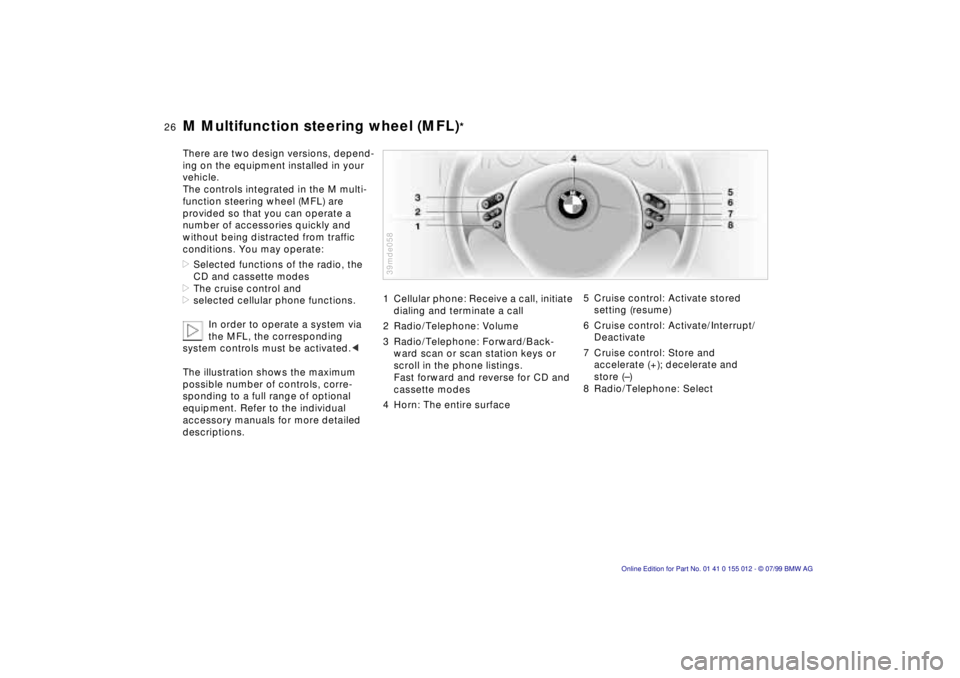
The controls integrated in the M multi-
function steering wheel (MFL) are
provided so that you can operate a
number of accessories quickly and
without being distracted from traffic
conditions. You may operate:
>Selected functions of the radio, the
CD and cassette modes
>The cruise control and
>selected cellular phone functions.
In order to operate a system via
the MFL, the corresponding
system controls must be activated.<
The illustration shows the maximum
possible number of controls, corre-
sponding to a full range of optional
equipment. Refer to the individual
accessory manuals for more detailed
descriptions.
1 Cellular phone: Receive a call, initiate
dialing and terminate a call
2 Radio/Telephone: Volume
3 Radio/Telephone: Forward/Back-
ward scan or scan station keys or
scroll in the phone listings.
Fast forward and reverse for CD and
cassette modes
4 Horn: The entire surface39mde058
5 Cruise control: Activate stored
setting (resume)
6 Cruise control: Activate/Interrupt/
Deactivate
7 Cruise control: Store and
accelerate (+); decelerate and
store (Ð)
8 Radio/Telephone: Select
Page 32 of 217
32n
Locks and security systems:
Keys34
Electronic vehicle
immobilizer35
Central locking system36
Opening and closing
Ð from the outside36
With the key36
Opening and closing
Ð from the inside40
Luggage compartment lid/
Tailgate41
Luggage compartment44
Alarm system45
Electric power windows47
Sliding/Tilt sunroof48
Adjustments:
Seats50
Steering wheel54
Mirrors54
Seat, mirror and steering wheel
memory56
Car Memory, Key Memory58
Passenger safety systems:
Safety belts59
Airbags60
Child restraints64
Child seat security66
Child-safety locks66Driving:
Steering/Ignition lock67
Starting the engine68
Switching off the engine69
Parking brake69
Manual transmission70
Automatic transmission71
Automatic transmission with
Steptronic74
Indicator/Headlamp flasher77
Wiper/Washer system77
Rear window defroster79
Cruise control80
Everything under control:
Odometer, outside temperature
display82
Tachometer83
Energy control83
Fuel gauge83
Temperature gauge84
Service Interval Display84
Check Control85
Onboard computer88
Technology for safety and
convenience:
Park Distance Control (PDC)90
Automatic Stability Control plus
Traction (ASC+T)/Dynamic
Stability Control (DSC)91
Tire Pressure Control (RDC)92
Page 34 of 217
34n
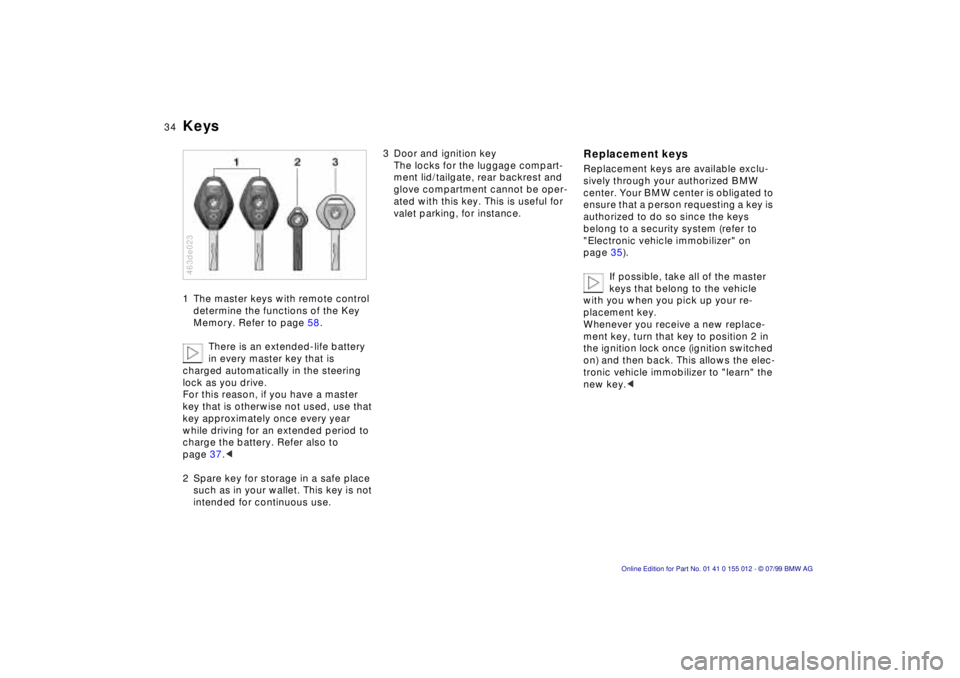
Keys1 The master keys with remote control
determine the functions of the Key
Memory. Refer to page 58.
There is an extended-life battery
in every master key that is
charged automatically in the steering
lock as you drive.
For this reason, if you have a master
key that is otherwise not used, use that
key approximately once every year
while driving for an extended period to
charge the battery. Refer also to
page 37.<
2 Spare key for storage in a safe place
such as in your wallet. This key is not
intended for continuous use.463de023
3 Door and ignition key
The locks for the luggage compart-
ment lid/tailgate, rear backrest and
glove compartment cannot be oper-
ated with this key. This is useful for
valet parking, for instance.
Replacement keysReplacement keys are available exclu-
sively through your authorized BMW
center. Your BMW center is obligated to
ensure that a person requesting a key is
authorized to do so since the keys
belong to a security system (refer to
"Electronic vehicle immobilizer" on
page 35).
If possible, take all of the master
keys that belong to the vehicle
with you when you pick up your re-
placement key.
Whenever you receive a new replace-
ment key, turn that key to position 2 in
the ignition lock once (ignition switched
on) and then back. This allows the elec-
tronic vehicle immobilizer to "learn" the
new key.<
Page 35 of 217
35n
RepairsIndexOverview Controls Car care Technology Data
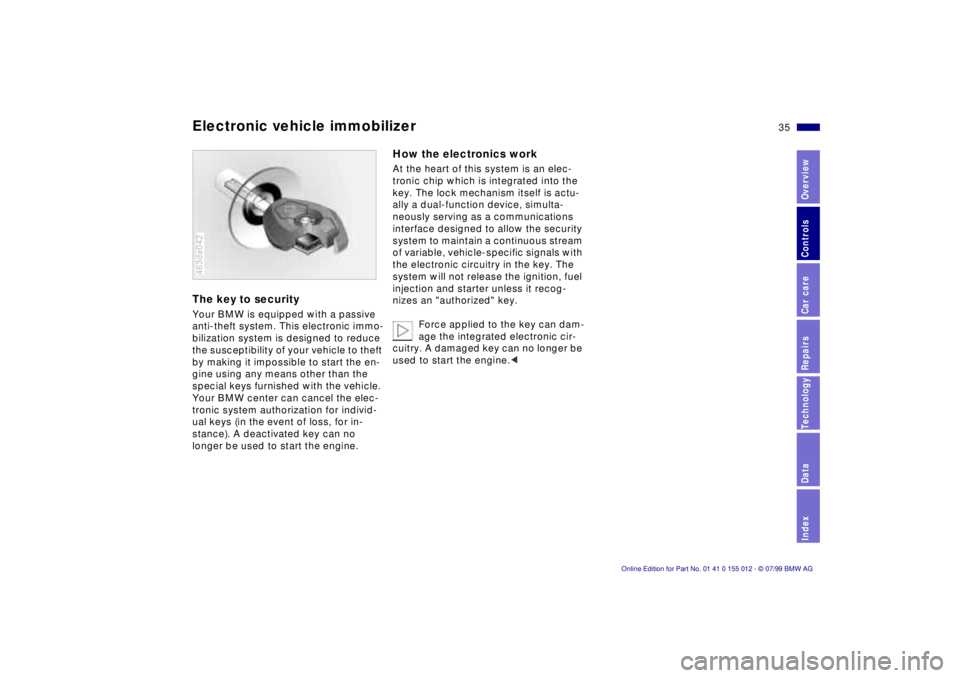
Electronic vehicle immobilizerThe key to security Your BMW is equipped with a passive
anti-theft system. This electronic immo-
bilization system is designed to reduce
the susceptibility of your vehicle to theft
by making it impossible to start the en-
gine using any means other than the
special keys furnished with the vehicle.
Your BMW center can cancel the elec-
tronic system authorization for individ-
ual keys (in the event of loss, for in-
stance). A deactivated key can no
longer be used to start the engine.463de042
How the electronics workAt the heart of this system is an elec-
tronic chip which is integrated into the
key. The lock mechanism itself is actu-
ally a dual-function device, simulta-
neously serving as a communications
interface designed to allow the security
system to maintain a continuous stream
of variable, vehicle-specific signals with
the electronic circuitry in the key. The
system will not release the ignition, fuel
injection and starter unless it recog-
nizes an "authorized" key.
Force applied to the key can dam-
age the integrated electronic cir-
cuitry. A damaged key can no longer be
used to start the engine.<