2000 BMW 540I SEDAN key
[x] Cancel search: keyPage 68 of 217

68n
Starting the engineBefore starting>Engage the parking brake
>Be sure that the transmission selector
is in "Neutral" (or "Park" if the vehicle
is equipped with an automatic trans-
mission)
>Step on the clutch pedal.
Do not allow the engine to run in
enclosed spaces. The exhaust
gases contain carbon monoxide, an
odorless and colorless, but highly toxic
gas. Breathing the exhaust gases poses
an extreme health risk, and can lead to
unconsciousness and death.
Never leave the car unattended with the
engine running. An unattended vehicle
with a running engine represents a po-
tential safety hazard.<
Starting the engine>Start the engine. Do not press the
accelerator pedal.
BMW 528i, BMW 540i with man-
ual transmission:
Do not actuate the starter for too short
a time. Do not turn it for more than ap-
prox. 20 seconds. Release the ignition
key immediately as soon as the engine
starts.
Do not allow the engine to warm up by
leaving it running while the vehicle re-
mains stationary. Instead, begin driving
immediately at a moderate engine
speed.
BMW 540i with automatic transmission:
Your BMW is equipped with the conve-
nience starting feature. Simply turn the
key to position 3 (starter) and then re-
lease it immediately.
The starter continues to operate auto-
matically.
The automatic starting mode will not
operate if the battery voltage is low.
Should this condition arise, it remains
possible to jump-start the engine (refer
to page 182).<
Should the engine fail to start on the
first attempt (if it is very hot or cold, for
instance):
>Press the accelerator pedal halfway
down while engaging the starter.
Cold starts at extremely low tempera-
tures, from approx. +57 (Ð156)
and at elevations above 3,300 feet
(1,000 meters):
>It may be necessary to allow the
starter to remain engaged somewhat
longer than under normal operating
conditions (approx. 10 seconds)
>Press the accelerator pedal halfway
down while engaging the starter.
Engine idle speed is controlled by the
engine computer system. Increased
speeds at startup are normal and
should decrease as the engine warms
up. If engine speed does not decrease,
service is required.
To prevent the battery from discharg-
ing, always deactivate electrical de-
vices which are not in use. Switch the
ignition off when the vehicle is not
being driven.
Page 69 of 217
69n
RepairsIndexOverview Controls Car care Technology Data
Switching off the engine Parking brakeTurn the ignition key to position 1 or 0.
Never remove the ignition key
while the vehicle is rolling. The
steering locks, making it impossible to
steer the vehicle.
Always remove the ignition key and en-
gage the steering lock before leaving
the vehicle.
Vehicles with manual transmission:
Always engage the parking brake when
parking on slopes and inclined sur-
faces, since placing the lever in 1st gear
or reverse may not provide adequate
resistance to rolling.
Vehicles with automatic transmission:
Place the selector lever in "Park."<
Vehicles with automatic transmission
*:
The vehicle must be stationary and the
selector lever in "Park" before you can
remove the ignition key.
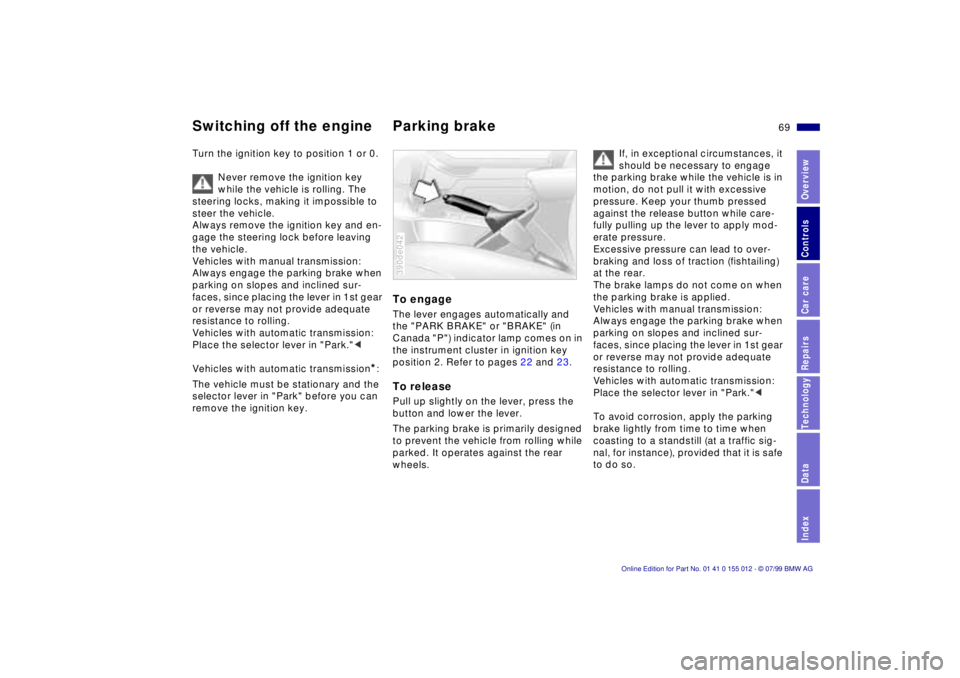
To engageThe lever engages automatically and
the "PARK BRAKE" or "BRAKE" (in
Canada "P") indicator lamp comes on in
the instrument cluster in ignition key
position 2. Refer to pages 22 and 23.To releasePull up slightly on the lever, press the
button and lower the lever.
The parking brake is primarily designed
to prevent the vehicle from rolling while
parked. It operates against the rear
wheels.390de042
If, in exceptional circumstances, it
should be necessary to engage
the parking brake while the vehicle is in
motion, do not pull it with excessive
pressure. Keep your thumb pressed
against the release button while care-
fully pulling up the lever to apply mod-
erate pressure.
Excessive pressure can lead to over-
braking and loss of traction (fishtailing)
at the rear.
The brake lamps do not come on when
the parking brake is applied.
Vehicles with manual transmission:
Always engage the parking brake when
parking on slopes and inclined sur-
faces, since placing the lever in 1st gear
or reverse may not provide adequate
resistance to rolling.
Vehicles with automatic transmission:
Place the selector lever in "Park."<
To avoid corrosion, apply the parking
brake lightly from time to time when
coasting to a standstill (at a traffic sig-
nal, for instance), provided that it is safe
to do so.
Page 70 of 217
70n
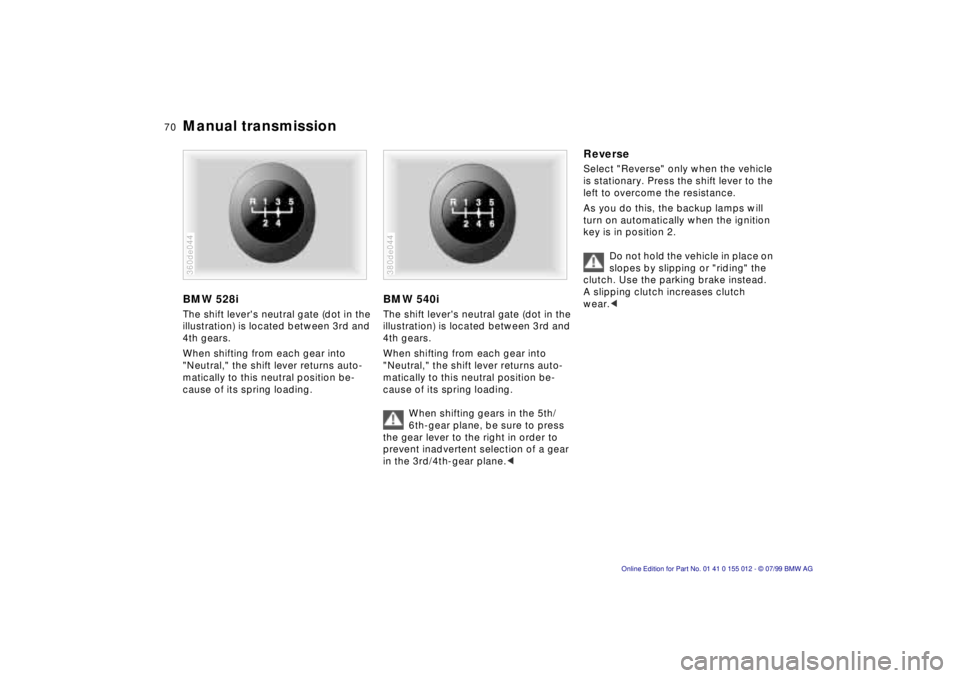
Manual transmissionBMW 528iThe shift lever's neutral gate (dot in the
illustration) is located between 3rd and
4th gears.
When shifting from each gear into
"Neutral," the shift lever returns auto-
matically to this neutral position be-
cause of its spring loading.360de044
BMW 540iThe shift lever's neutral gate (dot in the
illustration) is located between 3rd and
4th gears.
When shifting from each gear into
"Neutral," the shift lever returns auto-
matically to this neutral position be-
cause of its spring loading.
When shifting gears in the 5th/
6th-gear plane, be sure to press
the gear lever to the right in order to
prevent inadvertent selection of a gear
in the 3rd/4th-gear plane.< 380de044
ReverseSelect "Reverse" only when the vehicle
is stationary. Press the shift lever to the
left to overcome the resistance.
As you do this, the backup lamps will
turn on automatically when the ignition
key is in position 2.
Do not hold the vehicle in place on
slopes by slipping or "riding" the
clutch. Use the parking brake instead.
A slipping clutch increases clutch
wear.<
Page 73 of 217
73n
RepairsIndexOverview Controls Car care Technology Data
Automatic transmission
*
Electronic transmission control
module
If the indicator lamp comes on
or if the message "TRANS.
FAILSAFE PROG" appears in
the Check Control
*, there is a malfunc-
tion in the transmission system.
Bring the vehicle to a stop, select the
"Park" position, apply the parking brake
and shut the engine off (ignition key po-
sition 0). Restart the engine after a few
seconds. If the indicator lamp goes out
again after a few seconds, the normal
transmission functions have been re-
stored. You may continue to drive as
usual.
If the indicator lamp does not go out,
you can place the selector lever in all
positions. However, the vehicle will now
only drive forward with limited gear
selection.
Under these circumstances, avoid ex-
treme engine loads and consult the
nearest authorized BMW center.
Do not work in the engine com-
partment when a drive gear (for-
ward or reverse) is engaged. If you do
this, the vehicle could move.<
For jump-starting, towing and tow-
starting, refer to pages 182 and 183.
Page 76 of 217
76n
Automatic transmission with Steptronic
*
Upshifts or downshifts will be carried
out by the ATC only at appropriate en-
gine speeds and road speeds. For in-
stance, if engine speed is too high, a
downshift will not be executed. The
gear selected will appear briefly in the
instrument cluster followed by the cur-
rent gear.
If you are driving in the manual
mode and wish to accelerate rap-
idly from low road speeds (when pass-
ing, for instance), you must shift down
manually or with the kickdown func-
tion.<
You can only change from "M/S" to se-
lector lever positions "P,""R," and "N"
via the "D" position.
In the following situations, the Step-
tronic "thinks" for you in the manual
mode:
>In order to prevent engine over-
speeding, the transmission shifts au-
tomatically to the next higher gear
shortly before the RPM cutoff point
>At low speeds, the transmission shifts
down automatically Ð you do not have
to act
>In the kickdown mode, the transmis-
sion shifts down to the lowest gear
which is possible, depending on the
engine speed
>According to the situation, for
instance in wintry conditions, the
vehicle can be started in 2nd or
3rd gear.Electronic transmission control
module
If the indicator lamp comes on
or the message "TRANS.FAIL-
SAFE PROG" appears in the
Check Control
*, there is a fault in the
transmission system.
Bring the vehicle to a stop. Move the
transmission selector lever to "P." Set
the parking brake and turn the engine
off (ignition key to position 0).
Wait a few seconds, then start the
engine.
If the indicator lamp goes out after a
few seconds, normal transmission per-
formance has been restored. You may
continue to drive as usual. If the indica-
tor lamp does not go out, you can place
the selector lever in all positions. How-
ever, the vehicle will now only drive for-
ward with limited gear selection.
If this happens, avoid extreme engine
loads and consult the nearest autho-
rized BMW center.
Do not work in the engine com-
partment when a drive gear (for-
ward or reverse) is engaged. If you do
this, the vehicle could move.<
For jump-starting, towing and tow-
starting, refer to pages 182 and 183.
Page 77 of 217
77n
RepairsIndexOverview Controls Car care Technology Data
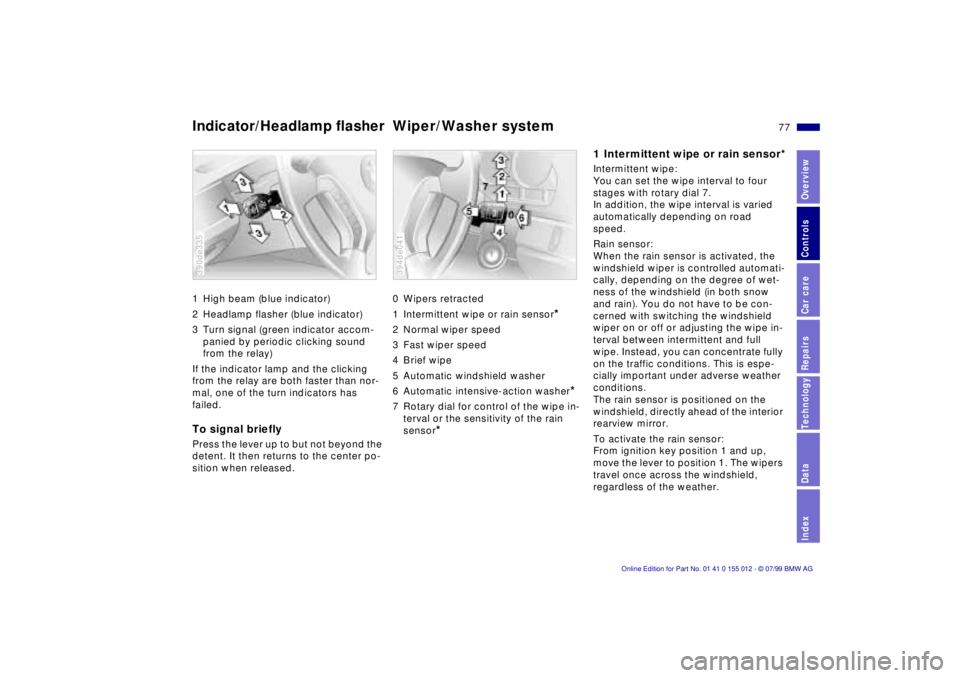
Indicator/Headlamp ßasherWiper/Washer system1 High beam (blue indicator)
2 Headlamp flasher (blue indicator)
3 Turn signal (green indicator accom-
panied by periodic clicking sound
from the relay)
If the indicator lamp and the clicking
from the relay are both faster than nor-
mal, one of the turn indicators has
failed.To signal brieflyPress the lever up to but not beyond the
detent. It then returns to the center po-
sition when released.390de335
0 Wipers retracted
1 Intermittent wipe or rain sensor
*
2 Normal wiper speed
3 Fast wiper speed
4 Brief wipe
5 Automatic windshield washer
6 Automatic intensive-action washer
*
7 Rotary dial for control of the wipe in-
terval or the sensitivity of the rain
sensor
*
394de041
1 Intermittent wipe or rain sensor*Intermittent wipe:
You can set the wipe interval to four
stages with rotary dial 7.
In addition, the wipe interval is varied
automatically depending on road
speed.
Rain sensor:
When the rain sensor is activated, the
windshield wiper is controlled automati-
cally, depending on the degree of wet-
ness of the windshield (in both snow
and rain). You do not have to be con-
cerned with switching the windshield
wiper on or off or adjusting the wipe in-
terval between intermittent and full
wipe. Instead, you can concentrate fully
on the traffic conditions. This is espe-
cially important under adverse weather
conditions.
The rain sensor is positioned on the
windshield, directly ahead of the interior
rearview mirror.
To activate the rain sensor:
From ignition key position 1 and up,
move the lever to position 1. The wipers
travel once across the windshield,
regardless of the weather.
Page 78 of 217

78n
Wiper/Washer systemYou can leave the lever permanently in
position 1. It is then only necessary to
activate the rain sensor from ignition
key position 1 and up. To do this
>turn rotary dial 7 briefly or
>use either the automatic windshield
washer 5 or the automatic intensive
washer 6.
To modify the sensitivity of the rain
sensor:
Turn rotary dial 7.
Turn the rain sensor off in auto-
matic car washes.
If you do not, damage may occur if the
wipers switch on unintentionally.< 2 Normal wiper speedThe wipers automatically revert to inter-
mittent operation when the vehicle is
stationary (not on vehicles with rain
sensor
*).
3 Fast wiper speedThe wipers automatically revert to nor-
mal speed when the vehicle is station-
ary (not on vehicles with rain sensor
*).
5 Automatic windshield washerThe system sprays washer fluid against
the windshield and activates the wipers
for a brief period.
If you only pull the lever briefly, the sys-
tem sprays washer fluid onto the wind-
shield without activating the wipers.6 Intensive automatic
cleaning unit
*
As in setting 5. In addition, an intensive-
action washer fluid is first sprayed on
the windshield.
For changing the wiper blades, refer to
page 166.
Headlamp washers
*
If they are on, the headlamps will also
be cleaned every fifth time you activate
the automatic windshield washer (inten-
sive-action or standard wash/wipe).
Do not use the washers if there is
any danger that the fluid will
freeze on the windshield, otherwise vi-
sion could be obscured. For this rea-
son, use an antifreeze agent. Refer to
page 148.
Do not use the washers when the reser-
voir is empty, since this could cause
damage to the washer pump. Windshield washer jetsThe windshield washer jets are warmed
automatically when the ignition key is in
position 2.
Page 80 of 217
80n
Cruise controlYou can store and automatically main-
tain any desired vehicle speed above
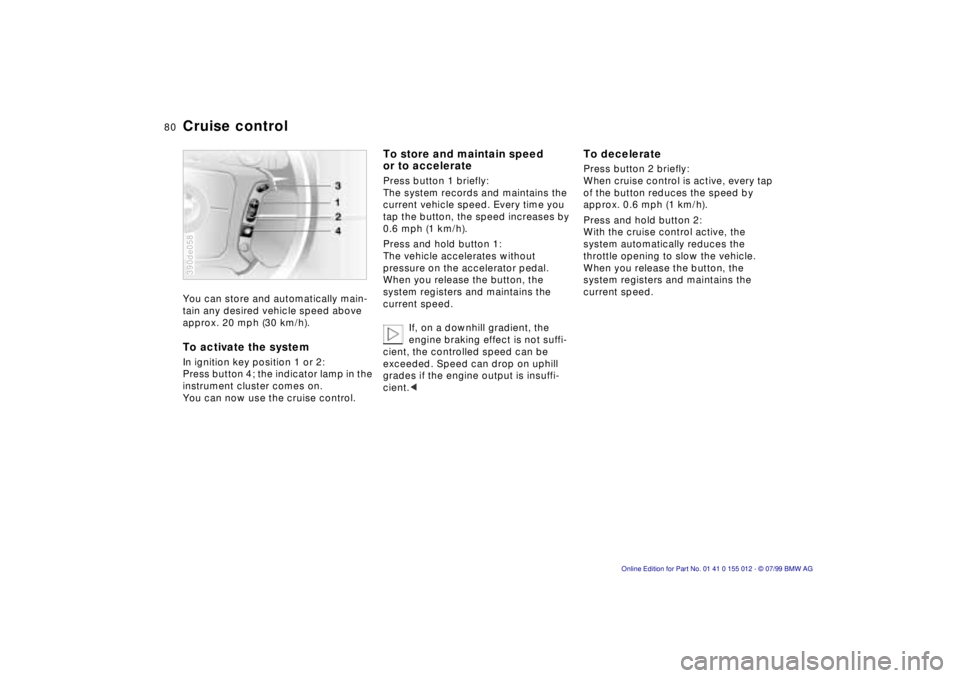
approx. 20 mph (30 km/h).To activate the systemIn ignition key position 1 or 2:
Press button 4; the indicator lamp in the
instrument cluster comes on.
You can now use the cruise control.390de058
To store and maintain speed
or to accelerate Press button 1 briefly:
The system records and maintains the
current vehicle speed. Every time you
tap the button, the speed increases by
0.6 mph (1 km/h).
Press and hold button 1:
The vehicle accelerates without
pressure on the accelerator pedal.
When you release the button, the
system registers and maintains the
current speed.
If, on a downhill gradient, the
engine braking effect is not suffi-
cient, the controlled speed can be
exceeded. Speed can drop on uphill
grades if the engine output is insuffi-
cient.<
To deceleratePress button 2 briefly:
When cruise control is active, every tap
of the button reduces the speed by
approx. 0.6 mph (1 km/h).
Press and hold button 2:
With the cruise control active, the
system automatically reduces the
throttle opening to slow the vehicle.
When you release the button, the
system registers and maintains the
current speed.